Showing posts with label Snowy Egret. Show all posts

Sunday, May 1, 2022

May 1, 2022: The Rookery

We've returned from our excursion in South Carolina, but not before experiencing a few more wonders of nature.  Our fabulous host and tour guide had tracked down a rookery along a marsh in Mount Pleasant and when we visited we found a host of southern bird species sharing an obviously popular spot for nesting which included Anhingas, Wood Storks, Snowy Egrets, and Great Egrets.  And in their breeding mode they were putting on quite a display - not for us, but for their mates.

A Snowy Egret struts its stuff.

The males of both the snowy and great egrets had their breeding plumage in place and were proud to display it.  

A great egret attracting attention.

It's easy to see why these birds where hunted to near extinction for their feathers during the early 1900s.  No longer at risk of being shot, they now have more time to discuss parenting methods.

"I think we should let them cry at night."

I couldn't tell which nests had chicks in them but it appeared that the great egrets were flying back and forth bringing food in to feed chicks in at least some of the nests.

Regurgitating food for the chicks.

Meanwhile, one of the snowy egrets continued to make home improvements.
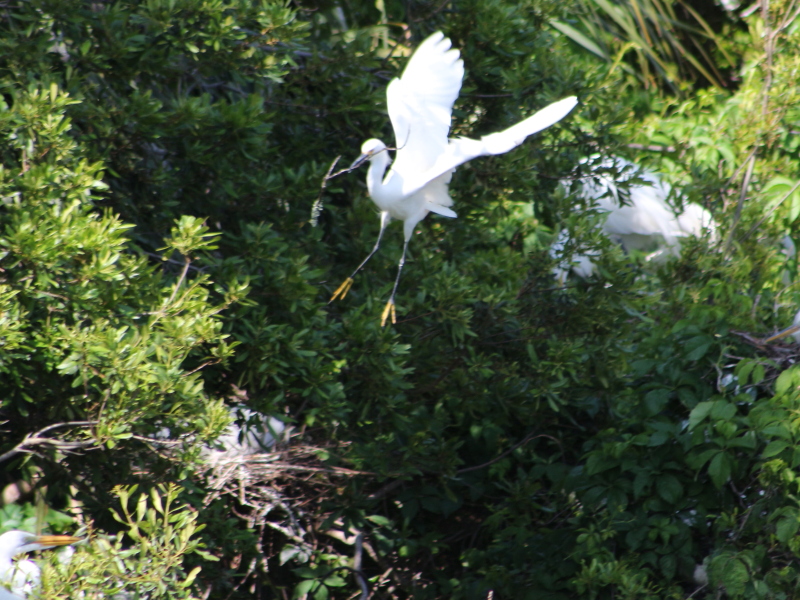
Bringing in some additional building materials.

The wood storks were well hidden deep within the trees so it's not clear what they were up to, but it appeared that the anhingas had already nested and were incubating their eggs.  

The anhingas looked like loons panting on their nests in the hot sun.

We earlier had watched a snowy egret fishing in Shem Creek at low tide and I found it fascinating how it would shake its foot in the mud to scare out a crab or a shrimp and then with lightning speed stab it with its bill.  You can see it in action in this video I took at the creek:


A couple of other interesting, non-New Hampshire creatures we came across during our travels in the low country included a reptile and a crustacean.

Brown anole  (Anolis sagrei)

Some kind of land-and-sea crab.

I don't what kind of crab that was, running around by the brackish water with the alligators, but the lizard is a brown anole, a non-native species that was likely introduced to Florida in the 1970s and has exploded in population throughout the south, largely displacing the native Carolina (aka green) anole. 

Upon returning home we found winter still hanging on strongly in New Hampshire, with barely any progress towards spring while we were away.  The red maple blossoms, the first to come out, had barely budged.  

Red maple blossoms still just emerging.


But at least the Trailing Arbutus (mayflower) are blooming in the forest.
Trailing Arbutus (Epigaea repens)

And, two more summer residents and a passing migrant arrived this week:

A palm warbler makes a rest stop on its way to Canada.

This pair of yellow-rumped warblers is behaving like they are going to nest right here.

On the lookout for the next insect.

Yellow-rumped warblers are an early arriver and we watched them dashing around the bare branches as well as on the ground, picking off insects, probably of the crawling variety.  The palm warbler is just passing through New Hampshire on its way to breed in Canada or downeast Maine.  I also heard a blue-headed vireo singing from somewhere high in the tree tops.

I'll end with one decidedly non-nature moment, but an interesting connection between north and south.  I saw a large ship which looked like a ferry heading out to sea from Charleston Harbor in a direction that didn't seem like a ferry route.  I took a picture and after expanding it I saw it was "The Cat" which I thought ran from Bar Harbor, Maine to Yarmouth, Nova Scotia.  A little digging revealed that after a few seasons off, it was returning to New England from its summer berth in Charleston.
"The Cat" returning north for its service between Maine and Nova Scotia.

This ship started life as the U.S. Navy Military Sealift Command fast ferry Alakai (USNS Puerto Rico).  There's a neat video of it being retrofitted at the Detyens Shipyard in North Charleston including how it was put into drydock and then refloated.  

It's one of the larger migrating objects I've seen this spring.


Sunday, April 24, 2022

April 24, 2022: Peculiar Pelicans

This week we took a diversion from spring in New Hampshire down to the Low Country of South Carolina and enjoyed experiencing some very different birds, the most peculiar of which has to be the brown pelican.

Brown Pelican (Pelecanus Occidentalis)

We often watch formations of pelicans gliding over the water as they search for fish where they appear to be such graceful birds.


But up close they are really quite ungainly.


One observer aptly describes the pelican as "comically elegant".  Of course their most dramatic feature is their huge bill with attached pouch.  One evening at low tide I watched a pelican catch a rather large fish which might have been a skate - it was certainly something with wide, thin appendages that hung out both sides of the bird's bill.

I really had to study this scene to figureout what I was looking at. The thin point is the top of the beak, with the fish below it, spilling out of the pouch. 


The pelican managed to toss it around enough to capture the fish mostly within its bill.

What's the reason for the strange wing position?

While it was tangling with it, other pelicans crowded in close hoping for a chance to steal the fish with any false move.

A competitor rushes in, hoping for a steal.

After it got things organized I almost wondered if it was going to split its pouch open.


But the bird managed to point its beak to the sky and somehow slide that sea monster down its throat.


Pelicans most often catch fish by plunge diving where they let their bodies fall from high above the water, crashing down with an impact great enough to stun the fish which they scoop up with their bill.  Pelicans are the only birds that use this technique.  They are truly a uniquely evolved creature of earth.

I saw and heard many other birds including some we'll see shortly up in New Hampshire as they follow the insect migration north.

Laughing Gulls will soon come to New Hampshire and Maine coasts to breed.

House Finches range from South Carolina to northern New Hampshire throughout the year.

Great Crested Flycatchers will be in New Hampshire soon.

We might see a Snowy Egret blown inland by a storm along the Laverak Trail in Meredith.  This one was fishing in Shem Creek at low tide.

One last bird we got an excellent look at is a great egret.


This particular bird has become accustomed to humans and hangs out along the Shem Creek pier with the fishermen, begging for handouts of extra bait.  It's not very healthy for it but it's fun to be able to see one so close.

The South Carolina coast was a great place to spend Earth Day 2022.


Sunday, December 1, 2019

December 1, 2019: Hungry Birds in South Carolina

We spent the past week in South Carolina, enjoying a wonderful visit with family in the Charleston area, adding in a few days in Beaufort, South Carolina, and Hunting Island State Park on Fripp Island.  Being migration season I kept my eye for our New Hampshire summer birds that have made their way this far south and I saw quite a few including these three, though there's no way of knowing whether they are migrating or permanent SC residents.
Bald Eagle at Palmetto Island County Park
Great Blue Heron at Hunting Island
Osprey at Hunting Island

Other birds I found were local to the South Carolina shore or its maritime forest including these two along the barrier islands.
Semipalmated Plover on Little Hunting Island
Semipalmated Sandpiper on Isle of Palms

After identifying my second shore bird with the term "semipalmated" in its name I figured I better find out what that means:  a semipalmated bird has webbing half way down its feet (semi and palm) - it seems obvious now.  At first I thought the plovers might be piping plovers, but they are clearly the semipalmated plover based on their coloring and location - piping plovers mostly stay on dry sand in the dunes.

I saw quite a few snowy egrets and great egrets which are common in the lowcountry.  One of the great egrets posed quite nicely and gave us all a good show.
Great egret on Hunting Island


The snowy egret on the other hand was more focused on catching food and didn't seem to pay any attention to us.  It would walk quietly along through the shallow water looking for a school of fish.
A Snowy Egret hunting on Hunting Island

When it saw a school it flew up and over them which caused the fish to thrash around wildly, churning the water up into a froth under the bird.
On the approach

On the attack

It then stabbed down into the water with it's beak, more often than not coming up with a little fish.
Success!

All the while these birds are fishing they must keep an eye out for predators, including these guys:
An alligator looking for its own meal

Tic-toc, tic-toc   (or was that a crocodile?)

We had a great visit as always with our wonderful hostess (thank you LG!) providing more great memories, including my favorite nature-moment of the trip:  As I was watching the sun rise over Fripp Island, a long line of brown pelicans flew low over the water in front of the emerging day - another uplifting moment courtesy of mother nature.