Showing posts with label House Finch. Show all posts

Sunday, February 12, 2023

February 12, 2023: More Fun with Ice

Last week it was hockey, this week it's the Great Meredith Fishing Derby run by the Meredith Rotary Club.  But first, some other fun with ice this week:

Profile Falls

We took the short hike up to Profile Falls in Bristol, expecting that the fluctuations between warm weather to get the Smith River flowing, and cold weather to form ice might have created some interesting sights, and we weren't disappointed.


The river was flowing strongly and there were lots of ice formations above, along, and below the falls.


Closer to home, on a walk out to some local ledges to see what the porcupines are doing this winter (more on that in a future post), some icicles that formed on a rock outcropping caught my eye.
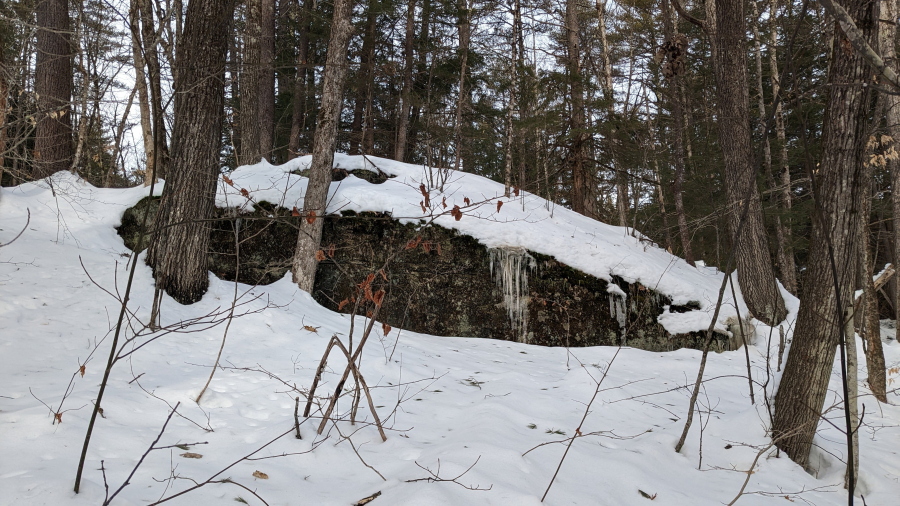


As I approached to get a closer look I saw these incredibly resilient ferns growing among the icicles.

Rock Polypody (Polypodium virginianum)

Not only are they still green here in the middle of winter, but they have found a way to eke out a living on the exposed face of a granite ledge.


I believe this is rock polypody which is found in several natural communities in New Hampshire.  It somehow thrives on rocky exposed surfaces, and growing throughout the year, is a winter food source for animals including deer, turkey, and grouse.  [Ref:  Sandra Mitchell, Evergreen Ferns can be Enjoyed Year Round, Northern Woodlands]  I expect the ferns take advantage of moisture and nutrients collected and stored by the moss and lichen that share the ledge.

As for the ice on the lakes, there was a lot of activity on Wicwas and Waukewan for the fishing derby because the larger lakes aren't safe.  We took a walk out to see the action on Lake Waukewan - it was breezy, but nothing like last weekend, and a lot warmer!  

Ice fishing action on Waukewan


And a quieter scene on Wicwas.

The NH Audobon Backyard Bird Count took place this weekend.  My inventory included:  chick-a-dee, goldfinch, downy woodpecker, red-bellied woodpecker, bluebird, mourning dove, titmouse, house finch, and red and gray squirrels.  I didn't see any blue jays, hairy woodpeckers, or even crows.

Eastern Bluebird

House Finch

Red-bellied woodpecker

The bluebird and house finch were seen near Lake Waukewan; all the others at Wicwas.  I also received a report of a pair of bald eagles on Waukewan (thank you BG!) , but they don't go on my bird count list.

I also saw one other bird during our visit to Profile Falls Park where there's a nice walk (or snowshoe or ski - they groom a short trail there) to the Pemigewasset River.  There we found the only wildlife on that excursion, three American black ducks out on the ice.

American Black Duck

It's not only humans that enjoy the ice in New Hampshire.

The Pemigewasset River in February.


Sunday, April 24, 2022

April 24, 2022: Peculiar Pelicans

This week we took a diversion from spring in New Hampshire down to the Low Country of South Carolina and enjoyed experiencing some very different birds, the most peculiar of which has to be the brown pelican.

Brown Pelican (Pelecanus Occidentalis)

We often watch formations of pelicans gliding over the water as they search for fish where they appear to be such graceful birds.


But up close they are really quite ungainly.


One observer aptly describes the pelican as "comically elegant".  Of course their most dramatic feature is their huge bill with attached pouch.  One evening at low tide I watched a pelican catch a rather large fish which might have been a skate - it was certainly something with wide, thin appendages that hung out both sides of the bird's bill.

I really had to study this scene to figureout what I was looking at. The thin point is the top of the beak, with the fish below it, spilling out of the pouch. 


The pelican managed to toss it around enough to capture the fish mostly within its bill.

What's the reason for the strange wing position?

While it was tangling with it, other pelicans crowded in close hoping for a chance to steal the fish with any false move.

A competitor rushes in, hoping for a steal.

After it got things organized I almost wondered if it was going to split its pouch open.


But the bird managed to point its beak to the sky and somehow slide that sea monster down its throat.


Pelicans most often catch fish by plunge diving where they let their bodies fall from high above the water, crashing down with an impact great enough to stun the fish which they scoop up with their bill.  Pelicans are the only birds that use this technique.  They are truly a uniquely evolved creature of earth.

I saw and heard many other birds including some we'll see shortly up in New Hampshire as they follow the insect migration north.

Laughing Gulls will soon come to New Hampshire and Maine coasts to breed.

House Finches range from South Carolina to northern New Hampshire throughout the year.

Great Crested Flycatchers will be in New Hampshire soon.

We might see a Snowy Egret blown inland by a storm along the Laverak Trail in Meredith.  This one was fishing in Shem Creek at low tide.

One last bird we got an excellent look at is a great egret.


This particular bird has become accustomed to humans and hangs out along the Shem Creek pier with the fishermen, begging for handouts of extra bait.  It's not very healthy for it but it's fun to be able to see one so close.

The South Carolina coast was a great place to spend Earth Day 2022.


Sunday, February 27, 2022

February 27, 2022: Snowshoe Hares in the Notch

Winter returned this week - after a brief glimpse of Spring on Monday when the temperatures rose to the mid 50s, climbing up to 58 on our thermometer.  So that was the day I took a hike up Cannon Mountain in Franconia Notch, and while it was a beautiful day, sunny and calm, it still certainly looked like winter above 3500'.

Kinsman Ridge Trail on Cannon Mountain.

Even in that harsh environment there are a few hardy critters that eke out a living high above the notch.  I found lots of tracks of snowshoe hares all along, even in the trail.  

Snowshoe Hare tracks dotted the landscape above 3700'.

The snowshoe hare is a wonderfully adapted animal with large hind feet which let it hop along the snow giving it an advantage in escaping its pursuers which include fox, coyote, bobcat, and lynx.  (I did see predator tracks near the hare tracks but I couldn't identify them.)  These hares also have fur on the bottom of their feet to protect them from the cold.  In the winter they sustain themselves by eating bark and twigs of trees.  Another valuable trait, shared by other hares and rabbits, is having multiple litters per year, producing lots of offspring which balances their high attrition rate.  Snowshoe hares are nocturnal, giving them an additional level of protection, though owls, another significant predator of hares, have also adapted to hunting in low light.  And then there's the hare's heavy fur which changes color twice a year:  white fur in the winter, mottled brown in the summer, both to blend in with their surroundings.

For all these reasons, I've never seen a snowshoe hare itself but have seen their tracks in many places, often near the summits of mountains including Cannon, Welch, Roberts, Whiteface, and Morgan.  But they are present at lower elevations too, including around the lakes.  I've seen their tracks in the Hamlin Forest on the Red and White Trails as well as right near downtown Meredith in Community Forest.

Recent snowshoe hare tracks in Hamlin, February 5th.

I also saw two bird species high up on the summit of Cannon:  Common Redpolls, and a single Pine Grossbeak.  I heard the redpolls before I saw them, just below the summit at an elevation of 3850'.  I stopped to see what was chattering and soon saw a few redpolls in the stunted spruce trees.  Then another group flew in.  Then another dozen or so, starting to make quite a racket.  They all took off together and circled around over me, and then another group joined in, and then another, and another joined the swirling flock, until there were at least 50 of them flying in ragged circles just above the tree tops before the entire flock spun off out of sight.  I'm confident in my estimate of well over 50 based on my recent counting of goldfinches in the trees around our birdfeeders.  I've counted up to 30, and when they took off, their flock was considerably smaller than this gang of redpolls.

Just a portion of our goldfinch flock, about 20 right there.  Many more were perched in the branches of the oak trees.  (Plus one dark-eyed junco waiting its turn on the feeder.)

The single Pine Grossbeak I saw was even closer to the summit of the mountain, and acting so nonchalantly beside the trail that I first thought it was a Canada Jay looking for a handout.  (Canada Jays are so bold they will come to land on your hand if you offer it with some trail mix.)  But when I got a better look - and listen - I determined it was a pine grossbeak.  I only had my phone with me, so this is the best picture I got (and no pictures of the fast moving redpolls).

A pine grossbeak at 4000' on the summit of Cannon Mountain.

It didn't have the rose or yellow coloring I would expect (leading me to the initial jay thought) but their coloration is quite variable and its distinctive song told me it was a grossbeak.  I was also in the right habitat:  subalpine spruce-fir forest.

We also had a different finch at our feeder this week, a house finch, our first of the year, but again, no pictures for you - it was here and gone in a minute.  I have Linda's quick eye to thank for catching it.

On Superbowl Sunday I mentioned that owls were starting to mate, and the woodpeckers aren't far behind.  I heard the back and forth rat-a-rat of two downy woodpeckers staking out their mating territory in the woods last week.  One would bang away on a hard, dead, resonant snag to let all know he has claimed that piece of the woods, and as as soon as it stopped another bird far away answered back with its reply from his home turf.  As long as the two birds keep their distance and each hears only a faint hammering, all will be well.  But if one moves in too close to the other, there will be trouble.   

This downy woodpecker must be looking for food - I think he knows this is too small for a nest!

With eight inches of sparkling light snow on Friday, winter is back.  It's hard to remember that on Monday was 50 degrees with the streams flowing like spring.

Spring melt runs into the Mill Brook on February 18th.
And then yesterday:
February 26th.  Photo by Linda Powell.

Scenery sure changes rapidly in a New Hampshire winter.


Sunday, April 14, 2019

April 14, 2019: The Caravan has Arrived

The first wave of migrants has hit New Hampshire.  The initial sign was the geese, but this week many others started to arrive in droves.  The unmistakable call of the phoebee from the tops of the trees was heard first, and that was soon followed by flocks of dark-eyed Juncos travelling back to the north country.
Dark-eyed junco (Junco hyemalis)

 I find it's one of the hardest birds to photograph, especially on a dreary day


It was unusual for me not to see any of these little "snow birds" around this winter;  they must have traveled to other climes which had better food sources for them.  The first flock arrived on a cold snowy morning, followed shortly by mixed flocks of sparrows and finches making their appearance.
 A common redpoll


Even without the bird feeders in place and after raking as much of the seed from the ground as possible these specialist in small seeds found plenty to keep them busy.
A couple of redpolls share the leftovers

The nuthatches are far too demanding of their large seeds and nuts to bother with little millet seeds down on the ground.  And it was sad to see the wood peckers come by looking for their usual feeding stations, circling around trees and posts wondering what happened to the easy pickings.  One of the less common birds I see, the common redpoll (an oxymoron there?) was in the flock.
Common Redpoll (Acanthis flammea)
A distinguishing feature of the redpoll is its black face

Just because I don't see them often doesn't mean they aren't numerous.  Estimates of the redpoll population is in the tens of millions, all located in the far northern latitudes.  Though not a finch, they are in the same family as finches and share many of the same characteristics including the preference for tiny seeds as fits their small beak.  Studies have shown that during the winter their diet consists of almost entirely birch seeds.  [REF:  Cornell Lab of Ornithology]

Other members of the flock include the very common Song Sparrow, which in a few weeks will be serenading us with its melodious song on warm spring mornings.
The song sparrow (Melospiza melodia) lives up to its name

We did suffer a set back on those elusive summer mornings this week when a coastal storm brought in some cold weather and an inch or two of wet, soggy snow.
April showers, New England style

But it won't last long, and we're already back to opening up larger bits of lake to attract more migrants to our lake, including, soon, we hope, our loons!
More open water will attract beavers and ducks soon, and the loons won't be far behind.