Showing posts with label Skiing. Show all posts

Sunday, February 9, 2025

February 9, 2025: Winter Conditions at the Lake

It was a hectic week for me so I didn't get out as much as usual, but I did fit in one beautiful ski trip early Friday morning after about 6" of snow overnight.  I was the first one on the trail that morning so I had a perfect blanket of white in front of me the whole way.

Except for the occasional animal track.  Several animals had been out before me, and they often took advantage of the human-produced trail to make their passage easier.  

The animals are smart enough to follow the trails.
With deep snow I couldn't determine who the early morning hunter was, but based on its timing and route it was probably a fox even though it doesn't show the usual straight and orderly track.


The first part of the trip up the south-facing hill was well protected from the wind; the combination of sun and calm made for a peaceful setting.


The occasional wind gust provided a glittering snow shower in the sunlight.


As is often the case, the Lakes Region was right on the boundary between stormy weather to the north and clearing to the south.  From Crockett's Ledge looking south the sky was clearing.  The building northwest wind after the front passed was already whipping up the dry snow from the trees where it collected overnight.

As I gained the ridge near the north-facing White Mountain Ledge I could feel the cold settling in as the wind was now making a direct affront on the ledge. 

The sun dimmed approaching the north end of the ridge.

Reaching the ledge, the usual expansive view of the White Mountains was completely obscured by a fierce squall.
A total white-out to the north.
I had fairly short visit there for obvious reasons.
Travelling from the trailhead up to the ledge is mostly climbing, but that means the way back down is a lot of fun on skis.
And as soon as I got down off the ridge, the sun was back and the sky was once again blue.  

It was a perfect winter day on what is turning out be a real New England winter for a change - we woke up this morning to another eight inches of fresh powder!

And don't forget today is the last day of the Backyard Bird Count if you want to participate.  You don't even have to leave your warm home!


Sunday, December 22, 2019

December 22, 2019: Winter Solstice Arrives

Sunset over Oakland Cemetery one day before the winter solstice.

Every year the winter solstice brings one of the most reassuring moments of winter:  The days are getting longer.  As of 11:19 pm last night the sun reached is nadir relative to the northern hemisphere, and from here on out it will rise higher in the sky every day.   It reminds us all that - even if there are many cold days ahead - spring will return and reopen our frozen lakes. 
The first two souls I saw on the lake this winter.

Lake Wicwas has been frozen for a couple of weeks now and on Friday I saw the first two people out on the ice.  After soliciting a report on the ice (thank you HC), and after two days with temps in the single digits and teens, I concluded it was safe for cautious travel and went for a ski before the warm weather arrives.
It's nice to see tracks on the lake again after being vacant for so long.
The skiing was quite good despite a bit of slush on the ice to contend with.

Of course, not all the lakes are frozen yet;  Winnipesaukee will take several more weeks to complete its turnover and freeze all the way across the broads.  Early in the week Lake Waukewan was partly frozen but there was a pair of bald eagles on the frozen area, doing some fishing.  The report (and picture - thanks for sharing Tony!) from a local resident was that the eagles actually cut a hole in the ice to pull out a fish! 
A pair of eagles try their hand at ice fishing.  (Photo by Tony Sabutus)

It's been cold enough that the snow we received on Tuesday has remained light and dry so the animals can still easily paw through the snow to collect the large stash of acorns hidden below.  I came across a section of turned up oak leaves which is a sure sign of some animal in search of acorns.

It could be turkey, bear, or deer, and it's usually pretty easy to determine which by the other signs.  Tracks are one, and these objects make it even easier.
Those are deer droppings, not coffee beans.

Acorns have such great nutritive value that deer feast on them as long as they can get to them.  These deer had plowed around over quite a large area under these oaks trees.  I found a few partially crushed acorns that had fallen from their mouths - not an unusual occurrence as a deer breaks up the hard shells to facilitate digestion in its four-chambered stomach.
A couple of crushed, but dropped acorns.


A deer's first chamber is partially for storage to let them eat more food than they can use in the moment, digesting it later.  Deer have developed quite an intricate system of processing food that they themselves can not digest - they employ the use of Ruminococcus bacteria in their stomach to ferment cellulose (hmm, makes me want to brew some beer....) which breaks it down into digestible products.  Wikipedia has a detailed description of the process here.

Another interesting aspect of deer's food processing is that all that chewing over the years wears down their teeth in such a reliable way that tooth wear is the best method of determining the age of a deer.  A deer will rarely live as long a ten years, but if it does, it's teeth will have worn down so much that it will probably starve to death - or become so weak that it becomes easy prey for coyotes.

There are plenty more cold, wintry days ahead for humans and deer, but every day, the sun will rise slightly farther to the north, and it will climb just a bit higher in the sky.
2:00 pm on December 19th.

I hope everyone has a warm, peaceful Christmas with family and friends where you may be.
Artwork by Desktop Nexus


Sunday, January 13, 2019

January 13, 2019: Flying Mammals in Winter

We had some of the coldest weather of the season this week which was good news for winter sports fans and for cool winter sights, and it also brought out one of the more reclusive critters in the forest.
The reclusive and nocturnal flying squirrel

Small animals like this flying squirrel can't hunker down in frigid weather as they have to eat every day to consume enough energy to burn just to keep warm.  Small birds for example can lose 10% of their body weight on a single cold night, a good reason why the chick-a-dees appear at the feeder at dawn's first light.

I have only seen flying squirrels in winter, though that's because they are nocturnal, and we only feed the birds in the winter.  Other people around the lake have special feeding platforms for flying squirrels and they are entertained by their acrobatics on warm summer nights.  They are amazing animals, having adapted a sheet of skin that extends between their front and hind legs, providing a steerable hang glider-type feature.  I have watched them sail off the feeder and make a perfect landing on their selected tree.
You can see the section of skin that stretches out when it spreads its legs to fly

If you want to attract them, try building a platform like this one,
Sharing the table

but attach it to a tree 15 to 30 feet above the ground.  They'll climb up, but fly off when it's time to depart.

The cold weather blew in from Canada after a storm which brouht heavy, wet snow that took down enough trees and limbs to leave 40% of Meredith without electricity;  Meredith and Moultonborough seemed to be hit the hardest, sitting right at the line where it was all snow, but still warm enough to wet and sticky.  It might have played havoc with the power company, but it was beautiful to look at and left a solid base for skiing and snow shoeing.
A good case of cement snow

I took a ski across the lake and up to the White Mountain Ledge as the storm was winding down.
Looking north from the White Mountain Ledge in the Hamlin Conservation Area

There were lots of trees bent down to block the trail, and countless limbs and branches broken off, laying on the ground.

The Meredith Trail Crew will have plenty to keep them busy this spring!

The coldest night was Saturday at just above zero, so of course that was the day we went skiing - cold but fabulous views.
Summit of Ragged Mountain

It was plenty chilly, but I'll bet this winter has worse yet to come.


Sunday, November 18, 2018

November 18, 2018: Tracks Galore

My how quickly things change.  Just a few days ago I was studying deer scrapes in the leaves, and by this weekend they disappeared under a white cloak and all kinds of tracks were waiting to be discovered.

The sudden change in scenery occurred on Friday with a nice soft blanket of snow;  I even got to make my own the tracks in the forest as there was just enough cover for a short ski on the smoothest trails.

An early snow lets one see a great variety of tracks, as animals that will soon bed down for the winter are still active, joining those that will be out and about all winter long.  One big example (no pun intended) is the black bear.
Bear prints are almost human-looking, and similar in size
Photos courtesy of Marge Thorpe

Marge Thorpe found this great set of tracks over on the west side of the lake after a dusting of snow earlier in the week.  It appeared to be a mamma bear with at least one cub in tow.  Marge noted that as she followed the tracks, when they came to the top of a stone wall, they turned around and went back rather than climbing down off the top.  Maybe the cub didn't like the look of that big step!  Weather will determine when the bears settle down in their dens;  it may be a few more weeks before the bird feeders come out.

Another set of tracks not often seen in snow were made by beavers.
Beaver print in the snow

Beavers don't hibernate, but once the lake freezes over they become much less active, staying close to home.  But right now they are still building up their insulating layers of fat and collecting food for winter consumption.
Tender plants cut by sharp beaver teeth
There wasn't the visible tail-drag usually seen with beaver tracks so I wasn't sure it was beaver when I saw the first tracks, but soon enough there was no doubt.

It was also quite clear where they come up from the lake to do their logging work.
A well worn beaver trail coming from the lake
They have even cleared out channels in the thin ice/slush on the lake from their frequent travels. 
There are other tracks there on the ice, but I wasn't about to venture out to investigate.

Where do they take all those trees and branches?  They put them right beside their lodge for handy winter snacking - a sure sign of an active lodge.
A nice pantry is being stocked right outside the front door
A bit farther along I thought I saw another, more ragged beaver channel.

But as I approached I saw only deer tracks leading to the point of entry, so evidently a deer decided to make its way over to the nearby island to browse.  And there are lots of deer tracks everywhere - often following the trails - including these two tracks which were made by a doe and her fawn.

In several places they stopped to feed, in this spot, nibbling on some sheep laurel on the shoreline.

It was just an early taste of getting to see who's been out travelling through the forest all year.  I'm always humbled when I'm reminded that all these animals have been here all summer long without me ever knowing it.
A mink pokes its nose in a hole by the lake - perhaps an entrance to one of its dens?

This snow looks like it won't last long, but there will be more on the way!


Sunday, March 11, 2018

March 11, 2018 - Changes, Fast and Slow

It was a week of contrast in most of New England, even throughout much of the Northeast, as the second nor'easter in six days passed through.  The week started like this

transitioned through this

and ended like this.


The 12 to 15 inches of dense snow resurrected the skiing and may have averted an early end to the season for many ski areas.

Fresh, pristine snow always entices me out on the snowshoes, and on Friday I crossed paths with our local bobcat, so I followed it along for a bit as it wound through the woods.  It took a good part of a mile before I found a print that was clear enough to confirm I was following the path of our only wild feline.
The round shape and boomerang foot pad of the bobcat

Nothing of note was observed from the cat, but one of the perks of following tracks is being taken places you've never been before - or would never go on your own volition:  through dense hemlock stands, across (barely) frozen swamps, and up ledges, all of which an 18 inch tall, four pawed creature thinks nothing of traversing.
Across almost-frozen wetlands
Up rocky ledges

This particular bobcat led me on a trip where I discovered an old relic from New Hampshire's agrarian past.

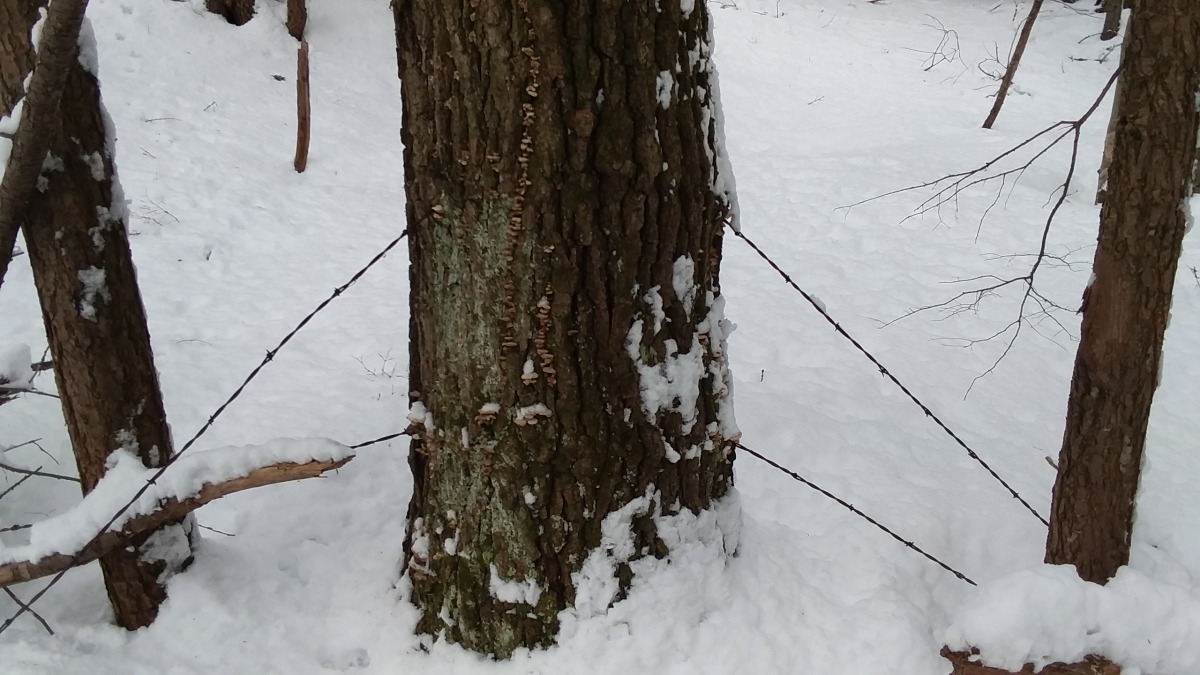
I love finding these old barb wire fences passing through the center of sizable trees.
I'm no expert on tree aging, but this red oak could easily be 100 or 125 years old, and since the wire is pretty close to the center it means the fence was set when the tree was just a tiny sapling, dating the wire to perhaps the late 1800's.  This recalls a different contrast in the New England landscape, one that happened slowly over the better part of a century.  A hundred years ago this land as well as most of the Lakes Region and much of New Hampshire was completely cleared of forest for farming, for lumber, and then for grazing.  Picture all the land around the lakes as fields rather that forest;  it's a stark contrast that happened slowly over so many years it was hardly noticed.
A typical New England landscape in the late 1800s

Another tree farther down the fence line has died and almost completely rotted away, again showing the age of the fence.
Wood around the wire indicates the size of this tree before decay set in

It appears that scar tissue grown to isolate a foreign object is more rot-resistant than the rest of the tree.

I also found a pretty ambitious pileated woodpecker excavation project.


It's hard to see, but the bottom is about 3" below the opening
This looks like a nice future residence for some bird or rodent.  And speaking of rodents, it sure was strange to see the chipmunks struggling to get through a foot of new soft snow.  They probably aren't enjoying the change back to winter any more than many humans, but at least we can appreciate the restored winter splendor.