Showing posts with label Rime Ice. Show all posts

Sunday, November 10, 2024

November 10, 2024: Cotton Candy Ice

It's been twelve years since I last saw these interesting ice formations, so long that I didn't recognize what they were.


I thought it was some kind of fungus until I reached down and touched one and it just crumbled in my fingers.  I then realized they were rime ice, like what forms on trees and structures on the top of mountains.  It occurs when super-cooled water vapor in the atmosphere bumps against a surface that's also below freezing, causing the moisture to change phase directly from a gas to a solid.  On mountains, it's clouds that cause rime ice and they often grow sideways in the direction of the wind.  

Rime Ice on the summit of Mt. Moosilauke.

The formations I saw this week were on stalks of plants less than two inches high.  My theory is that moisture in the warm, wet soil evaporated into the air, cooled to below freezing, and when it came in contact with the stalk which was also below freezing, it made the two-phase-change jump to a solid.  


The air must have been very still so it gently rotated around the stalk and grew into those neat circular patterns.  

They are tiny, and only formed on certain stems.

There's probably a scientific term for it, but I'll call it Cotton Candy Rime.  I noticed the cotton candy while admiring Jack Frost's handiwork with more typical ice crystals, the type I see every year but still find to be exquisite examples of crystalline structure.


On to the wildlife side of nature this week, the wood duck migration has slowed considerably, and the first flocks of migrating diving ducks appeared.  

Ring-necked Ducks

Like the Wood Ducks, Ring-necked Ducks like early mornings and are hard to photograph, but there were a dozen of them one morning.


One of the last groups of Wood Ducks did demonstrate how they are able to disappear so well when I witnessed them sneaking out from under low-hanging hemlock branches where they must have tucked themselves in and were totally concealed.

Look closely, there are a couple still right up against shore in the dark.

I also saw a couple of male Hooded Mergansers courting a single female in Double-dammed Pond at Hamlin, but they were too far away to get a good picture.

There's one.

Beaver activity is notable all around the lake - up at the Hamlin Town Forest, along Chemung Road, even right on our property, including this beech tree which they cut down and are in the process of gnawing off the branches to take away to their lodge.


Beavers harvesting winter food, bare branches on the trees, gray skies above, and cotton candy down below.  It's November at the lake.


Sunday, April 2, 2023

April 2, 2023: Caught the Otter

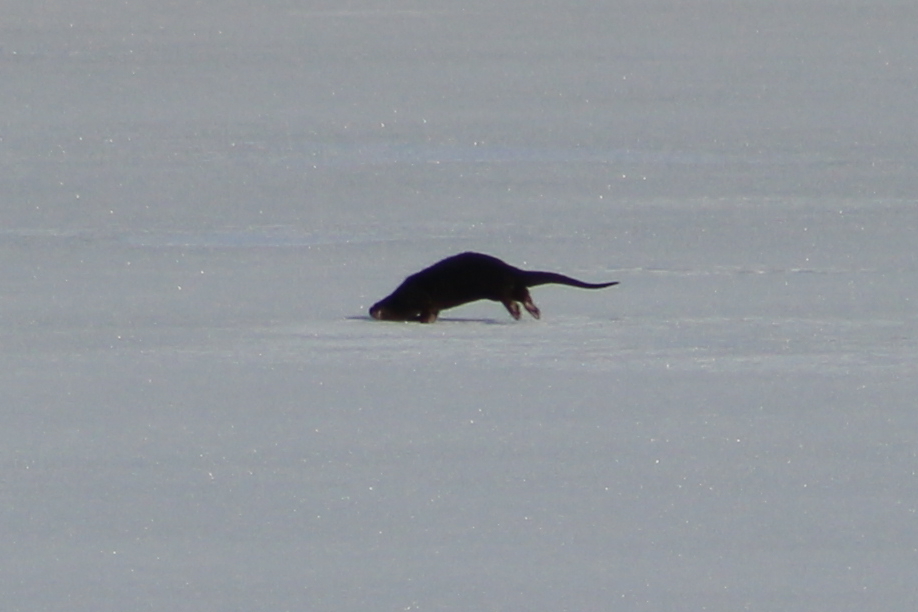
This week I caught a river otter on Lake Wicwas.  Not in the literal sense, but caught on film - well, silicon.  Earlier in the week I saw a bobcat bounding across the lake after being startled by a human.  It was way too fast to be able to catch.  But the otter was just lazily hopping and sliding across the ice, so I had time to pick up a camera and click some photos.  It was having great fun out there on the ice - it would take a couple of hops to get up some speed, 


then put its nose down on the ice, 


give a push with its strong hind legs and slide along on its belly for a few feet.


Then jump up, hop, and repeat. 

All told it took less than a minute before it slid up to an island where it disappeared down through a hole and under the ice.  And speaking of ice, there is still a lot of it.  I saw that Lake Winnisquam has much open water, but Meredith Bay is just starting to open up, and Waukewan and Wicwas still have only small gaps along sunny edges - of which the otters take advantage.

The few open spots freeze back over on cold nights.

There is plenty of ice for all the animals to travel on, including this pretty gray fox that walked by my trail camera one night.

It just simply skirted around that open hole to continue its path along the shoreline looking for a midnight meal (this was 2:12am).  At night it's probably looking for mice.  During the day there are lots of squirrels around both red and gray, and those are probably what the bobcat is hunting.

There is lots of snow and ice, but signs of spring are becoming abundant.  This week I saw a pair of buffleheads at the dam, three black ducks in a bit of open water along Chemung Road, and lots of turkey vultures soaring all around the Lakes Region.  A flock of dark-eyed juncos (aka snowbirds) arrived with yesterday's snow, just as their nickname warrants.  

Dark-eyed junco

Coming up from digging in the new snow with a bill full of seed.

Yes, more snow yesterday,
Saturday morning.

while three days earlier it was spring even up in the mountains.  

Mt. Lincoln from Little Haystack.

Though it might not appear that way, it was beautiful warm spring day.

Rime ice coats stunted spruce at the tree line.

Winter-spring-winter-spring - on rages the battle even as we move into April.
The Presidential Range all dressed in white.


Sunday, January 31, 2021

January 31, 2021: Windy Winter Days

Old mother west wind, to borrow a phrase from Thornton Burgess, sure was busy this week.  Not only did she usher in some real cold, but she swept almost the entire surface of Lake Wicwas clear of the recent snow.

Ready for skating again.

The snow could be seen blowing through the air, swirling into snow-tornadoes rushing down the lake before being dumped on windward shores where the trees ended their journey.  There were parts of the lake that didn't want to release its snow, hanging on to it in variously shaped islands with sculpted cliffs, a miniature version of the geological facies found in southwest regions like Moab and Bryce Canyon.


On one of those windy days I came across a set of tracks in the piled up snow near shore that I wouldn't have identified if I hadn't seen the culprit in action.

Who left these?

I could have spent hours searching through tracking books and not identified them.  I'll share a few more pictures before I reveal the perpetrator in case you want to figure it out.


Hint:  Remember it was a windy day, and it was close to shore.


So here's the answer:

That old mother west wind was having a good time tossing a white pine cone around the lake.


I have a recollection of seeing a mark similar to this in the past, but wasn't sure what caused it; having seen proof now I hope the memory will stick for future observations.  

With the cold and the wind I didn't observe much animal activity out there, and whatever tracks they made were quickly filled in with blowing snow.  But I did come across this tiny set of mouse tracks in a sheltered spot.

A mouse travelling back and forth between hidey-holes in the snow.

The strong wind also did some work on the ice hanging off the eaves where snow had frozen and slid slowly out to hang in the breeze.  

More wind sculptures.


I was fortunate enough to pick the calmest day of the week to ski up Mt. Cardigan, and though it was perfectly calm on the summit, proof of the wind was visible in the wind-scoured rocks and rime ice formations.


With the cold weather, Meredith Bay is also finally iced-over, getting prepared for the Pond Hockey Tournament next weekend.

A cold day on Meredith Bay, with the Belknap Range in the background.


The coldest days in winter do tend to be the prettiest!


Sunday, November 11, 2018

November 11, 2018: Bucks are Getting Active

Most of the smaller animals have their mating season in late winter or spring with their offspring being born or hatched several weeks later.  But the larger animals including moose and deer have much longer gestation periods, so they mate in the fall, again to give birth in the spring when food is plentiful.  (One interesting exception to this is the black bear which mates in June, but then employs something called "delayed implantation" so gestation starts around November with birth occurring in January, though the young won't leave the den until two or three months later, relying completely on the mother's milk during that period.)

The white-tail deer has a gestation period of just over 200 days, geared toward birth in late May or early June, so their mating period is right about now, and the bucks are busy marking their territory and rounding up their does.  The most visible signs of this are large scrapes bucks make in the forest floor where they scrape up leaves and soil and then mark the area with their scent using urine and the glands on their hind legs.
A large deer scrape in the middle of a trail

They tend to build these sites underneath branches - typically  hemlock in our area - and they will also scent these overhanging branches with the glands on their forehead.
This scrape has a common triangular shape where the buck was facing to the right

Also, if you look at the very top of the photograph below you will see where the buck has used its antlers to rub scent on the trunks of small hemlocks, scraping off the bark, adding further scent to the site.
Note the stripped bark on the skinny hemlocks at the top of the photo

I can imagine scented trees facilitating the buck's scent drifting through the forest with the wind, and the scented liquid absorbed by the soil lingering for days.  This behavior will alert both male and females that a buck has claimed this territory and the does within it as their own.  You might see these right on a trail as deer often take advantage of easy travel along these cleared paths through the woods.

The cooling weather has started to drive the birds migrating from Canada our way;  this week I saw two groups of hooded mergansers on Lake Wicwas, including one pair, and one group of two males courting a single female.
Male Hooded Merganser
And the female

Two males escorting a single female on the journey south

We haven't had any winter weather here in the Lakes Region yet, but 30 miles farther north it's starting to look frosty.  I took a hike up Mount Moosilauke last week, and there were sure signs of winter up at the 4800 foot summit.
North Kinsman from the south peak

Rime ice at the north summit


It was just a taste of what's to come.
Snow started at 3800' elevation

Finally, on this Veterans Day, a thank you to all those who served our country - especially you dad!