The Lake Wicwas Association held its annual meeting yesterday at the Wicwas Grange in Meredith Center; it was well attended with lots of catching up with friends over coffee and treats before the meeting began. The featured speaker this year was Patrick Tate, wildlife biologist at the New Hampshire Fish and Game department who provided a presentation on the life and habits of New Hampshire's bobcats.
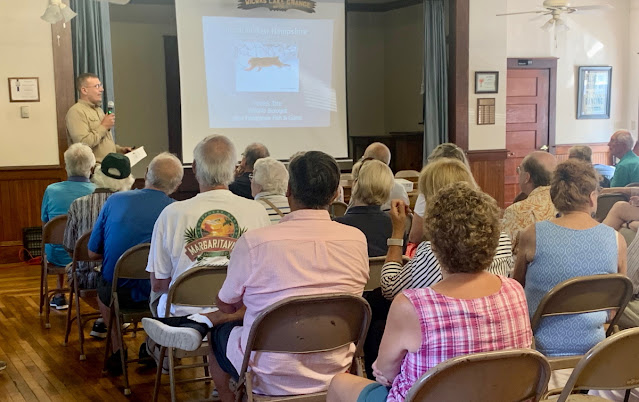 |
NH Fish and Game wildlife biologist Patrick Tate speaks about bobcats in New Hampshire.
Photo by Shayne Duggan. |
One of the new things I learned is that bobcats have a very "plastic" diet, which means they readily change their diet based on the availability of prey. In some years white-tail deer are their primary food source and in other years it's small animals such as squirrels. But they are true carnivores, completely dependent on catching other animals for their sustenance - no veggies for them. Tate also explained that bobcats were considered primarily southern animals but have moved north and now occupy all of New Hampshire except for the white mountains. Unlike other far-northern species such as the snowshoe hare and the lynx, bobcat do not have large paws to let them hunt efficiently on deep, dry snow, so they aren't found at high elevations in the mountains. Tate also described how to identify their tracks - round footprints with round toes prints absent claws - as well as their preferred habitat which includes the edges of wetlands and the margins of farms.
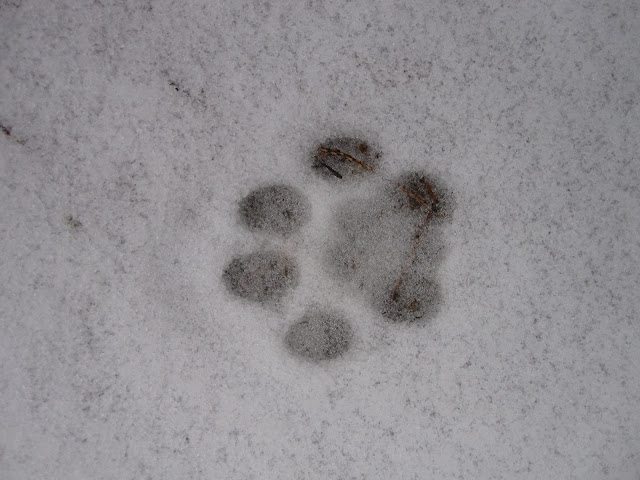 |
| A bobcat print seen near the shores of Lake Wicwas. |
We'll all know a bit more about these wild felines when we see them around the lake in the future. Many thanks to all who attended and helped organize the meeting and asked Mr. Tate such great questions about bobcats.
We also had a very successful silent auction, raising over $2000 for the Lake Host program. Another big thank you to all who donated items for the auction!
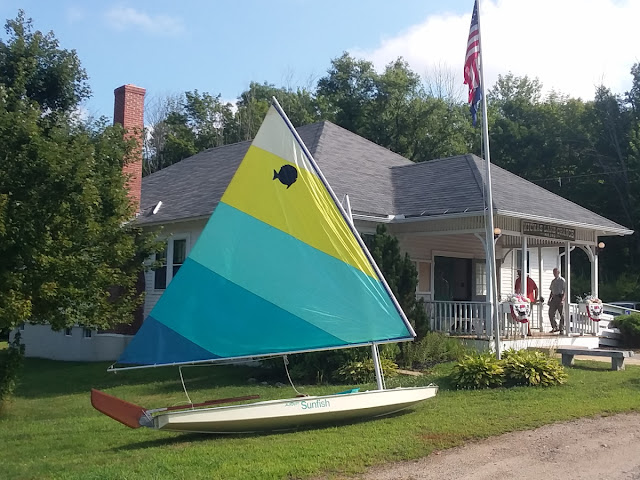 |
| A sunfish donated by the Larsens and prepped by Dean Cascadden was the headliner for the auction. |
The loons have captured most of the attention around the lake for the past few weeks and there's still a lot going on with them, but they're not the only birds that are active this time of year. The songs on my morning walks have changed noticeably, as the spring calls of warblers have been replaced by the sweet summer song of the Hermit Thrush and the tireless singing of the red-eyed vireo which can sing non-stop for an hour at a time even on the hottest summer day. Both of these birds are difficult to find as they sing from thick brush or in high tree tops, but I know they're in there. Here's a good look I got of a vireo on a mid-summer day a few years ago.
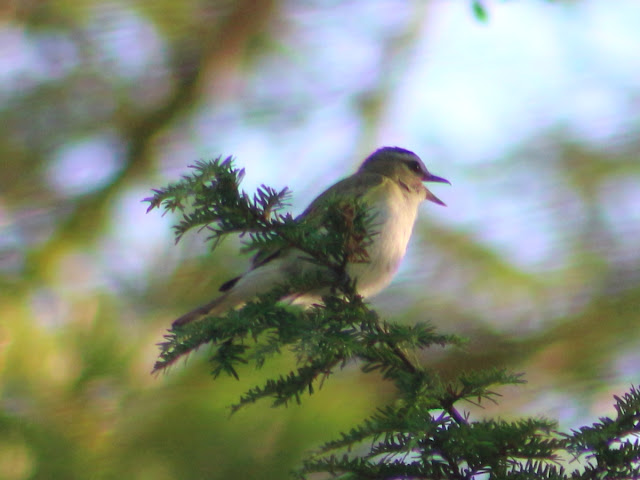 |
| Red-eyed vireo singing from its perch in a hemlock. |
Both the belted kingfisher and the eastern kingbird are very visible and active, darting around as they catch insects on the wing. I watched a nice acrobatic air show put on by the kingbirds one morning on the kayak.
It's also high butterfly season. Monarchs are in the fields at the Page Pond Town Forest where milkweed is starting to appear. The great-spangled fritillaries are sipping nectar from clover, and the pearl crescent butterfly is doing the same on bright orange hawkweed.
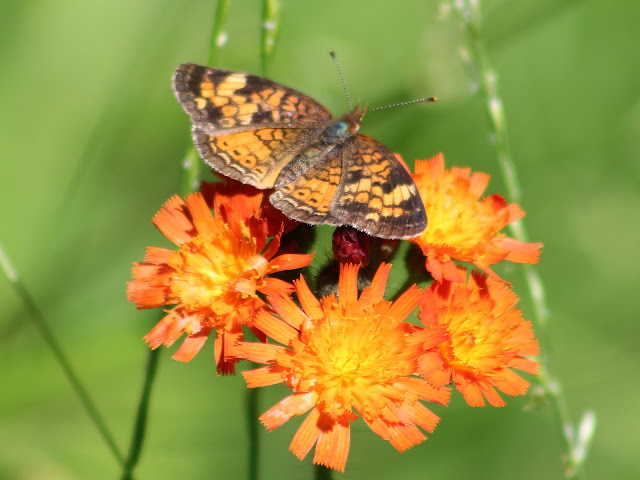 |
| Pearl crescent on hawkweed. |
 |
| Great-spangled fritillary on a clover blossom. |
 |
| Sipping nectar through its long hollow proboscis. |
On these hot August days the mammals are much less active, but I do see momma deer and her fawn regularly out browsing early on cool mornings before the heat arrives. (Still no pictures though.)
In the July 24 post I mentioned an injured loon that was observed on the lake. Since then multiple sightings were received and it looked weak enough that the LPC biologist came and searched the lake to assess it but the loon couldn't be located. Finally, last week, the bird had beached itself and a couple of intrepid volunteers were able to capture and safely contain it - the loon was very weak and didn't provide any resistance. The biologist was alerted and came immediately to pick it up and bring it to a rehabilitator in Concord. Unfortunately, the veterinarian decided the loon was too badly injured, and it had to be euthanized.
I don't know if we'll get any further information, but from descriptions of its condition it seems it had been involved in a lot of fighting with another loon. But there is happy loon-news on the lake: I don't have a recent photo of her, but Maddie was reported on Saturday to be healthy and growing by leaps and bounds.
Now that the fighting on the lake has passed, is there a better life than that of a loon, spending these hot august days floating on the lake and savoring those steamy, crimson summer sunsets?
 |
| A waxing gibbous moon watches over scarlet clouds after Saturday's storms passed. |
Hopefully I'll have a picture of Maddie for the next journal entry.


