Sunday, September 27, 2015

September 27, 2015

From death does life spring.  This large dead and decaying stump - probably from a white pine, but perhaps a hemlock - caught my eye due to the amount of new life springing forth from its remains.

What was once a mighty tree, perhaps 100 or more feet tall, is now only a rounded form of rotting wood.  But the strong heartwood that once supported its mass is now returning the energy it stored over many decades back to new and varied life.  I counted seven different species being incubated there and I'm sure there are many more a better trained eye would recognize.  The obvious ones:

A hemlock tree

An oak tree (a little chewed by the insects)

A maple tree

Ferns

Moss

Lots of partridge berry

And even a couple of new white pines to carry on the family tree.

And this is just on the outside.  I didn't violate the sanctuary, but if I did I'm sure I'd discover an even more interesting array of life including ants, grubs, earthworms, salamanders, and thousands of microscopic organisms working slowly but relentlessly to decompose the stump into rich soil and compost.  By the time that happens the plants now growing on it will have extended their roots deep into the earth and will survive without the stump, consigning to oblivion what provided their initial nurturing.

It will be quite a battle among the trees to see who reigns supreme over this little patch of New Hampshire.  There will be enough light and space for only one tree to emerge to any magnitude.  The maple and the pine will grow the fastest;  the hemlock and oak more slowly, but will establish a more complete canopy, perhaps shading out the faster upstarts.  Anyone want to make a wager on the victor?  I'll put my money on the hemlock;  it seems to be off to a healthy start, and they can inch upward for years with very little sunshine.  I'll hold your wager in escrow and get back to you in, oh, about 50 years.


This post is being sent from Steamboat Springs, Colorado as we are on a trip to visit the national parks of the southwest.  But fellow nature watchers (including our good friend who is staying at our house - thank you!) have offered to keep me appraised of what's happening around Lake Wicwas while I'm away.  Of course, I'll also share  interesting events I encounter along my trip.  The first thing I noticed is how far ahead the season is out here at the higher elevation.  Whereas the trees are just starting to turn in New Hampshire, the aspen in Colorado, even at Steamboat's base elevation of 6900 feet, are at already at peak color.
Summer colors at Lake Wicwas (photo credit:  Laurie Conn)

Steamboat Springs, Colorado in its fall colors


Sunday, September 20, 2015

September 20, 2015 - Leisurely Walks

Fall is here - it is my second favorite time of year to walk the trails around Lake Wicwas (early spring, with the renewal of life emerging everywhere tops my list).  With the black flies, mosquitoes, and deer flies now gone, I can once again enjoy a slow, leisurely walk in the woods without being hurried on my way by those annoyances.  It's a time to look closely at the lake and forest features I passed quickly by during the summer.  One of my favorites is the red eft.

Red Eft form of the Eastern Newt
As I was watching one recently it dawned on me just why I am so fascinated by these small amphibians.  One reason is that they move in such an interesting manner, like a giant dinosaur or alligator in miniature.  But I realized the critical factor is that I can watch it.  What other forest creature is so slow and calm that you can get right down on your hands and knees and watch it do its thing?  Just about everyone else - frogs, snakes, squirrels, birds, deer - they dash off in an instant.  But these little guys just go slowly on their way for you to watch.


While I was down there, I also noticed another miniature form of a previously giant object:  the Tree Clubmoss.
A forest of Clubmoss

This looks to me like a towering coniferous tree, but is in fact only five or six inches tall.  Similar to how the red-eft looks like a prehistoric creature, the clubmoss has been around for millions of years and is believed to be similar to very earliest plants that evolved on earth.  And in fact, their early relatives were 100 feet tall.  They grew in giant swamps and pumped so much oxygen into the atmosphere that the O2 content was 30 to 35% versus today's 21%.  This was during the "Carboniferous" period, so named because plants like the ancient clubmoss grew so abundantly that when they died their carbon loaded bodies were compressed into the coal and fossil (i.e. carbon) deposits we use today.  Imagine this a forest of 100 foot tall trees.

Much of what I learned on the Clubmoss came from a report on the NH State Parks blog - you can read the full report here.

If you're in the woods this fall, take advantage of the temperate, bug-free zone to look for previously unseen sights - maybe you'll even find a troll residence hidden beneath a moss-covered stone roof!
I hope the troll peeks out in the evening to catch the beautiful fall sunsets.

Sunday, September 13, 2015

September 13, 2015

This summer was the longest there can be, if one uses the dates of an early memorial day and a late labor day as the mileposts of summer.  But with labor day come and gone, the activity on the lake has subsided considerably.  This past weekend, even though the fabulous weather continued - at least for Saturday - there was less action on the lake, only a few kayaks and canoes along with the fishermen. 
A calm fall day on Lake Wicwas

We took a slow ride around the lake with a good friend to enjoy the beautiful calm day, and were treated to a few sights:  an osprey
a heron,

and a couple of loons.


Spring may provide the mother-load of wildflowers, often with stunning beauty and short blooming spans such as the Lady Slipper and Trillium, while summer treats us to longer lasting, often large fields of color provided by the likes of Daisies and Black-eyed Susans.  But fall has its own special flavor as late flowers fill in the color void before the trees start to turn.  These range from brilliant fields of goldenrod to tiny white flowers such as the Nodding Ladies' Tresses.
Nodding Ladies' Tresses
A classic fall bloom is the Pearly Everlasting, a dry white flower that lasts a long time.
Calico Aster (Aster lateriflorus)


Asters, closely related to daisies, are frequently found in fields this time of year;  these were growing near the lake.
Calico Aster (Aster lateriflorus)

Red clover is a summer flower that blooms into the early fall.

As with clover, the wild thistle is a favorite of bumble bees collecting their pollen,

but evidently Lady Bugs appreciate this food source as well.
Sharing a Thistle Blossom


The bumble bee, with its furry coat to keep it warm, will be active into fall well after the other bees have disappeared.

Yes, summer is waning and fall is on its way.  Early signs are evident with the animals, on the plants, in the trees - and on the water.


Sunday, September 6, 2015

September 6, 2015

Last week I commented on the large mats of Bladderwort in the lake.  It's not just Lake Wicwas, but many lakes are experiencing this phenomenon this summer.  Marge Thrope sent me an article on the subject written by Amy Smagula, NHDES Exotic Species Program Coordinator, in the Volunteer Lake Assessment Program newsletter (click here to read it).  Amy says aquatic plants have boom and bust years just like terrestrial plants, and 2015 is the bladderwort's time for glory. 

The autumn harvest and gathering has commenced in the Lakes Region;  an audible indicator is the annual pine cone drop which is now taking place in the pine groves around Lake Wicwas.  It's not the trees themselves dropping their cones, but rather these little rascals cutting them off the branches so they fall to the ground where they gather them up to store away for a cold winter day.


The originator of the term "squirreling away"
You hear it far off on a quiet morning, the cones bouncing off all the dead branches on its way from tree-top to forest floor.
The White Pine - Nature's pinball machine

It sounds like an old-time pinball machine where each branch rings up another 1000 points on the scoreboard.

This will be the source of those piles of pine cone shells that will appear on the snow this winter.
Midden Pile under a favorite lunch branch

(Sorry to use the "W" word - and to show snow.)

On August 16th this year I noted some of the berries around the area, including the Hobblebush viburnmum with its bright red fruit.  Now, three weeks later, those berries are turning black.


I find it interesting there aren't any berries that are part black and part red - it seems each berry changes color almost at once - maybe overnight?


I also showed evidence of bears eating berries of some sort, and this week I found signs of fox doing the same.

The berries in this scat look suspiciously like those viburnum berries, but that's just a guess.  You may have also noticed that this fox left its calling card right next to an antlion dwelling - that little cone in the sand where the antlion excavated its trap to catch unsuspecting ants - just like Sarlaac, the giant antlion in the Star Wars movie "Return of the Jedi".)

One more fruit bearing plant that is ripening at this time:  the Indian Cucumber.  The root of this plant is edible, but the berry is not.
At least not to humans -  I don't about animals.  If squirrels eat them, you can be sure this guy will be watching to make sure you don't steal its food if you lean down to take a look at it.


Sunday, August 30, 2015

Weed Watching

I took my late summer weed-watch tour of my section of Lake Wicwas this week.  The mission is to look for non-native plants that might have invaded the lake, but scrutinizing the water and shoreline with a keen focus also rewards me with interesting sights I usually pass right by.  One item that immediately caught my eye was this large mat of weeds - there were actually several such growths, some of them over ten feet across.


It looked like a familiar native species, but being rather large I sent pictures to our local expert, Marge Thorpe, who took a trip out to inspect it and confirmed it as native bladderwort.  (Thank you Marge!)
Bladderwort

I didn't see any other plants of concern, always a relief.  Hopefully my fellow weedwatchers will have the same results on their sections of lake.  Of course, the credit for this goes to all the users of the lake who are careful to remove any plants from their boats as they travel from lake to lake - as well as to all the great volunteers who conduct the critical Lake Host program on Wicwas and many other bodies of water throughout New England.

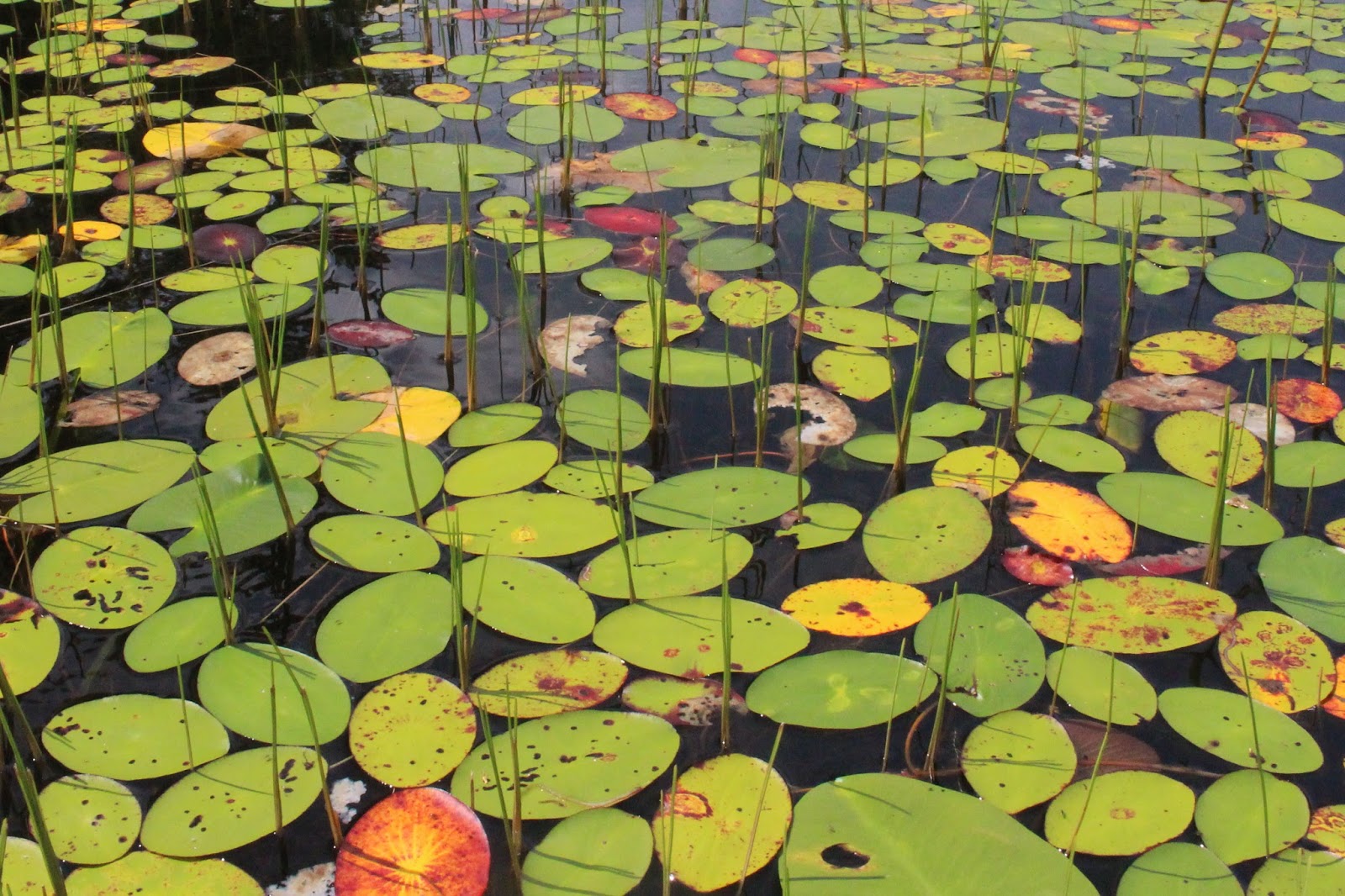
The variety of water plants within this one lake is really quite diverse.  There are many sizes and shapes of lily pads with wide, flat leaves that in some areas completely cover the surface of the lake, yet even when they blanket the water, other plants have evolved with the opposite form so they can protrude right up through them, tall and needle-like.

I saw only a few of a similar tall, skinny plant, this one with tiny white flowers on the top of each stalk.

Many of the arrowheads (pickerelweed) around the lake have had their leaves chewed off by the geese, leaving more narrow stalks sticking up out of the water.

Then there are the grasses, some of which grow tall and lie flat upon the surface.

Sorry I don't know the names of most of these - perhaps a project for a cold winter day....

In addition to providing a source of food, all these aquatic plants perform important functions in the life of the lake, including filtering water and providing cover for myriad small animals.  They can also help to crowd out invasive species that might otherwise try to take hold in a barren section of a lake.

The search also brought me to notice some terrestrial plants that grow right on the water's edge.  The Turtlehead for one:
Turtelhead (Chelone)

I liked the way one single plant found a place to settle down among the rocks on the shoreline.

Finally, peering into the water brought me to this pair of water bugs, identified by a fellow lake watcher and biologist (thanks Dave!) as "Whirligig Beatles" (Gyrinus natator).  They chased each other around madly in circles,

every now and then stopping for just a second to cozy up,

and then resuming the chase again.

Kind of reminds me of being a teenager.  Maybe he should search the lake and bring her a pretty flower.


Thursday, August 20, 2015

August 23, 2015

Oh, the dog days of August are here - and I love it!  Hot, hazy, humid days;  calm, quiet, still afternoons;  peaceful nights with the sounds of nature in the air - the past couple of weeks have endowed us with  classic late-summer New Hampshire weather.  Perhaps you saw some shooting stars during the Perseid meteor shower on one of those warm nights.

The heat and humidity may not be appreciated by all creatures, but one group, the fungi, thrive in this kind of weather, marking a time when it becomes interesting to take a look at your feet as you walk the pathways around the lake where various fungi emerge from the soil.  One of the most recognizable is the Indian Pipe, a skinny white fungus that grows tall and obvious in many places.

A very different fungus is one that is wide, flat, and shiny - one I think is a member of the family known by names like Shelf Fungi, Bracket Fungi, or Artist Shelf.

It certainly would be a useful platform for an artist to place her paints as she works in the forest.

I'm not one to pick mushrooms from the forest floor to eat, but I do enjoy the tremendous variety of size, shape and color they contribute to the walk.  And if you do like to forage for mushrooms and want to learn more from one of the most notable experts, the Lakes Region Conservation Trust is sponsoring a Mushroom Walk with Rick Van de Poll in September.  While you're on the LRCT web site you may notice they are also sponsoring a guided paddle excursion - right on Lake Wicwas no less.  It happens this Tuesday, August 25th, and the details on how to register for the trip are on the same page.  I will be there!

Here are a few more samples I found during this simmering stretch of fungi-favorable weather.

Black and White:


Red and orange:

Hard and shiny:


And just emerging from under the ground clutter:


Meanwhile high above my head, an Osprey flew through the thick atmosphere;  I caught a quick picture as it went overhead.  Only after later exploding the picture did I discovered that it had been on a successful fishing expedition at the lake.

Then later, I found this splat on the forest floor.

It is most certainly a raptor expulsion of uric acid.  Hawks, owls, and other raptors expel their solid waste via the familiar pellets one occasionally finds on the ground, but they must excrete their liquid waste and uric acid in liquid form.  I don't know for sure this is from an osprey, but based on its location just a few feet from shore, I expect it's from an osprey sitting on a branch at the water's edge looking for an unsuspecting fish to swim underneath it.  The osprey love these hot, still days where they have a clear view down under the surface of the lake.

Another benefit of this clime if you're a warm water lover:  the lake temperature this week was 83 degrees at the surface!  And even one more perk:  rainbows as the afternoon showers blow over the lake.
Looking west over Lake Wicwas - Photo courtesy of Bill Thorpe

I do love these dog days of summer!