Showing posts with label Mushroom. Show all posts

Sunday, September 22, 2019

September 22, 2019: Fall Fungi Fest

It's time for the annual mushroom festival.  The predictions way back in June were for a good mushroom crop due to the wet spring with abundant rain, and it appears to have been accurate.  Some fungi started appearing earlier in the summer, but they really started to kick in around late August.  All the samples below sprouted since August 23rd, with the earliest being the chicken mushroom I posted on September first.
Chicken mushroom, or sulphur shelf

My respect for mushrooms grew a lot when I came to understand that essentially no tree in the forest would exist without fungi to provide essential nutrients to the tree's roots.  And it increased further when I learned that the visible mushroom is just the fruit of a giant organism growing underground.  I'ts like a giant underground apple tree which just sticks it fruit up above ground to let its seeds (in this case, spores) be distributed.  I'll include my best idea as to the identity of any mushrooms I'm willing to take a guess at.

I always marvel at the variety of these interesting and important organisms.

Tiny ones
Purple ones (viscid violet webcap)

Small families
And large families

I love how they can push up through the ground and leaf litter.


Fly amanita

They're often consumed by various animals.
Usually I see little nibbles taken with lots of crumbs left on the ground.  But this looks like some large animal took a couple of big bites.  But who?


Some mushrooms can grow quite rapidly.  Here's a series of pictures of the same fruits I took over the course of several day.
September 9th

September 11th

September 12th
September 15th


And finally, to close out fungi fest 2019, a cute little family of mushrooms that could star in a performance of Fantasia.

Sunday, September 17, 2017

September 17, 2017 - Annual Fungus Review

It's time for the annual fungus parade.  I'm not a mushroom expert, so I can only identify a few, but I enjoy the great variety in size, color, and form of these intriguing organisms as I tour the woods.  I'll show some new ones along with my favorites, starting with the tiniest samples and working my way up.
British Soldiers among various fungi and mosses
These are called British Soldiers due to their color and form resembling British troops in the Revolutionary War.  This brigade was mustering on top of an old white pine stump;  they are really small.
That's my thumb
I cheated here a bit, because these are actually a lichen, which is composite organism made up of fungi and algae working together in a symbiotic relationship.  As I discussed in last year's fungus post, fungi work symbiotically with many other organisms which enables our entire forest ecosystem to exist.

A bit larger are these little white fungi that speckled the forest floor in the middle of August, something new I haven't noticed before.

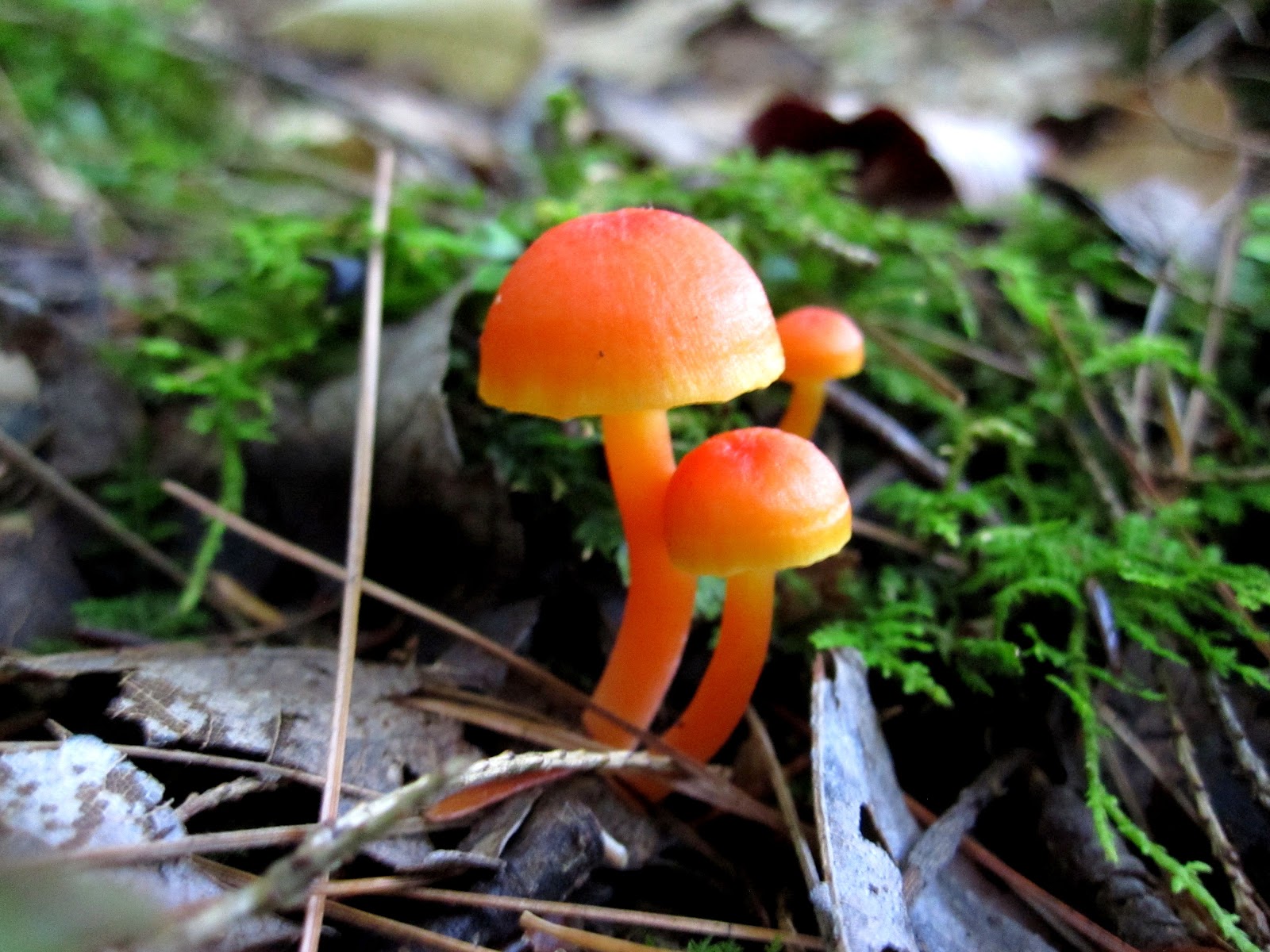
Next up are the small orange mushrooms that grow all summer long, often right near or on a trail. These are Orange Mycena.
Orange Mycena, (Mycena leaiana)
Now here's something that's a bit different:  Yellow Slime Mold.
Yellow Slime Mold (Fuligo septica) showing yellow and white tissue
I assumed this was a fungus, but looking it up I found that it has been re-characterized from a fungus to a "Eukaryotic".  [Ref:  Wikipedia Slime mold] It appears to be the species Fuligo septica, also known as "scrambled egg slime" or "dog vomit slime" (I don't make this stuff up).  And it gets better - this organism can move:  It can "form a ... mass of undifferentiated cells that that may move in an ameboid-like fashion during the search for nutrients."  [Ref:  Wikipedia Fuligo septica]  Sounds the plot of a horror movie - seen any of these walking around the lake recently?  You can read more about its bizarre properties at the references provided.

Moving up in size is this new (for me) mushroom, the first purple fungus I've come across.
Purple Cort (Cortinarius iodeoides)
I found this one while doing boundary monitoring on the Rawson Wood Conservation Area near Blake Brook on the west side of Lake Wicwas.  A quick search suggests it is a Purple Cort Mushroom, which grow in New Hampshire hardwood forests, especially oak, so it all fits [Ref: MushroomExpert.com].  Since it is only purple when it first emerges, turning gray as it ages, it's possible I've seen one before but never noticed it as something unique. It appears people eat these, but not this person.

So as not to bore the reader, I'll just show a few of the more interesting specimens I found, and then finish with the granddaddy of the summer. First, a medium size orange one emerging from under the leaf litter.

Next a Fly Amanita growing from a dead branch.
The common Fly Amanita


Here, emerging from the dirt and debris in the middle of a trail, is a family of pristine white mushrooms.

A nice collection of speckled maroon toadstools took up residence in this mossy spot.


There are many animals that consume these nutrient-filled organisms including insects, mammals and amphibians.
A red eft looking for small insects feeding on this medium-sized fungi
And finally, the biggest and brightest find of my roamings about the Lakes Region this summer:
Sulphur Shelf (Laetiporus sulphureus)
I'm pretty sure this is the sulphur shelf, or "chicken mushroom," considered by many to be good eating, but again, not something I'm going try.  I'm happy just to feast on these strange organisms with my eyes as the summer passes into fall.

Sunday, October 16, 2016

October 16, 2016 - Mushrooms


Mushrooms.  Or more accurately, fungi.  This is subject one can spend a career, even a lifetime studying.  And for mushroom lovers, at least those who forage and consume wild mushrooms, it's time well spent as there are mushrooms that really will kill you, and they are not always easy to identify.  Not being someone who savors this particular delicacy, I have not invested much time learning about them, but this summer on a guided walk on the Fogg Hill conservation area, I did learn a few lessons.  The most significant point being that the visible "mushroom" is actually the fruit of a much larger organism.

A fungus consist of an extensive underground network of threadlike strands called mycelium that grows slowly and may live for hundreds of years [REF:  Encylopedia Brittanica].  Now here's the really interesting part:  almost all plants rely on fungi for their survival;  without mushrooms there would be no trees and maybe no plants [REF:  mycologue publications] (this reference has a very short and concise description of this symbiotic relationship).  The fungus grow around and into the roots of plants, bringing nutrients to them, and in return, the trees provide the fungus with sugars that it produces via photosynthesis.  This explains why a mushroom can materialize and grow so large in just a few hours - it has stored tremendous energy in its vast underground system, and sends it to the fruit when triggered.

Even though this was a very dry summer, I saw many mushrooms growing all around Lake Wicwas.  The lightest mist or quick thundershower would trigger various fungi to send out their fruit, taking advantage of what little moisture the atmosphere would give it.  Here are just a few of the various fungi I found around the lake this summer.  I don't know what kind they all are, but the variety of size, shape, color and location is testament to its being everywhere, helping every plant thrive.

Big and yellow - this one's 6 inches across

Tiny and orange - only half an inch tall


Stuck right in a wound on a living tree
And forming a roof for a visitor
On a dead birch on the ground
Indian Pipe

Nature recycling - thousands decomposing a tree
A bid one on the Red Trail in Hamlin
I mean, really big.  This could feed a family!
Just poking up - it wasn't here yesterday
They'll take up residence just about anywhere

Maybe someday I'll come to find mushrooms tasty enough to invest the time to learn what's what.  Until then, I'll just appreciate them for their beauty, and for their essential role in life on earth!

Thursday, August 20, 2015

August 23, 2015

Oh, the dog days of August are here - and I love it!  Hot, hazy, humid days;  calm, quiet, still afternoons;  peaceful nights with the sounds of nature in the air - the past couple of weeks have endowed us with  classic late-summer New Hampshire weather.  Perhaps you saw some shooting stars during the Perseid meteor shower on one of those warm nights.

The heat and humidity may not be appreciated by all creatures, but one group, the fungi, thrive in this kind of weather, marking a time when it becomes interesting to take a look at your feet as you walk the pathways around the lake where various fungi emerge from the soil.  One of the most recognizable is the Indian Pipe, a skinny white fungus that grows tall and obvious in many places.

A very different fungus is one that is wide, flat, and shiny - one I think is a member of the family known by names like Shelf Fungi, Bracket Fungi, or Artist Shelf.

It certainly would be a useful platform for an artist to place her paints as she works in the forest.

I'm not one to pick mushrooms from the forest floor to eat, but I do enjoy the tremendous variety of size, shape and color they contribute to the walk.  And if you do like to forage for mushrooms and want to learn more from one of the most notable experts, the Lakes Region Conservation Trust is sponsoring a Mushroom Walk with Rick Van de Poll in September.  While you're on the LRCT web site you may notice they are also sponsoring a guided paddle excursion - right on Lake Wicwas no less.  It happens this Tuesday, August 25th, and the details on how to register for the trip are on the same page.  I will be there!

Here are a few more samples I found during this simmering stretch of fungi-favorable weather.

Black and White:


Red and orange:

Hard and shiny:


And just emerging from under the ground clutter:


Meanwhile high above my head, an Osprey flew through the thick atmosphere;  I caught a quick picture as it went overhead.  Only after later exploding the picture did I discovered that it had been on a successful fishing expedition at the lake.

Then later, I found this splat on the forest floor.

It is most certainly a raptor expulsion of uric acid.  Hawks, owls, and other raptors expel their solid waste via the familiar pellets one occasionally finds on the ground, but they must excrete their liquid waste and uric acid in liquid form.  I don't know for sure this is from an osprey, but based on its location just a few feet from shore, I expect it's from an osprey sitting on a branch at the water's edge looking for an unsuspecting fish to swim underneath it.  The osprey love these hot, still days where they have a clear view down under the surface of the lake.

Another benefit of this clime if you're a warm water lover:  the lake temperature this week was 83 degrees at the surface!  And even one more perk:  rainbows as the afternoon showers blow over the lake.
Looking west over Lake Wicwas - Photo courtesy of Bill Thorpe

I do love these dog days of summer!