Showing posts with label Tree Clubmoss. Show all posts

Sunday, April 1, 2018

April 1, 2017 - Carnivorous White Pines

That may sound like an April Fool's joke, but it's true, though somewhat indirectly.  A friend recently told me about spotting bunches of snow fleas - a type of insect know as springtails - on the snow (thanks BB!).
Snow Fleas on my finger

These are very tiny animals, but there are lots of them.

This reminded me of something I read in the Society for the Protection of New Hampshire Forest's publication "Forest Notes".  [Summer, 2017]  It has been found that a certain type of fungus, the bicolor deceiver (Laccaria bicolor), has a toxin that kills springtails when they feed on the fungus.  The toxin paralyzes the springtail, and then the fungus absorbs the insect's nutrients through filaments it extends into its body.  Knowing that the underground portions of fungus exchange nutrients with trees, scientists tagged a bunch of springtails with a radioactive tracker so they could follow it through the food chain.  The tagged springtails were placed near fungus which were in proximity to white pine, and after a few months, they found the pines contained radioactive nitrogen from the snow fleas.  It is incredible how so many creatures are interrelated and depend on each other for survival.  You can read more details about the process from the SPNHF article here.

The snow fleas will be around all year, though once the snow is gone they won't be noticed without looking for them, as they blend into the forest floor.
Snow fleas on an oak leaf

But they'll find the mushrooms, eat them, and in return, be fed to our giant white pines.
How many snow fleas were consumed in creating this giant?

As the snow melts, signs of spring are becoming more evident.
Puddles forming on the lakes
Hobblebush Viburnum ready for spring

Beaver ponds starting to open up
Meredith Bay peeling back


There are even a few green plants starting to photosynthesize the increasing sunlight.
Tree clubmoss (Lycopodium dendroideum) reappearing from under the snow pack

But don't let these signs fool you - there isn't much spring in the lakes on this April first.
Happy Easter!

Sunday, September 20, 2015

September 20, 2015 - Leisurely Walks

Fall is here - it is my second favorite time of year to walk the trails around Lake Wicwas (early spring, with the renewal of life emerging everywhere tops my list).  With the black flies, mosquitoes, and deer flies now gone, I can once again enjoy a slow, leisurely walk in the woods without being hurried on my way by those annoyances.  It's a time to look closely at the lake and forest features I passed quickly by during the summer.  One of my favorites is the red eft.

Red Eft form of the Eastern Newt
As I was watching one recently it dawned on me just why I am so fascinated by these small amphibians.  One reason is that they move in such an interesting manner, like a giant dinosaur or alligator in miniature.  But I realized the critical factor is that I can watch it.  What other forest creature is so slow and calm that you can get right down on your hands and knees and watch it do its thing?  Just about everyone else - frogs, snakes, squirrels, birds, deer - they dash off in an instant.  But these little guys just go slowly on their way for you to watch.


While I was down there, I also noticed another miniature form of a previously giant object:  the Tree Clubmoss.
A forest of Clubmoss

This looks to me like a towering coniferous tree, but is in fact only five or six inches tall.  Similar to how the red-eft looks like a prehistoric creature, the clubmoss has been around for millions of years and is believed to be similar to very earliest plants that evolved on earth.  And in fact, their early relatives were 100 feet tall.  They grew in giant swamps and pumped so much oxygen into the atmosphere that the O2 content was 30 to 35% versus today's 21%.  This was during the "Carboniferous" period, so named because plants like the ancient clubmoss grew so abundantly that when they died their carbon loaded bodies were compressed into the coal and fossil (i.e. carbon) deposits we use today.  Imagine this a forest of 100 foot tall trees.

Much of what I learned on the Clubmoss came from a report on the NH State Parks blog - you can read the full report here.

If you're in the woods this fall, take advantage of the temperate, bug-free zone to look for previously unseen sights - maybe you'll even find a troll residence hidden beneath a moss-covered stone roof!
I hope the troll peeks out in the evening to catch the beautiful fall sunsets.

Saturday, April 9, 2011

April 9, 2011

Not much changed around Lake Wicwas this week.  Even though the temperature was seasonably warm and the snow is melting, we just didn’t make a lot of progress.  The ice did give up a little ground, as it dropped two inches in thickness, but it remains 22 inches deep.  There are still only small openings around the shore line.
Maple Sugar season is comning to an end.  The Chemung Gang Sugar Shack (the Taggett's) are boiling their last batch for the season this weekend.  They said they had a record year, with 22 gallons of syrup made, and just about every drop sold.  They only had a few bottles left when I was there today, so if you want some great, fresh local syrup straight from the trees that drink the same water as Lake Wicwas, you'd better hurry!
Crows

Crow season never ends.  We saw a group of three or four harrassing a hawk who was too close to their nesting site. 

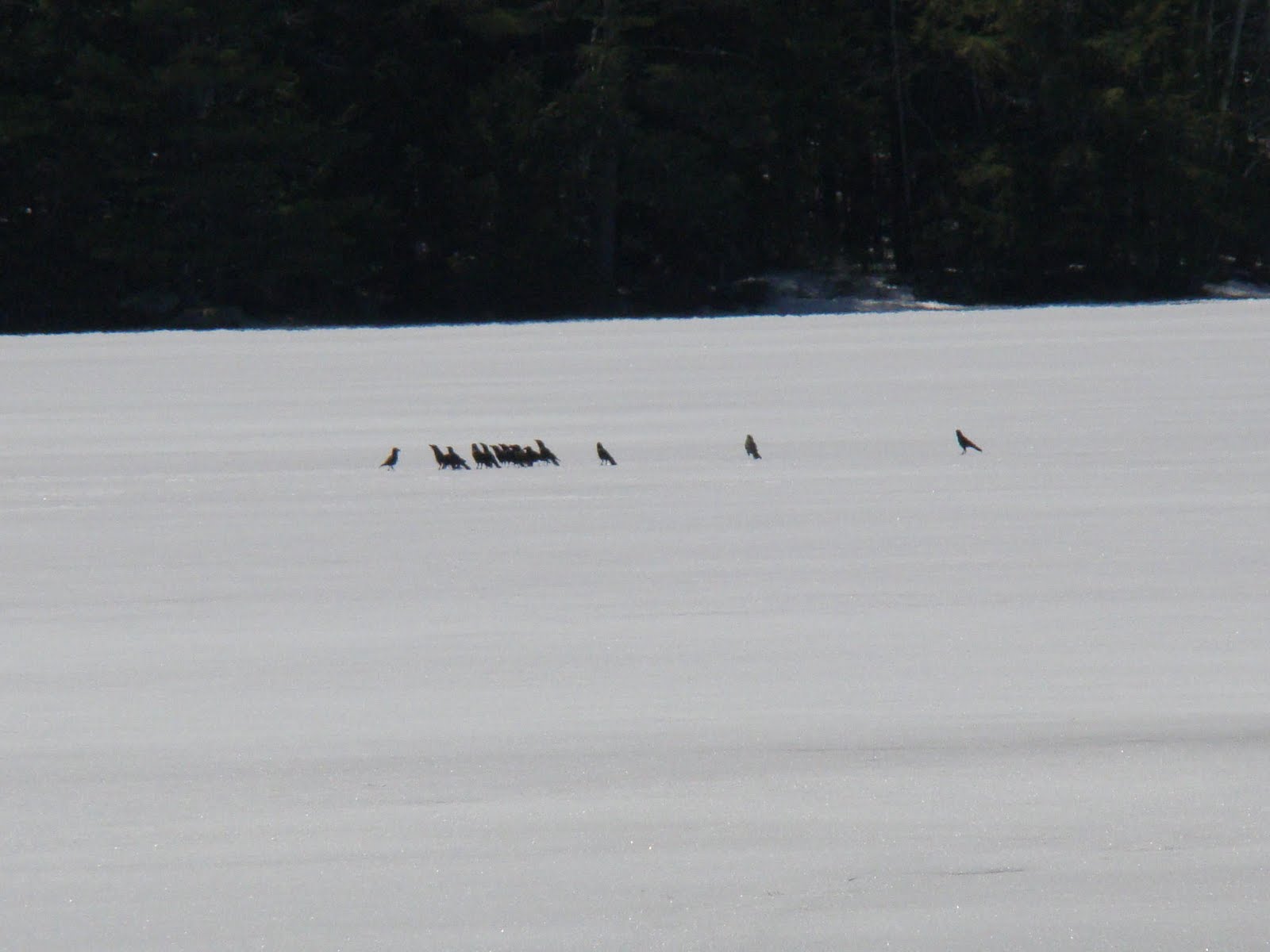
Later, a flock of crows was out on the ice huddling up like a football team as they decided who was going to get the fisherman's leftovers that were uncovered by the melting snow.


In the woods there are bare spots showing up now, and signs of life are reappearing.
Tree Clubmoss


Wintergreen

In the shade however, it's not uncommon to find well over a foot of snow.  Here and there one finds holes in the snow cover where a rock underneath the snow has conducted the warmth from below up to melt the snow from the bottom, sometimes suspending the snow several inches above the ground.

I haven't checked on the progress of the second house construction lately, but the one on the north side of the lake looks complete from the outside, and will certainly have happy occupants this summer!