Sunday, April 28, 2013

April 28, 2013

This is what we need - the first spring wildflower at Lake Wicwas!
Trailing Arbutus (Mayflower)


I saw the first one, a Trailing Arbutus, on April 26 - right on its usual schedule even with the cold spring.

The lake is still seeing some cold mornings with frost forming,

April Frost

but even with the cold nights the lake is warming up - the temperature is nearing 50 degrees in shallow water near shore.  The water was extremely clear for my first kayak trip, though I didn't see much activity in the water, only a few fish and painted turtle.  I did see a single Sandpiper on a rocky shoreline;  perhaps it is a Spotted Sandpiper.

Sandpiper
This bird has some amazing camouflage.

We took a long walk up through the Hamlin/Eames/Smyth conservation area on Saturday, as I wanted to get one more hike in when one can walk slowly and enjoy the world before the attack of the insects.  Plus, this time of year, with the leaves off the trees, the visibility into the forest is so much better.  We saw deer and a red fox on our trip, and even found some ice left in the pools below the white mountain ledge.  It was a peaceful, serene walk, accompanied only by nature without a single human encounter.  The wealth and diversity of nature and beauty in this protected forest is truly a gift to be treasured.
The last Ice - on the Lower Ridge Red Trail

Around the lake, the birds are very active in their mating and territorial behavior.  The geese are the most noticeable, aggressively protecting "their" property.
Protecting its Property


The loons are much more proper and composed, but no less effective or determined in their mission, as this pair was firmly escorting an interloper out of a cove it had claimed as its own.
Loons Escorting an Interluder from their Cove
Today there was a solitary loon floating all afternoon and evening in our cove.  Perhaps it was the same one, looking for a mate to come along and find Lake Wicwas.  Could it be our new loon that hatched on the lake last summer?

There was a pair of pileated Woodpeckers performing a mating dance around an oak tree.
Pileated Woodpeckers
 

Last year there were two males portraying similar behavior, but this time it is one male and one female - the female indicated the lack of a red "mustache".

One calm, sunny morning just after sunrise there were several Song Sparrows out serenading their mates from the branches hanging over the lake.
Song Sparrow Singing in the Morning Sun


So as the last vestiges of winter dissipate from Lake Wicwas, new life is evident everywhere, bringing with it renewal and hope, even as we grieve what we have lost. I wasn't quite up to putting it in words last week, but when I saw the Osprey - also knows as a Fishhawk because it is one of nature's most proficient fishers - soaring over Bev and Chuck's house, presenting a fish in its talons, I couldn't help but think it was showing its respect to Lake Wicwas' greatest fisherman.

Sunday, April 21, 2013

April 21, 2013

Spring continues to inch its way forward, however slowly.  There are only a very few small patches of ice left in the most shaded, low hollows around the lake, and tiny signs of spring can be found here and there, such as Red Maple blossoms, and the blueberry buds just opening.


Red Maple
Blueberry Buds
Still no signs of any wildflowers pushing their way up, but the animals are returning.  This pair of White Tail Deer came walking down the road one morning, calming nibbling on whatever new growth they could find along the way.


In the afternoon I saw bird of prey soaring over the lake, and grabbed a camera to see if I could get a picture.
Osprey over Lake Wicwas

I didn't even realize what I had captured until I blew the pictures up.  This is something you don't see every day:

An Osprey with a huge pickerel in its talons.  It flew well off looking for a place to feast in peace - or perhaps back to its nest.  Later in the afternoon when I was on a run, I flushed it - or one of its friends - out of a tree hanging over the lake.  It looks like we'll have osprey to watch again this summer!

On a walk up to Meredith Center we stopped to look at the ruins of the old mill on the river between Lake Wicwas and Lake Winnisquam.  Because all the leaves are off the trees, I saw something I hadn't noticed before - a large metal wheel near the river.  I'm pretty sure it is the turbine from a hydro-electric generator, probably put in place to power the mill once electricity replaced mechanical power. 
Hydro-Electric Turbine

From this side you can see the vanes where the water flowed down and through - the turbine would be mounted 90 degrees from its current resting position, turning a vertical shaft which drove the generator.  The water exited through the fins seen on the outside of the prior picture.

I can't figure out exactly how the river was diverted to flow down through the turbine, but I'm guessing it is sitting pretty much where it was used, so the water probably flowed through the stone channel and then reentered the river off to the left through the granite opening. 

My curiosity is now heightened about the history of this mill site.  The water of Lake Wicwas has served a lot of purposes over the years.   
Mill Site in Meredith Center

Sunday, April 14, 2013

April 14, 2013

Lake Wicwas certainly is unpredictable.  On Monday, the lake still had ten inches of ice, and by Thursday, it was essentially gone - just small sections along shaded shores.  By my reckoning, ice-out in 2013 occurred on April 11th.  But then, just to make sure we didn't get complacent, we received a couple of inches of wet snow the next day.
April Snow

It was barely enough to cover the ground.

But it provided one last (?) opportunity for easy animal tracking.  A bit farther along this trail I came across a fresh set of Otter tracks.

River Otter Tracks

It came out of the lake along a well-worn animal path, followed the trail for a short while, sliding on its belly when it could, then turned around and went back into the water.

We also saw the first beaver out in the evening cruising across the lake in search of fresh spring food.

With cold, wet conditions, it was the perfect weather for ducks, and there were plenty on the lake.  There were more Woodies;  this male waited patiently at the opening of an ice channel while its mate paddled all along the stretch and finally came back out again.

The first Mergansers arrived as well.
Common Mergansers


Sometimes in groups of six or more.

We also had a more rare visitor, one we haven't seen for a few years:  Bufflehead.
Buffleheads


These don't usually travel this far inland, staying more along the New Hampshire and Maine coast lines.  Buffleheads - named by a combination of "buffalo" and "head" due to its unusual head shape - are one of the smallest American ducks.  Like the Wood Duck, the Bufflehead makes it nest in trees rather than on the ground, but it relies on a meta-biotic relationship (meaning its mode of living is dependent on another animal to prepare an environment in which it can live) with the Flicker.  The Bufflehead makes its home in a Flicker's nest!  It evolved its small size to take advantage of this ready-made residence.  Also, similar to the Wood Duck, it's chicks will leave the nest one day after the last one hatches.  We won't see them nesting at Lake Wicwas though, as they will continue northward to breeding grounds in Canada.

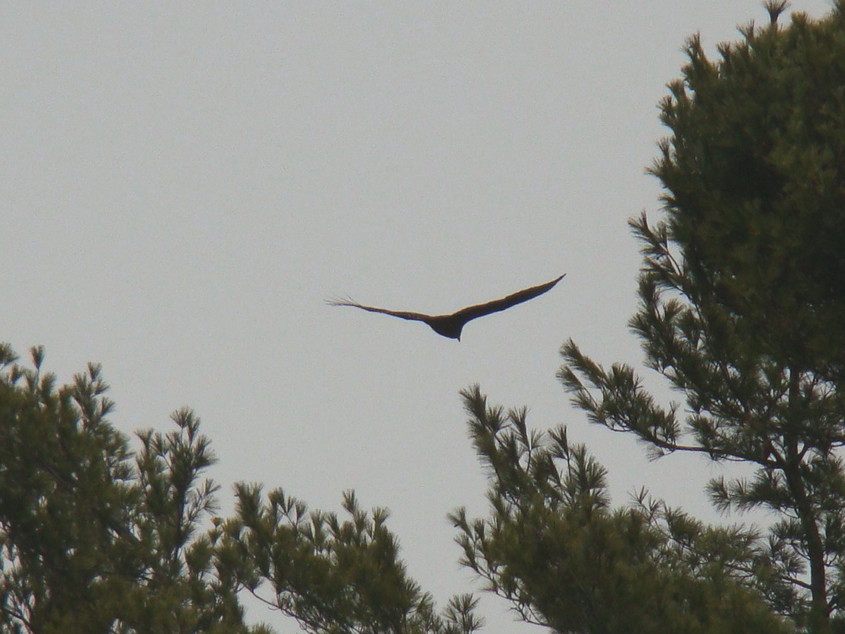
We also saw another very large bird wheel over the lake;  I'm guessing it was another Turkey Vulture, but with bad lighting it was hard to be sure.


Another early spring creature was pushing the spring season as well - the first of the year.

After many months of looking at a solid white cover on Lake Wicwas, it lifts the spirits to see the world again reflecting off a shiny, liquid surface.  It is a beautiful sight.


Sunday, April 7, 2013

April 7, 2013

It's still looking pretty wintery around Lake Wicwas as we start the second week of April.
10+ Inches of Ice Still Cover Lake Wicwas
Snow Hangs on in Well Shaded Areas

There are only narrow open areas along the south and west facing shorelines, and even those froze over in many places last night as the temperature dipped into the mid-twenties.


Where the shore is shaded from the sun the ice is still firm right to the shore.  I didn't venture out too far, but cutting holes as I went I found 10-12 inches of ice with the greater depths farther out from shore.

Although we did see a pair of Wood Ducks today in the skinny slice of wetness.
The First Wood Ducks of 2013

They weren't looking too happy with the situation.

They hopped up onto shore a couple of times looking for possible nesting sites, which are usually in hollow trees and can be as much as a mile from the lake - a good reason to leave dead trees standing rather than cutting them down. 

Woods Ducks have many predators, including raccoons, squirrels, and minks among others, that will go after eggs in the nest as well as the mother.  For this reason the mother calls her chicks out of the nest cavity (which may be dozens of feet above the ground) at a very early stage, sometimes even before they have all hatched.  Any not strong enough to make the leap and the crash landing will perish.  Next, the journey on foot from nest to lake provides another prime opportunity for predation, so the closer to the lake the better - another reason to leave standing snags close to the lake.  Once in the water, the chicks are still vulnerable to snapping turtles, snakes, and large mouth bass.  It's a tough childhood!

I went out searching for signs of spring, and I'm sorry to say they were in short supply.  The blueberry buds, though growing, are still tightly wrapped.

And the laurel leaves are still curled and droopy.

About the best I could find were buds on the Red Maple which are swelling and turning red.

With warmer weather forecast for the next few days, perhaps we see some progress next week....

Sunday, March 31, 2013

March 31, 2013

Those of us who are fortunate enough to spend at least some of our time in the New Hampshire Lakes Region, and Lake Wicwas in particular, know what a magical domain this is.  This has no doubt been recognized, consciously and unconsciously, for thousands of years.  Certainly the native Americans appreciated the beauty and bounty of the region, but even before them, other creatures found a welcoming home here.  Even those that couldn't survive the cold winter months traveled many miles each spring and fall to spend the summer here.  We still have a lot in common with that ancient time.

When the local weather gets out synch with the global weather and astronomical timing however, animals may arrive a bit before the lake is really ready for them, and this is one of those years.  There is a tiny bit of open water at the inlet from Dolloff Brook, and there we saw a Great Blue Heron poking in the mud looking for nourishment (not seen in this picture).
Inlet from Dolloff Brook

There is also a small - but slowly expanding - river of open water near the dam, and that has become the assembly point for the growing flock of Canada Geese. 
The Geese Have Arrived
 

They do sometimes march out across the ice like an army searching for a more hospitable homeland.


They are typically the first arriving water birds, often dropping in when there is still some ice left on the lake, but this year they must be wondering what's going on.  I measured 15 inches of ice in our cove, and a skier we met on the lake reported that a fisherman told him he found the ice to be between 15 and 30 inches thick.  Where I took my measurement, the top seven inches is soft ice, but there's still a good eight inches of hard, clear ice below.  Those geese are going to have cold feet for quite a while!
Cold Feet


We also saw a large light-colored owl, but that may be a winter resident.  A definite winter resident came and visited us this week:
Red Fox

A flash of red caught my attention as this fox took a run at one of the many squirrels in the yard.  It missed its target, so went and prowled in the snow looking for mice.  It circled back and investigated all the squirrel holes in the snow under and around the bird feeders.

It then rested a bit, scratched its chin, and then headed down the the lake, trotting along the shoreline looking for another unsuspecting squirrel to bring home to its family. 

It's striking when I think about the breadth of life - up and down the food chain - that one benefits by proving a few seeds intended for the birds:  from mice and voles to fox, coyotes, owls and hawks.

The weather is making for a productive maple sugar season this year, in contrast to last year's 80 degree March tempertures.  The sap is flowing, and both of Lake Wicwas' sugar shacks are boiling.

Sugar Shack Boiling on Chemung Road
Cooking on Route 104

It's great to see Meredith residents preserving the traditional methods of farming maple syrup.  Today, large manufacturers use reverse-osmosis equipment to separate the sugar from the sap.  Analysis has shown that some of the flavor compounds are affected by this process.  They are also using vacuum equipment to suck greater amounts of sap out of the trees, though they claim it doesn't harm the trees. 

One of the local houses said this will be the last week of collecting, and then they'll just be evaporating for a while, so it's nearing the end.  So be sure to stop in a get a quart of the authentic product, so you'll be ready to pour some Lake Wicwas Maple Syrup on those Lake Wicwas Blueberry Pancakes come July!  It will get here!
Happy Easter!