Showing posts with label Ice Out. Show all posts

Sunday, April 12, 2026

April 12, 2026: Ice-Out

We were making good progress towards ice-out early in the week with a strong April sun shinning down on the darkening ice.

Monday
But then the thinnest layer of new snow set things back when the fresh white surface turned those rays around and reflected them right back into space.
A Snowy Tuesday
But a couple of warm days followed and ate away at the new snow.
Thursday
and by Friday we were back on the path towards rapid melting.  
Friday
Interesting formations always appear as meltwater finds the path to a low spot on the ice.
Ice Spider
The very next day, after a windy night, we woke to this:
Blue Water on Saturday Morning

Wind had splintered the ice like a giant ice chipper into small crystal fragments and piled them up against the edge of the waning ice sheet.

I think that's a compact summary of the ice-out process:  solid ice on left, open water on the right, and the fragmented ice crystals at the interface.  The green color at the margin of ice and fragments comes from liquid water that was swept onto the ice reflecting green pine trees on the far shore.

The wave action continued to erode the ice during the day, and the wind drove everything to the shore line.

You could audibly hear the ice fragments clinking and tinkling against each other in the wave action. 

By afternoon, almost all the remaining ice had been melted and worn away by the wave action.  Ice-out on Wicwas was declared yesterday, April 11.
Lake Wicwas Boat Ramp at 4:41pm on April 11th.

April 11 is typical for ice-out on Wicwas, but due to the cold December resulting in an early ice-in date of December 10th, the lake was ice-covered for 122 days, the longest period of ice cover since the winter of 2018-2019.  Lake Winnisquam was declared ice free on April 6th, and Lake Winnipesaukee is getting close with ice left only in Center Harbor and Wolfeboro according to Emerson Aviation.  


Earlier in the week the lake was too soft to be an avenue for coyotes, but it wasn't too soft for water-loving animals.  A pair of geese walked across the lake.

Making the trek from open water along the shore to their nesting site.

I'm pretty sure it's the pair that nests in the wetland behind Sheep Island, and that's where they were heading to see if it's open enough to start nestbuilding.  It's a well protected nesting site, and they want first dibs on it.

We also watched a River Otter out playing on the ice - it has no concern with crossing open water at the shore lines.  It was dusk so I couldn't get a picture, but here's one from an otter on an earlier trip across the lake.

They run, hop, jump, slide, and just generally seem to have a grand time playing on the ice.

Belly Slide


And finally, more late breaking news from the lake: The loons have arrived!

This is most likely the northern territory male and hopefully, a new mate.


This pair arrived Friday (or earlier), before ice-out.  Like the geese, they want to claim their territory before any other bird noses in.  All our loon watchers will be looking for bands now to determine who they are!


Saturday, April 19, 2025

April 20, 2025: Hungry Beavers


Happy Easter!


While we're waiting for the wildflowers in the forests to bloom - the Trailing Arbutus will be first - we can enjoy cultivated crocuses, daffodils and Hepatica.  

These hepatica were planted by us, but at least they are native to North America, unlike the crocuses.


Hepatica are native in a wide range across the United States, from Canada to northern Florida.

I had my first paddle on the lake this week and appreciated the clear water and the chance to see new shoots of various aquatic plants pushing up from the bottom of the marshes.  There were also lots of birds to see and hear.  The Pine Warblers were the stars of the audio broadcast, but the Song Sparrows were a strong supporting cast and much more musical than the raspy call of the pine warblers.  But the most populous birds were the geese.

I passed by at least five pairs on the lake.  
Guard duty

Many were arguing with competitors for territory, but at least one pair was already on a nest.  I came around a corner just as one of the pair, likely the male, went off in the other direction to drive away an intruding goose, which left the female unprotected on the nest.  

Well camouflaged on the nest.

I was able to glide by without disturbing her, but she held her head low to the water just like loons do, and was absolutely motionless the entire time.


I saw only one loon on my paddle, but quarrels between loons have been seen and heard this week.  I was able to confirm that at least one of our banded loons is back on the lake.

That's a green and silver band on the right leg.

This is the female from the pair that has nested in Harris Cover for several years now.  It was interesting to find her far into the northern territory.  The long-time male in the northern territory lost his mate last summer so it will be interesting to see what happens there.  I haven't determined if the northern territory banded male is back on the lake this year.


We still have a few Ringed-neck Ducks  and many Wood Ducks.  

A couple of male Wood Ducks.
At one point there were five male Ring-necked Ducks courting a single female.
The main attraction was swimming away to the left of this picture.

It might seem like she was being harassed, but she was more likely assessing which one is best suited to be her mate.  The boldest male would often fend off another male if he approached her.  Five courting one makes me wonder if there are more males than females, and if it may be near the end of the pairing-up season.  


And the beavers - they are so much fun to watch.  In addition to seeing them swim across the lake every evening, one morning a beaver was feeding on submerged branches from a White Pine tree that had fallen into the lake.  It was just floating calm as can be enjoying its breakfast.

Look at that tail and those dexterous fingers!

When it finished with one branch it would dive down, gnaw off another from the tree and come back up to dine some more.  You can follow its path under the water by tracking the bubbles surfacing.


The beaver family creating a new pond near the Hamlin Forest trailhead continues to expand their domain.  I'll give an update on that situation in the coming weeks.


Ice-out on Wicwas was called on April 11th, three days before Lake Winnipesaukee was declared ice free.  That gave Wicwas a total of 105 days of ice cover, well below the average of 119 days due to the warm fall and late ice-in.  As of mid-week, I was still able to find a few patches of snow and ice around Meredith.


It's a different story in the mountains where it's still definitely winter.  Passing through Franconia Notch on our way up to Jay Peak in Vermont we saw Mt. Lafayette was freshly blanketed in white.  And at Jay, yes, it's still winter there!


It's easy to see why hikers that don't do their research get into trouble in the mountains this time of year.


Sunday, April 10, 2022

April 10, 2022: Ice-Out and Loons-In

Ice-out was declared on Lake Wicwas on the morning of Wednesday, April 6th, and it didn't take long for the loons to arrive.  (Ice-out on Winnipesaukee was declared two days later on Friday afternoon, wth Meredith Bay the last to clear.)  In fact, I saw my first loon one day before ice out when it was fishing at the edge of the ice line.  But even more exciting was seeing an otter only a hundred yards away from the loon, sitting on top of the ice, munching away on a sunfish.  


It was just lying there on the cold ice, holding that fish in its hands while it crunched it up with its teeth - bones, scales, and all.


I watched it finish it off and then, with a full belly, slide his way along the ice before disappearing down a hole in the ice, off to find something else to do.


This is one of the most vibrant times of the year to be watching nature, as everything is in transition between seasons and starting to come alive.  In the past week I saw a mink on the ice, many beavers swimming across the lake, a bald eagle devouring a fish it caught in the open water, a ringed-neck duck, and a couple of pairs of common mergansers as well as other ducks and geese.

A mink on thin ice that formed over a cold night.  No worries, it dove in at the edge of the ice anyway.  

An immature bald eagle rests between bites of the fish in its claws.

Mr. and Mrs. Merganser, fishing at the edge of the ice.

One of my favorites:  A ringed-neck duck on a rainy Saturday.

Those poor pisces sure have a lot hungry parties interested in them.  At least the mallards and the Canada geese mostly leave the fish alone.
I can't tell if this goose is dropping nesting material or just sticking its tongue out at its mate.

This mallard has terrible table manners.

I've also seen and heard some early spring birds:  phoebes, chipping and song sparrows, robins (though robins are now year-round residents in parts of NH, I don't see them in winter), yellow-bellied sapsuckers, and also dozens of wood frogs.  On Tuesday there were perhaps a hundred of them jumping into the water in a roadside ditch on the opposite side of the road from a vernal pond as I walked along.  By Friday they had made it to the pond and were singing away, sounding like a flock of ducks.  Spring peepers will be next!

On my paddle before ice out I had a chance to see up-close the delineation between the phases of water.  
At the edge of winter and spring.

And of course, the first loon.
I'll wager this is our nesting male, but we'll have to wait until we see a band to know.


But perhaps the most uplifting sight of all is blue water!
Blue water returns.

More spring changes are close at hand.

Thursday, April 8, 2021

April 8, 2021: Ice Out!

Ice out was declared today at 6:00pm when the last remnants of winter cleared out from the boat ramp.

11:46 am: still ice at the ramp.

Hello summer!


Sunday, April 5, 2020

April 5, 2020: Blue Water Returns

The ice is out of Lake Wicwas and the sight of precious blue water rejuvenates the soul and reminds us that all things have an end, and will return to their former state in due time.
Liquid water reflects blue for the first time in many days.


This particular change came quickly this year.  Just four days ago there were fox, geese, and otters running around on the ice - on Monday we watched a river otter run, hop, and sliiiide across the lake from one shore to another.  It's an extraordinary treat to watch to these fun-loving creatures out enjoying themselves.

A running start,
followed by a leap

then a dive down onto its chin
for a long slide on the ice.
Then a quick look around for a safety check, 
including a glance at the photographer, 
and he's off again for another free ride on the ice.


That was Monday - on Tuesday there was still full ice cover under a sunny sky.
Tuesday, March 31st.


On Wednesday it had been cold enough overnight for open water to skim over again, and being calm, Jack Frost stopped by to create the kind of artwork usually reserved for those first cold days of autumn.


But then a strong front came through with stiff winds and driven rain, the combination of which took a quick toll on the ice.  In one day much of the ice had broken up.
Getting close on Thursday.

And the next day, Friday, voila, the ice was out. 

Ice blown by the northeast wind.

There were still a few pockets of ice in protected coves, and a lot of loose ice and slush was blown down to the southern end of the lake by the northeast wind.  But all of the major coves were navigable and ice-out was declared on April 3rd.  Though on the early side, it was within the normal range, occurring eight days before the median ice-out date.  (As of Saturday, Winnipesaukee still had ice in Center Harbor and between Meredith and the weirs.)

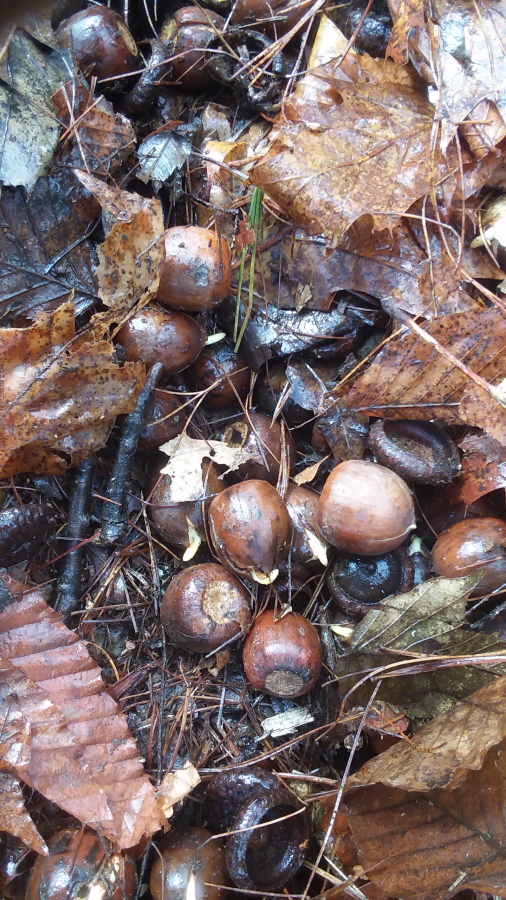
Seeing liquid water is just one aspect of this glorious time of year when nature returns to life after its long winter slumber.  Animals are becoming more active, birds are returning, plants are bursting with new life.  While clearing water bars on the local hiking trails I found masses of acorns under the wet leaves that had already started to sprout.

Acorns sprouting under the leaf litter.


The beavers commenced their evening patrols as soon as there was a sliver of open water along the shore. 


The moose have also left their calling cards around the lakes, including this large pile up on Arbutus Hill (thanks for sharing MK).

A big pile of moose Scat on Arbutus Hill.  Photo by Mary Kahn.


Ducks, mergansers, buffleheads, and yes, even loons have arrived back on the lake.  I started seeing loons fly overhead four days before ice out, and our early loon spotter (thanks for the report TC) saw a pair of loons on the water the day of ice-out.  We'll have to see a leg-band to know for sure, but their behavior sure implies it's our long-standing resident pair.  I did get out for a paddle yesterday but I didn't see them.

Paddling amongst the ice flows the day after ice-out.


It's a remarkable time of change, hope, and renewal in so many ways.  One other remarkable resurrection that occurred this week:  the transformation of countless wood frogs from a frozen-solid condition to a triumphantly singing chorus.  Serenading frogs and blooming crocuses are sure signs that spring is here.  And though there may be a few more cold nights, the sun will rise, and brighter days are ahead.
Spring beauty.