Showing posts with label Maple Sugar. Show all posts

Sunday, March 21, 2021

March 21, 2021: A Time to Wait

I might have had my last excursion on the lake for a few weeks as we enter one of the two times during the year when our lakes are inaccessible.  In both spring and fall there are several weeks where ice seals the lake off from boating but is not safe for travel even on foot, and with a forecast for several sunny days with temperatures near 60 I may have had my last trip until open water returns.  Even with well over a foot of ice covering most of Lake Wicwas - and many other lakes - there are already open areas where streams empty into the lake or where a south-facing shoreline heats the water.  


Things will progress quickly from here with full sun and warm temperatures.  That same spot looked like this just a few days ago, and it hasn't even been particularly warm.


What keeps me off the ice are the unknow danger spots as strong March sun makes the ice soft and porous, and currents in the lake create unpredictable thin spots.  But I did get one trip across the lake in astronomical spring - the vernal equinox occurred yesterday at 5:37am (eastern daylight time).  

On one of my last trips on the lake I took a walk to the site of the deer kill I found a couple of weeks ago to see if any more evidence had appeared as the snow melted.  It hadn't, and in fact, things had gone the other way.  All evidence of the fur and digestive tract was gone.  The only thing left was the contents of one of the deer's stomachs (being ungulates, deer have four digestive compartments though only one is technically a stomach).

Stomach contents left on the ice.

Looking closely at the contents you can see why they need four stomachs to digest their diet - in winter it looks basically like sawdust.


No wonder no other animal will eat that - except maybe a beaver!  Every other part of the deer has disappeared.

I mentioned last week that I saw the first migrating ducks in one of those open spots near the outlet of Lake Wicwas, and this week there was a pair of Mallards dabbling in the Mill Brook where it spills over the dam on its way to fill up Lake Winnisquam.

Mallards probe the mud in the brook for food.

Soon ducks will be paddling all along the shoreline as those open spots enlarge, and the beavers won't be far behind.

One item to follow up on from last week's barred owl is another candidate for Camouflage Champion:

A great horned owl hides in a tree fork.  Photo by Debby Crowley.

This photo of a great horned owl was taken by friend and photographer extraordinaire Debby Crowley.  Owls certainly have perfected their camouflage technique.

And finally, one of my favorite sights (and smells) of the season:

The Chemung sugar stack is steaming!
(Though you can't see it, it was a-boiling.)

Maple syrup is on the way - I'm already thinking about fresh blueberry pancakes!


Sunday, March 25, 2018

March 25, 2018 - The Sap is Flowing

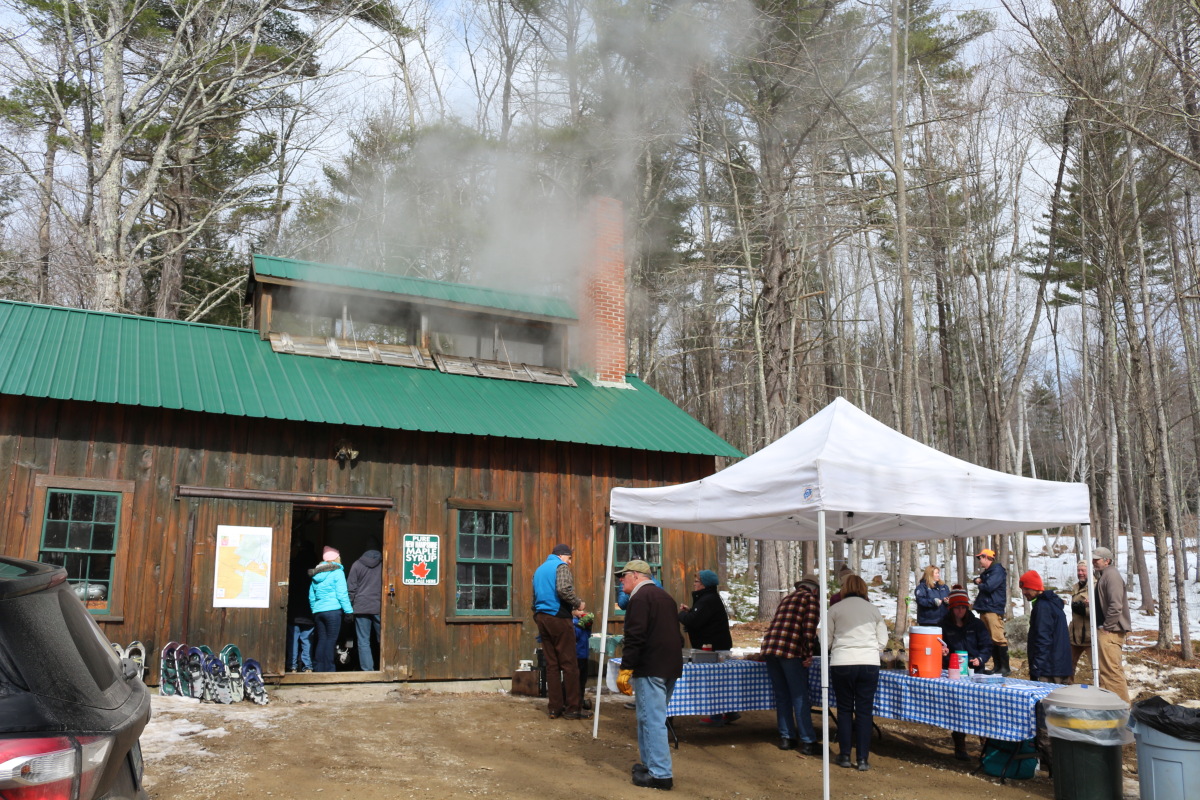
Sugar season is in full swing right now and central New Hampshire is having an excellent year.  Yesterday I went to the Maple Sugar Day at Burleigh Farm in Holderness, which was holding demonstrations of their sugaring process, tours of the sugar bush, and most importantly, tastings!
Sugar Shack at Burleigh Farm

The event was sponsored by the Squam Lakes Conservation Society, Squam Lakes Association, and the Lakes Region Conservation Trust which holds the conservation easement on 1500 acres of forest and farmland that protects the home of all those maple trees.  A knowledgeable team was on had to explain the process and answer everyone's questions.
Matt Evans describes the complete process from tree to jug
The final product ready for tasting
Yum!
The farm has taps in 3400 sugar maples which all flow via tubing, under vacuum, directly to the sugar house, allowing them to produce over 1600 gallons of maple syrup each year.
Collecting sap straight from the tree
One benefit of this system is that the sap doesn't contain all the bark, bugs, and other detritus that found its way into the sap with open collectors.  Unless, of course, a coyote or a fox decides to chew on the tubing and tear it open.

With that quantity of sap to process, the sugar house has been updated with modern technology.  The raw sap is processed through a reverse osmosis membrane system which concentrates the sugar content from about 2% straight from the tree up to 14% after two passes through the system.
Peter Webster explains the membrane system

This greatly reduces the amount of boiling required.  After being concentrated by reverse osmosis it is finished in a good old fashioned open boiler, but heated with oil or propane rather than wood.
The final boil

But from the outside, it has all the appearance of a traditional New England sugar shack.


Later, back closer to home, I saw that the Chemung Gang sugar shack was boiling away as well, still doing it the good old fashioned way!

The lakes sure don't look much like spring, but nonetheless there was a nice reminder that spring is coming:  I saw my first loon of 2018 fly overhead one afternoon - apparently we are not only ones watching the lakes, waiting to see some open water.  And wait we will, as there are still 21 inches of ice on Lake Wicwas.
Thick ice remains even where it is hanging in air because the lake has dropped
It's going to be a while before this mass of snow and ice lets the loons come home
That photo was taken after the most recent snow storm (for us that is - we missed the fourth nor'easter which hit only the southern part of the state).  What is so intriguing for me is how tracks in the snow change over time.  Those depressions formed by snow shoes were completely inverted after just a few days of wind and sun acting on the snow - five days later those indentations had become convex bulges sticking up above the surrounding snow.
Wind and sun etched away the softer snow, leaving the packed tracks protruding up
After the storms we had more perfect blue-sky days luring me out onto the trails.
The Mill Dam in the Page Pond Town Forest
More apples still to fall for the hungry spring animals
I knew apples must still be around due to seeing fox and coyote scat containing apple skin, but it was neat to see some still hanging on their branches.

A final note, as bears are one of those hungry, spring animals, NH Fish and Game reminds us:  Spring is Here: It's Time to Take Take Down Birdfeeders!
Photo by NH Fish and Game
Those loons aren't the only animals out in search of spring.

Sunday, April 9, 2017

April 9, 2017

Spring sure it taking its own sweet time to arrive in New England this year.  Right now there are still 20 inches of ice out there - no joke, I checked.  The ice was clearly sound enough to support me, so I took the auger and cut a hole about 30 feet from shore.  Even subtracting the top 4 inches which, though strong enough to support my weight, was soft enough that I could remove it with a sharp shovel, still left 16 inches of good solid ice.  Progress towards ice-out has been hindered by the recent snow falls, including another light storm on April 5th.
Yet another April snow
Last week I saw the first geese and ducks, and this week more have  arrived, as well as the first of the great blue herons.  I didn't get any pictures but on a run down Chemung Road I did flush out a heron that was fishing in a tiny spot of open water where Lake Wicwas comes close to Chemung Road.
Just enough open water for the heron to hunt for food
And the geese - I always think this is a ridiculous sight:
Canada geese taking a stroll on the ice
It seems like they are looking around at each other asking, "why are we here when it's still warm in South Carolina?"

We have had enough warm days to get the sap flowing, and buckets are hung on sugar maples all around the Lakes Region.  This is the scene beside the Lakeland School.
Syrup being collected beside Lakeland School
Plastic tubing and buckets appeared at the school for the first time time this year;  last year they still used the system of spiles (metal taps put into the holes drilled in the trees) and metal pails hung on the spiles.
Metal pails (and no snow), March, 2016
You may have seen the high-tech system used in a large sugar bush - a stand of sugar maples - where long plastic tubes wind from tree to tree, running down hill to terminate at a large collection vessel at the bottom of the hill.
Sap collecting system at Prescott Farm in Laconia (January, 2016)
I do miss the nostalgia of the old galvanized steel pails, though I'm sure this high-tech system keeps out a lot more of the rain, pollen, bugs, and assorted debris that made its way into those those classic pails.  I suppose the old timers felt the same way a hundred years ago when those modern, unsightly metal pails replaced the classic wooden bucket.
Classic sap bucket complete with hook to hang it on a tree
Another sign that spring is coming was the first evidence of a skunk, a set of tracks showing it was rummaging near the house, probably attracted by dropped bird seed on the ground.
The hap-hazard trail typical of a skunk

Like bears, skunks don't truly hibernate, though they will spend most of the winter sleeping away in their dens, only coming out during a warm spell to poke around for any available food.  Their presence means they are hungry, wanting the snow to melt as well.

I took a hike up to a remote pond the day the snow fell to see what other animals were active;  it was still misty and gray after the storm, but beautiful in its own way.
Wachipauka Pond, Warren, NH


There were lots of animal tracks along the way:  Deer, coyote, snowshoe hare, bobcat, even a fisher - but no bear or moose tracks to be seen.  I was amazed at the size of some of the hare tracks;  I have nothing to show scale in this picture, but each track from front to hind foot is about two and half feet long.
Snowshoe Hare tracks


The larger prints are from the rear feet, and show how the foot spreads out to distribute the animals weight on the snow, lending it the name "snowshoe" hare.  A snowshoe hare weighs almost twice that of a cotton tail rabbit.

Along the way I was happy to see a few signs of spring pushing through mother nature's stubborn hold on winter.
This Hobblebush Viburnum, tired of waiting for spring, is pushing its buds out
The forecast has warm weather for the coming week - maybe there will be more sightings of the elusive 2017 spring soon.

Sunday, April 12, 2015

April 12, 2015

Maple sugar season is nearing the end in the lakes region.  Both sugar houses around Lake Wicwas have been processing the delectable treat the past couple of weeks.
Chemung Gang Sugar Shack

We stopped by the Chemung Gang Sugar Shack (just up Chemung Road from Meredith Center Road) to get some local syrup, and Bill Taggett gave us an overview of their operation.
Custom-made Evaporator


Bill said it is a less-than-average year for sap production, but they will have some for sale.  If you want to have maple syrup with local Lake Wicwas flavor on your blueberry pancakes this summer, you'd better stop by one of these operations soon!

As if the arriving waterfowl weren't struggling enough with the lack of progress on the melting ice, we received some snow this week to fill in the few openings that had formed.

Snow in April
Last week I found a Heron fishing in one of those tiny openings in the lake;  this week I noticed this pair of ducks trying to eke out a living right beside the road where running water from a culvert under the road had carved out a small pool.
Waiting for Ice Out

And beside the dam, where running water has created another opening, I saw my first pair of Canada Geese.  While we were watching them, another pair of geese came flying in to the same spot, and we got to observe some territorial defense in action.  As soon as they touched down, the two that had staked their claim to perhaps the largest open section of water on Lake Wicwas decided it was not big enough to share and went after the intruders immediately.

A loud standoff and aggressive posturing took place, with the established pair chasing the new-comers onto the ice.  That wasn't sufficient, so they took to the air in pursuit.
 The unwanted guests flew off.

"And Stay Away!"
But they weren't ready to give up the fight;  they landed again just a bit a farther along the ice, so the residents went after them again.
There were several up close and personal encounters.


They continued to harass them, chasing them along the ice to make sure they got the point. 


Did you notice the little Hooded Merganser just sitting at the edge of the ice watching all the antics?

Eventually the initial residents reined supreme and successfully defended their homestead.  I put a video clip of the final chase across the ice on Youtube, as blogger doesn't upload video very well.

Warm weather today is helping open things up more now.  As the ice recedes there will eventually be enough lake to accommodate everyone.  The minute there is enough runway for loons to be able take flight off the water, I expect they will join the crowd now assembling for another summer on Lake Wicwas.

Sunday, March 31, 2013

March 31, 2013

Those of us who are fortunate enough to spend at least some of our time in the New Hampshire Lakes Region, and Lake Wicwas in particular, know what a magical domain this is.  This has no doubt been recognized, consciously and unconsciously, for thousands of years.  Certainly the native Americans appreciated the beauty and bounty of the region, but even before them, other creatures found a welcoming home here.  Even those that couldn't survive the cold winter months traveled many miles each spring and fall to spend the summer here.  We still have a lot in common with that ancient time.

When the local weather gets out synch with the global weather and astronomical timing however, animals may arrive a bit before the lake is really ready for them, and this is one of those years.  There is a tiny bit of open water at the inlet from Dolloff Brook, and there we saw a Great Blue Heron poking in the mud looking for nourishment (not seen in this picture).
Inlet from Dolloff Brook

There is also a small - but slowly expanding - river of open water near the dam, and that has become the assembly point for the growing flock of Canada Geese. 
The Geese Have Arrived
 

They do sometimes march out across the ice like an army searching for a more hospitable homeland.


They are typically the first arriving water birds, often dropping in when there is still some ice left on the lake, but this year they must be wondering what's going on.  I measured 15 inches of ice in our cove, and a skier we met on the lake reported that a fisherman told him he found the ice to be between 15 and 30 inches thick.  Where I took my measurement, the top seven inches is soft ice, but there's still a good eight inches of hard, clear ice below.  Those geese are going to have cold feet for quite a while!
Cold Feet


We also saw a large light-colored owl, but that may be a winter resident.  A definite winter resident came and visited us this week:
Red Fox

A flash of red caught my attention as this fox took a run at one of the many squirrels in the yard.  It missed its target, so went and prowled in the snow looking for mice.  It circled back and investigated all the squirrel holes in the snow under and around the bird feeders.

It then rested a bit, scratched its chin, and then headed down the the lake, trotting along the shoreline looking for another unsuspecting squirrel to bring home to its family. 

It's striking when I think about the breadth of life - up and down the food chain - that one benefits by proving a few seeds intended for the birds:  from mice and voles to fox, coyotes, owls and hawks.

The weather is making for a productive maple sugar season this year, in contrast to last year's 80 degree March tempertures.  The sap is flowing, and both of Lake Wicwas' sugar shacks are boiling.

Sugar Shack Boiling on Chemung Road
Cooking on Route 104

It's great to see Meredith residents preserving the traditional methods of farming maple syrup.  Today, large manufacturers use reverse-osmosis equipment to separate the sugar from the sap.  Analysis has shown that some of the flavor compounds are affected by this process.  They are also using vacuum equipment to suck greater amounts of sap out of the trees, though they claim it doesn't harm the trees. 

One of the local houses said this will be the last week of collecting, and then they'll just be evaporating for a while, so it's nearing the end.  So be sure to stop in a get a quart of the authentic product, so you'll be ready to pour some Lake Wicwas Maple Syrup on those Lake Wicwas Blueberry Pancakes come July!  It will get here!
Happy Easter!