Showing posts with label Bufflehead. Show all posts

Sunday, November 16, 2025

November 16, 2025: Buffleheads

A few more migrating birds found Lake Wicwas a pleasant place to rest during their long travel south for the winter, including this group of Buffleheads.

Bufflehead are really enjoyable to watch this time of year, bringing a flash of brightness and action to the November scene.  

Buffleheads relaxing on Lake Wicwas.

And they seem to be more tranquil than many other ducks; they spend many hours just swimming around slowly in formation, occasionally diving for food.  

Six males and two females.

I'll assume this is because they are tired!  Bufflehead migrate at night, leaving precisely at dusk, and sometimes traveling hundreds of miles in a single night. [ref:  Travis Audubon]  This allows them to take advantage of calmer winds and helps them avoid predators.  

But, as you probably noticed, they weren't a uniform flock - for some reason there was a Scaup mixed in with them, though it tended to drift away to fish closer to shore on occasion.

A Lesser Scout hangs out with the Buffleheads

If I've seen a Scaup before it would have been on the ocean, and I didn't know it.  I've not seen one on Wicwas.  I believe this is a Lesser Scaup based on a small corner on the back of its head; the Greater Scaup has a smooth, rounded head.

The squared-off back of the head is barely discernable in this picture.

You can read more about buffleheads in the above link to Travis Audubon.


More signs of the colder temperatures are evident around the lake.

Ice crystals on wintergreen, an evergreen which turns a burgundy color in cold weather.

Radiation cooling and damp ground provide an excellent canvas for Jack Frost to practice his art.

Low bush blueberry

Jack really pays attention to detail.

Beautifully rendered ice crystals.

Other signs of the season were found at the water's edge:

Cat-o-nine Tails

When the cat-o-nine tails start to shred you know winter's near.  We also had our first snowflakes in the air this week, as well as a little graupel that collected on the ground.

Graupel

I've mentioned this interesting form of precipitation before.  It forms when a snowflake floats around inside a cloud containing supercooled water droplets which adhere to the snowflake.  When the growing ice ball gets too heavy, it drops from the cloud to earth.  Here you can see some of the snowflakes as well as the graupel.


November is a transition time between seasons with less activity taking place as everyone prepares for winter, both human and wild.  It makes for a  peaceful time on the lake. 


And a nice reprieve from the busy summer and fall seasons before winter hits, a time for all to relax, reenergize, and enjoy some tranquility along with the buffleheads.


Sunday, April 17, 2022

April 17 2022: Our Banded Loons Return

An encouraging sign for our loons as well as the loon population in general appeared this week:  Our mating pair of loons has returned.  I was able to get a good look at the bands on the legs of both the male and the female, proof they are the same pair that fledged two healthy chicks, last summer, Jimmy and Coco.

The female has lots of jewelry, two bands on each leg.

The male has only a single band on its left leg.

The pair will spend the next month or two fattening up on fresh fish and selecting a nesting site.  I've heard sounds of contests with other loons, so there's likely to be a little territory resolution to be done as well.  Last year the various loons resolved their differences fairly quickly and this pair had nested by the first of June; we can only hope this year goes as well as last.  (I reported this sighting to the LPC, and perhaps you saw that they scooped me and put these pictures in their newsletter!)  

On the subject of mating and territory, one day I was drawn from a long distance by the persistent tapping of a woodpecker declaring his territory.  As I carefully closed in on the sound I was amazed at how much noise a small bird can produce.  The downy woodpecker knows to find good solid, dead but dry branch to hammer on which will resonant loudly throughout the forest.  The farther the sound can carry, the larger territory a male woodpecker can claim.  After a long time circling under the tree I was finally able to spot the percussionist, way up high on a dead oak limb.  The video is poor, but you can clearly understand how his signal carries far across the land (click on the video below):


Our list of summer migrants continues to grow, with this week's arrivals including pine warblers, brown creepers, and great blue herons, one of our larger birds on the lake.  Our highly visible raptor, the osprey - also known as the fish hawk - has returned and immediately made its present known by its loud kip-kip-kip call as it flies off from its perch overhanging the lake where it sits looking for an unsuspecting fish down below.  One evening after a successful fishing expedition it flew into our cove and ate its catch in a secluded spot where an eagle wouldn't steal its dinner.  It was dusk and I didn't want to disturb it, knowing it was hungry after its long flight from Central America, but I was able to get a couple of pictures of meal time.

"This looks like a safe spot."

"No one followed me?"

"Time to eat!"

I'm not sure why osprey fluff all their feathers up like this:


Could it be to help them dry off after their dive into the water to catch the fish?


Another of my favorite birds that visit Lake Wicwas in the spring and fall made a quick appearance this week.

Mr. and Mrs. Bufflehead

This is Mr. Bufflehead, I didn't get a decent shot of Mrs.
These birds still have a long way to travel - their primary breeding ground ranges from western Canada to Alaska.  The Lakes Region may be their first fuel and rest stop as they leave their winter grounds along the Atlantic coast.


Last week it was the wood frogs singing, and this week, on April 11th, it was the spring peepers raising a racket in the newly awakening forest.  And as spring unfurls, lots of green shoots are erupting from the earth and buds are swelling, ready to burst open with the next sunny warm day.  And more spring flowers are blooming too!

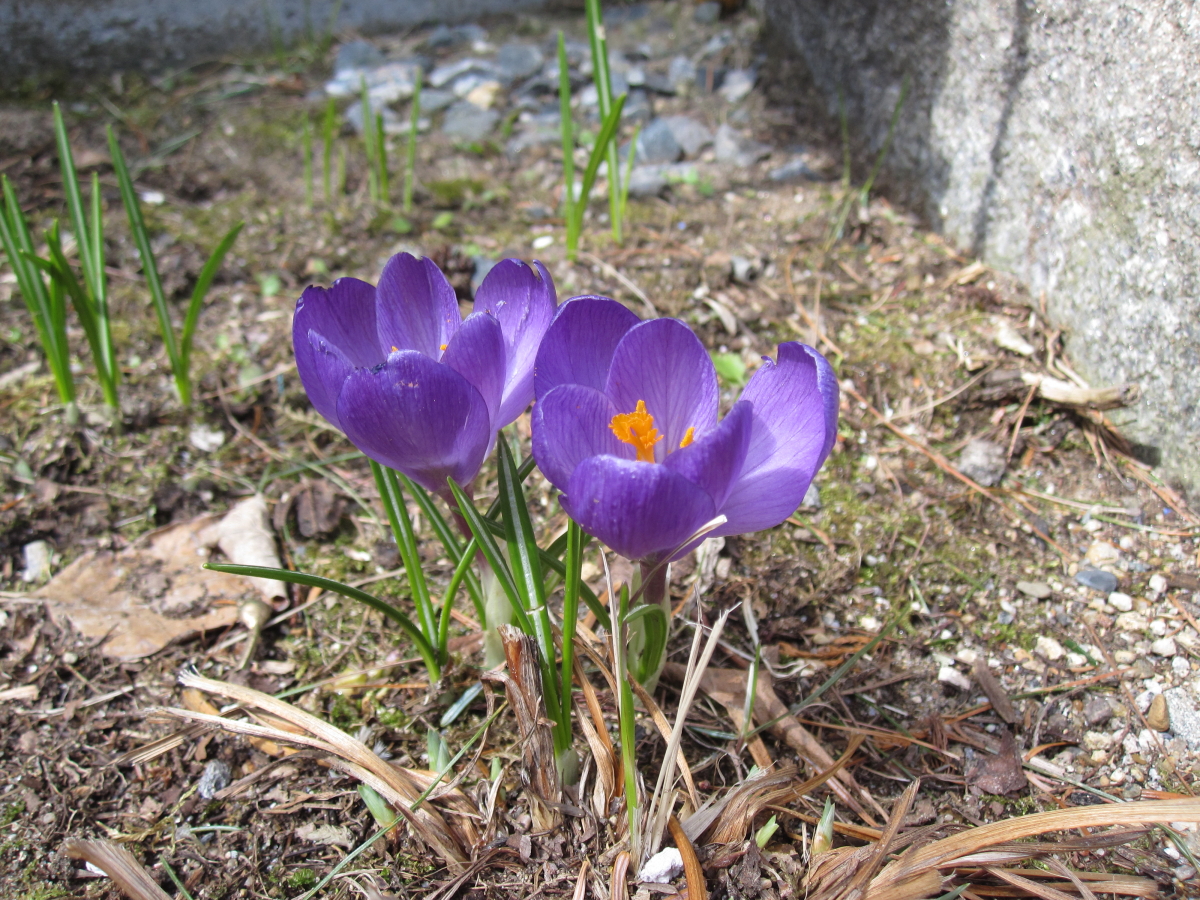
Crocuses

The season of renewal is here  -  Happy Easter!


Sunday, April 18, 2021

April 18, 2021: Warblers, Another Sign of Spring

As the weather warms more and more summer birds are arriving.  This week I heard my first pine warbler, one of the earliest warblers to appear each year, and checking my notes, this was three weeks earlier than last year.  Pine warblers spend their time high up in the tree branches so I wasn't able to see any, but there are many.  As I walked along I would hear one loud and close, and then far away in the distance, another would respond, sending its report right back after the first one finished its message.  As I got close to the second one, I could hear a third off in the distance responding to the second.  I believe what's going on is that each bird has staked out its nesting territory and is proclaiming its domain with its song.  If it hears another pine warbler far away, all is well.  But if another gets too close, there will be an altercation.  I imagine a checkerboard pattern of pine warbler nesting sites throughout the forest.  

What's interesting is that within this range there may be a dozen other bird species doing the same thing, and they are perfectly comfortable with sharing their territory with different species of birds, just not with those of the same species.  

Here's a picture I took of a pine warbler back in 2013 when a male perched on a dead branch with no leaves to hide behind.


Pine warblers are unique among warblers in that seeds make up a large part of their diet, especially, perhaps as expected, pine seeds.  If you keep bird feeders out at this time of year and want to try to attract a pine warbler, try hanging your bird feeder high up, maybe 30 or 40 feet above the ground (that will also discourage the bears).  Having a diet of seeds lets pine warblers arrive earlier in the spring than birds that rely on insects, and pine warblers will starting breeding soon - thus the claiming of territory at this point in the year.

I mentioned seeing ring-necked ducks last week; on one kayak trip I came upon an interesting combination of three ring-necked ducks and a lone female merganser.


Earlier the same day I watched what was likely the same three ring-necked ducks, two males apparently courting a single female early in the morning.


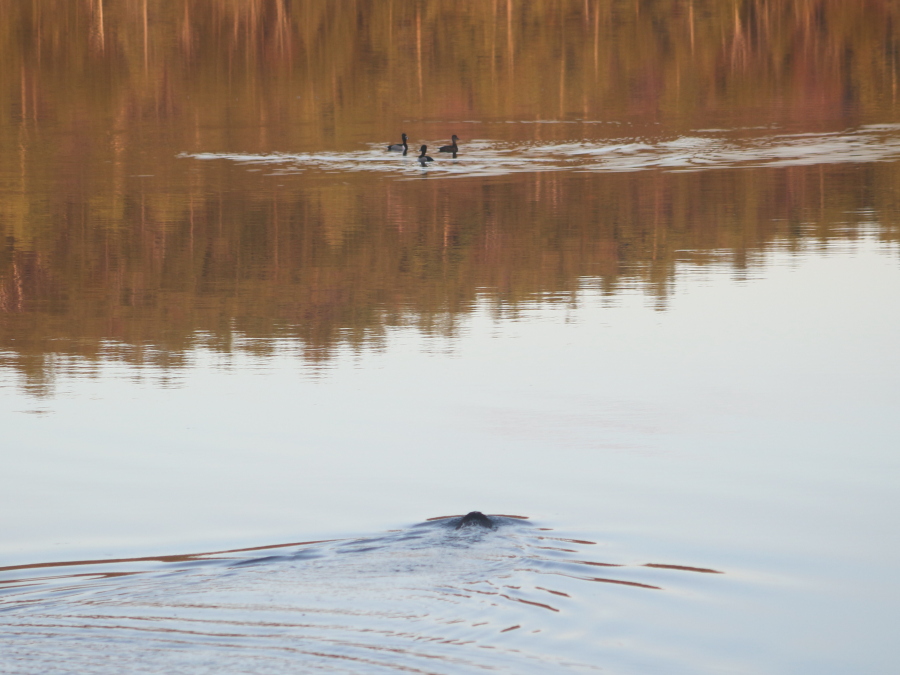
A curious beaver on patrol seemed to be heading in that direction to see if there was going to be a show to watch as they fought over her attention.


I often struggle to differentiate between beaver and muskrat, but I'm pretty sure I saw a couple of muskrats this week.  At morning or night it's a pretty good bet a swimming rodent is a beaver, especially if it's on a high speed mission; muskrats are more likely to be active during the day and often are a little more erratic in their swimming patterns.  Muskrats are also smaller, but the sure way to tell is by the tail, as the muskrat has a thin rat-like tail versus the wide, flat paddle of the beaver tail.  I think this medium size rodent, swimming along the shore at 2:00 in the afternoon, was a muskrat:

A muskrat enjoys a warm spring afternoon.

In addition to the ring-necked ducks, we were visited by several groups of buffleheads this week.  

Mrs. Bufflehead.
And Mr. Bufflehead.


I always enjoy seeing these pretty birds and watching their dives - they are so quick as they upend themselves and plunk straight down into the water.  

One other neat observation was made by Tom Crane back on March 29th, before ice-out:  a pair of common goldeneyes visiting Wicwas, diving within a small channel that had opened up along the northern edge of the lake.

A pair of common goldeneyes fish between the ice sheets.


Tom noted "The male's head really gleamed a beautiful green when the sun hit it. We have also had a pair of Wood Ducks hanging around the cove longer than usual. We have also had a few of what look like Buffleheads around lately, as well as passing Mergansers. An interesting time of year."

Hopefully we'll get an improvement from the recent chilly, wet weather so we can get out and see more of the migrating birds.  It won't be long before the birds heading for Canada will have departed the Lakes Region.

A bufflehead takes off for places unknown.

But they'll be back again next year.

Sunday, April 19, 2020

April 19, 2020: Bufflehead Bobbleheads

Last week the loons were providing the show as they displayed their territory-defining behavior.  This week it was the buffleheads showing off their own performances - in their case it was mating behavior.
An aggressive male chasing competitors away from an eligible female.


Buffleheads are small, sharp, black and white ducks that appear in the Lakes Region in spring and fall.  I'm not aware of them nesting in this area even though their reported breeding range includes central New Hampshire.  They are one of only a few ducks that are monogamous (loons are another) that will keep the same mate for several years.  An unattached female however, will be pursed by a group of males, each trying to impress the female with its beauty and physical abilities.
Four drakes (males) courting a single hen.

One such display is called head-bobbing, which the males were using to flatter the lone female on the day I saw them.  I was able to catch a couple of examples on this video where several drakes show off their head-bobbing prowess:  https://youtu.be/DETEk5BUwik

Another interesting aspect of buffleheads is that they nest in tree cavities, particularly those that were excavated by Norther Flickers, which means the bufflehead's range closely aligns with the flicker's.
Another mating behavior to impress a mate:  the neck extension.


Windy and cool weather this week wasn't conducive to boating so I stayed mostly on land.  Looking for ways to get outside in lightly traveled areas, I decided to start my conservation easement monitoring early, in some safe, local areas.  Now is a good time before the leaves come out and obscure those hard to locate survey pins and tree blazes (it's also a bonus to do it before the black flies are out).  This is a relatively new axe blaze, perhaps 40 years old; they can be discernible much longer.
Axe blaze on a slow-growing eastern hemlock.

Axe blazes on trees have been used for centuries to make a lasting indication of a property boundary, long before iron survey pins were employed, and they are often easier to locate.  But an unexpected bonus of searching the ground for survey pins hidden among the leaves was seeing this just-sprouting violet, already blooming deep in the woods.
A Downy Yellow Violet just erupting in a sunny spot provides an early start to wildflower season.

This was in a hardwood forest where the lack of leaves exposed the forest floor to warming sunshine all day long, giving the flower a nice early start.  And right next to the violet I caught sight of this three-leaved plant just sprouting.
Perhaps a trillium?

It's too small to be sure but I think it just might  be the first trillium of the year pushing its way up through last year's leaf litter.  I'll keep an eye out for others to verify because I don't expect to be back to this corner of the forest again this year.

I've mentioned previously the timber that was sunk in Lake Wicwas after the hurricane of 1938 to preserve it from rot, and while monitoring near the end of the lake where the saw mill was located I saw almost a dozen old logs floating up.
Saw logs left near the saw mill on Lake Wicwas.

It's something not likely to be noticed once the trees leaf out and the lily pads fill in this shallow cove.  If you're getting outdoors these days, keep your eyes open; there's so much more to see now than in mid-summer when many interesting sights are hidden behind all that dense foliage.

Yes, we're seeing tree flowers and wildflowers now, but it doesn't mean there's not a glimpse of winter still to be seen here in the second half of April.

Red Maple flowers in Saturday's April (snow) shower.

I don't often see snowflakes on spider webs.

Sunday, April 12, 2020

April 12, 2020: Loon Dance

It was a good week for ducks.  A large assortment of waterfowl is in the Lakes Region right now, some here for the summer, others just stopping in to refuel on their way to breeding grounds farther north or west.  One of the more distinguished visitors seems to be present only for a day two each spring before moving on.

Ring-necked Duck.


A flock of ring-necked ducks stopped for a rest and some nourishment on their way to Canada or perhaps northern Maine for the summer.  There were eight males all congregating around a single female; I wondered whether she was being harassed by them, or whether she liked all the attention.


She certainly had her pick of mates, and didn't seem to have any trouble holding her own against them.
Whether pursuing or chasing away, she's in control of the situation.

Where are all the other females?

Ring-necked ducks are divers, but not for fish; they consume mostly plants but also eat animals such as snails, nymphs and leeches.  [Ref: Cornell Lab or Ornithology]  I love their sharp mating-season plumage.

Here are a few of the other ducks that stopped by Lake Wicwas this week:
Mr. and Mrs. Bufflehead

Mr. Mallard

Mrs. Mallard

Mr. and Mrs. Common Merganser


I also saw the loons for the first time, and not just two.
Three loons in a dance.

The third loon is perhaps the same rogue we've had on the lake for several years now, and they were certainly engaged.  I had heard some loud vocalizations indicating there was unhappiness on the lake; later I observed an interaction of all three.  It was far away, but I was able to record enough for you to get the idea of what was going on.  Click here to watch the dance.

This fascinating behavior went on for about 20 minutes before two of them moved away down the lake.  According to Stokes' book "A Guide to Bird Behavior" [Donald and Lillian Stokes, Little, Brown and Company, 1989] this behavior isn't necessarily aggressive, but rather a way to "appease aggressive tendencies".  Stokes says that all the behaviors displayed in that video, "Bill-dipping, Splash-dives, and circling around each other", may take place at territory boundaries by neighbors who know each other.  So maybe the pair is telling the rogue that he's ok as long as he stays in his territory.  The display took place at the mouth of Marion Cove, and the next day, a single loon was out fishing in that cove. So I'm putting the pieces together and predicting our mating pair and our regular rogue are back in their usual areas of the lake.  Now let's see if the second pair that owns Harris Cove will return.

Our rogue loon in his territory of Marion Cove.


The past few weeks I've been avoiding the popular outdoor areas, instead visiting less traveled places to get outside for some exercise.  Last week brought me to a remote conservation area in Ashland where I discovered another benefit of avoiding crowded trails:  greater chances of finding wildlife.  Some large wounds on a couple of red maple trees right beside the trail had a tale to tell.

Scrapes over seven feet high.

Our thoughts went to bears, porcupine, deer, and moose.  When I got home I checked a couple of books and was able to confirm they are moose scrapes, with the height, direction (vertical), condition (smooth), and hanging parts at the top of the scrape all helping in the identification.


Moose will scrape upwards with their lower incisors to peel off the bark and nutritious cambium underneath.   That also explains why there was no bark on the ground since they eat what they peel off.  The height of the scrape proves the impressive size of moose, the largest animal in our New England forests.

On the same hike I saw my first reptile of the year, out warming itself in an open sunny spot.
Garter snake, the first reptile of the year.


On another walk, visiting the artwork on the Meredith Sculpture walk once more before some of them are replaced this summer with new artwork, we enjoyed this group of flying ducks.

Coming Home, by Elise & Payne Junker


I know you'll be able to find these birds on your own excursion in the fresh air.

And lastly, a couple of glimpses of  welcome changes that are on the way:
Tree flowers are out.


Chickadee posing with red maple buds.

The trees are starting to bud.  Yes, a brighter future is ahead.  Happy Easter!