Sunday, August 5, 2012

August 5, 2012

No posting last week, as we were in Colorado for a week of visiting family and touring the Rocky Mountains.  We had a rejuvenating vacation that included tubing the Yampa River, inspiring music at Strings, and magnificent scenery while hiking and biking in the mountains. It's great to have local hosts and tour guides!

Although much of the environment is similar, everything is bigger in the Rockies.  We saw larger versions of woodchuck (yellow-bellied marmots) and deer (prong-horn), and of course, mountains and valleys which dwarf New England.  Unfortunately, the forest fires are bigger also, and we drove through miles of scorched landscape between Fort Collins and Steamboat Springs.  Here's a sample of a lake in Colorado - at about 11,000 feet!  No fires here.  And yes, that's snow still up in the mountains.

Little Causeway Lake, Routt National Forest
Back at Lake Wicwas we were happy to find the find the forest green and lush, as some rain had fallen while we were away.  (Drought is something else the west is having in a big way right now.)  On the kayak, looking to see what new plants are blooming around the lake I found buttonbush, ripe huckleberries, and a couple of white flowers I hadn't identified before.  In this spot on the edge of an island, all four of there were growing together.


With a little research I was able to identify the plant with the rather unusual flower - it is a Turtlehead.  I'd never heard of this plant, but once you know what it's called, it's obvious, and not a name I'll likely forget.

White Turtlehead (Chelone glabra)
Here's an interesting claim about turtlehead:  according to wikipedia, the Abenaki used it as method of birth control (no guarantee made by the author).

The buttonbush name is also pretty descriptive:
Buttonbush (Cephalanthus)
The exciting news is that the newest loon on the lake has survived its most precarious period, having it's two-week birthday just today. 
Two weeks old

Its parents are taking good care of it, keeping a close eye on it, although they do both dive at the same time, leaving it alone and vulnerable on the surface.

The little guy is starting to dive already, and the parents are teaching it to fish.  Here, all three are looking for lunch.

We watched one adult catch a fish and then play with it for a long time until it was tired out, and then let the chick catch it for itself.


The chick is also starting to spread its little wings.


It's hard to believe they will be strong enough for it to fly away in three or four months.  Let's hope for a late ice-in this year since it got such a late start.

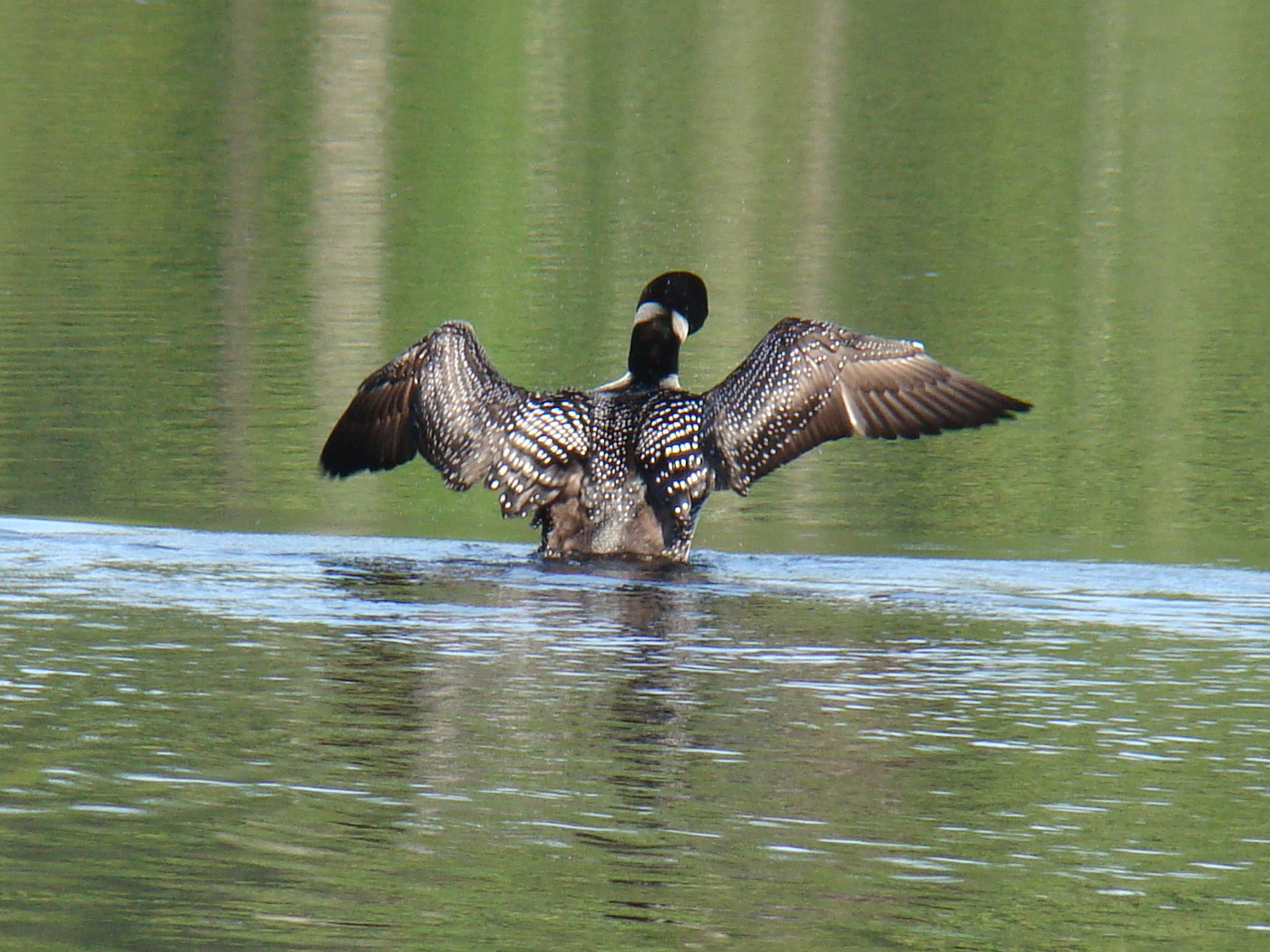
There was also a second pair of loons on the lake this weekend, travelling around together, though keeping well away from the breeding pair.
 Their wings are just a bit larger.

There was a large bass tournament on the lake this weekend, with lot of big, high-tech bass boats out competing with the loons for fish.  But I liked this different approach to fishing!
Did you happen notice the sign of fall in the background....?

Sunday, July 22, 2012

July 22, 2012

Persistence pays off.  Through high water, hot temperatures, thunderstorms, and spectators, the loons hatched a chick on Lake Wicwas this weekend.  This picture was taken a long ways off on the same day it hatched. 
One day-old loon chick riding on its parents' back

Chick and parent were staying near the island and communicating with its mate who was still on the nest, but there's no indication that a second egg hatched, or will hatch.  The next week is the most critical for Lake Wicwas's newest inhabitant, and a lot of good fortune will have come together for it to survive.  Time will tell....

This week seemed to have an avian theme.  On one trip on the lake, we counted at least 35 Canada Geese swimming together in a giant flotilla.  And later, along the shore of the lake, they were feasting on huckleberries which are ripe and quite abundant this year. 
Canada Geese Feasting on Huckleberries

It was great amusement watching them stretch high to snatch a berry, sometimes standing up on rocks to reach higher in their plunder of the lake.


Back closer to home, we didn't have to search out a Great Blue Heron - one came to visit us right on our dock!
Great Blue Heron
Cool Shadow!


OK, so this isn't too exciting, but it's still a pretty bird with a pretty song:
American Robin
Tramping around the woods I continue to find more scars from the Independence Day storm.  This giant pine tree was ripped up the roots.

But right next to it are a dozen tiny seedlings that it had spawned from its pine cones, so in a hundred years, it will have resurrected itself.

While I was studying this tree, I also observed an oak leaf that had been almost totally consumed by caterpillars.

If you were on the lake this weekend, you undoubtedly noticed a lot of boat traffic, including a pretty Hobie Cat cheating the wind.

In fact, on Saturday there were over 60 boats inspected as they came in or out at the boat landing - a record as far as our Lake Host coordinator knows.  That's an awful lot of opportunity for invasive species like Milfoil to enter our lake, so please thank our volunteers for being lake hosts.  And we always need more, as there are many hours the ramp goes unstaffed, so please volunteer to be Lake Host and help keep Lake Wicwas pristine.  (Send me an email, or leave a comment if you need to know who to contact to volunteer.)

As one last salute to birds this week, this interesting creature buzzed over the lake on one of those fabulous summer afternoons.


Sunday, July 15, 2012

July 15, 2012

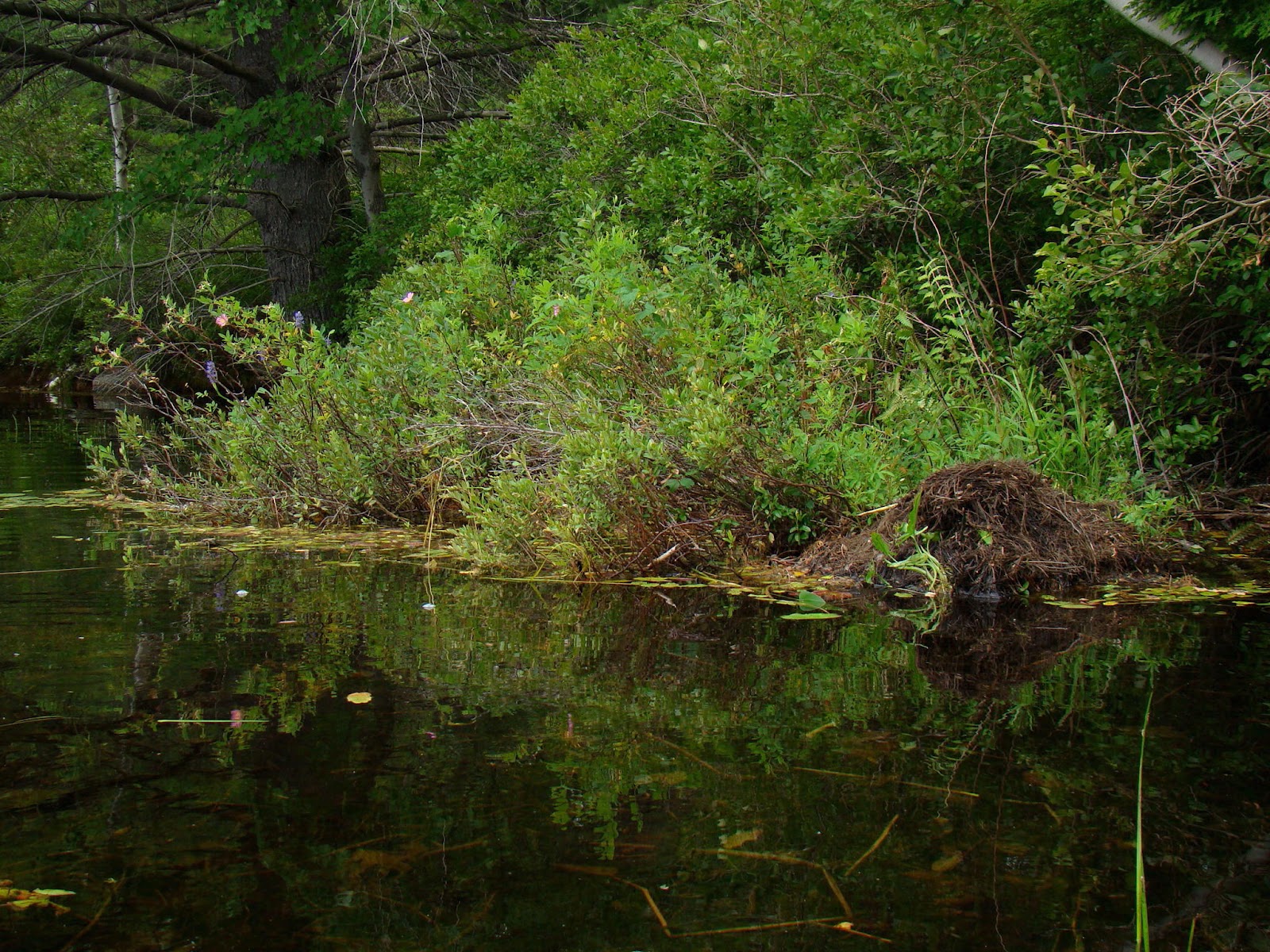
Last week when I was looking at the blown down trees on the shore I noticed this pile of vegetation which I thought was a muskrat lodge.

Muskrat Lodge

Reading up on muskrats, I determined that's what it is.  Muskrats are much like beavers in that they build lodges, though their construction material is mostly soft aquatic vegetative matter rather than tree materials.  The muskrat will use a base of mud, and add weeds, cattails, sedges and sticks, though I have seen them use small, leftover beaver branches as well.  When the mound is large enough, it hollows it from the inside to form its home.

Muskrats consume large amounts of aquatic plants, enough in fact, that they can have a significant impact on recovering open water that has become clogged with weeds.  I wonder if they like milfoil - maybe the DES can hire them?

I have seen muskrats on and around Lake Wicwas a couple of times, but never had an opportunity to get a picture.  Once, in the early spring, as the ice was coming out, a muskrat was sitting on the ice at the edge of a melting hole where there was open water.  It seemed to be dipping its front paws in the water; for what reason I don't know.  The other time was when I was riding by bike along Chemung road just south of the boat launch.  I spooked a muskrat by the side of the road and it raced along ahead of me until it found a hole to duck into.  Here's an interesting fact about muskrats:  they have teeth outside of their lips that let them chew on plants underwater without drowning!  (from Rezendes, Paul, "Tracking and the Art of Seeing".)

Did you notice the muskrat has Pickerel Weed and Swamp Rose decorating its back yard?
Pickerel Weed and Swamp Rose

A quasi-quatic animal I did capture on film recently is the raccoon - this one came along at 10:00 pm and had obviously just emerged from the lake.
Raccoon


Out on the lake, it appears the loons are still nesting - hopefully we'll be seeing a new chick soon.  Decorating the lake are the Fragrant Water Lilies.

On land, the flowers from spring are now producing berries in abundance.  Blueberries of course, but also Bunchberries and even the Painted Trillium, which has large green berries that will eventually turn red.
Blueberry

Bunchberry

Painted Trillium

Continuing the bear and blueberry story from last week, the blueberries are at their peak right now.  We enjoyed blueberry scones this morning with some good friends before a beautiful paddle on the calm, placid water.  And the bears continue to enjoy the blueberries as well, leaving more evidence of their presence.

Finally, I found a boat that tore off its mooring and washed ashore.  If you know someone who lost a small yellow boat, let me know - I have it.


Sunday, July 8, 2012

July 8, 2012

There's bear in the them thar hills.  I've seen several deposits of bear scat around Lake Wicwas the past few days, though I haven't seen any of the creatures that left them.  This morning, picking a few blueberries, I found a very fresh sample left earlier this morning when the bear was visiting the blueberry patch. 
Black Bear Scat


Bears don't appear to be very careful in the berry picking, judging by number of undigested green berries, leaves, and sticks in their excrement. 

Mature Black Bears weigh about 350 pounds;  did you ever think about how many blueberries a 350 pound bear must have to eat to get meal?  I guess that's why they basically spend their days roaming the forest and eating everything they find - from berries and insects to mushrooms and mice.  It's a good time to make lots of noise when walking in the woods.

I did bump into a couple of deer, most recently, right in the middle of the day up by Crockett's Ledge on the Hamlin trails.  It saw me coming down the trail, and trotted a few steps up around the corner, then stopped and looked back. 

I crept up a bit and we sized up each other before it walked off the trail about 20 yards, where it turned around again and watched me.  It stamped its front hoof a few times, trying to get me to move, which I eventually did, and it sauntered off into the woods.
They sure are well camouflaged - their colors blend in with the forest, and their legs look like saplings.  I'm sure I've walked right by deer many times without ever knowing they were there.

There were a lot trees knocked down on the trails west of the lake, particularly around the trail junction just up-hill from the maple grove.  Trees of all kinds are down - hemlock, pine, maple, oak.  One large sturdy hardwood was snapped off like a toothpick some 25 feet high.  Most were uprooted, blown down flat along the ground.  I only saw one of the giant maples that had succumbed to the storm. 


Ridge Along the Red Trail

Similar damage is to be found around the edge of the lake.  The worst damage I found is along the west shore of Sheep Island, where two stands of trees were peeled over onto land. 


You really need a person in the picture to understand the scale of the root ball. 

It provides an opportunity to see what's hidden underground.

Look at the size of one the rocks lifted up.

A couple of weeks ago I was intruiged by this large white pine that had clearly died on the shore, so I took a picture of it. 

It was lucky happenstance, because now I have before and after shots - here what it looks like after the storm blew through.


These trees were right in line with the ones that were blown down in our cove.  This Aspen was snapped off about five feet above the ground, exposing a bright red layer under the bark and splintering the soft wood.
Big Tooth Aspen


The same storm cell continued on down through Tilton and Belmont, taking numerous trees down along the way.  Winds were reported to be as high as 80 mph.


Warning:  If you're not comfortable with animals swimming in lake with you, you should stop reading here...


Because, we also found a cute little water snake swimming right across the middle of the lake.  If that Bald Eagle were around it would have had a nice afternoon snack.

Northern Water Snake