Showing posts with label Thunderstorm. Show all posts

Sunday, July 23, 2017

July 23, 2017 - Lightning Strikes

Meredith and much of the Lakes Region was treated to a dramatic electrical storm on Monday night.  There were thunderous lightning strikes, sometimes two or three in quick succession, and almost two inches of rain fell in an hour or two.  Harry Clymer sent me a chart showing the areas where lightning struck, which indicates three hit around Lake Wicwas, though Meredith Village really won the jackpot.

Somehow Debby Crowley was able to capture this incredible picture of a bolt that appears to have struck the surface of the lake south of Bryant Island.
Lightning over Wicwas - photo by Deborah Crowley
Thank you Ken and Debby for sharing that!  Fortunately there was no reported damage and I'm not aware of any significant power outages.  I looked for signs of strikes around the lake but didn't find anything.

The lack of rain lately has let the earth dry out a bit, but given such torrents of rain, most still ran off into the streams and lakes, and Lake Wicwas immediately rose four or five inches.  A quick check of the loon nest showed that their kingdom had become smaller, but it was still intact.
Its world looks a little smaller today
Like a dog, on a hot day a loon will cool itself by breathing with its mouth open.  The cool water below will help cool the egg while the parent protects it from the mid-day sun.  The parent may take a quick dip if needed before being spelled by its mate, but it won't be off the nest for long lest the egg cook in the hot sun.

Neil Crimins had observed on Sunday that the loons were augmenting their little island, dredging up mud and debris to build up the land.  It's fun to think they knew a storm was coming and were preparing for it, but more likely the island had been eroded by waves over the busy, beautiful weekend and they were just doing some restoration.

I continue to watch this year's premium crop of Black Cherries, and this week they are starting to ripen - perhaps two weeks behind the blueberries.

I hope to be able to determine who consumes them in the coming week or two.  Certainly birds will get many of them, but I expect the neighborhood bear will also get his or her fill.  I know it's still around, as it made a return visit to the yard to take out our second bird house.
The scene of the crime
It takes a big bear to bend that heavy steel stake
At this point, we have decided to post the houses "No Trespassing - Crime Scene" and board up the doors.  Not that their nests elsewhere are necessarily safe from predators, but we don't want to attract bears to human areas, and at least we won't feel complicit in crimes they commit elsewhere!

And just to make sure there's no doubt, one morning this week I came almost face to face with Mr. Black Bear.  I heard crunching the woods ahead of me on an early morning walk, and assumed it was a deer since I was in an area where I frequently come across deer at that time of day.  So I raised the camera hoping to get a picture in the dim light.  But instead of a deer poking its curious head out, it was a tremendous black bear.

Bears have poor eyesight, but stupendous sense of smell and excellent hearing.  One click of the camera and even at that distance it heard the shutter and looked right at me.

For all of two seconds - then it turned tail and bolted off into the woods.  It stopped not too far away, maybe 50 yards, but a couple of loud shouts and it was off and running far up and over a hill.  It must not have been a mother with cubs or it would have collected its cubs before it ran so I felt safe, but nonetheless decided to continue my walk in the opposite direction.

I've had this experience before - upon a bear hearing or smelling me it runs away a few yards, then stops and looks back as if to make sure it really needs to alter its planned route for the day, then decides, yup, it's time to go and disappears off into the forest.

As the ruckus caused by the bear dissipated, the tranquility of early morning returned, the rising sun bathing the world in soft, silken light, revealing, as it always does, a bounty of beautiful scenes.
The mushrooms love this weather  (Fly Amanita)

A yellow-bellied sapsucker soaks up the morning sun

Eastern newt, red-eft phase
Pickerel Frog
And finally, an old birch tree creates a home for new life to flourish.

Be sure to enjoy this great summer weather - we're already into the last week of July.


b

Sunday, July 22, 2012

July 22, 2012

Persistence pays off.  Through high water, hot temperatures, thunderstorms, and spectators, the loons hatched a chick on Lake Wicwas this weekend.  This picture was taken a long ways off on the same day it hatched. 
One day-old loon chick riding on its parents' back

Chick and parent were staying near the island and communicating with its mate who was still on the nest, but there's no indication that a second egg hatched, or will hatch.  The next week is the most critical for Lake Wicwas's newest inhabitant, and a lot of good fortune will have come together for it to survive.  Time will tell....

This week seemed to have an avian theme.  On one trip on the lake, we counted at least 35 Canada Geese swimming together in a giant flotilla.  And later, along the shore of the lake, they were feasting on huckleberries which are ripe and quite abundant this year. 
Canada Geese Feasting on Huckleberries

It was great amusement watching them stretch high to snatch a berry, sometimes standing up on rocks to reach higher in their plunder of the lake.


Back closer to home, we didn't have to search out a Great Blue Heron - one came to visit us right on our dock!
Great Blue Heron
Cool Shadow!


OK, so this isn't too exciting, but it's still a pretty bird with a pretty song:
American Robin
Tramping around the woods I continue to find more scars from the Independence Day storm.  This giant pine tree was ripped up the roots.

But right next to it are a dozen tiny seedlings that it had spawned from its pine cones, so in a hundred years, it will have resurrected itself.

While I was studying this tree, I also observed an oak leaf that had been almost totally consumed by caterpillars.

If you were on the lake this weekend, you undoubtedly noticed a lot of boat traffic, including a pretty Hobie Cat cheating the wind.

In fact, on Saturday there were over 60 boats inspected as they came in or out at the boat landing - a record as far as our Lake Host coordinator knows.  That's an awful lot of opportunity for invasive species like Milfoil to enter our lake, so please thank our volunteers for being lake hosts.  And we always need more, as there are many hours the ramp goes unstaffed, so please volunteer to be Lake Host and help keep Lake Wicwas pristine.  (Send me an email, or leave a comment if you need to know who to contact to volunteer.)

As one last salute to birds this week, this interesting creature buzzed over the lake on one of those fabulous summer afternoons.


Sunday, July 8, 2012

July 8, 2012

There's bear in the them thar hills.  I've seen several deposits of bear scat around Lake Wicwas the past few days, though I haven't seen any of the creatures that left them.  This morning, picking a few blueberries, I found a very fresh sample left earlier this morning when the bear was visiting the blueberry patch. 
Black Bear Scat


Bears don't appear to be very careful in the berry picking, judging by number of undigested green berries, leaves, and sticks in their excrement. 

Mature Black Bears weigh about 350 pounds;  did you ever think about how many blueberries a 350 pound bear must have to eat to get meal?  I guess that's why they basically spend their days roaming the forest and eating everything they find - from berries and insects to mushrooms and mice.  It's a good time to make lots of noise when walking in the woods.

I did bump into a couple of deer, most recently, right in the middle of the day up by Crockett's Ledge on the Hamlin trails.  It saw me coming down the trail, and trotted a few steps up around the corner, then stopped and looked back. 

I crept up a bit and we sized up each other before it walked off the trail about 20 yards, where it turned around again and watched me.  It stamped its front hoof a few times, trying to get me to move, which I eventually did, and it sauntered off into the woods.
They sure are well camouflaged - their colors blend in with the forest, and their legs look like saplings.  I'm sure I've walked right by deer many times without ever knowing they were there.

There were a lot trees knocked down on the trails west of the lake, particularly around the trail junction just up-hill from the maple grove.  Trees of all kinds are down - hemlock, pine, maple, oak.  One large sturdy hardwood was snapped off like a toothpick some 25 feet high.  Most were uprooted, blown down flat along the ground.  I only saw one of the giant maples that had succumbed to the storm. 


Ridge Along the Red Trail

Similar damage is to be found around the edge of the lake.  The worst damage I found is along the west shore of Sheep Island, where two stands of trees were peeled over onto land. 


You really need a person in the picture to understand the scale of the root ball. 

It provides an opportunity to see what's hidden underground.

Look at the size of one the rocks lifted up.

A couple of weeks ago I was intruiged by this large white pine that had clearly died on the shore, so I took a picture of it. 

It was lucky happenstance, because now I have before and after shots - here what it looks like after the storm blew through.


These trees were right in line with the ones that were blown down in our cove.  This Aspen was snapped off about five feet above the ground, exposing a bright red layer under the bark and splintering the soft wood.
Big Tooth Aspen


The same storm cell continued on down through Tilton and Belmont, taking numerous trees down along the way.  Winds were reported to be as high as 80 mph.


Warning:  If you're not comfortable with animals swimming in lake with you, you should stop reading here...


Because, we also found a cute little water snake swimming right across the middle of the lake.  If that Bald Eagle were around it would have had a nice afternoon snack.

Northern Water Snake


Thursday, July 5, 2012

July 5, 2012

Independence Day yesterday, and it was quite a day.  From a rainy start, to an absolutely beautiful day, to a violent summer thunderstorm, this July fourth had it all.

Independence Day!
Celebrations and Bar-B-Ques and enjoying the lake were the themes of the day.


In the evening, prior to man-made fireworks, nature provided her own firworks with a very impressive lightning display that was immediately followed by high winds and torrential downpours - three quarters of an inch of rain in maybe fifteen minutes.  The storm left wires and trees down, and much of the lake without power.  There was a wire down across Meredith Center road, and several trees blown down around the lake, including this oak and cluster of maples that pulled up a good chunk of shore line. 

Storm Blow-Down

After the storm the temperature dropped and the humidity went up, making for a misty morning today with sunbeams shining through the forest.

I looked up a couple of creatures I found around the lake this week, including the real name of these insects we call "mosquito eaters":  Large Crane Fly (Family Tipulidae).  There are 10,000 individual species in this family.
Large Crane Flies

The female has a larger abdomen than the male, as it is full of eggs;  it also has a pointed tail as seen on the female on the right.

And of course, they don't eat mosquitoes, although some species, when they are in the larval stage, will eat mosquito larvae, so they're a good insect.  They look a bit scary, but are harmless and don't bite or sting.   They are an important food source for birds, amphibians and reptiles, keeping the widlife round Lake Wicwas well fed, so when one sneaks into your house, shoo it safely out the door!

One of their predators might bt this little toad - a Fowler's Toad, I believe.
Fowler's Toad
A Crane Fly might look like a big meal for this little guy, but I'm sure it could manage.  The Fowler's Toad, a race of the Woodhouse's Toad, is named after Samuel Fowler who founded the Natural History Department at the Essex Institute om Salem Mass.  Fowler discovered it in 1843 [http://library.thinkquest.org/11034/].

A couple of butterflies - Duskywings I think - were enjoying the nectar in Linda's bright blue flowers for their meal.  They in turn may become some other animal's dinner.
Duskywing

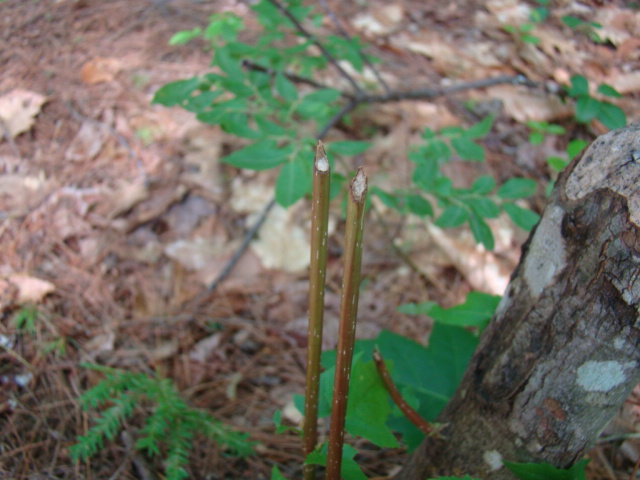
I have also seen deer around lately, though no fawns.  There are lots of signs of their browsing as well.  These poor trees are really having a tough time;  first the beaver cut them down, and when they tried to put out some stump shoots to survive, the deer coae along and stripped the stalks of their leaves.

All they left is bare, chomped-off shoots.
Deer Browse