Thursday, July 5, 2012

July 5, 2012

Independence Day yesterday, and it was quite a day.  From a rainy start, to an absolutely beautiful day, to a violent summer thunderstorm, this July fourth had it all.

Independence Day!
Celebrations and Bar-B-Ques and enjoying the lake were the themes of the day.


In the evening, prior to man-made fireworks, nature provided her own firworks with a very impressive lightning display that was immediately followed by high winds and torrential downpours - three quarters of an inch of rain in maybe fifteen minutes.  The storm left wires and trees down, and much of the lake without power.  There was a wire down across Meredith Center road, and several trees blown down around the lake, including this oak and cluster of maples that pulled up a good chunk of shore line. 

Storm Blow-Down

After the storm the temperature dropped and the humidity went up, making for a misty morning today with sunbeams shining through the forest.

I looked up a couple of creatures I found around the lake this week, including the real name of these insects we call "mosquito eaters":  Large Crane Fly (Family Tipulidae).  There are 10,000 individual species in this family.
Large Crane Flies

The female has a larger abdomen than the male, as it is full of eggs;  it also has a pointed tail as seen on the female on the right.

And of course, they don't eat mosquitoes, although some species, when they are in the larval stage, will eat mosquito larvae, so they're a good insect.  They look a bit scary, but are harmless and don't bite or sting.   They are an important food source for birds, amphibians and reptiles, keeping the widlife round Lake Wicwas well fed, so when one sneaks into your house, shoo it safely out the door!

One of their predators might bt this little toad - a Fowler's Toad, I believe.
Fowler's Toad
A Crane Fly might look like a big meal for this little guy, but I'm sure it could manage.  The Fowler's Toad, a race of the Woodhouse's Toad, is named after Samuel Fowler who founded the Natural History Department at the Essex Institute om Salem Mass.  Fowler discovered it in 1843 [http://library.thinkquest.org/11034/].

A couple of butterflies - Duskywings I think - were enjoying the nectar in Linda's bright blue flowers for their meal.  They in turn may become some other animal's dinner.
Duskywing

I have also seen deer around lately, though no fawns.  There are lots of signs of their browsing as well.  These poor trees are really having a tough time;  first the beaver cut them down, and when they tried to put out some stump shoots to survive, the deer coae along and stripped the stalks of their leaves.

All they left is bare, chomped-off shoots.
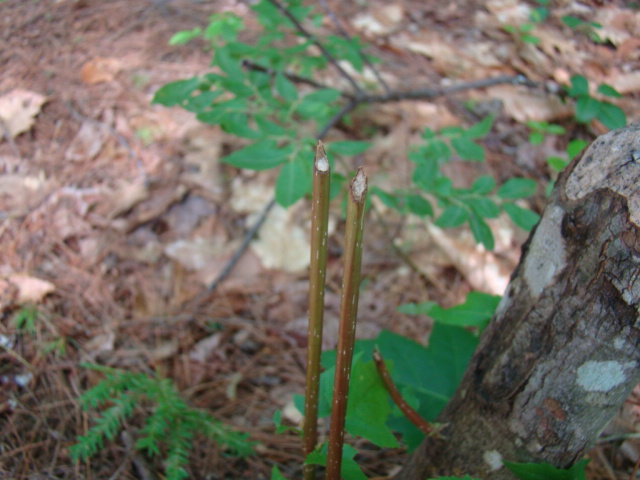
Deer Browse

Sunday, July 1, 2012

July 1, 2012

July is here, the longest day of the year has passed, and summer is in full swing as Lake Wicwas prepares for the big holiday week.  On Saturday the lake was home to a fishing tournament - there were quite a few bass boats on the lake, but the fishermen are quite polite and non-intrusive - great visitors all around. As a study in extremes, look at these two very different approaches to same sport of attempting to outwit a fish:
250 Horsepower
250 Horsefly Power


The loons on Lake Wicwas have had a difficult year so far, but they are still trying to have a successful nesting.  Their first attempt was foiled by the rapid water level changes, which forced them to abandon their egg on the nest, as the receding water left it too far from the waters edge. 


Their current site is highly visible, on an island right in the middle of the lake. 

The loon committee has a tough decision between keeping loon nesting sites hidden, or making them extremely visible as they have done with the current site.  Because so many people visit this island, especially with this second nesting attempt right at the the peak of the summer season, they determined the best approach was to mark it clearly and ask people to stay away. 


I have no idea where the nest is, and I'm not going to look for it.  Any approach near a nest will cause the loon to leave the nest, which leaves the egg vulnerable to predators, as well as temperature changes which can quickly kill an egg by either being too cold or too hot.  When one understands just how many threats there are to a successful nesting, it becomes clear why we must help them every way we can, mostly by leaving them alone, but also by not using lead fishing tackle, which is the number one killer of loons.  If you ever see a loon acting strange, it means you are too close and you should move away quickly. 

There is also a third loon still on the lake, far away from the nesting pair, mostly just floating calmly and not moving around much.


It sometimes pops up quite close to us when we're swimming, and seems to enjoy waving its foot at us.


While the loons struggle to hatch a single chick, the Canada Geese have no such problem.  We counted 37 in this flock, and that's not all of them, as there's at least one other family with much younger chicks.

The weekend concluded with a quick rain storm on Sunday evening, but cleared in time for nice sunset and a nearly full moon rising over the lake.


Sunday, June 24, 2012

June 24, 2012

Lake Wicwas has certainly been treated to some great weekend weather lately.  Even this past Saturday, when thunder could be heard rumbling close by with storms all around us, we received only a few raindrops, not even enough to get the roads wet.  Taking a bike ride south along lake Winnisquam in the evening it was evident that just a couple of miles away they had much more precipitation. 

My simple curiosity this week was with the water bugs which have hatched out in massive quantity and form giant black swarms on the surface of the water.  From well over a hundred feet away I could see thousands insects no more than quarter of an inch across dancing in formation on the water.  Their behavior is much like schools of fish or flocks of birds that swim or fly in ever changing shapes, something known as swarm behavior.  They would group tightly together, then something would cause them to spread out getting so thin that the swarm almost dissapeared, only to reform again in tens of seconds.  It's also rather fun to swim into their swarm;  as you approach they start hopping up off the water about six inches like miniature pogo sticks.
Waterbugs Swarming


Another insect hatching now is the Mayfly, an insect that clearly hasn't learned how to read a calendar.

Mayflower

A late blooming wildflower is decorating the forest floor - the partridgeberry.  I don't have any good guesses as to why this flower blooms so much later than all the other small, forest ground plants.
Partridge Berry
Several more cormorants have made the lake their home, perching on dead branches of favorite pine trees on a couple of islands.  They are pretty cool looking birds, with webbed feet that can hold onto branches, even if they are rather messy.
Cormorant

The loons have been busy trying to nest, but with the changing water levels, it is not apparent they have been successful, and it's getting late for another attempt.
Common Loon

They are a beautiful bird. 

Another beautiful, and rarer bird visited Lake Wicwas this weekend:  a Bald Eagle!  We saw it Friday afternoon, circling rather high over the south part of the lake.  It flew in from the north, made quite a few large circles over the lake, moving slowly southward until it went over the hill towards Lake Winnisquam.  A fabulous sight to see.

The heavens also added some beauty this weekend, with a nice sunset followed by a bright crescent moon.


The fireflies have also emerged.  After watching the moon pass in out of the clouds, I walked to a field on that dark, warm, humid night, and was treated to a fabulous light show of hundreds of twinkling lights dancing all around me.

Sunday, June 17, 2012

June 17, 2012

This weekend was cool for June, but it was bright and dry.  I'm still not seeing a lot of animals, but the plants around Lake Wicwas are taking full advantage of the long summer days.  On a kayak trip, I found a lot of Sheep Laurel blooming all around the aptly named Sheep Island.  They grow with the huckleberries and blueberries on the shoreline, and their blossoms are small, and easily overlooked from a distance, but they are beautiful flowers.
Sheep Laurel (Kalmia angustifolia)
 Also growing along the shoreline are the Larger Blue Flags, a wild iris.
Larger Blue Flag (Iris versicolor)

Back on shore the Orange Hawkweed have joined the wild daisies. Their colors are so intense in the bright sunshine.

The honeybees are taking advantage of their pollen, buzzing in and around and building large yellow balls of pollen on their legs to bring home to make our honey.  Good thing they are not allergic - they are covered with pollen - eyes, antenna, and hair.


Other insects that thrive on plant juices are butterflies.  This White Admiral was flitting around this weekend, complementing the Red Admiral that I saw back on May 6th. 
White Admiral (Limenitis arthemis arthemis)
At one point, when I was trying to get close for a picture, it landed right on my finger.  I got a good look at it, but it was not conducive to photography!

Unlike the Red Admiral, the White Admiral doesn't migrate.  They will mate in summer, lay eggs that hatch into caterpillars that will feed for the summer and hibernate over the winter.  In late April each caterpillar will feed some more before it forms its chrysalis where it transforms into an adult butterfly.

I've seen these foam bubbles on blades of grass for many years, and have never been sure what they are - the rumor is Spittlebugs. 
Spittlebug Protective Bubble
So I did a little research and in fact that's what it is.  Spittlebugs are tiny, aphid-like insects that feed on the juices of plants.  They build this bubble home to protect them from predators, and to keep them from drying out.  They are expected to appear around the summer solstice, so this one is right on schedule.  The foam is harmless, and even the insects rarely are a problem to the host plant.

Back in the lake, I noticed this trail through the weeds that the beavers have worn by passing to and from their lodge.  First they cut down trees within the protected 50 foot zone, then they dredge the lake to put mud on their lodge, and now they are forming channels through the marsh.  Someone better call the DES!


I'll finish this with a couple more bright examples of nature's artwork.  A bright yellow fungus, and another Orange Hawkweed.


Sunday, June 10, 2012

June 10, 2012

I have seen very little mammal activity around Lake Wicwas this week;  a couple of beavers swimming by at dusk, some signs of deer browsing, and early one morning I heard a deer snorting at me from Sheep Island.  Perhaps they are all hiding away, taking care of young and vulnerable offspring. 

But the birds are very active - sometimes too active.  One day, driving home across the dam, we saw a mother duck with five or six of the tiniest ducklings I've seen trying to cross the road from the lake to stream.  Mom scurried them back to the lake and down safely into the tall grass.  We stopped and went back to look, and they had just disappeared! 

While we were there we noticed some eye-catching dragon flies flitting around the stream leaving the lake:  they were Ebony Jewelwings. Jet black, with black wings, the male has a bright, iridescent green body that looks like its glowing compared to its black body.  The female's wings, though also black, are somewhat transparent and have white spots near the rear of the wing. 
Ebony Jewelwing


Their segmented bodies are amazingly flexible;  when they mate the female bends its body forward 180 degrees so the male can hold onto it during mating. 

The pictures don't do them justice - they are really quite stunning, and being so numerous you'd have good chance of seeing them if you were too look soon on a warm day.

The Canada Geese are much farther along in their development, with some of the new birds starting to look like immature adults.   We saw this mother and father working to round up their brood to get them moving after a short respite.  First mom and dad whispered their secret plan to each other.

The Plan
Then they stretched out to surround the gang.
The Round-Up

With one parent taking the lead and the other playing sweeper and rounding up the stragglers. 
The Stragglers

Finally they were all in a row and off to their next dining spot!
Off to the Races

We also had a lone make Wood Duck make a visit right to our dock. 
Wood Duck


It was rather bold, not flying off until we approached to within 20 feet, but it was clearly aware of us and watching every move.

When it did take flight it went just a few yards and just swam along slowly.


We have had a lot of Grackles around the lake this year.  Though not uncommon, we haven't seen this many for such long periods of time.  They are quite visible with their large size and shiny green head, and also make a loud sharp call that gets one's attention.

The transition to summer is revealed by the summer flowers capturing the lead role from the spring wild flowers in coloring the shores of the lake.  The only spring flower I found this week is the Bunchberry, while the wild daisies are blooming, and the Hawkweed are about to burst out. 

The Lupine are also in full bloom, and so we took a drive up to Sugar Hill to enjoy the fields of Lupine with Cannon and the Lafayette Range in the background during the Lupine Festival.  And of course, the trip required a visit to Polly's Pancake Parlor!

Get ready next weekend for the two-wheeled thunder - let's hope they get a repeat of this weekend's fabulous weather.!