Showing posts with label Honey Bee. Show all posts

Sunday, July 27, 2025

July 27, 2025: No new Veeries this Year

There's sad news on the Veery nest, but let's start with something pleasant.  Checking the Evening Primrose flowers as promised, I did find a Primrose Moth one morning.  

Primrose Moth  (Schinia florida)

This insect is considered an "obligate species" because it is entirely dependent on one plant, the Evening Primrose.  Where there are no evening primrose plants, there are no primrose moths.  Adult moths spend their days hidden inside the closed-up blossom.  When the sun sets, the blossom open (thus the name "evening primrose") and the moths can move safely under the cover of dark to drink the flowers' nectar using their long proboscis.  Eventually they will lay their eggs inside a primrose bud for safe keeping.  When the larvae hatch they will feed on the primrose blossoms before burying into the ground to overwinter.  In the spring when the earth warms, the caterpillars emerge to feed on the primrose plant and the cycle repeats.  Thus the moth's entire life cycle is dependent on this single plant species.  [Ref:  A Study in Pink and Yellow, Gita Yingling, Sept 2024]  

It is a pretty insect.


We had an entertaining few minutes when a Gray Catbird came to our water feature for a bath.  It hopped in and out of the water a dozen times, splashing around and diving under to get all its feathers clean.  It looked like a wet rag by the time it was done.

Gray Catbird takes a bath.


Now the sad news.  Last year's veery nest was destroyed by a predator, so this year I used a trail camera to learn who might be the culprit if it happened again; unfortunately, it did:   A raccoon took out the veery nest.  The 'coon was happily using the trail for easy egress through the forest.

 Its sharp nose picked up the scent of the nest.  

From there it took just a moment for it to zero in on the nest and head straight to it.  It was quite tentative as it approached, not sure what it would find.  I love the way it held its left front paw up close to its chest, ready to defend against something larger than it hoped to find.  Note how close the mother bird let the raccoon get before it flew off.  The raccoon sniffed a bit, probed down into the nest, and then proceeded to gobble up the four little chicks.  You may want to skip the video if you don't want to see the deed take place.

A veery egg weighs about 2.5 grams; four new born chicks probably weigh about a third of an ounce.  That tiny bit of sustenance seems hardly meaningful to a 20 pound raccoon, but animals will take any bit of food they can find.  Before the raccoon found the nest, but after the eggs had hatched, the camera took hundreds pictures of mother flying back and forth all day long catching food and bringing it to her chicks.  Here are just a few, ending with a close up of her tending to her chicks.

Veeries will occasionally have two broods in a summer, and since the pair won't have to raise this brood, they may try again.  Let's hope they find a nesting site farther away from a trail.

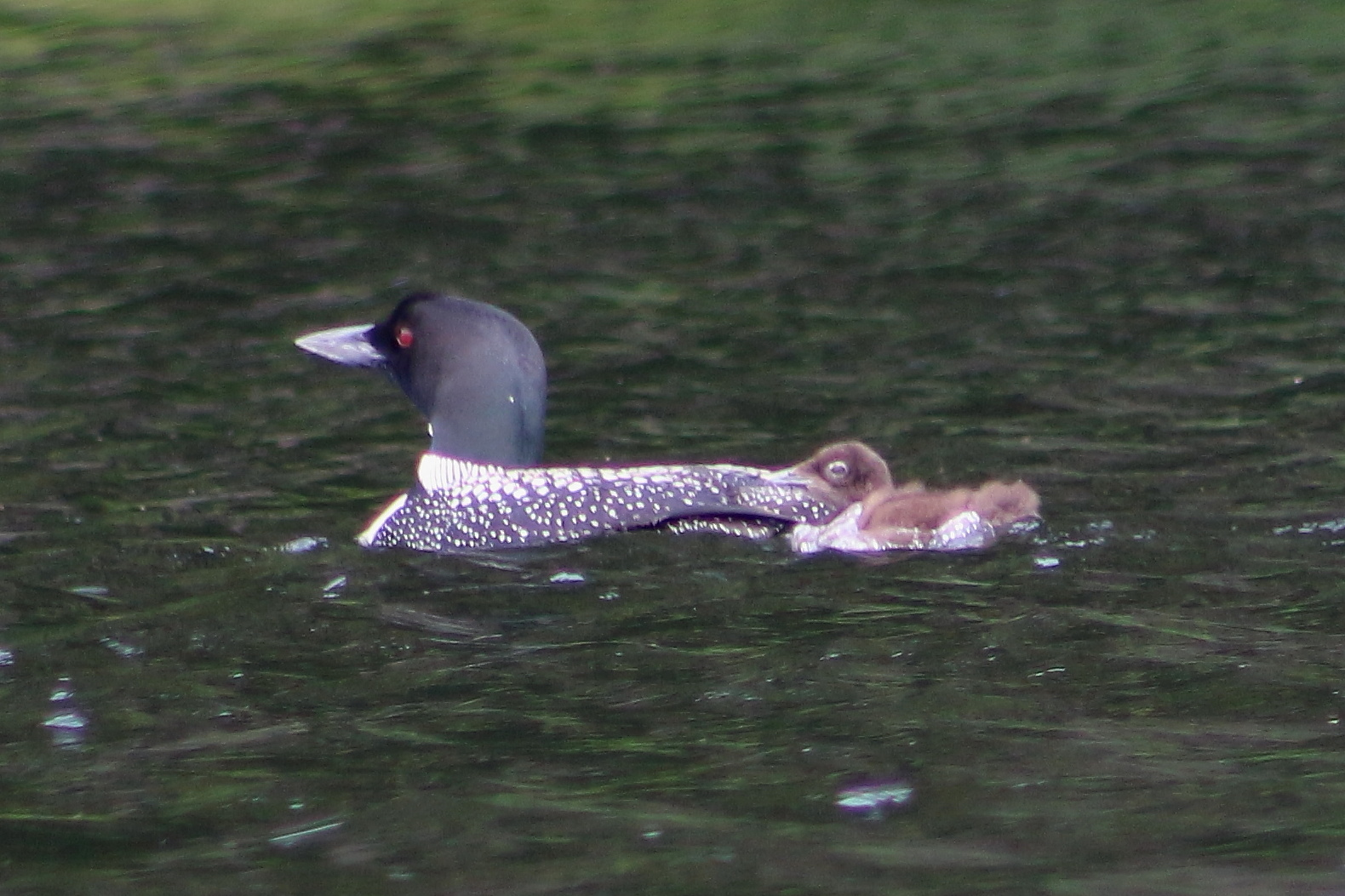
On a much happier note, the loon chicks Spangle and Star are doing great.  Spangle has even caught her first fish!  Star is still a bit smaller, but it looks like he might be catching up.  Maybe with Spangle preoccupied with her fishing, Star is getting more fish from mom and dad.

Spangle and Star with a proud parent.  Photo by Deb Crowley.

To close on another pretty note, if you're out near a field or maybe just a quiet road side, be on the watch for Queen Anne's Lace - it's having a good summer.

Queen Anne's Lace.
Which the honey bees and other pollinators appreciate!


Sunday, August 2, 2020

August 2, 2020: Birds on the wing

Mother nature sure has been giving us some spectacular weather this summer, warm and sunny, with gorgeous sunsets and calm mornings perfect for a sunrise or sunset paddle on the lakes.  

As I kayaked on one of those calm mornings it seemed the birds were out enjoying the morning as much as I was.  First I spotted a Great Blue Heron gliding over the water.


I always think of herons as wading birds because they spend so much time in the shallow water searching for frogs or fish to swim by their skinny, stationary legs which carefully imitate stalks of plants growing in the lake.  But they do make their nests in tall trees, and will also sit high in a tree to observe their world.  When airborne they do their best to minimize air resistance from their long gangling appendages.

A nice streamline form as it gains altitude.

I was able to track this one as it rose up and prepared to land at a prime vantage point to watch out over the lake.

Extend landing gear.

Flare wings on final approach.

Safely in the  hangar.

The next bird showing off its flying skills was an Eastern Kingbird.

I saw and heard many of these as I paddled that morning, seeing them flit out to catch a bug and return to their perch.  I stopped at one point to watch one of them go out on a few breakfast sorties.
On the hunt.

The flying skills of these birds are pretty amazing, especially when you think that they never studied aerodynamics or flight control - it's all just natural talent.

Bogey off to port!

Gotcha!
Back to the perch.

The kingbird knows how to flare also.
Just a few moments and it will be off again.

Sometimes the purpose of their mission was to repel another bird from its hunting grounds - that's when they were most noisy.
These are not a couple of love birds - one is letting the other know "these are my insects".


The next flying object out on the lake wasn't a bird, but a bee - a honey bee collecting pollen from the pond lilies which seem especially abundant this summer (maybe they like the weather also).  Morning is the best time to see these lilies as they bloom early in the day and close up in the heat of the afternoon, which the bees seem to know.  Here's one coming in to inspect a prospect:
Note the pollen sac it's carrying.

It's clear it's already visited a few other flowers this morning.  It hovered a bit,
then decided it liked what it saw and went in.
It climbed down among the stamens to extract all the pollen it could carry and still get airborne.


All this pollen collection and sharing from flower to flower ensures fertilization to generate new plants.  Deep down in the bottom of the lake are the rhizomes that anchor these plants in place - until a muskrat or beaver comes along and eats the root, continuing the endless food cycle of nature.  Here's an interesting fact about the White Pond Lily:  According to the Lady Bird Johnson Wildflower Center the stalks contain air channels which allow oxygen collected by the leaves to travel down into the roots in the bottom of the lake.  

It is such a pretty flower.

Nature does give us us the most beautiful sights.

Summer sunset in New Hampshire

P.S.  Harold and Betty are doing fine, I saw them yesterday.  I'll try to get pictures next week - they're getting big!

Sunday, August 27, 2017

August 27, 2017 - Harvest Season

The harvest season has begun, which is appropriate, as it has felt like fall the past few days, cool, bright, and dry.  Some harvesters have begun collecting the smallest items of the autumn crop as the pollen flies all around.
A heavily-laden bumblebee comes in for a landing
A honey bee with full pollen sacs

It's good thing bees aren't allergic.
Just looking at this makes my eyes itch
The largest animals are also collecting the fall bounty;  the bear has completed the removal of the black cherries, bending over the flexible trunks and stripping off all the fruit.  It also rolled a rotten log right into the middle of the trail to extract the bugs from underneath.
An old pine log left behind after a meal

The least it could have done was clear the table after its meal and roll the log back off the trail.

The large quantity of ground-based insects this time of year - ants, crickets, grasshoppers, etc. - make it a good time for snakes to be born.  I found this new-born garter snake slithering around the wood chips near the house.  (Garter snakes are ovoviviparous, meaning they give birth to live offspring rather than laying eggs as most reptiles do.)

The new moon that blotted out just over half of the sun on Monday will, in two weeks, also follow the harvest theme as the September full moon is known as the Harvest Moon.
The eclipse at maximum blockage.  Two sunspots are visible on the left side

We were fortunate enough to have clear skies during the entire period of the eclipse.

Well, I guess I can't put off the sad news any longer:  Tardy is no longer part of the Lake Wicwas community.  The first indication came on Wednesday when I heard news of a long period of awful, mourning loon calls, which was described as sounding like a parent who lost a child.  Then a careful loon watcher reported that the chick had not been seen for a couple of days, even though there was a pair frequenting the waters where the nesting family had usually been seen.  Next came a report of a loon swimming around for 30 minutes with a minnow in its beak, as if searching for a chick to feed - that sure sounded like a animal with parenting hormones in play.  So yesterday I went on two searches for the family, and on the second I found the banded female in close proximity to (presumably) its mate, with no chick to be seen.

There have been many eagles seen circling over the loon family, so that is a likely cause of its demise.
A bald eagle soaring over the loon family - photo by Debby Crowley
There are other possibilities, including turtles and other loons, but unless a body is recovered, we'll never know for sure.  Two years ago when we lost both chicks, one of them was found with a neck injury indicative of attack by another loon.

At least mom and dad appear to be fine;  mom must have been hungry after all that work raising and defending a chick, as she caught herself a tremendous meal.


Either that or she was consoling herself with the loon-equivalent of a pint of Ben and Jerry's.

She spent a long time catching and releasing this large fish, tiring it out before swallowing it.  Here's the whole sequence:


I guess we'll just have to try to enjoy the harvest season without our little Tardy.
My last picture of Tardy, August 21, 2017