Showing posts with label Milkweed Tussock Moth. Show all posts

Sunday, August 18, 2024

August 18, 2024: Summer's Creepy-Crawlers

Mid-summer is prime time for all kinds of creepy-crawlers.  They've been feeding on plants and other smaller insects for a while, growing larger, and many being quite colorful, they can be easy to spot.  This orb-weaver, a Yellow Garden Spider, is a good example. 

There are several theories about why they make the zig-zag pattern in the web.

This spider, along with dozens more, was in an open field of wildflowers which is their usual habitat, though I have seen them and their webs right  on the eaves of our house.  Both males and females weave webs but the males' webs are smaller. 

There's a huge variety of caterpillars munching on our plants here in August and they're large enough now to be quite visible.  One or more of them is doing quite a job on the oak trees.  
The ground in places is covered with shredded oak leaves.

On a quiet day it sounds like rain as leaves and caterpillar droppings fall to the ground.  One afternoon I counted 25 of this variety of caterpillar on the ground in an area no larger than 10 square feet.
An unknown moth caterpillar.

They must have all just dropped down to go find a place to form their pupae, and I'm guessing these are the ones feeding on the oaks. There are several kinds of moths that have similar larvae and I don't know what these are.

Several colorful and hairy caterpillars are munching on plants too, some on trees, others on smaller plants such as this Milkweed Tussock Moth caterpillar on, yes, a milkweed plant.
Milkweed Tussock Moth Caterpillar on a milkweed pod.

Just like the Monarch Butterfly caterpillar, the Milkweed Tussock Moth caterpillar consumes milkweed almost exclusively.  

Next up is a Banded Tussock Moth caterpillar. 


This tussock caterpillar isn't a picky eater and will consume a wide variety of trees and shrubs including oak, ash, birch, and blueberry.  This one was crawling along the ground, looking for a safe place in the leaf litter to make its cocoon in which it will spend the winter.

Next I saw a Wooly Bear caterpillar.
One of the best known of the caterpillars.

Unlike the tussock caterpillars which should not be touched, the Wooly Bear won't cause skin irritation if it's handled.  This larvae will pupate and overwinter under the leaf litter and turn into an Isabella Tiger Moth next summer.  This species consumes an even wider variety of herbaceous plants:  flowers, shrubs, and trees - most anything but grass.  

Grasshoppers on the other hand, will eat grass, and I've seen lots of flying grasshoppers in dry sunny areas lately; at least that's what we called them as kids.  I don't know what the problem was with this one I saw on a gravel driveway, but it was just buzzing along the ground, making more noise than motion.


The video makes it look like it was moving its wings slowly when in fact they were moving so fast you couldn't see them.  When it finally stopped and tried to hide under a tuft of grass I got a good look at it and I think it's a Carolina Locust.  
Carolina Locust (Dissosteira carolina)

What incredible camouflage for a dirt road.  They're fun to watch but I guess a large outbreak can damage crops even here in New England.

The last crawler I saw was the biggest of all - almost 3" long.

It seems every summer I see one - and only one - of these many-legged, well-armored arthropods.  Arthropods, which includes spiders, aren't insects or bugs, and more closely related to crustaceans.  They don't go through a metamorphosis but remain crawlers all their lives and are harmless to humans.  They are born with only a few of those four legged segments and add more segments as they molt over the five years it takes them to reach maturity.  During that time they are helpful animals, consuming small insects and decaying plant material.  [University of California, Oakland]

Here's yet another creepy-looking insect that is completely harmless.
A Katydid, also called a Bush Cricket.

Katydids, in the cricket family, are mostly nocturnal, using their color and leaf-life patterning to hide on plants during the day.  I have no idea why it was resting on a white deck chair at 2:00 in the afternoon.  

Finally, here's an insect that has completed its metamorphosis into an airborne adult. 
Green Comma (Polygonia faunus)

This flashy Green Comma was flitting around in its primary habitat of a small mountain stream running along the Edmund Path on the flank of Mt. Eisenhower.  It lives in boreal north America, primarily mountain woodlands, so not likely to be seen around Lake Wicwas.

Something I'm watching for but haven't seen yet is a cicada.  But the creepy-crawler season isn't over yet....


P.S:  There was a lot of interest in last week's osprey so I'll share a post from August 2020 which includes another osprey fishing experience.  It was also in mid-August, in the same part of the lake, and within 5 minutes of the same time of day!  7:15pm on a quiet mid-August evening is the time to watch for them!


Sunday, August 20, 2023

August 20, 2023: Little Red Eft

I sure have seen a lot of these little guys lately with all the rain we've had - it brings them onto the trails in droves.  One day mountain biking there were so many that they were the biggest obstacle to avoid on the trails.
Eastern Newt (Notophthalmus viridescens), Red Eft phase

The red eft is the intermediate stage of the Eastern Newt.  These amphibians start their life in the water as green-colored aquatic larvae with gills, then move onto land after a few months when they become this red eft form.  During this time they can travel "great distances" [Ref:  Smithsonian National Zoo] moving to a different water body in the process.  They live in this form for two or three years before a metamorphosis back to an aquatic animal, and their return to water as adults.  They mate in early spring with a single female depositing between 200 and 400 eggs onto various aquatic plants.  According to the above reference however, some populations remain in the red eft stage permanently and only return to water long enough to breed.  The life span of these small amphibians is 12 to 15 years, their long life perhaps helped by their production of a toxin that discourages predation by other animals.


Mid August is a good time to look for caterpillars.
Hickory Tussock Moth Caterpillar (Lophocampa caryae)

This Hickory Tussock Moth caterpillar was on the ground looking for a safe place to spin its cocoon, and nowhere near a hickory tree.  But oak is also a favorite food for these caterpillars and there are plenty of those around.  It's best not to touch any of the various types of tussock moth caterpillars, especially the hickory species as it can cause a severe allergic reaction if its sharp hairs pierce your skin.  

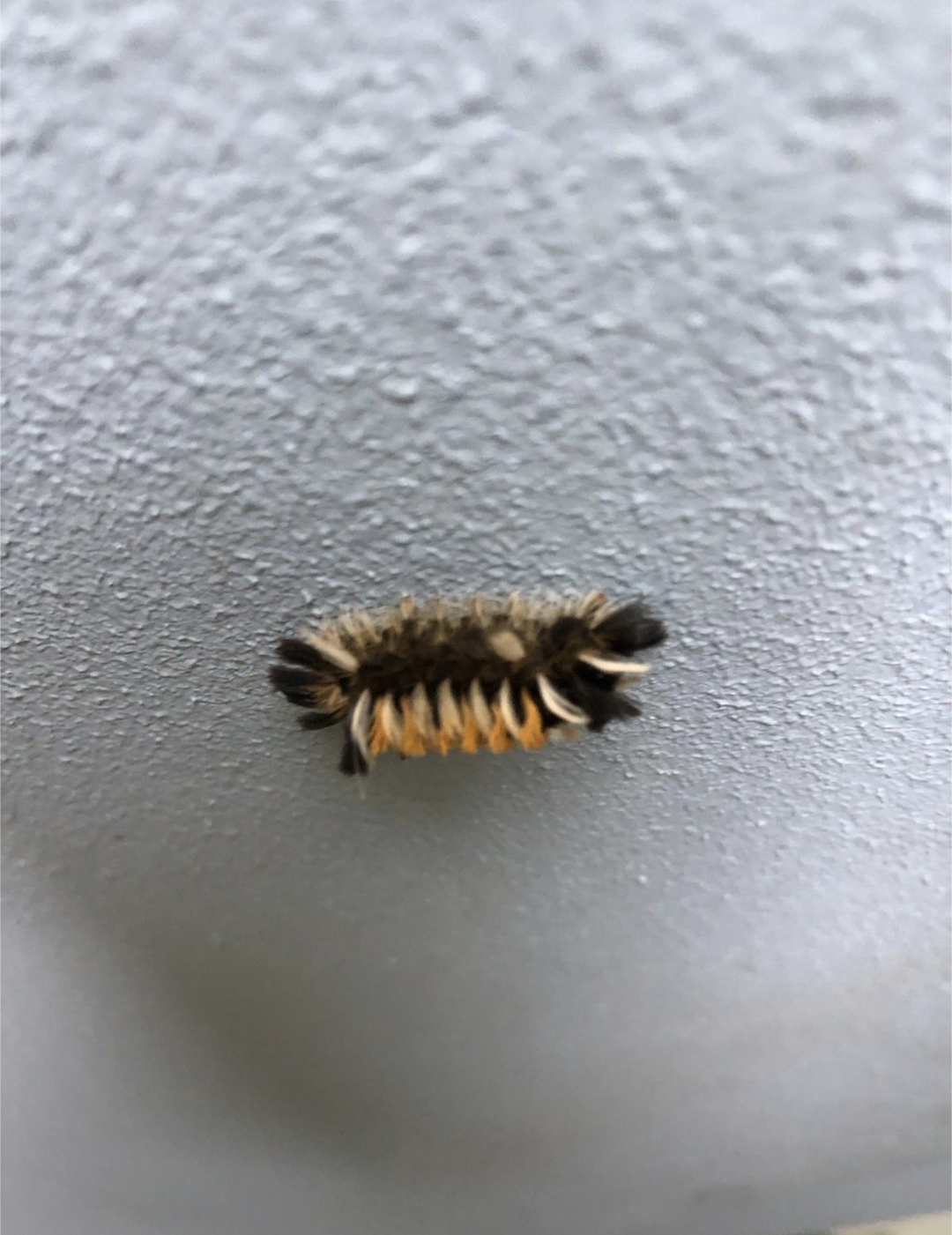
It's also a good time to look for caterpillars on milkweed plants, and not just for monarch butterfly caterpillars.  I found this small army of Milkweed Tussock Moth caterpillars on the underside of a milkweed leaf on the shoulder of Chemung Road.
Another tussock moth caterpillar, the Milkweed Tussock Moth (Euchaetes egle)

The whole tussock moth caterpillar started when a friend (thanks Tutu!) found this guy on a run down in New Jersey!


There are just a few milkweed plants around the lake as they grow mostly in fields that aren't mowed during the summer.  Around the lake we have mostly Swamp Milkweed.
Swamp Milkweed (Asclepias incarnata) on the shore of one of the Rawson Wood Islands.


I mentioned a couple of weeks ago the good pinecone crop this year.  They are really visible now in the tops of the trees, and the squirrels have begun to chew them off the trees to collect them before they release their seeds so they can store them away for winter.

I've also seen beech nuts underneath large beech trees, so the beech are starting to produce mast also.
Beechnuts on a trail in a hardwood forest.

The beechnuts are quite small this year, about half the size of what I expect to see.


There is a new development with the loons this week:  One of the chicks is starting show its independence.  Previously the two have always been close together, but now one of them is moving away from the family, starting to head out on its own.  
They sure have grown in two short months.
I can't tell them apart anymore.

There are still other loons visiting the lake, having daily interactions with the family.  One morning we watched two loons frantically wing-rowing back and forth and around the lake for long time, probably the chicks' father defending their territory.  When the chasing loon got close to the pursued, the later would thrust its head and one wing into the water making an abrupt stop and turn to throw off its pursuer - just like Starsky and Hutch's J-turn with the parking brake in their '76 Ford Gran Torino.  I wish I had some video of the chase for you.

I don't know how much stress eagles add to the loons' lives right now, but they are here, as this fabulous picture taken by Debby Crowley shows.
A bald eagle watches over all activity on Lake Wicwas.


I'll end today with a non-nature picture, but it's a really neat sight.  There are a lot of pretty boats on New Hampshire's lakes, but few as beautiful as this classic.
"N. H. Dreamin' " cruises the waters of Lake Wicwas.

Keep watching for those fuzzy caterpillars!

Sunday, August 12, 2018

August 12, 2018 - 250th Celebration

Meredith is celebrating it's 250th anniversary in 2018, and this week was packed with events.  On Tuesday the Meredith Historical Society sponsored a presentation on the History of Bear Island, on Thursday the Greater Meredith Program unveiled the New "Archie" statue, and yesterday the town sent a great parade down Main Street and back up Daniel Webster Highway.
"Archie" with scupltor Valery Mahuchy (second from right) and members of Bob Montana's family


Meredith's 250th Anniversary Parade proceeds down Main Street
You know you're in the Lakes Region when there are boats in the parade


It was fun a week, and good to have lots of excitement to offset more sad news back on Lake Wicwas.  It appears that our second loon chick, Sam, has succumbed to the attack of other loons.  The first indication we had was a single loon swimming quickly around the cove multiple times with its head on swivel as if searching for a lost chick.  We can't be sure of the culprit, but the parents have been fending off at least one rogue loon all summer, and with how large Sam had become this is the most likely cause.  Furthermore, the Loon Preservation Committee's Lake Region Field Biologist Henry Stevens (who spoke at the Lake Wicwas Association annual meeting last week) reported that this year "the overwhelming cause of nest failure and chick death was intruding loons."
My last sighting of Sam, August 7, 2018
It is sad, but this is nature ensuring the survival of the fittest.  A more concerning issue for Lake Region's loons was noted in Henry's presentation at the meeting.  He stated that New Hampshire is at the southern boundary for loons.  It's sad to think that as the planet becomes warmer, driving loons farther north, future generations of Lakes Region inhabitants might never experience the haunting call of a loon drifting over the water on a calm summer evening.


On the other hand, some animals may become more prevalent, such as this pretty caterpillar.
Milkweed Tussock Moth (Euchaetes egle)
New Hampshire is toward the northern side of its range, so it will be fine here as things warm up.  And this creature has some pretty amazing traits.  First, like the monarch butterfly, its preferred food is milkweed.  Did you know that milkweed has poisonous constituents called cardiac glycosides which affect the heart (thus "cardiac" in its name) and can be fatal to animals including humans?  [REF:  "Bug of the Week", Michael J. Raupp, Professor of Entomology, University of Maryland]  But the Milkweed Tussock Moth is unaffected by the poison, and in fact it consumes and stores the toxin in its body.  When a bird eats one of these caterpillars it immediately vomits, so predators quickly learn to leave these easily identifiable black and orange caterpillars alone.

And it gets better.  The toxins remain after the caterpillar becomes a moth, but at night, bats are the primary predator, and hunting at night, they don't have the visual cue to know not to eat them.  But this wily insect has also developed an organ that emits an ultrasonic sound that is detected by bats, so when bats have a similar unpleasant reaction after eating a milkweed tussock moth, they also learn to avoid them.  More information on this remarkable animal is at the link in the reference above.

One more animal item:  have you ever wondered why there are so may porcupines hit by cars?  Here's a clue:

I saw this big porker just waddling down the middle of the road without a care in the world.  I stopped to watch, and it wasn't until I pulled up quite close before it decided to wander off into the bushes.

Porcupines know almost nothing (other than a human) is a threat to it.

Perhaps our loons should grow quills.
Sam, July 4, 2018 - August 7, 2018