Showing posts with label Leatherleaf. Show all posts

Sunday, June 28, 2026

June 28, 2026: A Floating Nursery Log

Before we look at the nursery log, here's the loon update.  All our hopes for fledging a chick this year may fall upon little Northern Pip and its parents' vigorous protection of it from all danger. 

Northern Pip, five days old.  Photo by Debby Crowley.

Which by all appearances, they are doing. 
Two parents and one chick means twice the attention.  Photo by Debby C.

The reason we have all our hopes on Pip is because the southern pair has abandoned its nest - and for no clear reason.  On Monday, Shayne D. noted that both adults were out on the lake away from the nest.  On Thursday, seeing the same situation, I took a look at the nest, and found a single egg. 
A lone, unattended egg in the southern nest.

On Friday afternoon, the Loon Preservation Committee (LPC) gave the order to mark the egg and check it on Saturday.  Dave T. did that and found it had not been tended, so he collected it for analysis by the LPC.  We may not know the status of the egg until winter when things slow down enough for the LPC biologists to do forensics, but we may learn then why it was abandoned.  There's a chance the southern pair will attempt a second nest, but if not, we'll have to hope the big, strong male, and unknown female that make up the northern pair can keep Pip safe all summer long.
Our banded male, up close and personal.
Wicwas isn't the only Lake having loon challenges.  A pair using one of the floating nests that the LPC has a camera on is on their fourth egg, after three failures, each for a different reason.  Details were in the Laconia Daily Sun yesterday (see page 25).


Now the "nurse log".  You may have heard about nurse logs in the forest - large trees that fall to the ground and decay slowly over many years, providing a fertile bed for plants to grow.  Much of a forest floor is covered with a dense layer of leaves which can prevent germination, so these fallen trees can become filled with new life.  Well, on a paddle this week I came across an aquatic analog, an old log floating in the lake that's serving the same purpose, but for bog-centric flora.

Nurse log
Let's look at what's growing here.

The primary base plant is Sphagnum Moss, which covers much of the log and may provide a good place for other plants to take hold.

Sphagnum Moss

The tall, grass-like plant growing most profusely on the right is a sedge.  There are many varieties of sedge and I won't attempt to determine which this is.

Sedge

In the center is another tall plant, this one woody, which can grow quite tall and dominates much of the higher ground in the bogs around Lake Wicwas:  Leatherleaf.

Leatherleaf

Growing on the right side of the log, with a reddish-green color (which helps identity this species) is Bog St. John's Wort.

Bog St. John's Wort

One of the most interesting of our bog plants is the carnivorous Round-leaved Sundew, which is on the log in several places, but most visibly right in front of the St. John's Wort beside the bare spot on the log.

Round-leaved Sundew

When you find these on your paddles near a bog, look closely and you'll see fine hairs with a sticky drop of dew on each which catches small insects which the plant then digests.

Hardest to find on the log is the Purple Pitcher Plant, another carnivorous plant.  These are small, tubular stems growing right along the water's edge.  They'll be easier to spot in fall when they've grown larger.

A mature Pitcher Plant, fully grown in October.
Finally, the crown jewel of the log is the Rose Pogonia.

Rose Pogonia
This pretty member of the orchid family also grows on wet soil around water, and it's extremely abundant this year.  There are two growing on the log and another ten or so behind the log at the very top of the first photo of the full nursery.

These are some of the most common species seen in an exemplary acidic bog habitat in New Hampshire.  I will remind you that I have no formal training in botany, but am learning from books and often the internet (PlantNet ID is excellent), and I may not have all these right.  If you notice an error, please let me know!

In a few weeks, I hope to have a similar post on plants in the aquatic habitat, this time with expert assistance.  Wicwas' resident biologist, Russ Brummer, is leading a Weed-Watcher class on July 11th, and all are welcome to participate.  Below are the details in case you're interested in becoming a weed-watcher, or are just curious about the aquatic plants we have in our NH lakes.  Last year's class was interesting, and a lot of fun - you can see what we did on the July 13, 2025 post, "Weed School".

I hope to see you there!

Sunday, May 11, 2025

May 11, 2025: Happy Mother's Day!

Flowers for mom.

It's very kind of Mother Nature to provide a bright sunny day to help celebrate Mother's Day after a rather dreary week.  That's a Service Berry tree blooming on Sheep Island.  

Serviceberry (aka Shadbush) on Sheep Island.

I'd hoped we would have enough sun to get some of these trees blooming for Mother's Day.  The Black Cherry didn't make it, but the Hobblebush Viburnum did.
Hobblebush Viburnmum

This shrub has two distinct types of flowers.  The outer blossoms are sterile, and likely developed just to attract pollinators to the small fertile flowers in the center which produce the seeds.  It seems every plant evolved with some special trait that gives it enough of an edge to survive in a competitive world. 

There was enough sun to get a few more wildflowers to brighten up the world for mom, including these violets.

Common Blue Violets in a sunny moment.


Sunny moments were the exception for the week as it rained more days than not, giving us almost five inches of rain in the past week.  The lake rose to more to 12 inches above normal, even with the dam lowered.  We'll keep the dam open to get the lake down as quickly as possible so the loons will be able to access their nesting sites which are currently submerged.  This was the scene more often than not around the lakes this week:

A calm, misty evening.

I did fit in a couple of paddles between the showers, taking advantage of high water to explore areas of the lake that are typically inaccessible.  

Exploring a marsh near the Wicwas dam.

There were blackbirds singing loudly from tall stems in the marshes.
A Red-winged Blackbird sings its distinctive song.

I should also mention the new arrivals this week:  Chestnut-sided Warbler, Magnolia Warbler, Nashville Warbler, Yellow Warbler, and Blackburnian Warbler.  That's a lot of warblers!

I found leatherleaf that had bloomed in spite of the rain and high water.

Leatherleaf

These plants are wetland-specific species, not bothered by the high water levels.

I'll close with one more almost-flower:

A Pink Lady's Slipper preparing to bloom.

One more sunny day ought to do it - something to look forward to next week!


Happy Mother's Day!

A mid-day update:  I was way off on the lake level.  It's more like two feet above full level, lapping over the top of the dam!


Sunday, January 24, 2021

January 24, 2021: Hidden Secrets of Plants in Winter

January doesn't provide a lot of opportunities for plant observations because so many of them have closed up shop for the winter.  Flowers are either dormant below the snow or have died and left only their seed behind, waiting for the encouragement of the spring sun to spur them back to life.  The deciduous trees have cast off their leaves and sent all the energy they created over the summer down into their roots, also waiting for spring to warm the soil.  But the bareness of January does divulge some secrets that are concealed or inaccessible - or both - when the lakes are alive with summer greenery.  One such plant confessed its hidden beauty to me on a recent walk on the ice.

Tiny, spent blossoms of the leatherleaf.

These plants are abundant in the marshes around Lake Wicwas, the dominant plant in fact of many bogs around the lake.  I didn't immediately recognize it even though in the summer I'd seen it many times, it's pretty white flowers drawing my attention.  Now in winter, those tiny blossoms, still clinging to the branches, once again caught my eye.  Looking it up in the guide book reminded me it's leatherleaf.  

Next year's buds are already in place.

Here's the leatherleaf in its spring dress.

Leatherleaf  in its May glory.

Leatherleaf is classified as an evergreen (though it's leaves turn reddish-brown in winter). I should have recognized it!  

On the same winter walk on the lake we came across another plant exposing it's secrets.


This fruiting shrub is growing on a tiny island in the lake, and is one I still haven't positively identified but my best guess is a variety of viburnum.  It has large, dark berries that are not yet desiccated, but also not consumed by the birds. 


 Any suggestions?

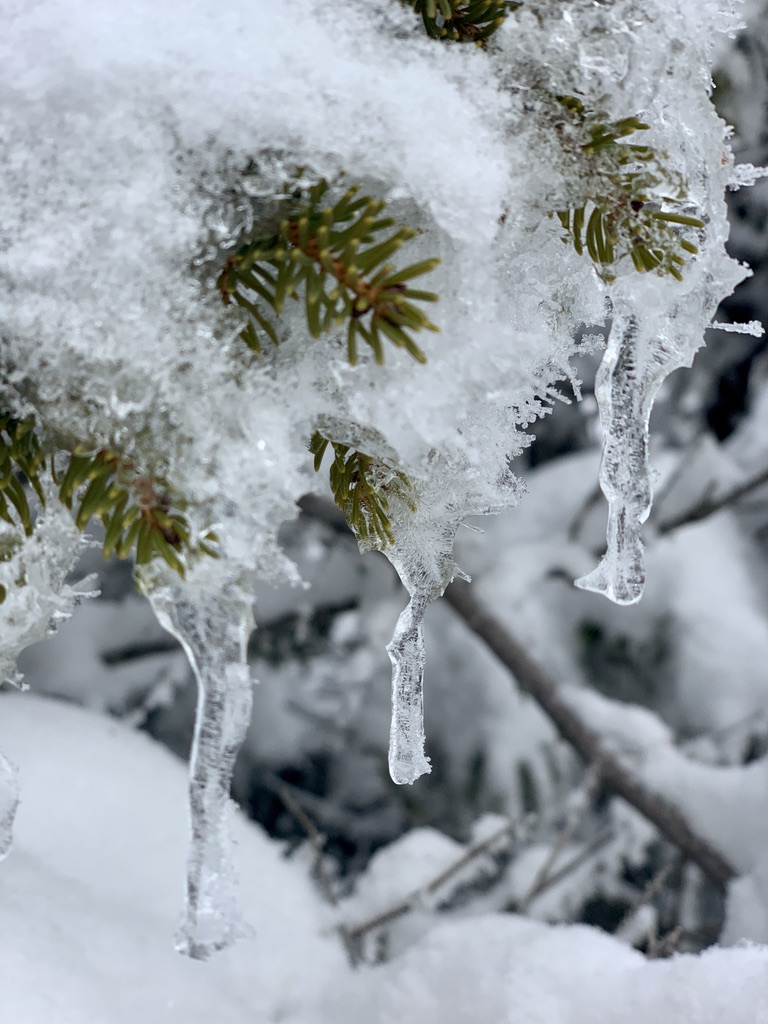
Of course, in winter there are plenty of other trees that, like leatherleaf, keep their leaves all winter - pines, hemlocks, spruce, laurels, both mountain and sheep, and sometimes in winter the heat they absorb from the sun, combined with surrounding cold air, creates icicles as on these spruce trees in the Sandwich Range at an elevation of about 3000'.  

Photo by Jim Lerner.

With more snow and cold blustery weather, it's finally feeling like winter in New Hampshire!

An untracked trail leads up to Jennings Peak.

But down under that cover of snow and ice there are plants and fish and amphibians, all waiting out these cold, blustery days, anticipating the time they can rise again.

Wind and snow add texture to the lake.

Sunday, May 17, 2020

May 17, 2020: Fresh Fish for Dinner

There is so much going on around the lakes these days, with wildflowers blooming, birds arriving, animals nesting, that I was already struggling with what to eliminate to keep this week's journal entry from being too long, and then something exceptional came along that trumped all.  One evening, right at dinner time, Linda saw a large raptor fly by with a good size fish dangling from its talons.  Then, lucky for us, it decided to savor its dinner just about a hundred yards away and though it was partially blocked by trees branches it was clear enough for us to see that it was an osprey, and for us to watch what unfolded.  I should warn you, this might get a little graphic.

Somehow the bird managed to land on a branch with one foot without dropping the flailing fish - which was very much alive - from the other foot .


It held on to the tree with one leg and onto the fish with the other.

It looked like it caught a horned pout (aka catfish, officially the brown bullhead), but I'd be happy to have any fishermen out there weigh in on the identification.
Looks like a Bullhead to me.


If it is a catfish, that's interesting, as catfish prowl around on the bottom of the lake - not where I'd expect an osprey to be fishing.

When the fish gave a violent thrash it would throw the osprey off balance and it would have to use its wings to keep its perch on the branch.  This went on for a while, and at one point the bird seemed to yell at the fish, "Give up, your fate is sealed!"
"It's over!"

Eventually the fish lost enough strength that the osprey was ready to partake in its catch.  (This is where it gets bloody.)  The osprey started at the head, perhaps even avoiding the skin, and reached inside the fish's mouth to extract choicest cuts of meat.
The first tasty bite.

It would rip out a chunk of flesh and then lift its head up to swallow it down.
A piece of fish being chewed.

Every now and then it would look over at me to make sure I wasn't an eagle that was going to swoop in and steal its hard-earned dinner.


We watched for while, but eventually the osprey flew off with most of the fish still intact.  This was most likely a male, as females do most of the incubating while the males provide food for the nest.  Mom - and any chicks if they have hatched yet - will be happy to have fresh fish delivered right to their home for dinner.

OK, even with lots of other action taking place right now, it all pales in comparison to that, but here's a quick run down of what else is happening around the lakes right now.

Downy Serviceberry and Leather Leaf are blooming.
Leatherleaf (Chamaedaphne calyculata) grows right at the waters edge.

Downy Serviceberry (Amelanchier), also called Shadbush, are blooming all around the Lakes Region,
some growing as tall as 30'.

Their blossoms will produce edible fruit.

So are many azaleas.


The beech have followed the maples in pushing out new leaves.
Early beech leaves.

Last week's pond lilies have already pushed buds up above the surface of the lake.
Yellow Pond Lily.

Ferns are sprouting, and Jack has woken up.
Linda got some of these at Moulton Farm this week - they're delicious with butter and garlic!

Jack (in-the-Pulpit) is just getting started.


I also saw my first butterfly, first dragon fly, and heard my first leopard frog and spring peeper this week.  I'm seeing deer tracks regularly on my morning walks, including this set along the edge of the road.
Deer tracks near Chemung State Forest.

The warblers are arriving in mass now, which means one thing is certain: black flies.
Is seeing and hearing these pretty birds worth suffering with black flies?


 .

Those swarming, biting insects may drive us crazy, but they're a critical food source for all our beautiful song birds.  And the fish rely on them too, especially their larvae.  Which means, in turn, our fat and happy osprey does as well.
Off in search of his next meal.