A somewhat random record of observations of what's happening around Lake Wicwas and the Lakes Region. I hope to post about once a week - your comments are welcomed.
We have our first loon chick of 2026, earlier than anticipated. Eagle-eye loon-watcher Amy saw it on the morning of June 17 with both adults tending to it, far away from the nest. Which raised the question, was there a second egg? With the three loons well away from the nest, Amy checked the nest and found an unattended egg just sitting there. So we called the Loon Preservation Committee and they said the parents may return to it, but we should mark it and check again in 12 hours to see if it had been turned. If not, it would be an inviable egg. So following the described procedures, I went to mark it. When I got close, I could see it was damaged - there was a crack in the shell.
But then I thought I saw the crack move. And then I heard a peep!
The crack was the chick inside starting to peck its way out! I couldn't resist taking some pictures before I got out of there, hoping the parents would hear it calling and return.When I checked again in early evening, one loon was back on sentry near the nest, and the other was on the nest, and the next morning - there were two chicks!
Riding on mom's back.
Two chicks safely tucked up under dad's strong wing.
So now the addictive draw of watching baby chicks being raised has begun. One parent dives constantly to find tiny minnows for the chicks. Sometimes it takes a bit for the small fluff balls to build up the confidence to swallow what must appear huge to them. But when they're hungry enough, they do it.
Mom takes a well deserved nap.
While dad quietly brings in dinner.
Junior takes over.
It's a big bite.
Going down.
And dad's already searching the next fish.
Unfortunately, the good news didn't last long. The very next night there was a lot of loud ruckus on the lake, and the next morning, only one chick was to be seen. The pair has been fending off a rogue loon the past few days, and that may be culprit of the chick's demise. It was hard to watch the adults floating in the lake for hours that morning, scanning the water and cooing gently in hopes of locating their lost chick. Contrary to the tranquil appearance, being a loon is not an easy life.
We assume the surviving chick is the older, larger, stronger of the two. The tradition on Wicwas is that a chick is named by the first person to see it. Amy named our little one "Northern Pip".
Meanwhile, the southern pair has taken up residence on their nest, and because it's in a more travelled part of the lake, signs have been placed to alert boaters. Please encourage anyone you see too close to back off a bit.
Southern nest. Photo by Dave Thorpe.
Earlier in the week I saw a different bird collecting food for its young chicks.
A Tree Swallow with a beak full of damselflies.
There have been a lot of tree swallows zooming all over the lake this spring, feasting on the plentiful insect population that thrives near water.
On land, the mammals are raising their young as well. I came across a doe that was nursing a tiny, tiny, fawn right along the edge of the road beside the Hamlin Town Forest. I was on my bike and I stopped. Mom stared at me for a moment, then walked calmly off, dissolving into the forest. The fawn, confused, stood there for a second or two before wobbling off on its spindly little legs to find its mother. A second four legged animal we're not quite sure we're happy about is a skunk family that has taken up residence behind the house. So far we haven't seen anything more than a few little black and white fur balls scurrying around in the trees as mom shoes them back into the den.
The skunk family residence in the rocky hill behind the house.
Soon enough they'll be out exploring their neighborhood, and though skunks are mostly nocturnal, juveniles will often sneak out during nap time when mom is sleeping. Fortunately, young skunks don't develop the ability to spray for about three months, and by that time we hope they have learned to sleep whenever we might be out and about!
We'll be in loon overload for next couple of months, so I'll end with another of nature's summer light show.
The crescent moon was back to join Venus and Jupiter in the western sky.
It has been so windy this week there hasn't been much time on the water, but early in the week I had a nice paddle around the northern parts of Lake Wicwas including a trip up Blake Brook to the beaver dam. On my way across the center of the lake I was treated to an exciting acrobatic show being put on by a flock of tree swallows. These aerodynamic wonders are so quick and agile as they swoop overhead in pursuit of flying insects that it's hard to keep an eye on them, let alone take a picture.
The aerodynamic tree swallow (Tachycineta bicolor)
But I floated for a long while in the middle of the lake on a beautiful spring day, content to just watch the show and click away almost randomly, hoping I'd catch something to share. I didn't count, but with probably close to a hundred pictures I managed a few that had a not-too-blurry bird in them.
Much of the time they spent swooping the surface of the water,
A perfect setting for DL for this tree swallow.
but they would also soar high in the sky on occasion.
I wonder if they went up there to scout for bugs or just to enjoy the view.
Tree swallows are the first of the swallows to arrive each spring, both because they eat fruit in addition to the insects they collect, and also because they winter farther north than other swallows. They are not picky eaters, going after just about any insect they can find, and sometimes eating mollusks and worms. [Ref: Cornell Lab of Ornithology] During the breeding season they will also search out egg shells (goose, loon, egg shells from your compost pile - whatever they can find) for the calcium needed to produce their own eggs. [ibid]
I believe their Latin name of bicolor comes from their varying iridescent green and blue colors depending on how the sun hits their feathers. Their common name comes from the fact that they nest in trees, usually in cavities that other animals such as woodpeckers have created (yet another reason to let dead trees stand in the forest). To create a comfortable nest for their young both parents will collect cast-off feathers from other birds to line the inside of the tree cavity.
Something else I learned from the Cornell Lab is their unusual bathing method: tree swallows will skim low over water, dipping their bodies into the water, then fly up, shaking off the water and any dirt it attracted from their feathers. Now that's something to watch for next time I see their air show over the lake!
Here's another example of artistry in nature - look at the perfect shape and symmetry of this bird's wing feathers.
I always think of one of Lake Wicwas' ardent nature-lovers when I see swallows hurtling through the sky ever since I learned that he loves these birds and watches for their return each summer!
Eventually I went on my way, continuing across the water, paddling up Blake Brook, a much easier task in early spring before the lily pads clog the way. As I neared the dam I thought someone was mowing with a tractor on the other side of the beaver pond as I heard the slow chug of diesel motor. I honestly looked across the lake trying to figure out where the machinery was, without success, until I realized it was within the dam itself. Water glugging through the dam was making the tractor sound! You can hear it chugging among the spring peepers and the scolding chick-a-dees that weren't happy with my presence here:
It reminded me of how Steamboat Springs, Colorado was named after a hot spring that made a thumping sound like a steamboat. How does "Tractor Brook" sound?
I couldn't see over the top of the dam but held up my camera and would guess that the beaver pond is one to two feet higher than the lake level.
That's a lot of impounded water to help get us through a dry summer, and perhaps a big factor in Wicwas maintaining its level during last summer's drought.
I neglected to mention last week that I saw my first trailing arbutus flower on April 17th, though I had a report of a sighting a couple of weeks earlier in a warm spot on the Sherman easement at the Page Pond Town Forest. (Thank you for the report JS!)
Trailing arbutus (epigaea repens), also known as mayflower - April 17
I'll end with this altered picture I took a couple of weeks ago, just hours before ice-out - see if you can detect how I modified it.
It looks a little strange doesn't it? It's upside down. Here it is in its proper orientation:
This was taken at 7am on April 8th, the day of ice out, that beautiful calm day of my first paddle of the season.
For the second year in a row there are two loon nests on Lake Wicwas. I expect we'll see a band on the first pair to know it's our long-resident female, but without bands to identify the second pair we we can only postulate these are the same birds which have returned for another year.
The second nest is in a secluded spot on the lake where there isn't much boat traffic so it will not be marked with signs and its location won't be advertised. If you do happen to come across it or observe a loon behaving strangely just move away from the area.
I noticed the nest because two loons were close together near shore but clearly not fishing. Thinking something was going on, I took some pictures from a distance but only after blowing them up did I see they were building a nest on a tiny mound of earth. One bird was at the nest pulling up weeds while the other loon was farther out searching for more substantial building materials and bringing them back.
The second loon gathering sticks for the foundation
As of today a loon is sitting happily on the nest, though it has no shade at all so when the weather gets hot it might not be so happy. It will be important for one parent or the other to stay on the nest as an egg can cook quickly if exposed to the hot sun. They'll switch positions frequently to allow their partner to go for a swim and cool off.
Last year both of our loon pairs laid two eggs and each hatched a single chick, but both of them succumbed to the many threats a loon chick faces. Let's hope things go better this year.
The other large birds that nest on local lakes seem to fare much better, and the parents have already hatched their eggs and are out on the water tending to their brood.
Seven little goslings in a row
Geese and loons will sometimes interact but mostly they keep their distance from one another.
When I was out attending to some conservation areas on the lake this week I was visited by a few other birds including one I don't see very often.
A curious song sparrow wondered what I was up to
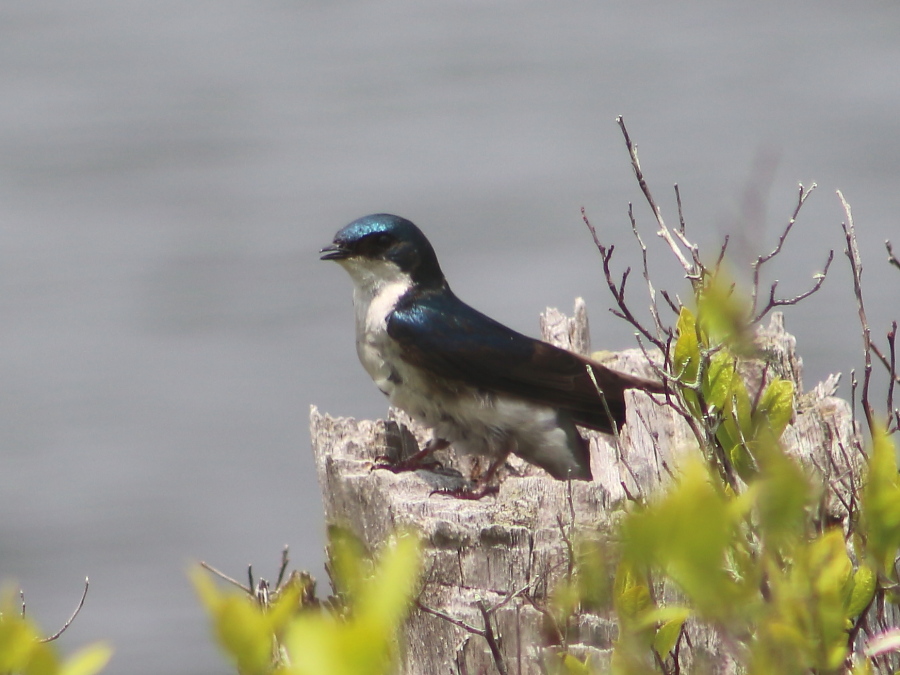
And a tree swallow sat for a long time and watched
Both of these were on Turtle Island. This next one was poking along the rocks over at Bryant Island looking for insects to eat.
I don't see a spotted sandpiper on the lake very often.
It's always nice to have some company to share the beautiful sights of early summer on the lake.
.jpg)
.jpg)


.JPG)