Sunday, April 8, 2018

April 8, 2018 - The Early Goose Gets the Nest

The Canada Geese always arrive at the lakes long before I think they should, well before the ice is out.  But this year, unless they get a sudden change in the weather pattern, they are going to have a particularly long wait to get their feet wet.
It looks cold, but at least it's soft

I can only imagine they arrive early in order to stake out their nesting location.  One pair always nests in the marsh near here, and these two are probably just hanging out to keep any intruders from taking their spot.  And yes, that's fresh snow all around, about 3" worth that fell on Friday night.

And just when we starting to see signs of progress towards spring, including the first bright yellow gold finch of the year.
My first "gold" finch

And then, the very next day:
Sitting in snow, looking for spring

Strips of liquid water were starting to open up along the shore lines, but when the temperature fell below freezing overnight, they iced over again - the water must still be only 32 degrees.  At least the strong April sun melts things away quickly at this time of year.
That black ice was water the day before

But fresh snow followed by blue skies is always a great reason to get outside and enjoy the sights.  I'd heard about a new hiking area managed by Squam Lakes Association in Ashland called Whitten Woods, so I took a drive up there to explore.  It's an easy loop of about 4 miles including a spur to a second summit.
Whitten Woods

There have been views cleared from the south summit and along a ridge approaching the north summit, both of which provide nice views of the mountains and lakes to the east.
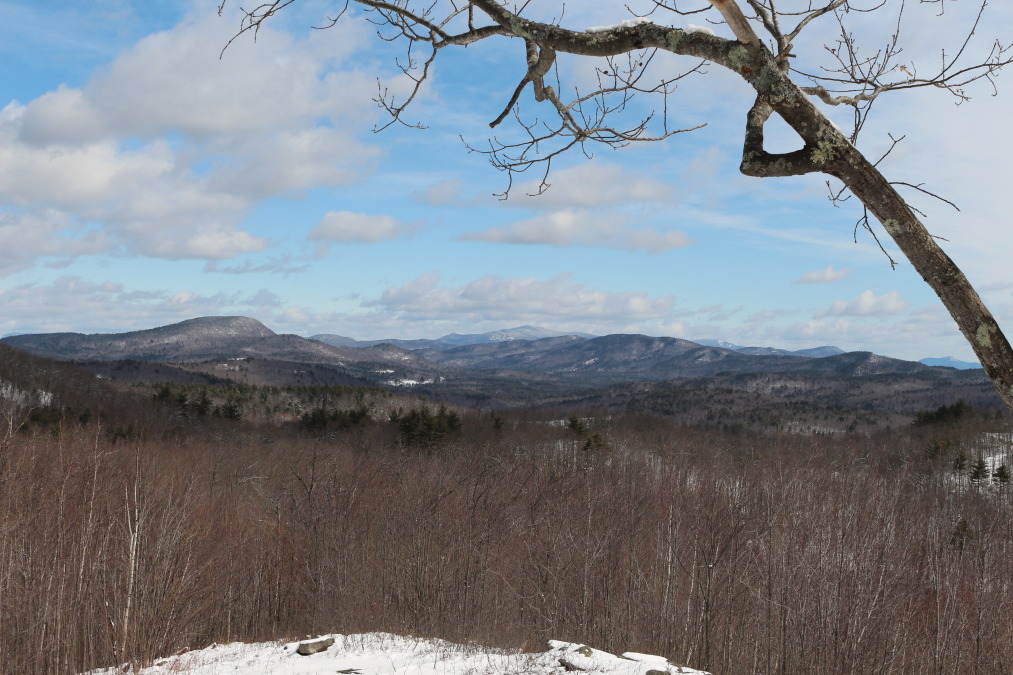
View from the south peak

The trailhead is on Highland Road, one mile north of Ashland center, and they have trail maps at the trailhead and posted along the trails at each junction.


Finally, on a run through Meredith Center this week I saw someone doing spring cleanup at an old family cemetery so I stopped to thank him.  He wasn't doing it for any group, or because he has any relationship to the family buried there;  he was just being a good neighbor and citizen, and he's been maintaining it for several years.  Volunteers truly are what makes New Hampshire such a great place to live.
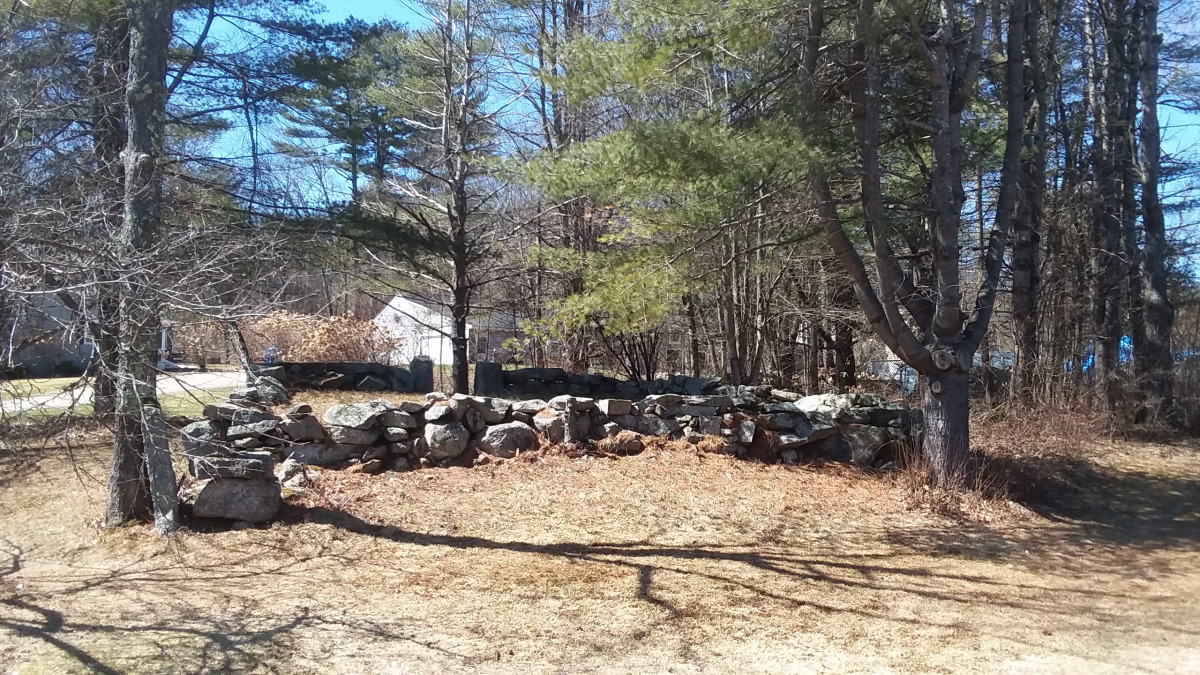
Cemetery on Meredith Center Road at the intersection with Chemung Road

Sunday, April 1, 2018

April 1, 2017 - Carnivorous White Pines

That may sound like an April Fool's joke, but it's true, though somewhat indirectly.  A friend recently told me about spotting bunches of snow fleas - a type of insect know as springtails - on the snow (thanks BB!).
Snow Fleas on my finger

These are very tiny animals, but there are lots of them.

This reminded me of something I read in the Society for the Protection of New Hampshire Forest's publication "Forest Notes".  [Summer, 2017]  It has been found that a certain type of fungus, the bicolor deceiver (Laccaria bicolor), has a toxin that kills springtails when they feed on the fungus.  The toxin paralyzes the springtail, and then the fungus absorbs the insect's nutrients through filaments it extends into its body.  Knowing that the underground portions of fungus exchange nutrients with trees, scientists tagged a bunch of springtails with a radioactive tracker so they could follow it through the food chain.  The tagged springtails were placed near fungus which were in proximity to white pine, and after a few months, they found the pines contained radioactive nitrogen from the snow fleas.  It is incredible how so many creatures are interrelated and depend on each other for survival.  You can read more details about the process from the SPNHF article here.

The snow fleas will be around all year, though once the snow is gone they won't be noticed without looking for them, as they blend into the forest floor.
Snow fleas on an oak leaf

But they'll find the mushrooms, eat them, and in return, be fed to our giant white pines.
How many snow fleas were consumed in creating this giant?

As the snow melts, signs of spring are becoming more evident.
Puddles forming on the lakes
Hobblebush Viburnum ready for spring

Beaver ponds starting to open up
Meredith Bay peeling back


There are even a few green plants starting to photosynthesize the increasing sunlight.
Tree clubmoss (Lycopodium dendroideum) reappearing from under the snow pack

But don't let these signs fool you - there isn't much spring in the lakes on this April first.
Happy Easter!

Sunday, March 25, 2018

March 25, 2018 - The Sap is Flowing

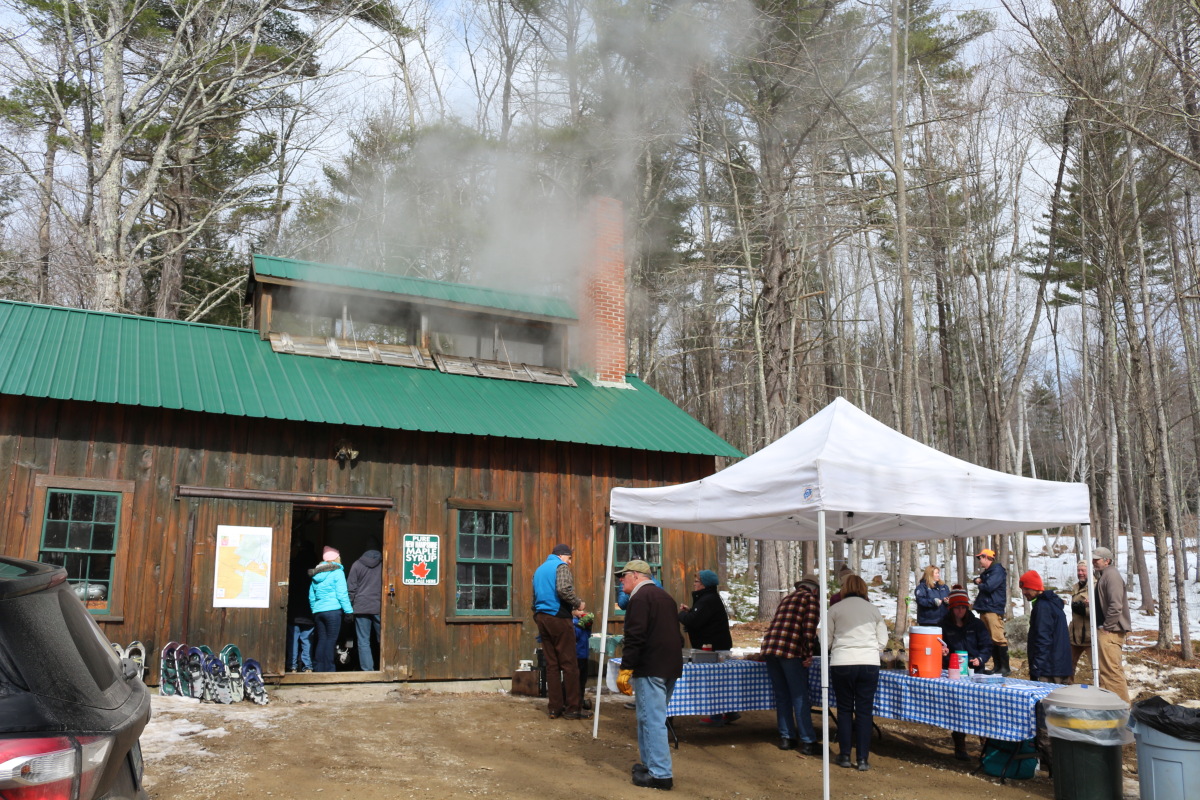
Sugar season is in full swing right now and central New Hampshire is having an excellent year.  Yesterday I went to the Maple Sugar Day at Burleigh Farm in Holderness, which was holding demonstrations of their sugaring process, tours of the sugar bush, and most importantly, tastings!
Sugar Shack at Burleigh Farm

The event was sponsored by the Squam Lakes Conservation Society, Squam Lakes Association, and the Lakes Region Conservation Trust which holds the conservation easement on 1500 acres of forest and farmland that protects the home of all those maple trees.  A knowledgeable team was on had to explain the process and answer everyone's questions.
Matt Evans describes the complete process from tree to jug
The final product ready for tasting
Yum!
The farm has taps in 3400 sugar maples which all flow via tubing, under vacuum, directly to the sugar house, allowing them to produce over 1600 gallons of maple syrup each year.
Collecting sap straight from the tree
One benefit of this system is that the sap doesn't contain all the bark, bugs, and other detritus that found its way into the sap with open collectors.  Unless, of course, a coyote or a fox decides to chew on the tubing and tear it open.

With that quantity of sap to process, the sugar house has been updated with modern technology.  The raw sap is processed through a reverse osmosis membrane system which concentrates the sugar content from about 2% straight from the tree up to 14% after two passes through the system.
Peter Webster explains the membrane system

This greatly reduces the amount of boiling required.  After being concentrated by reverse osmosis it is finished in a good old fashioned open boiler, but heated with oil or propane rather than wood.
The final boil

But from the outside, it has all the appearance of a traditional New England sugar shack.


Later, back closer to home, I saw that the Chemung Gang sugar shack was boiling away as well, still doing it the good old fashioned way!

The lakes sure don't look much like spring, but nonetheless there was a nice reminder that spring is coming:  I saw my first loon of 2018 fly overhead one afternoon - apparently we are not only ones watching the lakes, waiting to see some open water.  And wait we will, as there are still 21 inches of ice on Lake Wicwas.
Thick ice remains even where it is hanging in air because the lake has dropped
It's going to be a while before this mass of snow and ice lets the loons come home
That photo was taken after the most recent snow storm (for us that is - we missed the fourth nor'easter which hit only the southern part of the state).  What is so intriguing for me is how tracks in the snow change over time.  Those depressions formed by snow shoes were completely inverted after just a few days of wind and sun acting on the snow - five days later those indentations had become convex bulges sticking up above the surrounding snow.
Wind and sun etched away the softer snow, leaving the packed tracks protruding up
After the storms we had more perfect blue-sky days luring me out onto the trails.
The Mill Dam in the Page Pond Town Forest
More apples still to fall for the hungry spring animals
I knew apples must still be around due to seeing fox and coyote scat containing apple skin, but it was neat to see some still hanging on their branches.

A final note, as bears are one of those hungry, spring animals, NH Fish and Game reminds us:  Spring is Here: It's Time to Take Take Down Birdfeeders!
Photo by NH Fish and Game
Those loons aren't the only animals out in search of spring.

Sunday, March 18, 2018

March 18, 2018 - House Cat or Wild Cat?

It was another eventful week in New Hampshire as nor'easter number three blew through the region pushing warm air ahead of it, heavy snow during it, and the usual blast of cold, clear weather behind it.
Blue skies yesterday on the way back down to single degrees

On a warm day before the storm I went up to Arbutus Hill Pond in the Eames Conservation Area to see what was happening on the beaver ponds in late winter/early spring.  Walking in I came across the occasional coyote or fox track, but as soon as I neared the pond the animal activity increased dramatically, with otter, mink, and weasel tracks all around.
Many tracks leading from one opening to another
One mink down the hole
Otter slides all around the pond

It's no surprise that, as scientists are finding and documenting in books such as "Blue Mind" [Wallace J. Nichols;  Little, Brown, and Company, 2014], being near water makes us healthier and happier; water has been attracting, sustaining, and evolving life for millennia.  And that's in addition to the fact that it's just plain beautiful.

Water isn't the only thing that attracts animals - trees, plants, and their fruit are also large draws, bringing in forest animals such as birds and rodents, especially when concentrated into feeding stations.  And these in turn, bring in the predators.  A bobcat made several visits along Wicwood Shores Road before the latest storm, and thanks to Marge Thorpe, we have some great proof.  Look as this feline, sitting on someones doorstep just like a cute little house cat.
A house cat?   Photo by M. Thorpe

But let it turn its head, and its clear this is no domesticated animal.
Photo by M. Thorpe
The source of its attention was a collection of birds and red squirrels.
Mamma squirrel was a target.  Photo by M. Thorpe
As seen in this picture, it is breeding time for squirrels, and I kind of hope the kittens of this nursing mamma aren't orphaned by a hungry cat, but sometimes that's the way nature goes.  And at this point female bobcats are gestating their young, so at least it would nurture a different new life.  Bobcats typically have two or three kittens, but in a high food year they may have up to seven [wildlife.state.nh/wildlife/profiles/bobcat.html].

Thank you Marge for sharing the great pictures of wildlife in New Hampshire!

Photo by M. Thorpe


Sunday, March 11, 2018

March 11, 2018 - Changes, Fast and Slow

It was a week of contrast in most of New England, even throughout much of the Northeast, as the second nor'easter in six days passed through.  The week started like this

transitioned through this

and ended like this.


The 12 to 15 inches of dense snow resurrected the skiing and may have averted an early end to the season for many ski areas.

Fresh, pristine snow always entices me out on the snowshoes, and on Friday I crossed paths with our local bobcat, so I followed it along for a bit as it wound through the woods.  It took a good part of a mile before I found a print that was clear enough to confirm I was following the path of our only wild feline.
The round shape and boomerang foot pad of the bobcat

Nothing of note was observed from the cat, but one of the perks of following tracks is being taken places you've never been before - or would never go on your own volition:  through dense hemlock stands, across (barely) frozen swamps, and up ledges, all of which an 18 inch tall, four pawed creature thinks nothing of traversing.
Across almost-frozen wetlands
Up rocky ledges

This particular bobcat led me on a trip where I discovered an old relic from New Hampshire's agrarian past.

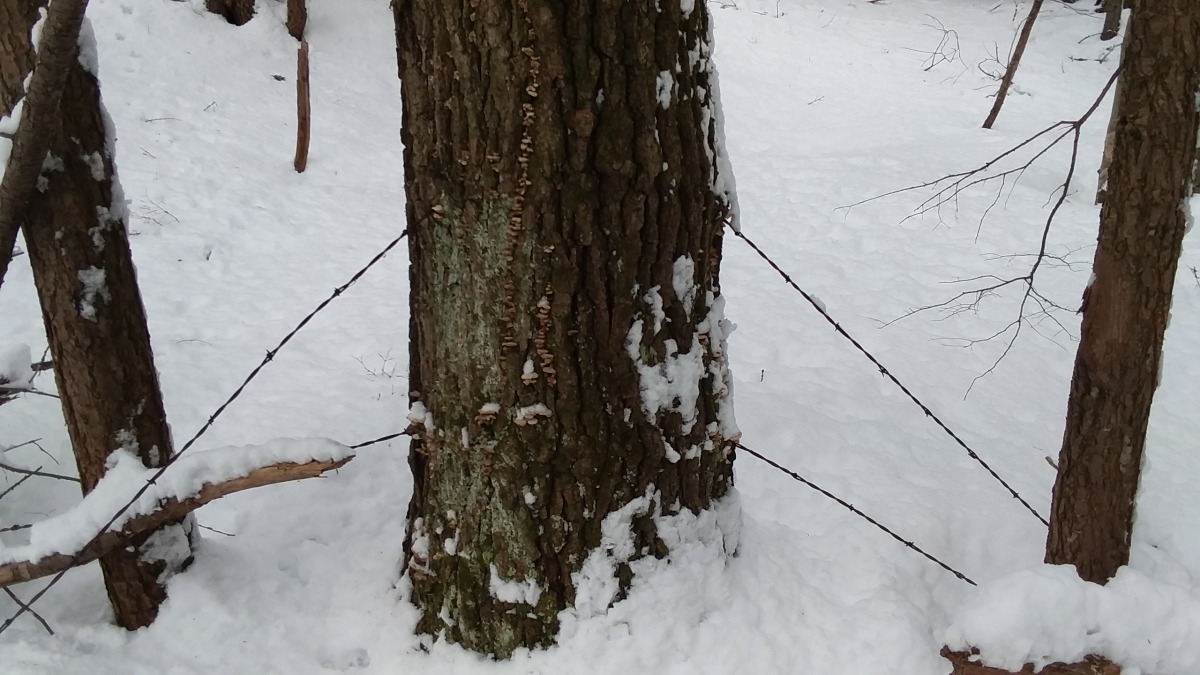
I love finding these old barb wire fences passing through the center of sizable trees.
I'm no expert on tree aging, but this red oak could easily be 100 or 125 years old, and since the wire is pretty close to the center it means the fence was set when the tree was just a tiny sapling, dating the wire to perhaps the late 1800's.  This recalls a different contrast in the New England landscape, one that happened slowly over the better part of a century.  A hundred years ago this land as well as most of the Lakes Region and much of New Hampshire was completely cleared of forest for farming, for lumber, and then for grazing.  Picture all the land around the lakes as fields rather that forest;  it's a stark contrast that happened slowly over so many years it was hardly noticed.
A typical New England landscape in the late 1800s

Another tree farther down the fence line has died and almost completely rotted away, again showing the age of the fence.
Wood around the wire indicates the size of this tree before decay set in

It appears that scar tissue grown to isolate a foreign object is more rot-resistant than the rest of the tree.

I also found a pretty ambitious pileated woodpecker excavation project.


It's hard to see, but the bottom is about 3" below the opening
This looks like a nice future residence for some bird or rodent.  And speaking of rodents, it sure was strange to see the chipmunks struggling to get through a foot of new soft snow.  They probably aren't enjoying the change back to winter any more than many humans, but at least we can appreciate the restored winter splendor.