Showing posts with label Arbutus Hill Pond. Show all posts

Sunday, February 18, 2024

February 18, 2024: Arbutus Hill Snowshoe Tour

The Meredith Conservation Commission had a successful snowshoe tour up to Arbutus Hill Pond yesterday when an avid group of winter enthusiasts made the three mile hike to the pond and back to explore the activity that takes place there in winter.

Photo by Marcella MacKenzie.

The fresh snow we had on Friday along with another light dusting Saturday morning not only made it quite pretty, but also created a nice surface to see animal tracks.  Along the way we saw tracks of fox, bobcat, ruffed grouse, deer, weasel, and mouse.
Bobcat print.

Grouse tracks were found in several areas of hemlock forest.

Mouse tracks.  There were also many red and gray squirrel tracks to be found.

The two-by-two track of a weasel, perhaps a mink or an ermine.


We walked on the ice beside the long beaver dam that impounds the pond, and stood within a few yards of the beavers themselves, warm inside their well-constructed lodge.  


We even found an old otter slide on the ice.  It was an enjoyable trip with good company on a perfect winter day.


I mentioned last week that the Great Meredith Rotary fishing derby was held last weekend on all the lakes in New Hampshire, but I didn't get down to the headquarters at Meredith Bay until Sunday afternoon, so here are some of the fish that ended up on the board.
The leaderboard right at final weigh-in last Sunday.
Some good size pickerel.


I like the way they award the grand prize:  The largest fish caught in each species is entered into a drawing for the grand prize, meaning regardless of what species you're fishing for, you have a chance to win. The grand prize winner this year was an 2.5 pound 17" black crappy.  
The Black Crappie board with the grand prize winner.

It was caught by Tom LaBrecque in Cawley Pond in Sanbornton, just a 26 acre pond, but obviously growing some big fish.  The winning angler has been fishing in the derby for some 35 years.

The uncertain ice conditions on the large lakes did in fact send a lot of people to Lake Wicwas, with cars lined up at the boat ramp as well as along Chemung Road near Harris Cove. 
Many anglers out on Wicwas last weekend.


It was a beautifully warm and sunny weekend for all the anglers to enjoy.
Wicwas fishermen enjoying 50 degree weather on Derby weekend.


The ice is plenty safe on Wicwas now - I measured 10-1/2" this week - and the ice has started to groan and moan as stress cracks form in artistic patterns across the lake. 
But the warm weather has foiled the Alton Bay ice runway, which for the second straight year will not open for planes to use due to lack of ice.  It's the first time ever that it hasn't opened two years in a row.

Finally, last week's warm weather did produce a sight for those thinking about spring:
Snowdrops on February 11th.

It's the earliest date I've ever seen the snowdrops emerge.


Sunday, January 8, 2023

January 8, 2023: Arbutus Hill Pond Beavers

In early December I noted a lot of beaver activity at Arbutus Hill Pond in the Eames Conservation Area (accessed via the Hamlin/Eames trailhead) so this week I took a walk back up to explore further now that the pond is frozen.  I found that the main beaver lodge has been well maintained, and a second lodge has been added to neighborhood.  

Two active beaver lodges at Arbutus Hill Pond.

This might explain all the activity this fall:  They needed building materials as well as food to sustain an expanding, multi-generational family network.  Larger branches from the trees they felled were used for lodge construction while the smaller branches and twigs were taken for winter food.  Beavers don't typically eat hemlock trees, but they are smart enough to know if they cut them down it will leave space and light for their preferred species to grow.  One homeowner even got into the holiday spirit and used hemlock to erect a Christmas tree on their lodge.


As the population grows beavers need a larger pond to support them and they've been busy on this aspect as well.  The beaver dam on the west side of the pond has been elevated to enlarge the pond, which also required lengthening it so the water wouldn't spill around the ends of the dam.  

Looking south along the dam.

The same point looking north.  The water level below the dam is perhaps three feet lower.
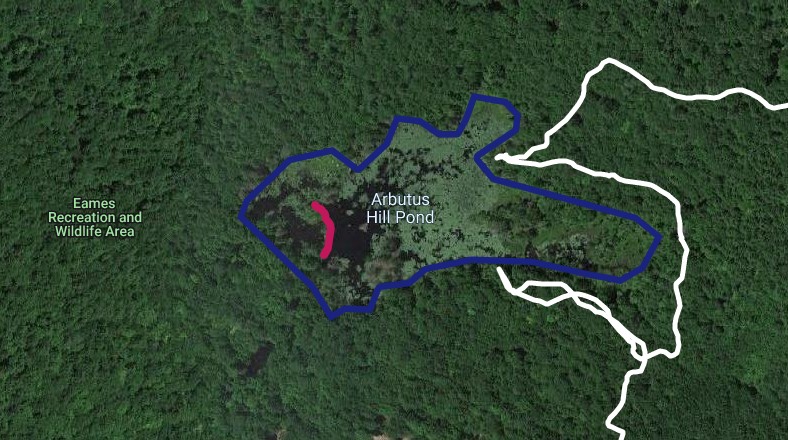
With no snow on the ground when I was there I could easily see the entire dam which I estimate to be 250' in length.

The pink line is the dam, the blue line is the extent of the wetland.  The white line is the hiking trail.  

I think there may be a second dam at the west point of the wetland - something to look for on a future visit.  Winter does make exploring wetlands much easier, though one must be careful of thin spots where there's moving water and beaver paths, especially with all the recent warm weather.  If you would like to visit you can find a trail map at the kiosk or on the Meredith Conservation Commission website.


In mid December we decided it was safe to put the bird feeders out for the winter and it was interesting to watch how long it took different birds to find it.  Within minutes a blue jay was on the feeder, but that was all on the first day.  Surprisingly it took until the second day for the chickadees to show up.  

Our first chickadee on the feeder.

By day three there were a bunch of chickadees, and on day four too many to count, as well as five gray squirrels.  On day seven a red-bellied woodpecker appeared.  It only spent a few seconds on the feeder before it flew off to explore every tree trunk in the yard looking for fresher food.  It's such a pretty bird I hope it returns often.  That same day the first white-breasted nuthatch made its appearance.  Since then there have been many nuthatches, following their usual routine of shoveling seeds out onto the ground until they can get to a great big juicy seed or nut.  Two days later we saw the first downy woodpecker, followed shortly by it's larger relative, the hairy woodpecker.

A hairy woodpecker selects a choice seed.

And it looks like it's going to be a big year for gray squirrels.  One day there were 14 of them in the yard, mostly staying on their own designated feeders and taking advantage of the nuthatches discarded seeds. 


With the low production of acorns this year I expect a lot of squirrels will be looking for handouts.  Maybe the bobcat will switch from venison to squirrel.  He may get a bird or two as well, but they are pretty good escape artists.

We received a couple of inches of snow on Friday, and fresh snow on a heavy overcast day always brings great contrasting scenes.


It even made me notice these tiny self-heal plants, standing in stark contrast against the white snow. 

Dried self-heal blossoms (Prunella vulgaris) poking up above the thin snow cover.
I've walked by these a dozen times in the past few months and never noticed them.  Their dried flowers remind me of hop cones - the kind used in making beer.


At least with Friday's snow the remnants of the deer are covered up - and it looks like winter again.


I hope this finally means a change to a winter weather pattern!


Sunday, January 27, 2019

January 27, 2019: The Colors of Ice

This week included a trip up to Arbutus Hill Pond to see what winter there has to offer.  It was after the snow and before the January Thaw, so the skiing was good and the views were beautiful.
The winter scene at Arbutus Hill Pond

Breaking out fresh snow heading up the Magenta Trail

The pond sure looks a lot different in winter than in the summer, and it offers a chance to get up close to some of the nesting sites that are not accessible in summer (nor would it be wise to disturb the residents anyway).  In addition to getting a good look at the beaver lodges, I was able to check out the heron nesting trees.
Heron nest atop a tall pine killed when beavers dammed up the pond

The nest seemed smaller than I remember from the summer - I wonder if it lost some mass during the recent storms, or whether is just looks larger from a distance.


On the way up I came upon a set of tracks running right along the trail that included an unusual mark in the snow that I couldn't figure out.
The mystery mark

It looks like some kind of studded wheel was rolled along beside the track.
This fisher was content to travel a long ways on the trail


I decided the tracks were from a fisher based on their size and track pattern.


A scent marker in a conspicuous location


At one point it also marked a log on the ground, which fisher will do.


Fox and coyote do this as well, but the tracks do not match up with a canine;  they have the all the characteristics of a member of the weasel family (which includes the fisher).
A perfect example of a fisher track set

One clue is that the mystery mark is right at the only place on the long trail where the fisher broke through the crust.  Is it possible that the hunter was carrying a porcupine and when it broke through the snow, its dinner hit the surface and the quills poked all those tiny holes in the crust?  Fisher will kill porcupine, and this trail was leading away from prime porcupine habitat, so it's a possibility.  Also fisher don't usually travel in a straight line;  they tend to weave all around in the forest, searching out rotten trees and tall oaks for squirrel nests.  So that lends credence to the thought that it had already caught its prey and was carrying it straight back to its den.  I haven't come up with a better theory - any ideas out there?

-------

New Hampshire Public Radio has an outdoor/nature piece every other Friday called "Ask Sam" in which Sam Evans-Brown always has something new and interesing to present.  This week the topic was the color of ice (Why is Some Ice Black and Some Ice White?) and I learned several things I didn't know before.  Right off the bat he corrected a misconception I had that water is colorless.  He explained that water is actually blue - a very faint blue - which is why it usually appears colorless to our eyes.  Only when water is very deep are our eyes able to detect the blue color.

Now what about the black ice we had earlier this winter?
This ice formed on a very cold, calm night back in December

He explained that ice appears black when it freezes under calm enough conditions to form very large crystals, which present few facets from which light can reflect and refract - thus light passes through it, and it appears black.  On the other hand, if water is disturbed when it freezes - for example, churned up by waves or wind, the crystals are banged around, preventing them from growing large, which results in countless tiny ice crystals, each with many surfaces to reflect the incoming light (white light) back to our eyes.
White ice near shore

He also describes the interesting aspects of how glacier ice is formed, and how its own weight squeezes out impurities resulting in extremely pure ice.  You can read or listen to this story as well as previous reports here.  And don't forget, next weekend is Pond Hockey on Meredith Bay.  If you look around, you might find your own little glacier on your local lake.


Sunday, March 18, 2018

March 18, 2018 - House Cat or Wild Cat?

It was another eventful week in New Hampshire as nor'easter number three blew through the region pushing warm air ahead of it, heavy snow during it, and the usual blast of cold, clear weather behind it.
Blue skies yesterday on the way back down to single degrees

On a warm day before the storm I went up to Arbutus Hill Pond in the Eames Conservation Area to see what was happening on the beaver ponds in late winter/early spring.  Walking in I came across the occasional coyote or fox track, but as soon as I neared the pond the animal activity increased dramatically, with otter, mink, and weasel tracks all around.
Many tracks leading from one opening to another
One mink down the hole
Otter slides all around the pond

It's no surprise that, as scientists are finding and documenting in books such as "Blue Mind" [Wallace J. Nichols;  Little, Brown, and Company, 2014], being near water makes us healthier and happier; water has been attracting, sustaining, and evolving life for millennia.  And that's in addition to the fact that it's just plain beautiful.

Water isn't the only thing that attracts animals - trees, plants, and their fruit are also large draws, bringing in forest animals such as birds and rodents, especially when concentrated into feeding stations.  And these in turn, bring in the predators.  A bobcat made several visits along Wicwood Shores Road before the latest storm, and thanks to Marge Thorpe, we have some great proof.  Look as this feline, sitting on someones doorstep just like a cute little house cat.
A house cat?   Photo by M. Thorpe

But let it turn its head, and its clear this is no domesticated animal.
Photo by M. Thorpe
The source of its attention was a collection of birds and red squirrels.
Mamma squirrel was a target.  Photo by M. Thorpe
As seen in this picture, it is breeding time for squirrels, and I kind of hope the kittens of this nursing mamma aren't orphaned by a hungry cat, but sometimes that's the way nature goes.  And at this point female bobcats are gestating their young, so at least it would nurture a different new life.  Bobcats typically have two or three kittens, but in a high food year they may have up to seven [wildlife.state.nh/wildlife/profiles/bobcat.html].

Thank you Marge for sharing the great pictures of wildlife in New Hampshire!

Photo by M. Thorpe


Friday, June 30, 2017

June 30, 2017 - Feeding Time at the Rookery

I'm posting early this week in case people want to take a walk this weekend to see the action at Arbutus Hill Pond.  Last week I noted that there was an active nest in the rookery at Arbutus Hill Pond in the Hamlin/Eames conservation area, and this week I went up with a camera to see if they were still in the nest, and they are!
On the lookout in a crowded nest high up in a dead tree
Last week I thought there were three, but now I see there are four in the nest, and they were standing up when I arrived, looking back and forth, waiting for a meal to arrive.
"Where's our lunch?"
While I was watching I had the good fortune to actually observe a feeding of these large chicks.  A loud racket erupted from the chicks as a parent approached the nest  - imagine a nest full of little robins chirping as a parent arrives with food, but about three octaves lower, and four times louder.

Male and female heron are identical in appearance, and both adults take part in feeding their young, but lets assume this was mom.  She stood on the edge of nest for a bit regurgitating food for the kids as the racket continued.
Feed me!
Earlier she would have placed food directly in the chicks' beaks, but now she leaves the food in her beak and the chicks take it out.  Later on she will just drop it in the nest and let the birds fight over it.  The young-uns were getting restless.
"C'mon mom, cough it up"
But soon the feeding began - click here to see and hear the action.

After mom had emptied the contents of her long neck, she turned to leave.
"What?  Is that all?"
Off to restock the pantry
The chicks were fed, but certainly not satisfied.
"Well, that was good, but I'm still hungry"

They immediately started scanning the horizon for the arrival of dad with the next meal.
"Ok, now where's dad?"
Look at the size of these birds and think about how many fish, frogs, small rodents and similar creatures it must take to grow four birds to this size.  They will stay in the nest until they are almost as big as their parents, at which point they will leave the nest to find their own hunting grounds.  So you probably have time to see them for yourself.  Bring binoculars, as the viewing spot is far enough away to not bother them, but still, be quiet and walk slowly as you approach.  I noted the location last week, but here it is again (the red star).  It's a 4-1/2 mile round-trip hike from the trail head.  Have fun with nature!