Showing posts with label Whitten Woods. Show all posts

Sunday, January 19, 2025

January 19, 2025: Tracks are Back

Cold weather and a touch of snow has all the creatures of the north out and active this week - including humans.

Ice fishermen and bob houses appeared on Lake Wicwas during this beautiful winter week, and the skaters were enjoying the ice, skating right through the thin layer of snow.  It was busy at the boat ramp!
Lots of people out enjoying winter fun on Lake Wicwas.

The local motorcycle gang was out in force too.

With metal studs screwed into their tires they were ripping up and down the beautifully smooth ice hidden by the sheer layer of fluffy snow.  

A lot of effort is put into homemade studded tires.


A thin layer of fresh snow provides a perfect substrate for animals tracks.  On a run along the trails at Whitten Woods in Ashland I found tracks of many animals, including one I always enjoy finding:  Snowshoe Hare.

The unmistakable track of a rabbit or hare.

There were a lot of these tracks all around the more remote section of the North Peak Trail where there had been few human visitors.  Lagomorphs (hares and rabbits) have very distinctive tracks that makes them easy to identify from other animals, but determining hare versus rabbit is more difficult.  Based on the size of the prints and length and width of the track, I believe these are Snowshoe Hare tracks.

This hare was travelling from right to left.

The side-by-side prints on the left are from the larger hind feet, while the smaller prints, one in front of the other, are the front feet.  Lagomorphs land on their front feet, then pull their hind legs forward, planting them ahead of their front feet, pushing off with their powerful hind legs.  Here's a slow motion video of the process.


Birds tracks are also not easily differentiated.  

About nine inches between tracks.

I don't know what bird made these tracks.  The print is small, but there's a long distance between them which hints that it's a long-legged bird rather than my first thought of a grouse.   The prints are too small for a turkey.  Maybe a pheasant?

Those are two gloved fingers.

These tracks wound all around the trails, again at the northern reaches of Whitten Woods, and there's a lot of toe-drag in the snow.  Any ideas?  


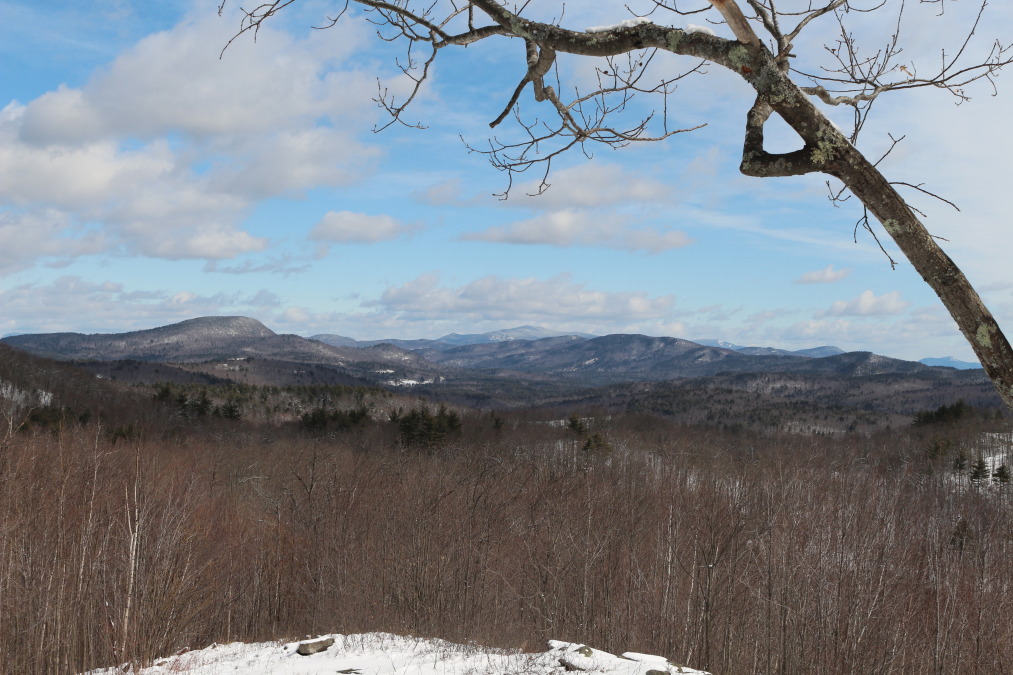
Whitten Woods is a nearby place to visit for a two to five mile hike on well maintained trails, and the best view is from the short walk to the South Peak.

Squam Lake and the Ossipee Mountains from South Peak.

I'll bet it's a great spot to watch the sun rise.  


All the upcoming ice events are still looking good.  We're also following the Alton Bay Ice Runway.  The runway has over 10 inches of ice now and with cold weather in the forecast, the runway may be FAA certified next weekend - I'll keep you posted.


Did you happen to see the full moon on Monday?

The Wolf Moon sets over Wicwas.

It was spectacular!


Sunday, September 30, 2018

September 30, 2018: Rubin Whitten Saved the Town of Ashland

The best season for hiking has arrived - cool temperatures, clear blue skies, and no bugs!  It's the perfect stage to explore all the bounty autumn has to offer, whether it's in your back yard, on a lake, or in the mountains.
Squam Lake and the Ossipee Mountains from Whitten Woods' north view point
Linda and I took a walk at Whitten Woods, a new conservation area opened by the New England Forestry Foundation and the Squam Lakes Association.  Located in Ashland at the site of a historic farm owned by Rubin Whitten who saved the residents of Ashland by sharing his wheat crop from this hill, the only crop that survived the "Year Without a Summer".

In 1816 Mount Tambora in Indonesia erupted, affecting weather across the world.  In New Hampshire there was frost, snow, and ice throughout the summer, with killing frosts every month.  Most of the crops failed, leaving the settlers without a winter food source.  But up on this high, south facing hill, Whitten had planted wheat - an unusual crop in these parts, but more tolerant of cold weather.  His was one of the only crops which survived; the elevation may have helped, as cold airs sinks down into the valleys.  He offered his crop to the townspeople, becoming a local legend and hero.  [Ref:  Eric Werme, Old Farmer's Almanac, WMUR]

It's a pleasant hike on good trails with two nice view points.
Whiteface (left) and Chocorua (right) from Whitten Woods' south view point
Starting up from the trail head on Highland Street just outside of downtown Ashland we enjoyed some early color in the leaves and plenty of fall flowers.
Calico Aster (Aster lateriflorus)
There is a lot of blue in flowers right now, including this dark-blue bud I didn't recognize and can't identify - any ideas?   (Update:  Paula Wanzer identified this for me - it is a Closed Gentian, an interesting flower. I'll try to provide more information on it next week.)
Closed Gentian (Gentiana andrewsii)

As we walked along the old roads of Whitten's farm, signs of human activity were evident, including fruit trees such as this crab apple.

Humans may not be harvesting produce here anymore, but the animals continue to take advantage of what the settlers left behind.  Seeing motion in the branches led us to a red squirrel fattening up for winter on the small fruit.

Most of the property has long since been taken over by forest, which has clearly been logged in the recent past based on the size of the trees.  But as we walked we came across some large areas that have been kept open over the years, though we couldn't determine why.
A long, wide slope running up the south hill has been continually mowed, with only ferns growing in it
Why was this stretch of gentle terrain kept open all these years?  It looked like a ski slope.

Whitten Woods is a great, nearby place to visit, and a good skiing and snowshoeing option in the winter.


Earlier in the week on a hike at higher terrain, a small visitor came to say hello to me.
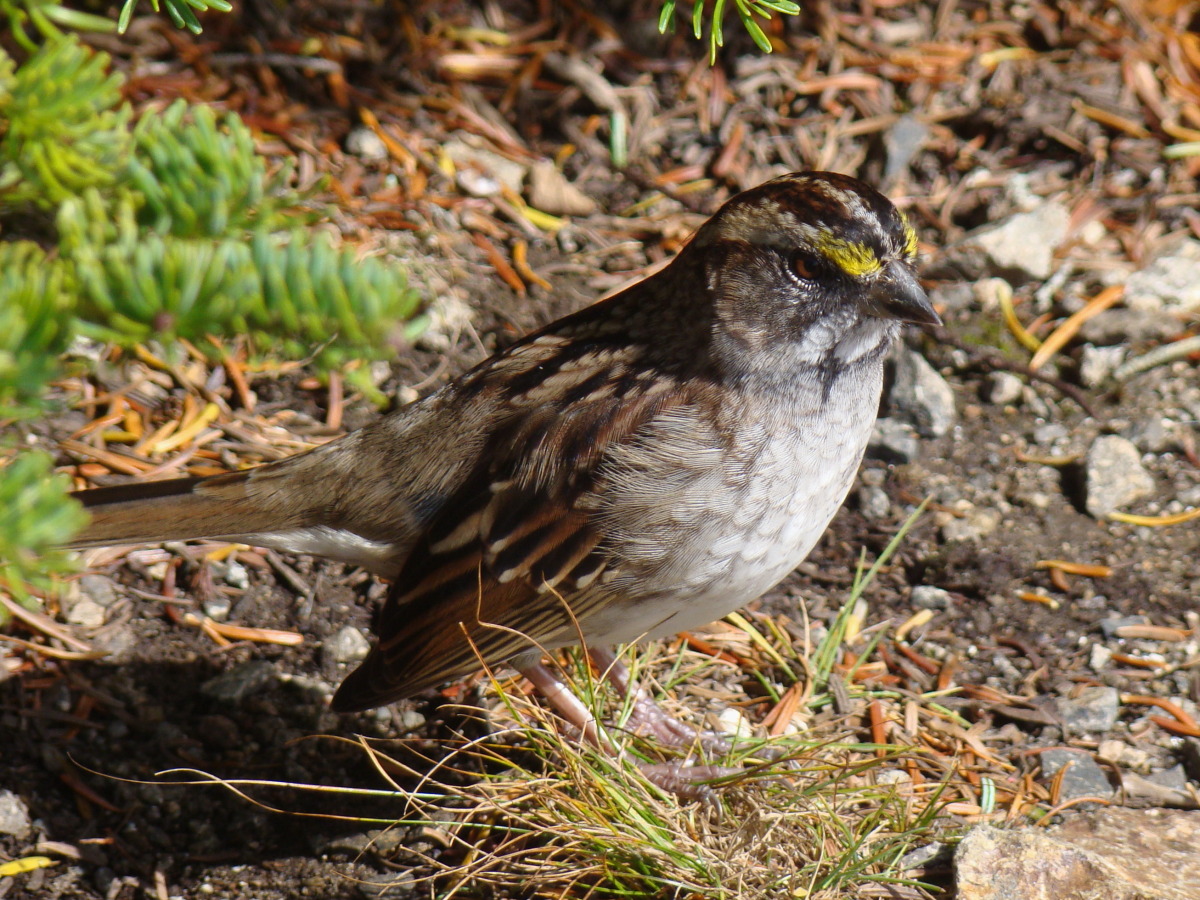
White-throated Sparrow (Zonotrichia albicollis)
This is the famous singer of "Old-Sam-Peabody-Peabody-Peabody" that frequents the boreal forests in the highest elevations of the White Mountains.

This pretty bird hopped out of the scrub, right up to my feet as soon as I sat myself down on the summit of 4327' high Mt. Flume at the southern end of the Franconia Range.  It was clearly looking for a handout (which it didn't get).
Mt. Flume, where this sparrow lives - probably knowing that's where hikers drop bits of food as they enjoy the view
It's a pretty harsh environment to survive;  they must put up with it in order to live in such a beautiful place.
A birds-eye view of Mt. Lincoln, Mt. Lafayette, and Mt. Garfield from the summit of Flume

Back down at lake level, the water has been cooling off, but it's still plenty warm to form morning mist on the lakes.

On Saturday the fisherman were out for perhaps the last bass tournament of the year.  As they roared down the lake in the morning a loon hid in the mist, watching them go by.

Our mating pair is still on the lake, though their brilliant contrasting black and white plumage is starting to fade into the drab gray clothing they will wear through the winter.

It may be the best season for hiking, but that doesn't mean there aren't plenty of days left on the water to watch for loons, sunsets, and coming shortly, brilliant fall leaves.  Whether at elevation or sea level, there's autumn beauty everywhere you look in New Hampshire.

Sunday, April 8, 2018

April 8, 2018 - The Early Goose Gets the Nest

The Canada Geese always arrive at the lakes long before I think they should, well before the ice is out.  But this year, unless they get a sudden change in the weather pattern, they are going to have a particularly long wait to get their feet wet.
It looks cold, but at least it's soft

I can only imagine they arrive early in order to stake out their nesting location.  One pair always nests in the marsh near here, and these two are probably just hanging out to keep any intruders from taking their spot.  And yes, that's fresh snow all around, about 3" worth that fell on Friday night.

And just when we starting to see signs of progress towards spring, including the first bright yellow gold finch of the year.
My first "gold" finch

And then, the very next day:
Sitting in snow, looking for spring

Strips of liquid water were starting to open up along the shore lines, but when the temperature fell below freezing overnight, they iced over again - the water must still be only 32 degrees.  At least the strong April sun melts things away quickly at this time of year.
That black ice was water the day before

But fresh snow followed by blue skies is always a great reason to get outside and enjoy the sights.  I'd heard about a new hiking area managed by Squam Lakes Association in Ashland called Whitten Woods, so I took a drive up there to explore.  It's an easy loop of about 4 miles including a spur to a second summit.
Whitten Woods

There have been views cleared from the south summit and along a ridge approaching the north summit, both of which provide nice views of the mountains and lakes to the east.

View from the south peak

The trailhead is on Highland Road, one mile north of Ashland center, and they have trail maps at the trailhead and posted along the trails at each junction.


Finally, on a run through Meredith Center this week I saw someone doing spring cleanup at an old family cemetery so I stopped to thank him.  He wasn't doing it for any group, or because he has any relationship to the family buried there;  he was just being a good neighbor and citizen, and he's been maintaining it for several years.  Volunteers truly are what makes New Hampshire such a great place to live.
Cemetery on Meredith Center Road at the intersection with Chemung Road