Showing posts with label Snow Flea. Show all posts

Sunday, April 1, 2018

April 1, 2017 - Carnivorous White Pines

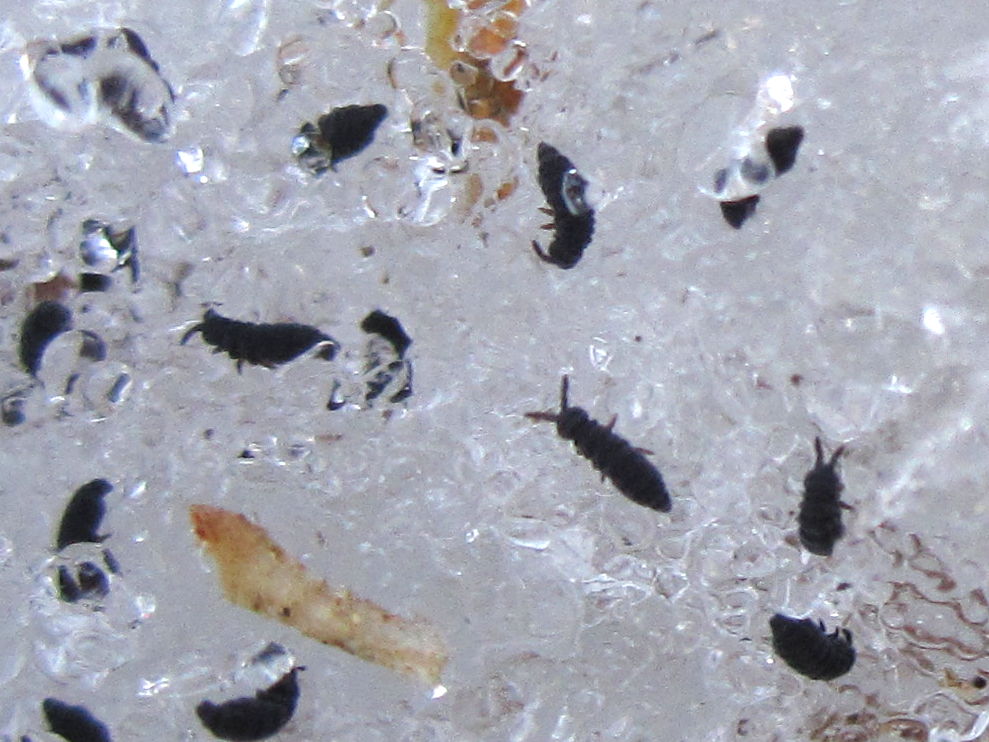
That may sound like an April Fool's joke, but it's true, though somewhat indirectly.  A friend recently told me about spotting bunches of snow fleas - a type of insect know as springtails - on the snow (thanks BB!).
Snow Fleas on my finger

These are very tiny animals, but there are lots of them.

This reminded me of something I read in the Society for the Protection of New Hampshire Forest's publication "Forest Notes".  [Summer, 2017]  It has been found that a certain type of fungus, the bicolor deceiver (Laccaria bicolor), has a toxin that kills springtails when they feed on the fungus.  The toxin paralyzes the springtail, and then the fungus absorbs the insect's nutrients through filaments it extends into its body.  Knowing that the underground portions of fungus exchange nutrients with trees, scientists tagged a bunch of springtails with a radioactive tracker so they could follow it through the food chain.  The tagged springtails were placed near fungus which were in proximity to white pine, and after a few months, they found the pines contained radioactive nitrogen from the snow fleas.  It is incredible how so many creatures are interrelated and depend on each other for survival.  You can read more details about the process from the SPNHF article here.

The snow fleas will be around all year, though once the snow is gone they won't be noticed without looking for them, as they blend into the forest floor.
Snow fleas on an oak leaf

But they'll find the mushrooms, eat them, and in return, be fed to our giant white pines.
How many snow fleas were consumed in creating this giant?

As the snow melts, signs of spring are becoming more evident.
Puddles forming on the lakes
Hobblebush Viburnum ready for spring

Beaver ponds starting to open up
Meredith Bay peeling back


There are even a few green plants starting to photosynthesize the increasing sunlight.
Tree clubmoss (Lycopodium dendroideum) reappearing from under the snow pack

But don't let these signs fool you - there isn't much spring in the lakes on this April first.
Happy Easter!

Sunday, March 20, 2016

March 20, 2016

If you saw Friday's post you know that the ice went out of Lake Wicwas on March 18, the earliest date ever, by three days according to my notes.  Lakes Winnipesaukee and Sunapee also went out on the same day.  The last spot on Lake Wicwas to clear out was the boat ramp, as the northwest wind blew the remaining ice down into that cove.
Friday, March 18 - The last of this short winter's ice

It's quite a change from last year - remember what the lake looked like in March 2015?
March 21, 2015 - A much different look three days later than this year's ice-out
With the ice gone from the lake the migratory birds started appearing immediately.  Of course the geese arrived even before the ice was out, walking around on top of the ice as usual.  But there were sightings of loons on the lake right on the 18th, as well as several of the other usual early spring visitors.  The first to appear was the pair of wood ducks looking for a nest in their favorite spot.
Male Wood Duck
Soon a pair of Hooder Mergansers stopped by for some fishing to nourish them for their travel farther north.
Male Hooded Merganser
 It's cool that they can raise and lower their hood!
A pair of Ring-necked ducks made an appearance also.


They didn't hang around long, but their departure showed their distinctive markings on their wings and bodies.

Finally, a threesome of Common Mergansers came by, two males and one female.  The female had chosen her mate, but the jilted male continued to pursue the pair, with the female occasionally chasing it away - I would have guessed the male would have done that.  Following behind her chosen one, the female swam for a long distance in very strange position - perhaps showing her submission?
Common Mergansers


The trails are all cleared of snow now so we should have several weeks of great hiking before the bugs make their appearance.  It's a great time to be out in the woods with the visibility so much greater than when the leaves are on the trees blocking the sight lines.  In one large melt puddle that collected in a depression I saw large masses of debris floating on the surface.

Closer inspection revealed there was actually some kind of life flourishing there.
Countless numbers of emerging creatures

And even closer inspection told us they were snow fleas! (Linda guessed it!)
Snow Fleas!

We saw these on the snow a few weeks ago and now I know where and how they develop.  It appears that they hatch out as a pink color, then change rapidly to orange, then on to their mature black color. 
Transitioning from larvae to adults

Based on their inefficient mode of transportation (see February 28 post) I wonder how they manage to get from their hatching puddles to become so well distributed throughout the forest.

Even after a short winter it is a beautiful sight to behold the sun reflecting off liquid water rather than ice.  I can't wait to discover what wonders the lake will reveal to us this year.

Sunday, February 28, 2016

February 28, 2016

The warming sun is already starting to initiate new signs of life.  A few days ago, in a moment of warm sunshine, a large ball of lichen that had fallen from a tree branch was soaking up the energy of the sun on top of a bed of transitional corn snow.

This unique composite organism, a combination of algae and fungus, is always intriguing, and when I picked it up to take a closer look, I saw that underneath the mass, taking advantage of the heat collected by the lichen, was a herd of snow fleas that had just emerged.
Snow Fleas - Hypogastrura nivicol
Snow fleas are not actually fleas, but are hexapods, and don't use their legs to jump;  instead they lock their tails underneath their abdomens, and when they release them, they are catapulted into the air.

Reading up on these little insects I learned that they are actually present year-round, it's just that they're usually only noticed in winter when they stand out in contrast to the snow.  How do they survive in winter when other insects either die or hide from the cold?  Their bodies have a high concentration of the protein glycine (think of ethylene glycol, the key ingredient in automotive anti-freeze) which protects their cells from damage in sub-zero temperatures.  You can read more than you'll ever want to know about this process in the article "Structural Modeling of Snow Flea Antifreeze Protein" in the Biophysical Journal.  The properties are so unique that these fleas are being studied as possibly providing improved storage time for organs being preserved for human transplants.

The downy woodpecker was also out enjoying the nice day - and the suet offering.

The varied weather conditions continue:  one evening after a 50 degree day there was a moth flying around the window!  The next day, frigid again, and the lake froze up solid.  The weather has taken a toll on the ice though, which is only 13" thick;  usually it is well over two feet at this point in the winter.  The ice fishermen are hanging in there for the fishing derby this weekend - there are three bob-houses on Lake Wicwas, which hasn't a flake of snow left on it.  

Does anyone know what this sculpture is all about?  I don't!
Ice Fishing Art


In addition to snow fleas, sunny days in February can bring out the bluest of skies. 
Blue sky reigns over Sheep Island

Saturday, December 27, 2014

December 27, 2014

It has been so warm this week that when I was walking today I wouldn't have been surprised to find the bear out again - but there were no signs, I am happy to report.  Warm temperatures - over 50 degrees on Christmas day - and more rain have washed away much of the Thanksgiving Day snow, and the ice on Lake Wicwas has retreated yet again.

December 27
And this was after we had a small dose of wet snow earlier in the week that had the world looking wintry again.

December 23

Then just a few days later, anywhere the sun could get through or water could collect, the ground was bare.
Sunlight Reflects off Large Puddles in the Trail


The streams are running like spring freshets, and the lake is back up several inches above full level.

The repeated melt-freeze cycles have converted the remaining snow flakes into various forms of opaque and clear ice crystals.

On the surface of the lake, wind and waves tossed chunks of ice many feet up onto the ice, leaving them stranded far from the water's edge.

The plants are animals are a bit perplexed, with green grass and ground cover appearing, and even some buds popping out.


Even the snow fleas think it's March - I found hundreds of them hatched out the surface of the snow in an area exposed to the sun.


The Black Bear may not have emerged to take advantage of the moment but other animals have!

Pine Cone Debris left by a Red Squirrel

Monday, March 4, 2013

March 3, 2013

March is here, and with it came the start of mud season.  Mild weather has softened the top few inches of plowed roads, and areas with sun exposure are already getting squishy.  But the roads are nothing compared to the lake.  The rain, snow, sun and warmer temperatures have created a deep slush layer underneath a couple of inches of snow on the lake.  Snow shoeing is barely  possible, as even then one sinks into the slush on occasion.  I even saw a snowmobile get stuck in the quagmire.

Yesterday was a beautiful day out, and it's fun to get out and see what's going on around the lake.  The newest house on the lake is taking shape now, and it looks to be another beauty, complete with a turret and weather-vane.

Another sign of warmer weather is the arrival of the snow fleas.  When I pulled a branch out of the snow, a flurry of fleas came off it - perhaps they are attracted to the warmth that the dark wood absorbs.

And this was a very unique find in the middle of the woods, a good hundred yards from the shore.
Fresh Water Mussel

Some creature must have brought this clam up from the water's edge, though there were no signs of tracks nearby.  Another mystery at Lake Wicwas.

All the recent snow did have an important role for the Lakes Region:  It put down a solid foundation for the Laconia World Champion Dog Sled races this weekend.  The race center was right at the bottom of Meredith Center Road.
Laconia World Championship Dog Sled Races

There was lots of action in the staging area with the teams getting ready to go.
Staging Area


There were both traditional sleds and high tech racing machines.


Lots of excitement at the starting line as the dogs knew they were about to be let loose.  Some teams were very animated, while others were quite calm and patient.
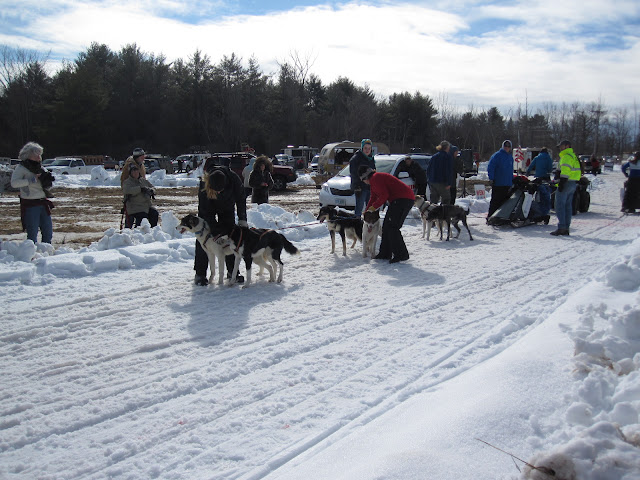
The Starting Line

And then they were off, with snow flying in the air!
They're Off!

Coming back to the finish line, the teams were just as fast and energetic, but their flapping tongues betrayed their great exertion.
The Finish


Here's some action footage of one team starting, and another approaching the finish.


So 2013 has been a good winter for Meredith, as we got in all three major events:  Pond hockey, Fishing derby, and Dog sled races.  It looks like another good month of winter is ahead, although a few impatient things are trying to get an early start on spring!

Crocus Shoots