Lake Wicwas saw the first accumulating snow of the season this week and though it had mostly melted by today, it gave us a few days of soft, gray-scale November scenery.
 |
| November Gray |
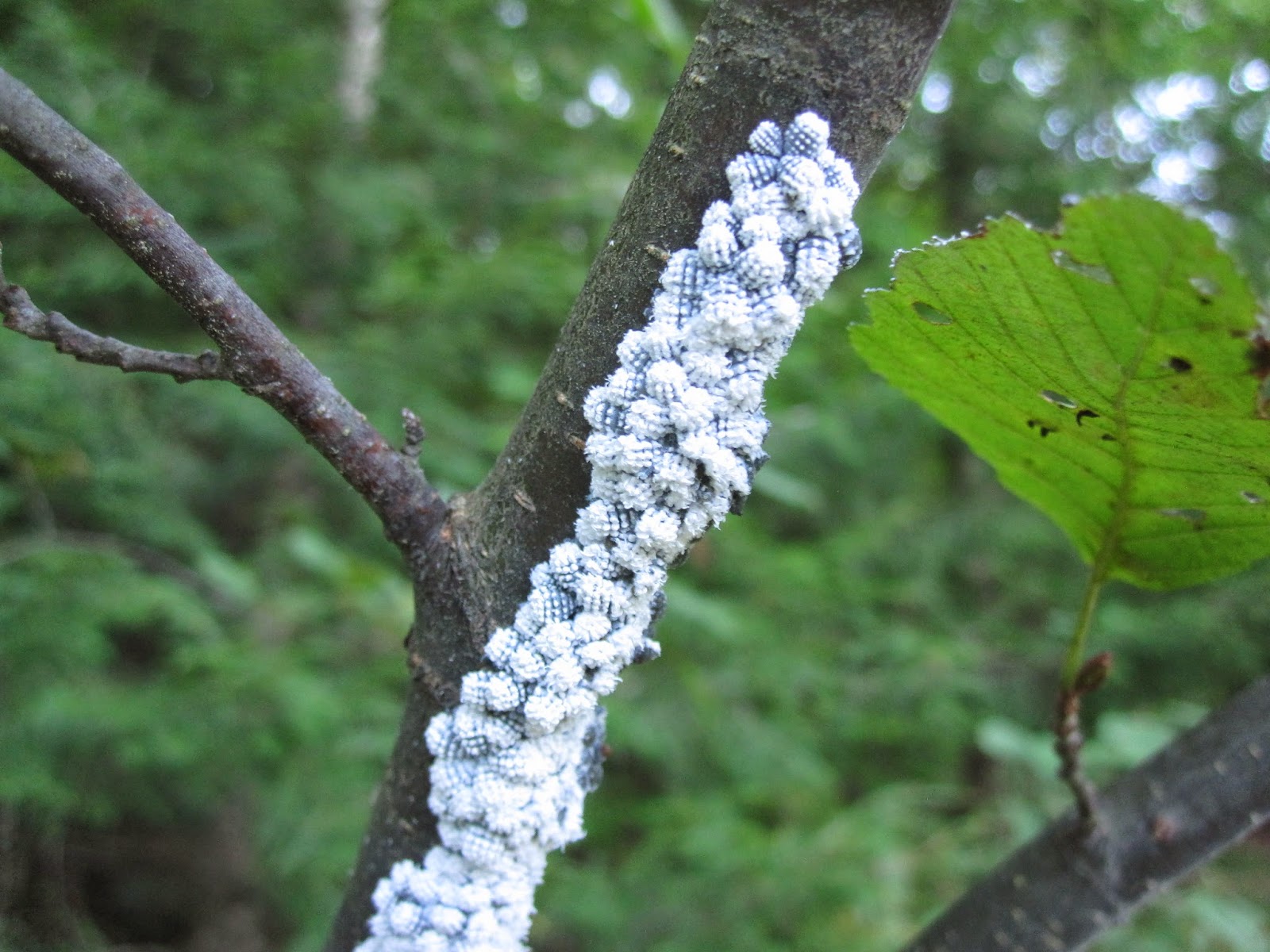
Earlier in the week one might have thought a strange erratic snow had already accumulated on some alder trees.
 |
| Snow? |
I haven't seen this in several years and it's been almost a decade since I last spoke of it in the Journal. These are insects, Woolly Alder Aphids, named because they use alder as their host tree, and because it looks like wool when they colonize a tree.
 |
| Woolly Alder Aphids on an alder tree. |
Like other aphids, they live off the sap in plants, sucking the sweet, sugary juices of alder through the bark. They secrete a white, waxy substance which they use to cover themselves as a defense mechanism - predators don't recognize them as an insect, and even if they do discover them, they find the waxy coating unpleasant to eat and leave them alone. I brushed a bit of the coating off to expose them; I was surprised that it came right off with just a light brushing - it's not stuck to them much at all.
 |
| What's hiding under that waxy barricade. |
Here are few in my hand. The really tiny ones are newly hatched aphids.

They have some interesting facets to their life cycle. During the summer the females reproduce asexually - no male required. That's when they build the large colonies on alder trees. Then later in the year the females search out males to mate with, resulting in just a single egg, which will then generate a new colony of aphids. This is thought to maintain diversity in the gene pool. [Ref: Michael J. Raupp, Ph.D, University of Maryland]
Before the snow fell this week we had some really nice weather to get out and savor the waning days of fall. I had perhaps my last kayak of the year.
 |
| Sure looks like November. |
It was a nice paddle even though I didn't come across any wildlife other than a few ducks. We still might get a nice day later in November, or even December, so the paddle hasn't been put up for the winter just yet.
Amy Wilson was also out on the lake last week and she did see wildlife, including this loon which sent us looking to understand its status.
 |
| A loon with perplexing markings. (Photo by Amy Wilson.) |
It has some aspects of a juvenile, but not the chevron pattern of one of this year's brood. It is sporting what looks like a few white dots on its back, reminiscent of an adult's breeding plumage. It also has an unusual black and white coloring on its beak, unlike either the black beak of an adult nor the white beak of a juvenile. Referring to photos and descriptions from both the Loon Preservation Committee and the Cornell Lab of Ornithology, I believe this to be either a non-breeding immature adult, or a molting adult transitioning to its winter plumage. It could be one of our breeding loons, but more likely it's a visitor on its way to the Atlantic Ocean.
Tramping on terra firma around Lake Wicwas, I twice came across a flock of turkeys, but they are so aware of their surroundings that they heard me coming and just melted away into the forest before I could get a picture. But Neil Crimins caught what is surely the same flock as it made its way right through his yard.
 |
| Our neighborhood flock of turkeys. |
I also took advantage of the nice days to walk in the Page Pond Town Forest. I stopped by the new accessible trail and viewing platform overlooking the quarry pond on the Quarry Loop Trail - it's great!
 |
| The viewing platform and accessible trail on the Quarry Loop built by the Meredith Rotary Club. |
I continued down the Yellow Trail, across the beaver dam, and returned via the Page Brook Trail. On the way I passed by this huge old pine tree that lies just a few yards off the Yellow Trail.
 |
| One big old pine tree. |
My final walk of the week was up Whiteface Mountain in the Belknap Range (not the 4000' Whiteface up by Wonalancet) after the snow fell.
 |
| A wintery scene on the top of Mt. Whiteface. |
November could be the definition of grayscale.