Showing posts with label Pine Siskin. Show all posts

Sunday, March 24, 2024

March 24, 2024: 115 Ring-necked Ducks

Advance notice, this is another long entry.  It was one of those weeks with so much going on - ducks, beavers, snow, timberdoodles - I don't know where to start.  I guess a couple of follow-ups should be first.  One or more Red Crossbills have been hanging around since my first sighting in early March, and one appears to have found itself a mate.  The two stay near each other but the female is less bold so I haven't gotten a picture, but I did get a good look at the male. 

A Red Crossbill in a Red Maple on Wednesday.  (Note the buds!)

Another follow-up goes all the way back to January 21st when I heard Pine Siskins and noted that NH Audubon predicted the pine siskin would be the finch of the year.  I can attest to the foresight of that prediction:  All winter long I heard these these loud and boisterous birds just about everywhere I went, and I'm still hearing them.  I was able to get a recording of both of their distinctive calls so when you're out and about you'll recognize it:

The highlight of my week was an evening visit to Page Pond to see if I could witness the strange mating practice of the American Woodcock, also known as the timberdoodle.  I've seen woodcock during the day on the wet trail just in from the field at Barnard Ridge Road, using its long pointed bill to probe around in wet soil in search of worms and other edibles.  But it's their nighttime courting behavior I was in search of this week, and I knew they might be in that area.

I arrived just after sunset and sat near the edge of the transitional forest between the field and the woods and waited.  It was almost dark when I heard the first nasal "peent" of the woodcock.  Soon I heard a couple more farther away in the field, and then a dark flying object sped right past me and landed in the field perhaps 30 yards away.  I knew it was a woodcock when it started to call:  peent... peent.... peent.  After a couple of minutes of this the bird took flight and I was able to watch it circle around in a large pattern over the field and the small trees gaining altitude higher and higher, emitting a musical burbling song from its wings, until I lost sight of it in the darkening night.  And that was a disappointment, because that's just when it was about to start its crazy decent back to earth.  Supposedly the male woodcock will drop in a twisting, almost deadfall decent, slowing his fall just before he hits the ground, right back where he started.  Apparently this wild behavior impresses the girls.  

I didn't see it land, but knew it had because soon it started again:  peent... peent... peent.  I saw him take flight one more time, but after that it was too dark to see.  But he continued this for another 15 or 20 minutes as indicated by the peenting and burbling that I heard.  I never saw him fly off, but when the music ended I knew he was done.  Did he get the girl?  

Another male was still at it somewhere off in the field, but I was cold and headed home.  I didn't get to witness the fall of the timberdoodle, but I got a pretty good taste of one of the more interesting mating rituals in the New Hampshire bird community.  Next time I'll try in the morning when the day is brightening rather than getting dimmer.  I don't have my own photo of the timberdoodle, but here's one from NH Audubon:
The American Woodcock.   Photo: David Nelson/Alamy


Another exciting event occurred on Friday - that cold, windy day before the storm arrived.  As the sun rose over the lake it revealed a huge flock of ducks all grouped up on the far side of Marion Cove, tucked in behind the lee of the land to get out of the brutal 20 mph wind.  The air temperature was 18 degrees.  It was too dark to see what kind of ducks they were but as the sun rose it became clear they were ring-necked ducks, and there was well over a hundred of them!  
This is only a portion of the flock.

On one count I got 115 and on another 117, but there were even more hidden behind a point of land that I couldn't count.  They must have flown in the day before and sought out the most protected part of the lake to spend the night, and they ended up staying all day.  

Linda observed there were two groups.  One consisted of apparent pairs, a hen and a drake staying close together and behaving calmly.  The other group was a jumble of males and females (more males than females though) that were much more active, especially the drakes.  Our hypothesis is that these birds had not yet paired up and the males were doing their best to convince a female to accept them as their mate.  As the day progressed, warmed, and calmed somewhat, the flock spread out and some came closer and gave us a better look at them. 

When a female or two took flight, many others in this sub-group would follow along after them. 

These ducks will soon continue on their way up to northern Maine and Canada to breed.

While the ring-necked ducks were here the much smaller group of Common Mergansers kept their distance - we saw them far away down the lake.  We also saw one pair of Hooded Mergansers in the cove before the ring-necked flock arrived.  
Male hooded merganser
And the female.


They are a pretty bird; these poor photographs don't due them justice, but the goal of the journal is to document what nature is present.  

We're having a lot of fun watching multiple beavers cruise by every night, sometimes giving us great shows with their tail slaps.   One sight that has not been seen however, is a loon.  None of our loon watchers has seen a single one, which is unusual as the loons usually arrive as soon as there are moderate-size areas of open water, often days before ice out.  Perhaps it's because ice out was so early this year.  We'll have to wait and see when they arrive.  Has anyone from other lakes seen their loons yet? 

My comment a couple of weeks ago that old man winter might not be done with us yet was on target and somehow those ring-necked ducks knew what was coming; we picked up almost two feet of snow yesterday which made for some of the best skiing of the year.
A good late winter snowstorm after a very long dry spell.


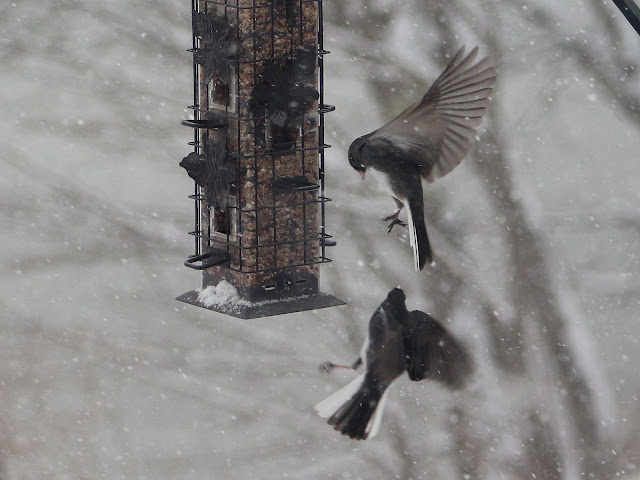
After having very few birds at the feeder recently, the Juncos - aka snowbirds - came out in force as soon as the snow started. 
Dark-eyed Juncos line up for their attempt at the feeder.

It may look like a blue-sky day, but this was before sunrise using artificial light.

These are not polite birds like the chickadees are; a dominant bird often jousts with the others to keep them away from the food.

Here they are in action:


I heard a pine siskin calling during a lull in the storm in the afternoon and looked out the window to see one perched on the feeder. I was impressed to see this little finch take on the flock of juncos for jurisdiction over the feeder. 

It confronted every junco that attempted to land including one persistent junco that wouldn't back down. 

Eventually the two of them came to a truce, each taking ownership of an opposite side of the feeder.


It was a busy week at the lake.  This morning, with almost two feet of new snow, the lake has filled up with frozen slush and the ring-necked ducks were nowhere to be seen.  I wonder if the timberdoodles' bills are long enough to probe down through a foot of snow to find their worms!
Sunday, March 23 - Winter's back.


Sunday, January 21, 2024

January 21, 2024: Pine Siskin

Light fresh snow and cold temperatures have provided the first good tracking conditions of the season - along with some really nice skiing. 

A late afternoon ski on Lake Wicwas.

On my first ski trip on the lake this winter I came across more signs of my new best friends, the otters. This time there must have been three of them out having a blast on top of the ice rather than under it. For a long stretch along the shore near Sheep Island I followed their hop-slide-hop game of follow the leader. 

A trio of river otters out sliding on the ice.

On a different trip in the woods behind the lake I found this animal sign right in the middle of the trail for all the animals of the forest to take note.


Based on the small, twisted form of the scat, it looks the calling card of a weasel.

On another beautiful, bright day Linda and I took a snowshoe out to the new viewing platform at the Page Pond Town Forest over looking the pond on the Quarry Loop Trail. 

The new viewing platform at the Quarry Loop at Page Pond.

There were plenty of animal tracks to be seen there including white-tailed deer tracks right at viewing platform. 

White-tailed deer were exploring the edge of the pond.


A hoof print that also shows the deer's dew claws (on the left).

At the other end of the size spectrum:  mouse tracks on the pond.

Standing quietly beside the pond we heard a rambunctious bird song that I thought was a bunch of goldfinches in the trees, but every now and then there was a distinct upward spiraling raspy call that wasn't anything I'd heard before.  I recorded his song and ran it through the Cornell BirdNET app  which identified it as pine siskin -  a new bird for me.  I looked for the rambunctious singer there at the pond as well as three other times when I heard one singing, but I could never find it high up in the branches.  Here's a picture of a pine siskin from the Cornell ornithology website that shows how it blends in so well, making it impossible for me to locate.

Pine siskin; photo from Cornell Lab of Ornithology.

If you participate in the NH Audubon Backyard Winter Bird Survey you should have received their recent newsletter about the upcoming survey.  It predicts the pine siskin will be "the finch of the season" so maybe we'll see (hear?) more of them.  If you're interested in the backyard survey you can find out how to participate at the NH Audubon Backyard Winter Bird Survey - it's very easy to participate, you can spend as much or as little time as you'd like, and you don't even have to leave your warm home!

🐦


Before the most recent snow fell there were a few interesting items visible on the top of the old crusty snow.

White pine cone scales shredded by red squirrels.

This particular patch of forest was covered with scales from white pine cones scattered uniformly over the snow.  I'm guessing here, the squirrel was up in a tree shredding pincecones and the scales fluttered down, spreading out over the ground.  Compare it to this situation where a squirrel sat on the ground having its meal:

Pinecone scales and the stem from which they were removed.

In another part of the forest the snow was littered with maple seeds. 

Maple seeds all over the snow.

Maple seeds in January?  I've always seen these released in the spring; it makes no sense to me why trees would produce seeds now when there's no hope of them finding warm soil on which to germinate. Could the tree have been confused by all the warm weather in December?

One more bit of good news from the cold weather (it got as cold as -5 this week):  People were fishing on Meredith Bay on Friday!  And the Pond Hockey rink area has been staked out on Lake Waukewan.  If it remains cold they should be able to hold the tournament on Winnipesaukee, but Waukewan will be a backup if needed.

It sure is nice to have real winter arrive.


Sunday, February 6, 2022

February 6, 2022: A Bluebird Invasion

Forget Ukraine, the invasion is happening right here!  This week a flock of over 20 bluebirds has stormed into the area, being observed by many people around the lake and it's quite a treat to see them with their bright blue color in winter when most other birds have replaced their summer plumage with more practical, safe, muted plumage.

Eastern Bluebird


This is the first time we've had bluebirds at our feeders though I know others in the area have seen them.  Some range maps (e.g. Cornell) still show their year-round range south of Massachusetts, but we had seen them in southern New Hampshire for years.  Other maps (e.g. Audubon) do show their year-round range extending up to central New Hampshire.  

Eastern Bluebirds feed primarily on insects but in winter their diet consists of fruit and a very diverse set of berries; it seems only in recent decades that they've started to partake in the seeds of birdfeeders.  


Bluebirds aren't picky at the feeder - large or small, seeds are now readily consumed.


It was a cold morning when we first saw them, near zero, and after filling their bellies some of them found a most endearing way to keep warm.

Keeping warm - and keeping watch in all directions.

Bluebirds, like all birds, have no blue pigment in their feathers.  To present their blue color their feathers take advantage of the wave properties of light.  There are tiny air pockets in the cells of the their feathers that have the right dimensions to reflect light such that blue light reflected from each pocket all lines up "in-phase" while other wavelengths are reflected randomly.  Thus the blue wavelengths are reinforced while other colors are diminished, resulting in the bright blue color that our eyes perceive.  [Ref:  Sibley, 2020, What it's like to be a Bird, Knopf, pg. 133]

Blue light is reinforced by a unique feather characteristic.

Blue light is at the short-wavelength end of human's visible spectrum, right up against ultraviolet light, which got me wondering if bluebird feathers might also reflect some UV wavelengths.  Looking into this I found that many birds do see in the ultraviolet spectrum, and in fact use that trait in interesting ways including some that explain avian abilities that had stymied scientists until this was studied.  That's a topic for the future; I have much more I need to learn on that subject, and there was a lot more going on this week to be shared.

We have a spring that flows year round which we let collect in a small pool well protected by hemlock trees and we often see birds and squirrels drinking from it all winter.  But this winter there have been holes in the ice that have opened up - the reason is unknown to me - but they are in fact open all the way through the 14" of ice on Lake Wicwas at this point.  And the bluebirds seemed to prefer this water source, right out in the open.

Three bluebirds take a drink.

That seems like an unnecessary risk considering the known presence of many predators such as bobcats, hawks, and the kestrel we saw a few weeks ago which is especially adept at catching birds.  And there was proof this week of the danger.  On a cross country ski excursion this week I came across a fresh bloody mess beside the trail which had all the indications of gray squirrel meeting its demise at the talons of a raptor.  

Sign of a very recent kill.

Bits of gray fur make me think it was squirrel.


I expected to see more remains of the animal on the ground, but then looking up I saw a big branch hanging right over the spot, a perfect perch for a raptor to feast upon its prey.  Perhaps the rest of the animal was taken off to share with its mate, or maybe I disturbed it and it flew off unnoticed to another dining location.  

Assuming the victim was a squirrel, it's not the last one; the second invasion this week was a ground assault.   The gray squirrels have stormed the yard in force - at one point there were eleven of them out under the feeders even after that one had departed from the land.  

Plenty of squirrels still abound.

And then, another new bird appeared at our feeder during Friday's snow - a pine siskin.

Pine Siskin

This was the third wave of the invasion; I only saw a few but another bird watcher (thanks MT!) reported a huge flock of them at their feeder, so many in fact that they emptied their bird feeder three times in one day.  

If I have seen a pine siskin here before I didn't identify it.  Unlike the easily recognized bluebird, the pine siskin is rather non-descript and I first thought it was a sparrow, but a key identifying feature is the slight yellow band along the edge of its flight feathers and its tail.

You can just make out the yellow bands on the edges of its wings.

The yellow bands are seen in flight but are barely visible when perched.  The pine siskin's beak is also thinner and sharper than a finch's beak.

A sharp, pointy beak.

Also in contrast to the southern-ranged bluebird, the pine siskin is a northern bird, living year-round in Canada and very northern New England, and breeding even farther north from Newfoundland in the east all the way across the continent to Alaska.  According to my new Audubon book (thanks VP!) they move southward when seed crops in the boreal forests are poor.  One of their favorite seeds is that of the hemlock tree so maybe the bumper crop of hemlock cones around the lakes this year will keep them in the area.

Even though I've gone on too long with all the nature sights, I can't let the week go by without a note on the disappointing effect of the weather on the Pond Hockey tournament.  Friday's games were cancelled due to unplayable ice conditions, and then on Saturday the entire tournament was cancelled due to unsafe ice.  According to their report, the weight of pushing the heavy snow from Friday's storm into piles to clear the rinks was so great it was causing the ice to sink and crack and lake water was coming up onto the ice.  They removed all their equipment and gear and had to cancel the entire tournament.  The coming week is forecast to be mild but hopefully it will be cold enough for everything to freeze up for the fishing derby next weekend.  

So on a happier note, I'll close with one more look at those beautiful bluebirds!