A somewhat random record of observations of what's happening around Lake Wicwas and the Lakes Region. I hope to post about once a week - your comments are welcomed.
One of our delinquent birds mentioned last week appeared after this week's snowfall: the dark-eyed junco.
Juncos are one of our most common and wide-spread species, ranging from New Mexico to Alaska to northeastern Canada, and they are winter specialists, earning the nickname "snowbird". They're present in New Hampshire year-round, though in the warmer months they stay hidden on the forest floor and at high elevations. Juncos have some similarities to finches, particularly their beaks, but they're in the New World Sparrow family as they forage mostly on the ground, hopping around on two feet, to collect small seeds which they crack open with their beak using their tongue to maneuver the seed as needed.
They do good job cleaning up the deck, though they aren't very neat diners.
Searching the snow for dropped millet.
Here's a short video of one cracking a small seed and dropping the shell:
In central New Hampshire, we see juncos mostly in winter after snow has covered much of their food supply, so they come to glean food under the bird feeders. Here, nuthatches are their best friends. The White-breasted Nuthatches in particular do much for the juncos as they shovel piles of small seeds from the feeder onto the ground while mining for the biggest nugget in the seed mix.
"This one will do."
We received a few inches of snow this past week which got me out on the skis for a short trip along the lake and up to the White Mountain Ledge. Snow caught in a tree on the shoreline with a bright blue sky behind caught my eye and helped me notice one of the natural sources of food for juncos in deep winter: Yellow Birch seeds.
Catkins on a Yellow Birch Tree.
These seeds aren't a staple of the juncos' diet because they don't pack a lot of nutrients, but they stay on the branches above the snow cover and they're better than nothing, becoming a factor in winter survival. Hemlock cones, which also stay on their branches into winter, and which we saw the red squirrels dining on last week, are another source of winter food for juncos and other birds.
Heading into the woods for the ledges behind Lake Wicwas, I found a winter wonderland of snow-draped forest.
The January thaw is over. Now we're heading into the deep freeze - yesterday's high at the Lake Wicwas Weather Station was 6.6 degrees F. Along with much of the country, a polar vortex is sending New Hampshire a blast of cold air down from the north. And it will usher in a good snowfall, beginning this afternoon. We may get over a foot of light fluffy snow which is a whole lot better than the severe hit of wet heavy snow and freezing rain the storm may bring to areas south of New England. With a long stretch of cold weather to follow, there may be some longer power outages in parts of the country, which makes a foot of dry snow look pretty good!
Looking north from the White Mountain Ledge.
Keep safe and warm this week, and don't forget about Pond Hockey on Meredith Bay next weekend.
Ah yes - Snowdrops are blooming - spring is coming along. Snowdrops aren't a native plant, but they're always the first to bloom, even before the crocuses.
Snowdrops in March.
A true native sign of spring is lichen greening up, which in spring, unlike its dry, gray, cardboard-stiff status in summer, is now plump and verdant with moisture provided by winter snow melting off its granite home.
Rock Tripe Lichen.
It actually looks somewhat edible this time of year.
This week we had more warm, beautiful days as well as some rainy ones, and what are usually small streams, sometimes even dry streambeds in summer, are now gushing with snowmelt.
And as a result, the lakes are flooding.
A flooded shoreline along Lake Wicwas.
Hiking trails are filled with with huge puddles.
Frost still in the ground keeps low spots from draining.
With all the runoff along the shoreline I decided not to venture out to measure the ice thickness, but I'll bet it's still a good foot thick away from shore. I may not trust it, but the animals do, so we know it's thick enough to support the weight of a bobcat.
A bobcat makes its way across the lake one morning.
And finds a way to get off the ice without getting its feet wet.
Cold ice on a warm day condenses some interesting fog banks as the moist air spreads across the lake.
We did take in the birdfeeders this week after they were emptied out, but I sprinkled a few seeds on the railing to give the birds a little more food while the rest of the snow melts. It provided an opportunity to watch the birds in action.
In this first video, a couple of White-breasted Nuthatches sort through the seeds to find one worthy of eating or taking away to hide somewhere.
In the next video, one bird works away on a hard-shelled safflower seed, then finds a few small seeds to gulp right down while it searches for another large seed worthy of hacking open. You can see how much effort it takes to extract that little bit of high-energy fat from the shell.
At first I thought they were eating seeds that had fallen into cracks, but I soon realized they are smart enough stuff thier seed down in the crevice to hold it in place while they crack it open. In this last video it hacks away at a safflower seed, then finds a few smaller ones to gobble up whole, before selecting a couple more safflower seeds to work on, finally taking one more large seed off to hide away in a tree bark crevice to save for later.
Look at those talons:
I guess that's how they can climb straight up and down tree trunks!
I also heard my first Red-winged Blackbird this week. Snow, ice, flowers, sun, migrating birds - they're all part of spring in New Hampshire!
We are lucky to fit Easter in between late winter snow storms. I was up in Franconia Notch after last weekend's big storm for what I though would be my last powder day of the season - Cannon Mountain is beautiful on a bright winter day.
Cannon Ski area with the Franconia Range looming behind.
I don't have a lot of confidence in weather forecasts after the last storm dropped twice as much snow as predicted, but they're forecasting another nice snowfall in the middle of this week, so maybe we'll get one more last powder day of the season.
With both the winter birds and the early migrating birds in the area we had quite a few visitors to the bird feeder which we put back out for a couple of days during and after the snow. There was one very pretty bird on the feeder that I didn't recognize.
It had a long bronze colored tail and sharp markings on its back. I'm embarrassed to say that when I looked it up I found it was a Song Sparrow. I guess they've never shown me their backside before - I've always considered them to be rather plain brown bird, but this perspective taught me to never judge another being until I thoroughly understand it!
We saw plenty of snowbirds, chickadees, goldfinches and mourning doves, as well as more pine siskins, and they all very much enjoying food not buried under the snow. Goldfinches, snowbirds, and pine siskins are plenty happy with the small millet seeds.
Small birds with small beaks are very happy with small seeds.
But not the White-breasted Nuthatches.
No thank you.
Nuthatches are never satisfied with small seeds - it dropped this rejected morsel down onto the snow for some other bird to have and went back to shovel through the feeder for a seed more to its liking.
This one will do.
One of our many beavers came by early enough in the evening for me to get a good picture of it swimming by.
A large beaver cruising the lake early one evening.
When you have something for perspective you can see how much larger this rodent is than the mink that went by a couple of weeks ago.
As everyone has heard, the big astronomical event of the decade for New England occurs in just over a week on Monday, April 8th when there will be a total eclipse of the sun in northern New Hampshire. It may be my last opportunity to experience a total eclipse, though being April, my expectations for a clear sky aren't high. But with such a rare event, I'll be ready for it if we get lucky. The Lakes Region isn't quite in the path of totality, but it will still be a good show with about 97% of the sun blocked by the moon. If conditions are even slightly favorable I'll probably fight the crowds and head up north to experience the complete blotting out of the sun. Lancaster is right on the edge of totality, and I expect there will be a lot people heading up Route 93 to Lancaster and points north, so it might be a bit of fiasco. But with another total eclipse not visible in New England for over 50 years, I'll give it a shot. From my recollection of an eclipse years ago it won't get totally dark, but it will still be neat to be able to see the corona around the sun. I even got a solar filter for our binoculars so we can get a good look at the event, and I purchased another filter for my camera. I know I won't be taking pictures that rival what the professionals will capture, but it will be fun to see what I can get.
From what I've read, taking pictures of an eclipse is challenging due to the dramatic changes in light intensity between even a sliver of sun being exposed and the moment of total eclipse, especially when you have only seconds during totality. So I did a little practicing with the sun and the moon. The solar filter is pretty neat, letting me see sun spots on the surface of the sun.
Sunspots visible with a solar filter that blocks over 99% of the light.
A new crescent moon a couple of weeks ago showed the challenges of photographing different brightness levels.
Those two pictures are of the same moon just moments apart, but with the first photo exposed to show craters on the crescent of the sunlit surface and the second showing the dark side of the moon. The second photo has a much longer exposure to capture what appears as total blackness in the first picture, but is actually lit up very dimly by light from the sun, reflected off the earth back toward the dark side of the moon, then after hitting the moon being reflected back to earth into my camera. The long exposure means the lit crescent is highly overexposed, and even a few bright stars are visible in the second photo.
All this preparation before an event that might not even be visible in the often cloudy days of April, but if we can see it, it could be a once-in-a-lifetime experience.
But before that happens, maybe there's one more good powder day in store for us?
We've had an unusually high number of white-breasted nuthatches at our feeders this year so I thought I'd doing a little looking into the subject of nuthatches.
Yes, birds have tongues.
The White-breasted Nuthatch (Sitta carolinensis) is a small, acrobatic bird that is found throughout much of the eastern and central United States. This species is a year-round resident of deciduous and mixed woodlands, and is commonly found in residential areas and parks.
One of the most distinctive features of the White-breasted Nuthatch is its ability to walk down trees headfirst. This behavior is made possible by its sharp claws and strong toes, which allow it to cling to the rough bark of trees. The bird uses this ability to forage for food, probing crevices in the bark for insects and seeds.
White-breasted Nuthatches are also known for their vocalizations, which consist of a variety of calls and songs. The most common call is a nasal "yank" or "yank-yank" sound, which is often heard in the woods. The bird also has a loud, ringing "whinny" call that is used to defend its territory.
In terms of diet, White-breasted Nuthatches are opportunistic feeders, consuming a variety of insects and seeds. In the summer, they primarily feed on insects such as beetles, caterpillars, and ants, while in the winter, they shift to a diet of seeds and nuts. They also hoard food, caching it in crevices and other hidden places for later use.
White-breasted Nuthatches are also known to be cooperative breeders, with the breeding pair being helped by one or more helpers in raising their young. The breeding pair excavates a hole in a tree, usually in a dead tree or a dead branch of a live tree. The female lays an average of six eggs and both parents incubate them for about two weeks. The young are then cared for by both parents and helpers, if any, and fledge in about three weeks.
In conclusion, the White-breasted Nuthatch is a fascinating and familiar bird that is well adapted to its forested habitat. Its acrobatic ability to walk down trees and its vocalizations, along with its opportunistic feeding habits and cooperative breeding behavior, make it a unique and interesting species to study and observe.
Did that sound a little stilted? Have you heard of ChatGPT? ChatGPT is an artificial intelligence software program that's been in the news a lot lately and has been predicted by some to replace lots of people's jobs in the future, so I thought I'd give it a test. The above description of white-breasted nuthatches is word-for-word what ChatGPT gave me when I asked it to "write a scientific article about the white-breasted nuthatch". It isn't bad, but it is somewhat, shall I say, artificial, so I think my job is safe for a bit longer. But I can envision a day where a web-connected trail camera sends photos to an image-recognition system connected to an artificial intelligence engine that will document what's happening around Lake Wicwas with no human intervention. Then I can just stay home all day like the human blobs in the movie WALL-E.
This isn't going to happen as long as I have a say in it.
My own research revealed that the migratory behavior of white-breasted nuthatches is still being studied. It had been believed they were not migratory and stayed in their territory year round, but recent studies have found they may in fact have some migratory behavior, possible being an irruptive species like their red-breasted cousin, meaning they move in mass migrations in years of low food supply in their home range. Because white-breasted nuthatches are such common and widespread birds this is hard to determine without banding specific birds and tracking them, something that a group of ornithologists is starting to do. So maybe this is an irruptive year with low food supply in Canada bringing more white-breasted nuthatches to central New Hampshire, but regardless, I'll enjoy watching them on the feeder, even if they do shovel seeds onto the ground as they dig through the feeders looking for the largest, choicest seeds.
Nuthatches excavate in the feeder to find the perfect seed.
This is a female.
Another thing I learned is how to differentiate male and female nuthatches. The female has a slightly gray cap on its head as seen above, while the male's cap is black, matching the shade of its nape just behind the cap. The distinction is slight, but noticable.
Although the larger lakes are still ice-free, Wicwas has between seven and ten inches of good ice on it. There are people out fishing, and the first bob house has appeared.
That sky looks like snow is coming.
I saw this on Thursday after a cold night had frozen the surface up nicely, allowing a skating excursion around the entire lake, just before more snow fell. Then on Friday we received a nice snowstorm, one without any rain involved, and the world was freshened up with a beautiful blanket of white - easy to shovel and great to ski on.
Turtle Island on Friday morning.
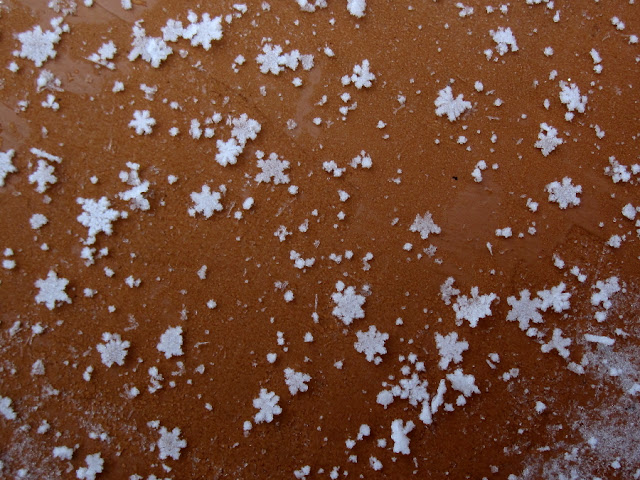
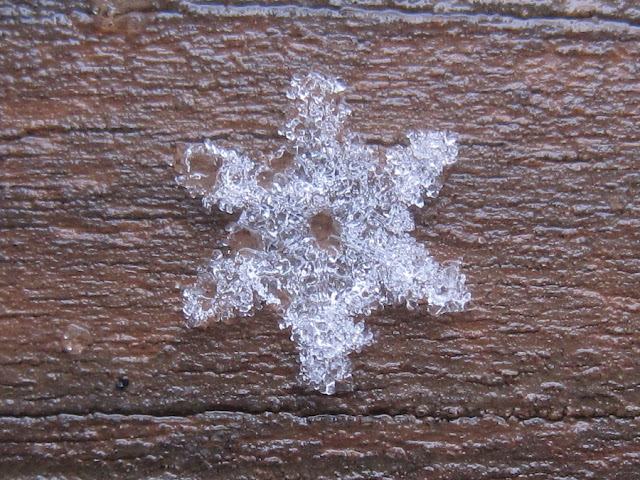
As the storm wound down the heavens started sending these perfect snowflakes down to earth.
It's the kind of snow you'd see in a Hollywood movie on Christmas Eve and call it fake.
But it was real.
Whether it was the snow, or the breast of a bird, white was the color of the week, and none of it was artificial.