Showing posts with label Crocus. Show all posts

Sunday, April 5, 2026

April 5, 2026: Happy Easter!

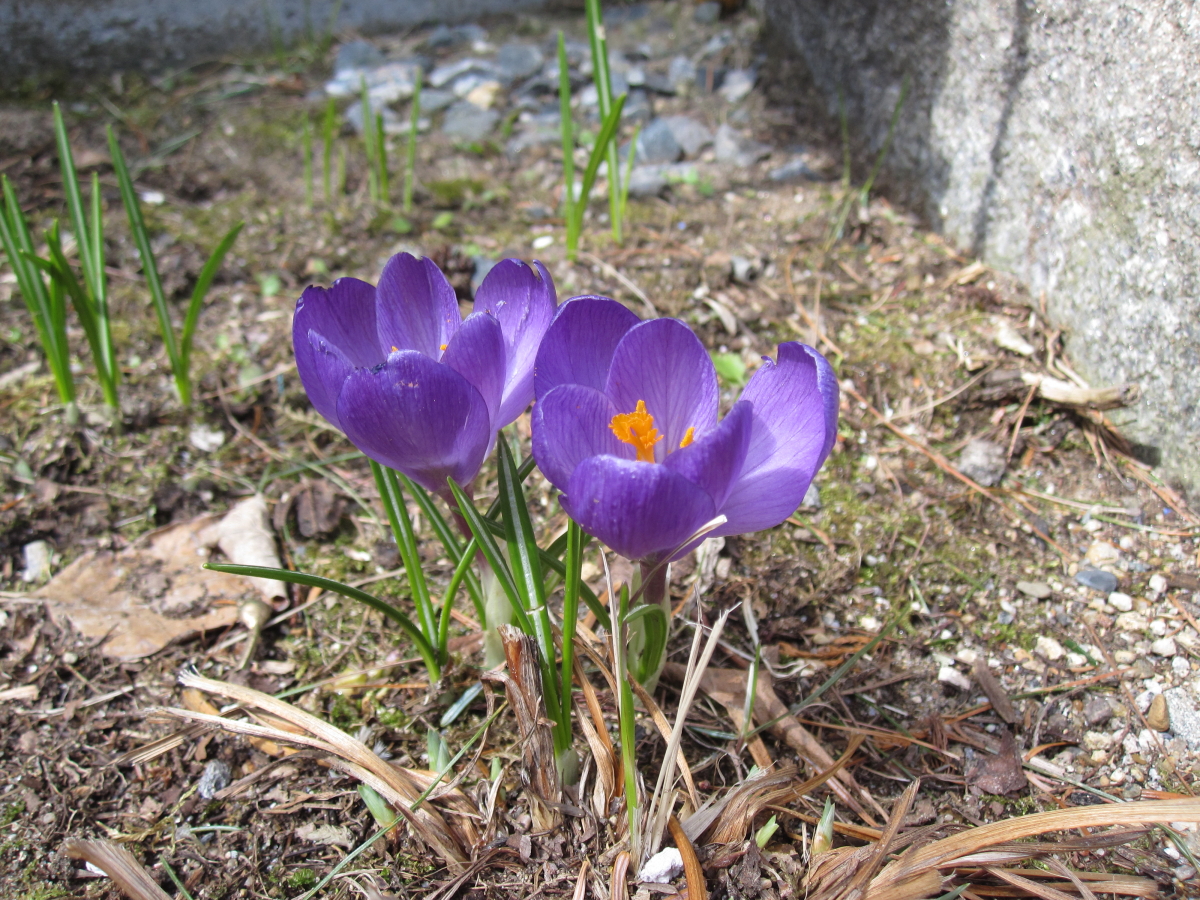
Spring is coming to New Hampshire.  The crocuses have joined the snowdrops in bloom, and the early spring birds are singing their joyous Easter songs. 

Crocus
Snowdrops
This week I heard the spring songs of phoebes (the first of the flycatchers to arrive), brown creepers, red-winged blackbirds, the singing-star Song Sparrow, and even a northern parula - all promising signs of spring.  Meanwhile, the lake is still firmly iced in, though with a beautiful warm and sunny day yesterday, the ice is turning dark, large cracks are forming around the edges - large enough to support the occasional pair of ducks - all of which mean the end of ice is near.  
Looking north over Wicwas yesterday from Wicwood Shores Road.

I doubt there will be any more coyotes crossing the ice unless we get an unexpected cold snap.

Last week's mid-day sighting of a coyote in the open was unusual because coyotes are primarily nocturnal.


There's not a clear story of the evolution of the Eastern Coyote, but a widely accepted theory is they are a mix of the Western Coyote and the Eastern Timber Wolf.  DNA testing of our coyotes shows roughly equal parts of these two species, with a small amount of domestic dog DNA as well.  The theory is that two major factors lead to this as a new species.  First, Europeans cleared the eastern forests where the timber wolf was present, all the way to the mid-west which was the eastern limit of the Western Coyote.  The presence of wolves probably kept them out of the east, but as the wolves were removed, there was the opportunity for coyotes to move in.

The second factor is that both wolves and western coyotes were hunted in a relentless effort to exterminate them.  As the popultion of both species declined, mating opportunities became scarce, and a result, they started interbreeding.  The extermination of wolves was largely successful, but it was not for coyotes which have incredible survival characteristics.  The result of the interbreeding is the eastern coyote, which weighing 30 to 50 pounds, is noticeably larger than the western coyote at 20 to 30 pounds.

Between the wolf extermination project and the decimation of the large mammal population (caribou, moose), wolves are no longer present in New England.  But coyotes have extremely wide diets including mammals large and small, birds, insects, amphibians, fruit, vegetation, and human garbage, so they thrived as the wolves departed the scene.  Despite governments spending millions of dollars to kill coyotes (in 1971 alone, the US government spent $8 million on the coyote extermination project), their numbers continued to grow.  The effort was self-defeating.  It turns out that coyotes have a remarkable survival instinct:  when their population is stressed for any reason, they actually increase their rate of  reproduction to ensure their lineage continues.  Coyotes are probably here to stay.

I rarely hear coyotes, though people west of the lake report hearing them at night on occasion, and I see their tracks and their scat regularly all around the lake.  

Coyote  tracks and scat after a light snow earlier this winter.


I've seen several instances of successful coyote hunts, most dramatically, deer killed on the ice in winter (See January 22, 2012).  One winter I set a camera at a kill site and captured a lot of nighttime action. 
A coyote approaches a deer carcass.

One coyote came near the site during the day, but it didn't venture out in the open; it crept along the shoreline, deciding to wait for the safety of dark.

As to why a coyote was out in daylight last week, it may have been needing extra hunting runs for its family.  Coyotes mate in winter, giving birth in spring, and the female remains with the pups in the den while the mate and other males in the pack hunt for food for her and the pups.  Both the male and female as well as perhaps an older sibling will care for the young.  The book "Tracking and the Art of Seeing" by Paul Rezendes [HarperCollins, 1990] provides an excellent portrait of coyotes.


I was in the Ossipee Mountains this week, and even in that southern part of the White Mountains, it's still winter at higher elevations.

Mount Washington viewed from the summit of Mt. Shaw in the Ossipee Range.

Ice formations on the Mt. Shaw Trail.
The warm day was sending a lot of snow melt into the streams.


I'm always happy to come across signs of moose wherever I am.  These tracks and droppings were near the Black Snout summit at an altitude of 2800'.
A pile of moose droppings near the summit of Black Snout.
Moose prints are huge compared to white-tailed deer.
The large animal followed the trail for quite a distance;  it requires a lot less energy than breaking its way through deep snow and dense forest. 

Down at the base however, it was back to spring, and there is a large sugarbush near the trailhead.

They were collecting sap as I arrived in the morning.  When I returned after my hike, I took a peak in one of the buckets.
In just a few hours, a couple of inches of sap had been collected.
The sap was flowing nicely.  
They must have to empty the pails every morning when the sap is flowing this well.


A lot is changing now in the Lakes Region.  Warm days and cold ice sometimes conspire to give us unexpected experiences.
Fog settles in on Lake Wicwas as the sun sets.

Spring is a beautiful season in New Hampshire, something worth waiting for - and appreciating when it finally arrives.  

Happy Easter!


Sunday, April 7, 2024

April 7, 2024: Temperature Shock

From 80 degrees to snow - this week's journal was supposed to be all about wildlife in South Carolina, but upon returning home Thursday night the local picture became the story.

Marion Lane on our arrival home from South Carolina.

Once we got north of Concord NH the scene looked like an Alaskan tundra with everything white and trees down beside the road for miles.  


We arrived to find over a foot of heavy snow plastered to everything, branches and trees down everywhere, and about half the people in Meredith without power including most homes around Lake Wicwas.  But that's better than some towns in the Lakes Regions which had 100% of their customers without electricity.  And many of us around the lake are still without power as of 9:00 this morning.

The heavy snow and wind brought trees down into the lake in multiple locations - I expect there will be more to be found as we get on the lake to explore.  This huge white pine and several hardwood trees were some of the casualties. 


There will be a lot of trail maintenance to do over the next few weeks.
Trail crews in Meredith will be busy this spring.

On the bright side, there were some signs of spring including my first loon sighting on Friday.  I also received a report of a pair of loons on the lake, so we're heading in the right direction. 

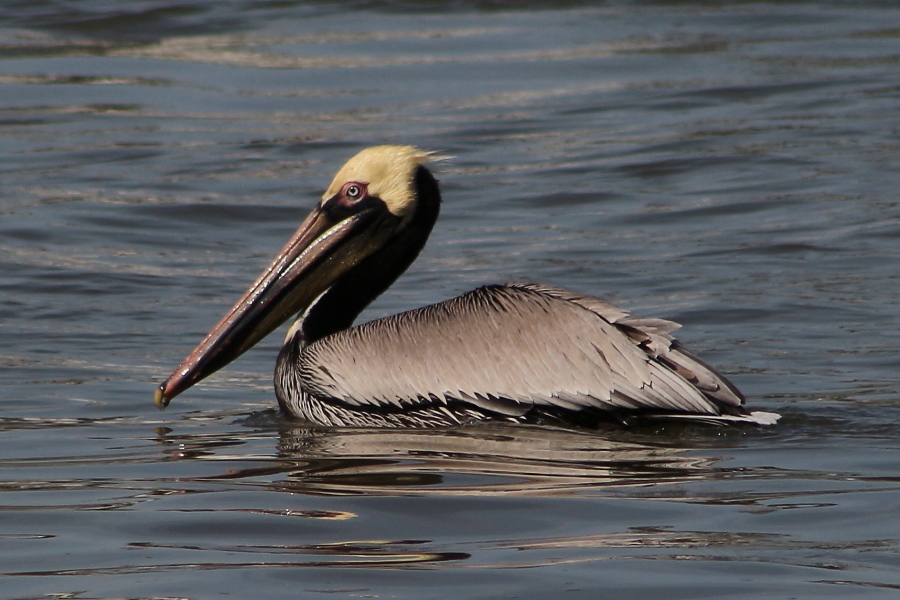
Enough of winter in April; now down south to South Carolina where we had another fabulous time in the low country with our great host, tour guide, and entertainment director.  We took walks along creeks, through swamps and old plantations, and of course along the Atlantic Ocean. These gave us the opportunity to enjoy wildlife much different from that in New England including dolphins, alligators, and anoles.  The most fascinating of these are the pelicans, truly bizarre birds with some amazing abilities.  Just floating on the water their unique physical attributes are immediately apparent with exception of not being able to see just how large their gular pouch is because it's all folded up under their beak.  
A pretty bird in its special way.

This photo, taken in Alabama and sent to me by a good friend (thank you PL!) shows the gular pouch in its full glory:

Soaring along in formation, often close to the water to take advantage of air pressure off the water, is when they are most elegant.
Flying in close formation over Shem Creek.


Other times they will use the currents and updrafts from the onshore breeze when it hits the dune line to facilitate their flight.  Wherever they are, they are an oxymoron of awkward beauty.


At feeding time they use powerful wings to gain altitude where they are able to see fish under water even with waves and reflections on the surface.  When they identify a school of fish they just fold their wings and let themselves plunge head first down into the sea.  

Target in sight.
Contact
Splash down

If they're on target that pouch swells with water and a number of fish which they swallow whole after letting the salt water drain out.  When the tide changes they know to congregate around the breach between Sullivan Island and the Isle of Palms (that's also where we saw dolphins) and when there's a big school of fish it's quite a spectacle to see.


The other bird I'll mention is the Anhiga, another ungainly bird with a long neck that it uses in a most unusual manner, stretching it out for no apparent reason.


I often see this behavior - is it a threatening position to scare me away?  Twisting its neck into a pretzel is just as interesting, but that makes sense for grooming or situational awareness.


The Anhniga, like a cormorant, will spread its wings out to dry them after diving for fish.
Sunbathing by a lagoon in the early morning light.


Other birds we saw were ones we'll soon find here in New Hampshire including yellow-rumped warblers, palm warblers, and bluebirds already feeding their chicks.
Papa Bluebird.

And Mama Bluebird.  That might be a tick!

Back in New Hampshire, April is always a time of change, and this year, everyone and everything will need to be resilient to make it through to May.
The crocuses didn't succumb to an April snowstorm, and neither will we!

Some other good news:  The forecast is for clear skies for tomorrow's eclipse.  Fingers crossed for this rare astrological experience!  

🌒


Sunday, April 17, 2022

April 17 2022: Our Banded Loons Return

An encouraging sign for our loons as well as the loon population in general appeared this week:  Our mating pair of loons has returned.  I was able to get a good look at the bands on the legs of both the male and the female, proof they are the same pair that fledged two healthy chicks, last summer, Jimmy and Coco.

The female has lots of jewelry, two bands on each leg.

The male has only a single band on its left leg.

The pair will spend the next month or two fattening up on fresh fish and selecting a nesting site.  I've heard sounds of contests with other loons, so there's likely to be a little territory resolution to be done as well.  Last year the various loons resolved their differences fairly quickly and this pair had nested by the first of June; we can only hope this year goes as well as last.  (I reported this sighting to the LPC, and perhaps you saw that they scooped me and put these pictures in their newsletter!)  

On the subject of mating and territory, one day I was drawn from a long distance by the persistent tapping of a woodpecker declaring his territory.  As I carefully closed in on the sound I was amazed at how much noise a small bird can produce.  The downy woodpecker knows to find good solid, dead but dry branch to hammer on which will resonant loudly throughout the forest.  The farther the sound can carry, the larger territory a male woodpecker can claim.  After a long time circling under the tree I was finally able to spot the percussionist, way up high on a dead oak limb.  The video is poor, but you can clearly understand how his signal carries far across the land (click on the video below):


Our list of summer migrants continues to grow, with this week's arrivals including pine warblers, brown creepers, and great blue herons, one of our larger birds on the lake.  Our highly visible raptor, the osprey - also known as the fish hawk - has returned and immediately made its present known by its loud kip-kip-kip call as it flies off from its perch overhanging the lake where it sits looking for an unsuspecting fish down below.  One evening after a successful fishing expedition it flew into our cove and ate its catch in a secluded spot where an eagle wouldn't steal its dinner.  It was dusk and I didn't want to disturb it, knowing it was hungry after its long flight from Central America, but I was able to get a couple of pictures of meal time.

"This looks like a safe spot."

"No one followed me?"

"Time to eat!"

I'm not sure why osprey fluff all their feathers up like this:


Could it be to help them dry off after their dive into the water to catch the fish?


Another of my favorite birds that visit Lake Wicwas in the spring and fall made a quick appearance this week.

Mr. and Mrs. Bufflehead

This is Mr. Bufflehead, I didn't get a decent shot of Mrs.
These birds still have a long way to travel - their primary breeding ground ranges from western Canada to Alaska.  The Lakes Region may be their first fuel and rest stop as they leave their winter grounds along the Atlantic coast.


Last week it was the wood frogs singing, and this week, on April 11th, it was the spring peepers raising a racket in the newly awakening forest.  And as spring unfurls, lots of green shoots are erupting from the earth and buds are swelling, ready to burst open with the next sunny warm day.  And more spring flowers are blooming too!

Crocuses

The season of renewal is here  -  Happy Easter!


Sunday, April 4, 2021

April 4, 2021: March Madness

So much for "Out like a Lamb".  March ended with a vengeance, hitting us with some of the strongest winds we see around the lakes.  And it came at a time when the frost is leaving the ground and the soil is wet and soft, allowing for toppling trees over by the roots.   Fortunately we were far enough north that shaded forests still had a decent frost base and most of the trees I saw blown over were snapped off above the ground at a weak point in the trunk.  This particular tree was inconsiderate enough to fall right along a trail, which makes a lot more clean up work than if it fell straight across the path.  

A white pine snapped off by wind.

A much more thoughtful tree was kind enough to fall away from the house by which it stood for the past 80 or so years, and then, in an extreme case of good fortune, it lined itself up precisely between two other pines that were narrowly spaced and joined forces to grab hold of it right before it completely demolished all of the boats so carefully lined up between them.


Sometimes all the stars just line up right!

Another boat on the land wasn't quite as fortunate.  This aluminum rowboat was picked up by that northwest wind and blown, Dorothy-style, over the land and into the lake.


I didn't see it happen so it's possible it landed on the ice and then was blown into this stretch of open water where it got trapped.  After the storm I was able to secure it on land and later paddle it back to its home when after the wind died down.  So here we are, days before ice-out and the first boat has already been launched.  

The animals are taking advantage of bits of open water as well, as I heard my first beaver-tail crash onto the water when I walked along the lake just after sunset.  We also have a pair of mallards that appear to have made this small stretch of open water their new home.

"How does this spot look dear?"

Sailing among the icebergs.


They spend all day cruising in these tiny areas, paddling back and forth in the narrow channels, sometimes walking over the icebergs, sometimes using them for a napping spot.  

"Ouch that's cold."

Goose and duck down is still the best insulation.

Whenever another pair of mallards shows up these guys waste no time in shooing them away.  I didn't realize mallards were that territorial; we've had fun watching them all week.  They've also found a good source of food under our bird feeders and are doing a great  job of cleaning up all the mess the birds created all winter.

Nature's vacuum cleaner

Those open spots have been freezing over at night so I'm not sure where they go - probably onto land or down to the outlet by the dam which remains open all night.

Cold nights are slowing the ice-out process.

Sadly, with the arrival of April in bear-country, it's the end of bird feeders.  We've had a few new appearances this week including the first robin, the first song sparrows, the return of the redpolls, and even a few juncos which we haven't seen all winter.

A common redpoll cracks one of the last seeds from the feeder.

Birds have tremendous memories when it comes to remembering where they've stored individual seeds as well as where they've found food sources.  I wonder if these are the same redpolls that were at our feeder in February, coming back to where they previously found a meal on their way south.  Redpolls are now migrating all the way up to Greenland and the farthest northern parts of Canada for their breeding season.

As far as the ice goes, Meredith Bay is clear of ice as are many other parts of the big lake.  But that wind blew a lot of ice into Wolfeboro, the Weirs and other southern bays so Winnipesaukee hasn't declared ice-out as of today - maybe it will happen early next week.   Lake Waukewan shows a lot of blue water with all its ice blown onto the shore of the town beach.

Lots of blue water on Waukewan with all the ice blown down toward the town beach.

But Wicwas still has a ways to go.


A few more warm sunny days will get us blue water too!

I'll end with one last bird feeder moment for the year.
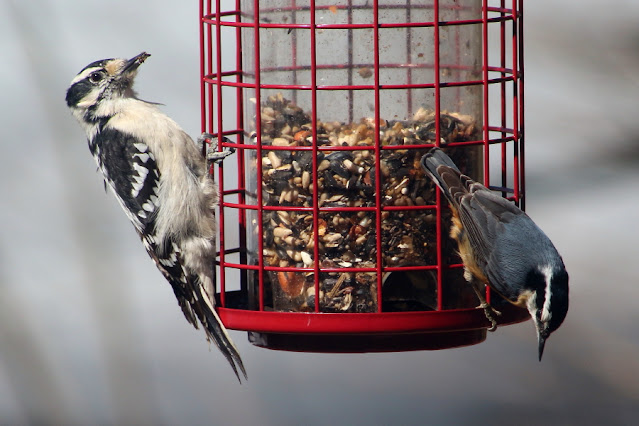
A downy woodpecker and a red-breasted nuthatch help empty the feeder for the last time.

I'm glad there are plenty of natural food sources available for them now.  And look - the crocuses bloomed for Easter!


Happy Easter!