Showing posts with label Oriole. Show all posts

Sunday, July 11, 2021

July 11, 2021: Big Moths and Big Snakes

I need to go back and catch up with some items that were neglected the past few weeks due to all the loon news on the lake.  First, the appearance of Luna Moths occurred quite some time ago and several people told me of their sightings including this one by Dotty Treisner who found two of them resting on the red siding of her house.

Luna Moth (Actius Luna).   Photo by Dotty Treisner.


Though jealous of these sightings because I haven't seen one myself in many years I'm always excited to know these beautiful, huge moths are still present in the Lakes Region.  A big reason they're not often seen is that they only live for about a week in their adult, moth form, during which time they mate but they don't eat - they don't even have a mouth or a digestive tract.  All their food consumption occurs while they are a caterpillar, munching on tree leaves such as birch.

Another overdue observation dates all the way back to the rained-out bird walk that was to be led by UNH Extension Service biologist Mart Tarr at the Page Pond Community Forest.  As we were all waiting at the trailhead to see if the thunderstorm would pass quickly (it didn't) he mentioned there had been a lot of Baltimore Orioles in new Hampshire this summer.  Since I hadn't seen one of these bright orange birds yet this year I went out the next morning in the kayak to peruse likely oriole habitats, and sure enough I found one right away.
A Baltimore Oriole (Icterus galbula) sings from the highest branch of a white pine.   


They are such impressive birds and their loud, repeated song carries a long way over the water to lead you to them.  You can listen to their songs here.

Another impressive bird is the great blue heron which even standing three feet tall is often hidden among the weeds and bushes of the shoreline.  So it was an uncommon sight when Cindy Desmond saw one perched completely exposed on a raft.
A great blue heron (Ardea herodias) standing tall.  Photo by Cindy Desmond.


Wild creatures aren't ashamed to take advantage of human alterations to the environment when they suit their needs, sometimes to their benefit, sometimes to their demise.  Running along the side of the road one day I saw a bright green snake sunning itself on the edge of road, soaking up the heat from the pavement.   I stopped to encourage it to move farther from the road lest it become a participant of the old "Frogger" video game, but I was too late.  Though still alive and wriggling from what looked like a minor injury I'm pretty sure it wasn't going to survive the trauma it had endured.  And that wasn't the only snake-on-human-structure moment this week.  One morning I found this large northern water snake sunning itself on our dock when I went out for a paddle.
One warm, happy, water snake.

Like all snakes it wanted nothing to do with me and immediately slithered off the dock as I approached, but I was ready.  You probably shouldn't watch this video if you don't like snakes and ever want to swim in a lake again.


There's been plenty of stormy weather lately including the most recent heavy rains from tropical storm Elsa; the lake right now is a good six inches above full pond.  Did you catch the sunset as one of the recent storms departed?


I think our drought conditions have been largely remedied at this point.

I can't close without an update on the loons.  Coco and Jimmy were both doing fine at my last check on Saturday.  I don't see them as often now that they are widening their circle of travel all the way out to the area between Sheep and Bryant Islands.  Keep an eye out for them on your lake trips as they may be most anywhere on the northern portion of the lake in the coming weeks - they are still pretty small and vulnerable.
"Move your head dad, I can't see!"


My counterparts who report on the nature scene at Pleasant Lake in New London have been following an interesting loon story that mirrors our experience with a mate change.  But the female loons battling each other on Pleasant Lake have not given up the fight and it's taking a toll on everyone.  Their reporting implies that male loons fight over territory while female loons fight over males.  This week's report is dramatic, violent, and heart wrenching, but it's worth reading to better understand these complex animals.  You can find their report here; it will make you appreciate how fortunate we are to be having a peaceful year on Wicwas.

Nap time on Lake Wicwas.

Sunday, May 21, 2017

May 21, 2017

There is so much going on around the lakes in spring and early summer - people and animals returning, trees flowering, flowers blooming, amphibians breeding - it's hard to decide what to leave out from the journal. It's always a good feeling this time of year when you meet a familiar face on the trails that you haven't seen for a while.
A Gray Tree Frog (Hyla versicolor) sitting in the middle of the trail
This little gray tree frog seemed happy to see me as well, as he was quite content to sit and chat with me for a while, even offering to pose for a portrait before I went on my way.  Later that evening he sang a nice etude for all to hear around the lake.  (You can listen to the song of the gray tree frog here.)

There is much to enjoy at a frog's-eye view at the moment, and purple seems to be the theme of the week.  
Fringed Polygala (Polygala paucifolia)


Wild  Common Violet (Viola papilionacea)
In addition to fringed polygala and violets, there are wild strawberry, sweet white violets and trillium blooming down at frog level.  A bit higher up is more purple - lilacs, rhododendron, and rhodora.
Purple Lilac (Syringa vulgaris), the New Hampshire state flower, even though not indigenous to NH
Rhododendron at Oakland Cemetery

Rhodora (Rhododendron canadense)

Other friends get the bird's-eye view of these charms, although their own colors compete for attention in the upper-level beauty pageant where yellow and orange are added to the color scheme.
Baltimore Oriole (Icterus galbula)
Hang on to that bloomin' blueberry bush!

Yellow Warbler (Dendroica petechia)
Black-throated Green Warbler (Dendroica virens)
This week brought me two new sightings.  The black-throated green warbler I have heard many, many times signing it's memorable song, but I had never seen one, as they hide deep in the trees' foliage;  I was happy to finally see one in person.  (Though I must say I can barely see the green on its back that gives it its name.) 
A small streak of olive green is visible on the back of its head and neck

The next flying ornament, a mourning cloak butterfly, was also a new discovery for me.  
Mourning Cloak butterfly (Nymphalis antiopa)
They have some unique characteristics, including the longest lifespan of all our butterflies.  Although some migrate, most overwinter locally, and thus are among the first to appear in the spring.  They breed in spring, then after feeding - especially on the sap of oak trees - they go into a state of dormancy during the hot summer, reawakening in fall to feed again and store energy for the winter. [Ref:  Butterflies and Moths of North America]  I also learned they make an audible click when they take off, a defensive trait to startle a predator.  [Ref:  "Eastern Forests," Ann Sutton, Knopf, Inc, 1985]

On a somewhat sad avian note, we appear to have had a visit from the bear this week.  We woke one morning to find one of our birdhouses ravaged by a wild beast.
Bird house, with nest to the left
I'm guessing that only a bear would be able to pull apart this house, bending five nails in the process.
Birdhouse easily and cleanly disassembled required some strength
A raccoon or a weasel would happily go after a bird nest, but with not a scratch left on the birdhouse, I think it was a feat requiring the strength of a bear.  We're glad we had taken in the bird feeders a few weeks ago.  

I did some work with the Lakes Region Conservation Trust this week on Rattlesnake Island. (Can you count a trip on Winnipesaukee and a perfect hike on an island "work"?)  It was my first time on the island and it is beautiful, including a nice two mile (round-trip) trail with great views south and west towards the Belknap Range, and north towards the White Mountains.  

If you are on Lake Winnipesaukee this summer, make a stop there.  The Lakes Region Conservation Trust does ask that you become a member if you visit, and display your decal on your boat.  Their dock is on the southeast point of the island, and is marked.  
Approaching Rattlesnake Island from the east shows the ledges upon which the trail passes
Alton Bay and Mount Major to the south as seen from the ledge
White oak flowers frame Gunstock and Belknap Mountains to the west

Boats and docks are starting to appear on all the lakes, and more people are arriving every week.  I look forward to seeing many more familiar faces on the water and on the trails in the coming weeks. 
More friends returning for the summer?
Welcome back to summer!

Monday, May 30, 2016

Memorial Day 2016

Memorial Day brings a time to give thanks for all we have in this country;  it is so easy to forget the sacrifices so many have made for us.  This grave of two revolutionary war veterans is barely visible from Chemung Road, but is well maintained.
From Chemung Road
Grave of Jonathan Leathers and Hilliard Shaw
 

The hot weather this week set the stage for quiet early-morning paddles on Lake Wicwas.  On two occasions I watched Baltimore Orioles enjoying the fruits of spring on Sheep Island. 
Baltimore Oriole (female)

Get a grip on life

They were hopping from branch to branch, plucking off delectable, energy-rich insects from the pine trees. 
Where is it hiding?

There it is
Yum!
This a synergistic service, removing damaging pests from trees while nourishing themselves, keeping nature in balance.  Orioles are known predators of tent caterpillars, and this seems to be big year for those unsightly insects.
Tent caterpillar nest in a denuded tree
They look like easy prey once they get out of the tent.
Caterpillar mass after they outgrew the nest

Tent caterpillars may completely defoliate a tree, but unless it is otherwise stressed, the tree will usually sprout new leaves and survive.  I've seen a scarlet tanager frequent the vernal pool where this nest is located.  Many other animals feed on these caterpillars as well, as unlike the non-indigenous gypsy moth, tent caterpillars are native to New England.  A Michigan study by the Conservation Resource Alliance found that on average, one bear eats 25,000 caterpillars in a single day!   (They determined this by sifting through their scat - how's that for a job?)

If any nests are built over the lake, and a caterpillar should fall onto the water, these guys would be sure to gobble it up!  (This one's for you, GameFisher316!)
Largemouth Bass on their nest in shallow water (location not disclosed!)


After depositing her eggs, the female bass will depart, possibly placing more eggs in another nest with another male;  this increases the odds of passing on her genes.  The male will stay at the nest to guard the eggs and protect the minnows when they hatch.  At least until he gets hungry - then he will likely eat plenty of his own young.  [Ref:  William K. Johnke, Dorbil Publishing Co, 1995]

If you were out around the lake this weekend you probably saw lots of flowers:  lilac, cherry, jack-in-the-pulpit, and everyone's favorite, lady's slippers.

Now an update on the loons:  they still appear to be in search of the perfect nesting site, as the pair remains together, out fishing and doing home inspections.  Early Saturday morning one popped up near me to say good morning.

And there is good news and reason for optimism:  on Pleasant Lake, 30 miles southwest of Wicwas, the loons have re-nested after abandoning their first nest due to eagle harassment.
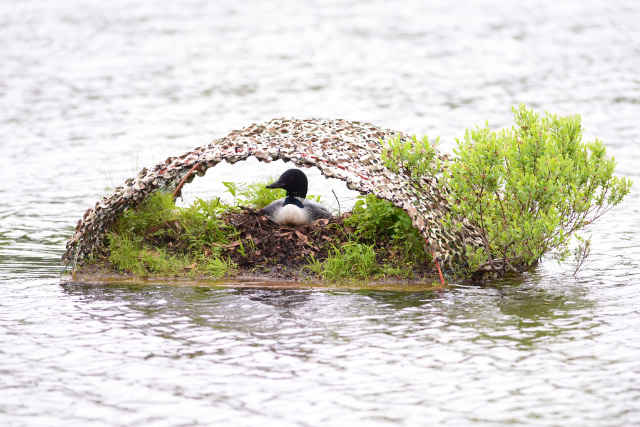
Pleasant Lake loon on their custom-built floating raft.  Photograph by Kittie Wilson

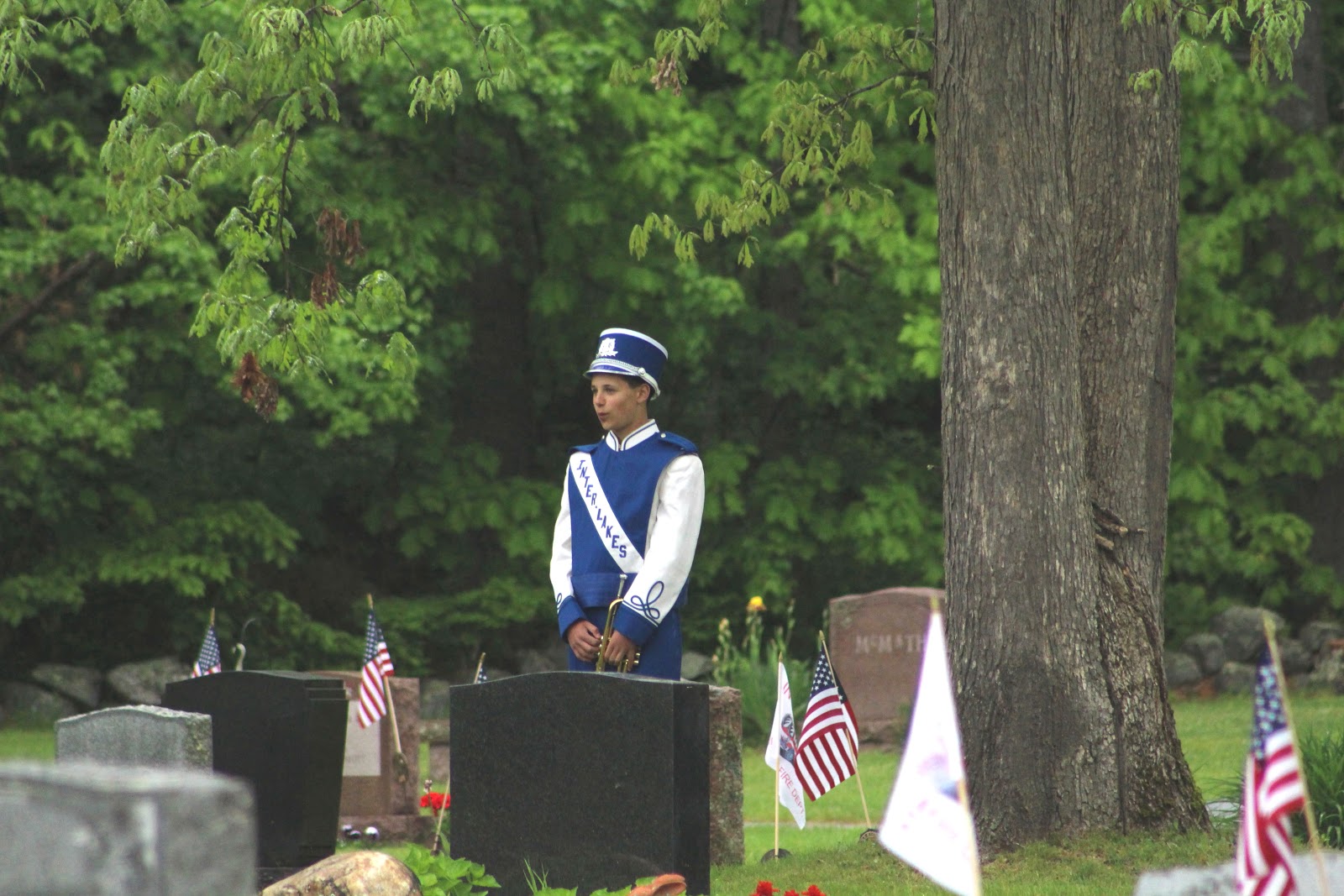
Finally, Meredith Center held a Memorial Day service at Oakland Cemetery today to once again remember, on this Memorial Day, all those that served and sacrificed to secure our safety and freedom. 


Thank you.  We remember.

Sunday, May 20, 2012

May 20, 2012

After six weeks, I'm finally back on my feet and able to take my first kayak on Lake Wicwas, and a walk along the shores - and there's a lot going on!  We had some gorgeous warm, sunny weather, and this calm morning revealed the presence of what's afflicting allergy sufferers, with a layer of pollen on surface of the lake.

While taking this picture, I noticed a small black fly suspended in the air, caught in an invisible spider web!

Here's the source of much of the pollen - the flowers in the oak trees are releasing their massive store of pollen.  It's perhaps not as thick as the White Pine pollen that will be released soon, but there is a lot of it.

Red Oak Flowers

From flowers at the highest point of the forest - the Red Oak - we go to the lowest floor and find one of the most remarkable flowers in the forest, the painted trillium.


I don't quite understand why there are hundreds of starflowers, and thousands of violets and mayflowers, but only one trillium along my usual  hike.  What is it about that one spot that nurtures a trillium that is so different from the rest of the forest?  It also makes me realize how easy it is for a rare flower to be eradicated - just one person plucking or trampling a trillium every few years could be the end of them.

Along the shores of the lake I found lots of Hawthorn blooming.  I first noticed the sweet fragrant smell coming form shore, and that led me to the flowers.

On this one you can see another fly caught in a spiders web!

And here's an insect that evaded the web and is helping with pollination.

Out on the lake itself the plants are growing rapidly.  The Yellow Pond Lilies are already blooming where they get a lot of sun, and the lily pads are already giant.


The young water creatures are also growing quickly.  I saw a water snake that is already almost a foot long, and this painted turtle - which is only about two and half inches long, though there's no scale to see that in this picture.

I saw lots of birds also, including the cormorant sitting high on its pine tree, the loon pair (scouting for a nesting site) and the geese.  It looks like they have a child care center, as this one pair of adults was watching over at least 15 goslings.

When they go on family outings they somehow know which ones are theirs.

There are many Red-Wing Blackbirds providing lots of color to the marshes, both visually and aurally, as they bestow a large variety of loud, stark calls to all visitors.

A bird I don't think I've seen before at the lake is an Oriole.  I had to go to the books to look this one up - it's a female.
Oriole, female

She was flitting from shrub to shrub along the shoreline.  Orioles like fruit, and she was in the blueberry bushes, but she wasn't finding any yet!

But the most exciting bird sighting was a pair of Broad-Winged Hawks that circled overhead for a long time.  On the thermals of the hot afternoon (it was 84 yesterday, and 89 today!) the two of them soared directly above us.  We first heard them calling in the trees, so we saw them as soon as they set sail, getting a great look at their wings and tails as they spread, flared, and narrowed them, maneuvering to find the best lift.  It was too fascinating to leave to get a camera, but here's a link to a picture that shows the sight.  (I'm respecting the photographer's copyright request.)

One other really neat sight this week that I didn't capture on film (that is, silicon) was a Mink that hopped along our shoreline about 8:30 one morning.  It went right along a path, then down the bank of the lake, and we followed it along the shore by the shaking blueberry bushes as it searched for frogs, chipmunks, or anything else it could find where land meets water.

There were a couple of less enjoyable sights this week.  This one, man-made, of an old tire in the lake, was disappointing.  It was right next to a pressure-treated 4x4 from the dock on Bryant Island that was cut out of the ice two years ago.  This must be the spot where flotsam collects.  I'll go back once the boat's in the lake - nothing to be done about it in a kayak....

The sight of tics on the grass is much easier to take, but still not fun to see!

They are so incredibly well adapted to catch anything that goes by them - look at the tiny barbs on their legs.  Their legs move around slowly most of the time, but when I got really close, they starting vibrating madly to increase their batting average.

These tent caterpillars are also not a pretty sight.  This nest was munching on a black cherry tree, already having stripped a number of branches.


I'll end this rather long rant with a beautiful sight of the coming season.  I'm looking forward to seeing lots of people out on the lake next weekend as we remember those who gave the ultimate sacrifice so that we may enjoy the freedoms of this beautiful country.