First it's the prey. Lots of small ripples on the surface of the water raised our curiosity when it continued for an hour or more. Linda was the first to investigate and found a very large fish - a largemouth bass - swimming casually around in shallow water very close to shore.
 |
| Papa Largemouth. (A polarizing filter helps to reduce reflections from the water.) |
There are lots of bugs on the water, so the ripples were probably the fish rising to catch them.
 |
| Lots food for birds and fish right now. (No polarizer has surface reflection.) |
This continued for a second day, and now there was a school of mixed species swimming around the area together, perch, bass, and sunfish, all not seeming to bother each other.
 |
| A mixed school of fish is waiting for lunch to arrive. |
 |
| Yellow Perch |
 |
| Sunfish (Pumpkin Seed) |
And now there were two largemouth bass.
 |
| Note the distended belly on the lower fish. |
They were swimming and circling close together over an areas swept clear of silt - all the clues of a largemouth bass nesting area. Bass nesting starts in the spring when the water temperature rises to about 65 degrees, at which point the male bass will select a site and clear it out by fanning the bottom with its fins. When the water has been warm for a few days the females will arrive near nesting sites and the male will go in search of an egg-bearing female, herding her to the nest site. At the nest the male will strive to keep her there, swimming alongside and circling the female, sometimes bumping her abdomen to encourage the release of her eggs. When she does release eggs, she will only release a portion of them, saving the remainder to deposit in another male's nest, increasing the odds of her offspring's survival.
After spawning the male will remain at the nest to defend the eggs from predators - that's probably why all the other small fish are hanging around the nesting site, hoping for an easy meal of fresh fish eggs. After the eggs hatch in about a week the male will continue to defend the small fry for up to two more weeks when they will disperse from the nest. During this time the male will not eat - until it's so hungry that it just can't resist all the young fish it has been protecting, and will often eat much of its own young. The strongest and fastest will escape and survive, keeping the gene pool strong. Still, males may die from the exhaustion and lack of food from defending the nest. By Saturday only one bass was to be seen, and it was busy chasing away any smaller fish that dared enter its lair.
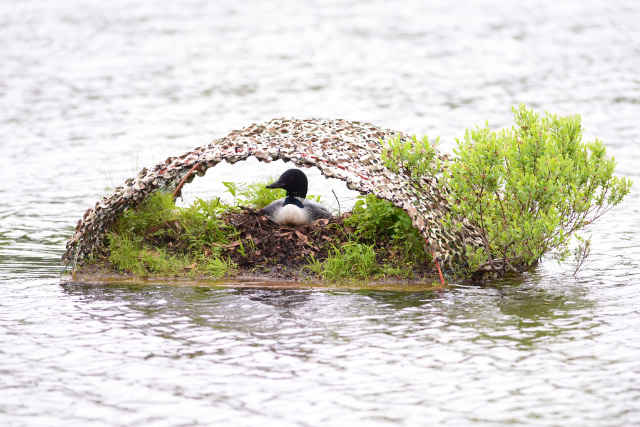
The second mating scene this week is a predator of the first: Our loon pair, which has been spending lots of time poking around various islands in search of the perfect nesting site: one close to the water (because they can't walk on land) but not too close to the water level (so a heavy rain won't flood the nest) and on a lee shore (so waves won't flood the nest). It's not clear to me whether they have learned the boat patterns on the lake to know where they're safe from boat wakes, but they seem to do a pretty good job with that. I only recall one year when a nest was located where it received a lot of boat wake.
There have been a few territorial fights where one loon - presumably the mating male - chases an intruding loon. These chases of high-speed wing-rowing along the water can go on for a quarter of a mile across the lake.
 |
| Wing-rowing to drive off an intruder (photo taken a few years ago). |
After one of these events, successful in driving off the unwanted loon, the victor swam slowly back to a tiny island it has been scouting with its partner.
 |
| Returning home. |


Arriving at the island, a second loon magically appeared.
 |
| There she is. |
She was probably hiding safely out of site so as not to reveal a possible nesting site to the intruding loon. They once again perused the real estate as a potential place to live for the next four or five weeks.

 |
| "It seems rather small to me." |
They seem confident they'll be able to nest in peace somewhere on the lake, because on Thursday, they were actively mating.
 |
| I'll try to keep this R rated. |
Eggs are usually laid a few days after successful fertilization which may require several copulation attempts. With any luck they will be on a nest by next weekend. And a few weeks after that, they'll be in search of those tiny bass minnows to feed to their chicks. The timing of nature sure has things figured out.
And the blueberries!
 |
| A bumper crop of blueberries has started. |