Showing posts with label Oakland Cemetery. Show all posts

Sunday, May 28, 2023

May 28, 2023: Pickerel Frogs

I think we're pretty close to having a full contingent of summer residents now.  This week I saw a veery, a Yellow Warbler, and a Red-eyed Vireo, some of the last arrivals.  The amphibians are also out and about; the tree frogs are singing, and I saw my first pickerel frog.
Pickerel Frog

It blended in so well with its surroundings that I never would have seen it if it didn't leap out of my way as I approached.


It was down near the lake where there are lots of good things to eat, but that's also where our resident garter snake hangs out, so it better be on high alert.  Pickerel frogs are considered poisonous as their skin excretes a toxin that is harmful to humans, cats and dogs, other amphibians and some snakes, but the garter snake has developed immunity to the pickerel frog's toxin [Amphibian Planet].  Dogs often learn about amphibian secretions from toads which have a more mild toxin, but the dog still ends up with a foaming mouth.  Pickerel frog secretions can be fatal to small animals, but to humans and pets it's usually just irritating to the skin and mucous membranes.  

Dragonflies are becoming numerous as they emerge from the depths of the lake as it warms.
Common Brown Baskettail (Epitheca cynosura)

I recently learned that dragonflies are actually considered aquatic insects because they spend most of their lives in the water. They live as nymphs in the lake for a few months or even a few years depending on species.  Then most only live for a few weeks as flying dragonflies to mate and lay their eggs back in the lake.  Their mating process is fascinating - a topic for another day.

Another small animal I saw this week was a Dock Spider.
This little guy was hanging out on our screen.  I think it looks like a pirate.

I've never seen such a little one. Usually I find huge ones on the dock or the boat come mid summer.

On a much larger scale, I've seen deer a few times over the past couple of weeks so I set up the trail camera to see what I could catch. What I caught was a rather skinny young deer, nibbling its way through the trees, and then grooming itself in the opening where I placed the camera. 

It must be relieved to have green grass and new leaves to browse on after what looks like a hard winter for it.  It looks like it might have little antler stubs known at buttons - perhaps it's a young buck.
Here's a video as it browsed and groomed and picked off ticks.


Now on to the flowers - the Lady's-slippers are out.
Pink Lady's Slipper

While I was enjoying this one I noticed a dry, brown stalk coming out from its base.  It's last year's flower which is now a seed pod - an empty seed pod.  Inside it would have been many, maybe hundreds, of tiny seeds.
The now-empty seed pod.

The seeds have presumably been released on the ground so perhaps there will be a whole patch of lady's-slippers here in a few years.

Around the lake, the white blossoms of the serviceberry are gone, replaced with chokeberry growing all along the shoreline.
Black Chokeberry (Aronia melanocarpa)
The chokeberry flower is very similar to other fruit trees such as cherry, plum, and apple.


You've likely heard about the smoke in the upper atmosphere that was blown here from fires in Canada.  Between the smoke and the pollen there have been some pretty impressive sunsets.


It looks like we're going to have nice sunsets all weekend; let's enjoy this beautiful weather as we remember what this long weekend commemorates.  There will be a memorial service at Oakland Cemetery on Monday morning at 8:00 and all are welcome.
A prior Memorial Day Ceremony at Oakland Cemetery.

Sunday, December 22, 2019

December 22, 2019: Winter Solstice Arrives

Sunset over Oakland Cemetery one day before the winter solstice.

Every year the winter solstice brings one of the most reassuring moments of winter:  The days are getting longer.  As of 11:19 pm last night the sun reached is nadir relative to the northern hemisphere, and from here on out it will rise higher in the sky every day.   It reminds us all that - even if there are many cold days ahead - spring will return and reopen our frozen lakes. 
The first two souls I saw on the lake this winter.

Lake Wicwas has been frozen for a couple of weeks now and on Friday I saw the first two people out on the ice.  After soliciting a report on the ice (thank you HC), and after two days with temps in the single digits and teens, I concluded it was safe for cautious travel and went for a ski before the warm weather arrives.
It's nice to see tracks on the lake again after being vacant for so long.
The skiing was quite good despite a bit of slush on the ice to contend with.

Of course, not all the lakes are frozen yet;  Winnipesaukee will take several more weeks to complete its turnover and freeze all the way across the broads.  Early in the week Lake Waukewan was partly frozen but there was a pair of bald eagles on the frozen area, doing some fishing.  The report (and picture - thanks for sharing Tony!) from a local resident was that the eagles actually cut a hole in the ice to pull out a fish! 
A pair of eagles try their hand at ice fishing.  (Photo by Tony Sabutus)

It's been cold enough that the snow we received on Tuesday has remained light and dry so the animals can still easily paw through the snow to collect the large stash of acorns hidden below.  I came across a section of turned up oak leaves which is a sure sign of some animal in search of acorns.

It could be turkey, bear, or deer, and it's usually pretty easy to determine which by the other signs.  Tracks are one, and these objects make it even easier.
Those are deer droppings, not coffee beans.

Acorns have such great nutritive value that deer feast on them as long as they can get to them.  These deer had plowed around over quite a large area under these oaks trees.  I found a few partially crushed acorns that had fallen from their mouths - not an unusual occurrence as a deer breaks up the hard shells to facilitate digestion in its four-chambered stomach.
A couple of crushed, but dropped acorns.


A deer's first chamber is partially for storage to let them eat more food than they can use in the moment, digesting it later.  Deer have developed quite an intricate system of processing food that they themselves can not digest - they employ the use of Ruminococcus bacteria in their stomach to ferment cellulose (hmm, makes me want to brew some beer....) which breaks it down into digestible products.  Wikipedia has a detailed description of the process here.

Another interesting aspect of deer's food processing is that all that chewing over the years wears down their teeth in such a reliable way that tooth wear is the best method of determining the age of a deer.  A deer will rarely live as long a ten years, but if it does, it's teeth will have worn down so much that it will probably starve to death - or become so weak that it becomes easy prey for coyotes.

There are plenty more cold, wintry days ahead for humans and deer, but every day, the sun will rise slightly farther to the north, and it will climb just a bit higher in the sky.
2:00 pm on December 19th.

I hope everyone has a warm, peaceful Christmas with family and friends where you may be.
Artwork by Desktop Nexus


Sunday, May 21, 2017

May 21, 2017

There is so much going on around the lakes in spring and early summer - people and animals returning, trees flowering, flowers blooming, amphibians breeding - it's hard to decide what to leave out from the journal. It's always a good feeling this time of year when you meet a familiar face on the trails that you haven't seen for a while.
A Gray Tree Frog (Hyla versicolor) sitting in the middle of the trail
This little gray tree frog seemed happy to see me as well, as he was quite content to sit and chat with me for a while, even offering to pose for a portrait before I went on my way.  Later that evening he sang a nice etude for all to hear around the lake.  (You can listen to the song of the gray tree frog here.)

There is much to enjoy at a frog's-eye view at the moment, and purple seems to be the theme of the week.  
Fringed Polygala (Polygala paucifolia)


Wild  Common Violet (Viola papilionacea)
In addition to fringed polygala and violets, there are wild strawberry, sweet white violets and trillium blooming down at frog level.  A bit higher up is more purple - lilacs, rhododendron, and rhodora.
Purple Lilac (Syringa vulgaris), the New Hampshire state flower, even though not indigenous to NH
Rhododendron at Oakland Cemetery

Rhodora (Rhododendron canadense)

Other friends get the bird's-eye view of these charms, although their own colors compete for attention in the upper-level beauty pageant where yellow and orange are added to the color scheme.
Baltimore Oriole (Icterus galbula)
Hang on to that bloomin' blueberry bush!

Yellow Warbler (Dendroica petechia)
Black-throated Green Warbler (Dendroica virens)
This week brought me two new sightings.  The black-throated green warbler I have heard many, many times signing it's memorable song, but I had never seen one, as they hide deep in the trees' foliage;  I was happy to finally see one in person.  (Though I must say I can barely see the green on its back that gives it its name.) 
A small streak of olive green is visible on the back of its head and neck

The next flying ornament, a mourning cloak butterfly, was also a new discovery for me.  
Mourning Cloak butterfly (Nymphalis antiopa)
They have some unique characteristics, including the longest lifespan of all our butterflies.  Although some migrate, most overwinter locally, and thus are among the first to appear in the spring.  They breed in spring, then after feeding - especially on the sap of oak trees - they go into a state of dormancy during the hot summer, reawakening in fall to feed again and store energy for the winter. [Ref:  Butterflies and Moths of North America]  I also learned they make an audible click when they take off, a defensive trait to startle a predator.  [Ref:  "Eastern Forests," Ann Sutton, Knopf, Inc, 1985]

On a somewhat sad avian note, we appear to have had a visit from the bear this week.  We woke one morning to find one of our birdhouses ravaged by a wild beast.
Bird house, with nest to the left
I'm guessing that only a bear would be able to pull apart this house, bending five nails in the process.
Birdhouse easily and cleanly disassembled required some strength
A raccoon or a weasel would happily go after a bird nest, but with not a scratch left on the birdhouse, I think it was a feat requiring the strength of a bear.  We're glad we had taken in the bird feeders a few weeks ago.  

I did some work with the Lakes Region Conservation Trust this week on Rattlesnake Island. (Can you count a trip on Winnipesaukee and a perfect hike on an island "work"?)  It was my first time on the island and it is beautiful, including a nice two mile (round-trip) trail with great views south and west towards the Belknap Range, and north towards the White Mountains.  

If you are on Lake Winnipesaukee this summer, make a stop there.  The Lakes Region Conservation Trust does ask that you become a member if you visit, and display your decal on your boat.  Their dock is on the southeast point of the island, and is marked.  
Approaching Rattlesnake Island from the east shows the ledges upon which the trail passes
Alton Bay and Mount Major to the south as seen from the ledge
White oak flowers frame Gunstock and Belknap Mountains to the west

Boats and docks are starting to appear on all the lakes, and more people are arriving every week.  I look forward to seeing many more familiar faces on the water and on the trails in the coming weeks. 
More friends returning for the summer?
Welcome back to summer!

Monday, May 30, 2016

Memorial Day 2016

Memorial Day brings a time to give thanks for all we have in this country;  it is so easy to forget the sacrifices so many have made for us.  This grave of two revolutionary war veterans is barely visible from Chemung Road, but is well maintained.
From Chemung Road
Grave of Jonathan Leathers and Hilliard Shaw
 

The hot weather this week set the stage for quiet early-morning paddles on Lake Wicwas.  On two occasions I watched Baltimore Orioles enjoying the fruits of spring on Sheep Island. 
Baltimore Oriole (female)

Get a grip on life

They were hopping from branch to branch, plucking off delectable, energy-rich insects from the pine trees. 
Where is it hiding?

There it is
Yum!
This a synergistic service, removing damaging pests from trees while nourishing themselves, keeping nature in balance.  Orioles are known predators of tent caterpillars, and this seems to be big year for those unsightly insects.
Tent caterpillar nest in a denuded tree
They look like easy prey once they get out of the tent.
Caterpillar mass after they outgrew the nest

Tent caterpillars may completely defoliate a tree, but unless it is otherwise stressed, the tree will usually sprout new leaves and survive.  I've seen a scarlet tanager frequent the vernal pool where this nest is located.  Many other animals feed on these caterpillars as well, as unlike the non-indigenous gypsy moth, tent caterpillars are native to New England.  A Michigan study by the Conservation Resource Alliance found that on average, one bear eats 25,000 caterpillars in a single day!   (They determined this by sifting through their scat - how's that for a job?)

If any nests are built over the lake, and a caterpillar should fall onto the water, these guys would be sure to gobble it up!  (This one's for you, GameFisher316!)
Largemouth Bass on their nest in shallow water (location not disclosed!)


After depositing her eggs, the female bass will depart, possibly placing more eggs in another nest with another male;  this increases the odds of passing on her genes.  The male will stay at the nest to guard the eggs and protect the minnows when they hatch.  At least until he gets hungry - then he will likely eat plenty of his own young.  [Ref:  William K. Johnke, Dorbil Publishing Co, 1995]

If you were out around the lake this weekend you probably saw lots of flowers:  lilac, cherry, jack-in-the-pulpit, and everyone's favorite, lady's slippers.

Now an update on the loons:  they still appear to be in search of the perfect nesting site, as the pair remains together, out fishing and doing home inspections.  Early Saturday morning one popped up near me to say good morning.

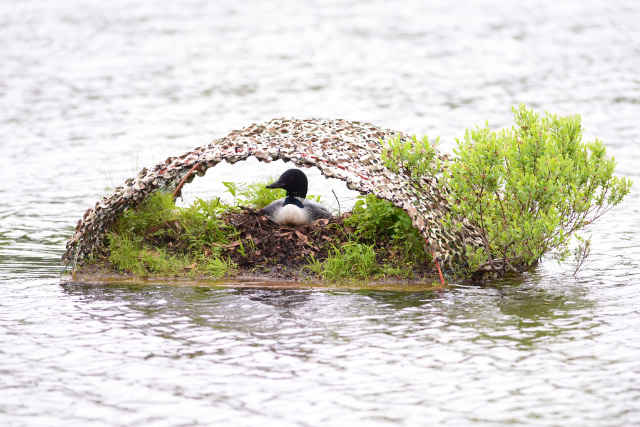
And there is good news and reason for optimism:  on Pleasant Lake, 30 miles southwest of Wicwas, the loons have re-nested after abandoning their first nest due to eagle harassment.
Pleasant Lake loon on their custom-built floating raft.  Photograph by Kittie Wilson

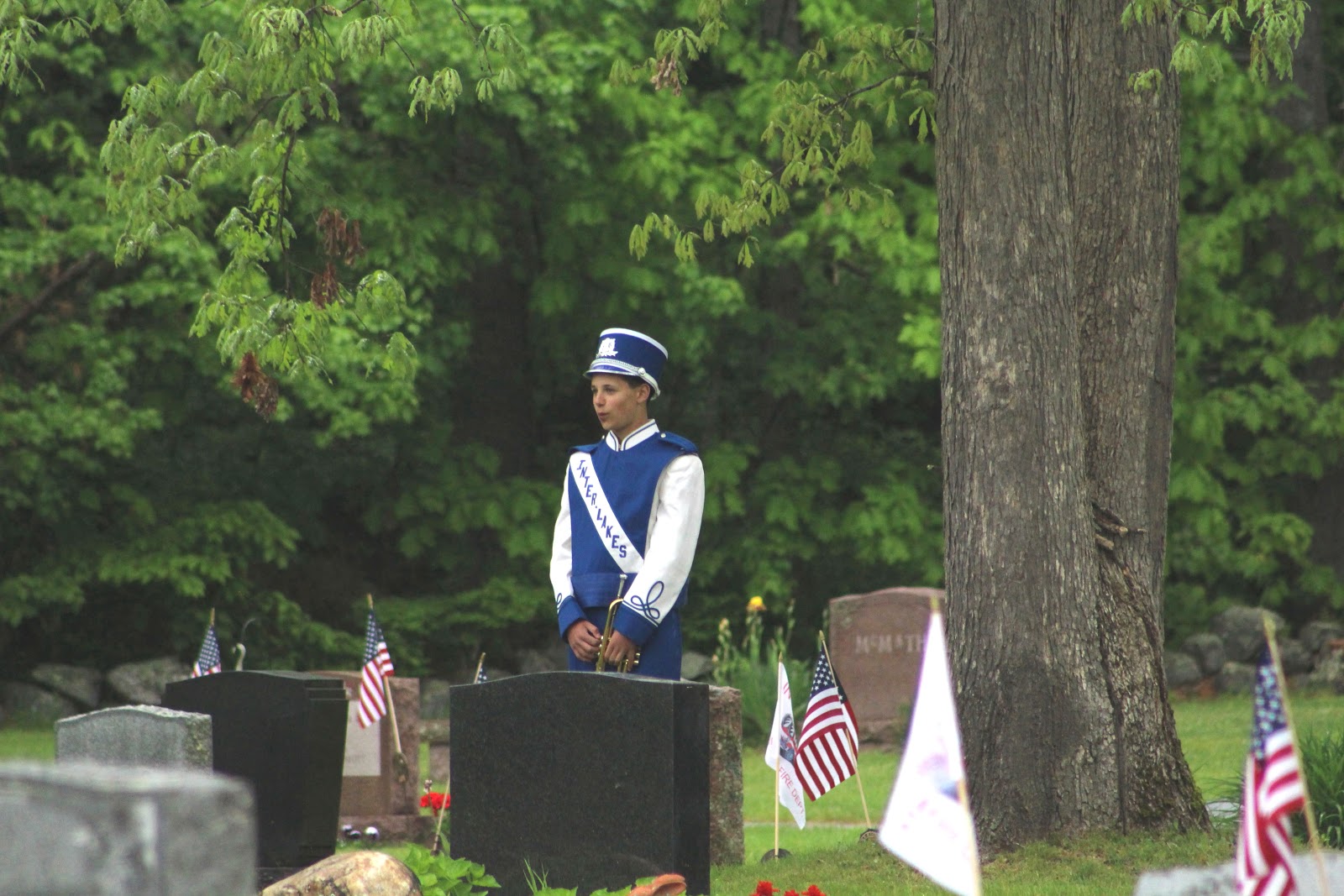
Finally, Meredith Center held a Memorial Day service at Oakland Cemetery today to once again remember, on this Memorial Day, all those that served and sacrificed to secure our safety and freedom. 


Thank you.  We remember.