Showing posts with label Winter Solstice. Show all posts

Sunday, December 25, 2022

December 25, 2022: Stubborn Loons, Winter Solstice, And Merry Christmas!

It's now officially winter by any measure - would someone please tell the loons?

But first, the solstice.  I took a hike up to Crockett's Ledge to watch the sunrise on the shortest day of the year.  I have watched sunrise from this vantage point before, but always in the summer, and I was curious to see just how much farther south the sun rises at the winter solstice.  I found that it comes up directly behind 2382' high Belknap Mountain which delayed the sun's appearance until 15 minutes after official sunrise. 

At Crockett's Ledge in December, the sun rises directly behind Mt. Belknap.

This made sunrise less colorful than in summer because the sun was relatively high in the sky when it breached the mountain.  But it did make for a really neat scene:

The sun crests the south flank of Belknap while snow blows on the north flank of Gunstock.

Gunstock ski area was making snow overnight and the plume of snow from the snow guns was backlit by the rising sun right on schedule for sunrise.  Just by luck I also captured an airplane flying between the two mountains at that moment.


When I see Belknap Mountain from a distance I often note the fire tower on the summit.  But seeing the mountain that morning in silhouette reminds me that I'm actually seeing the radio tower near the summit, not the fire tower.  The fire tower (the small bump to the left of the radio tower) is now just barely above the tree tops while the much higher radio tower protrudes well above the tree line. 

Now to the loons.  Even with temperatures dropping to ten degrees the past two nights, our loon chick Maddie is still here.  

One stubborn and foolish teenager.
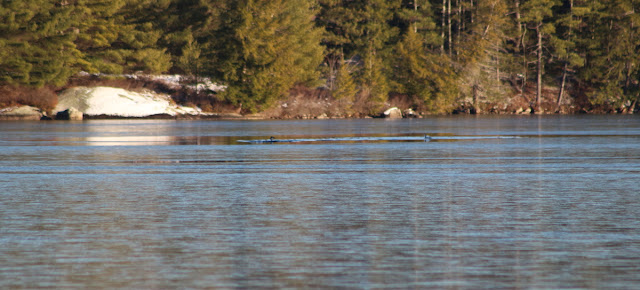
Here it is late December, the lake is almost frozen over, and she refuses to leave.  It appears her mother (that's a guess) has returned to encourage her on her way, and now both of them are at great risk.  Amy Wilson continues to be our best eyes on them, giving us daily reports.  On Wednesday I was able to find them far out in the middle where they were restricted to a tiny sliver of open water as the lake had mostly skimmed over.
Over 90 percent of the lake was iced over on Wednesday.

Our two loons in a tiny patch of open water.

On Thursday the situation was no better and John Cooley from the Loon Preservation Committee came to assess the situation and determine whether a rescue was needed or feasible.  In order to execute a rescue there needs to be at least an inch of ice so a small, flat bottom boat can be taken out to where the loons are trapped in a small enough open area (30 to 40 feet) that they can be netted without them swimming away.  

My last sighting of our two loons amidst the frozen lake.

The decision was to wait until after Friday's warm rain event to see if enough water opened up for them to be able to take flight in case they finally decide it's time to move on.  And the drama was heightened on Friday by the arrival of predators.  Amy and Russ reported two juvenile bald eagles were sitting on the ice perusing the two stranded loons, which were very agitated by the eagles' presence.  They reported the loons would come up, take a quick look around then dive back down.  At one point two mature eagles arrived and were devouring what appeared to be a large bird they had captured - but not one of our loons, as they were both still in the water.  

After the warm and windy day on Friday, a large opening had formed across the middle of the lake, plenty of room for them to take flight - if they are able.  I would think with all they've been through - winter storms, wind, ice closing in, eagles watching them - they would be ready to get out of dodge.  If they are still here when the ice closes in again to a just small opening, and if the opening is in a safe location, a rescue attempt may still be an option.  Only time will tell.  I wish someone would tell the loons that winter is here.
"One kind word can warm three winter months."
Japanese Proverb


Merry Christmas!


A last minute update:  As of this afternoon, Sunday, there is very little open water no loons have been seen.  We hope they have finally departed!


Sunday, December 22, 2019

December 22, 2019: Winter Solstice Arrives

Sunset over Oakland Cemetery one day before the winter solstice.

Every year the winter solstice brings one of the most reassuring moments of winter:  The days are getting longer.  As of 11:19 pm last night the sun reached is nadir relative to the northern hemisphere, and from here on out it will rise higher in the sky every day.   It reminds us all that - even if there are many cold days ahead - spring will return and reopen our frozen lakes. 
The first two souls I saw on the lake this winter.

Lake Wicwas has been frozen for a couple of weeks now and on Friday I saw the first two people out on the ice.  After soliciting a report on the ice (thank you HC), and after two days with temps in the single digits and teens, I concluded it was safe for cautious travel and went for a ski before the warm weather arrives.
It's nice to see tracks on the lake again after being vacant for so long.
The skiing was quite good despite a bit of slush on the ice to contend with.

Of course, not all the lakes are frozen yet;  Winnipesaukee will take several more weeks to complete its turnover and freeze all the way across the broads.  Early in the week Lake Waukewan was partly frozen but there was a pair of bald eagles on the frozen area, doing some fishing.  The report (and picture - thanks for sharing Tony!) from a local resident was that the eagles actually cut a hole in the ice to pull out a fish! 
A pair of eagles try their hand at ice fishing.  (Photo by Tony Sabutus)

It's been cold enough that the snow we received on Tuesday has remained light and dry so the animals can still easily paw through the snow to collect the large stash of acorns hidden below.  I came across a section of turned up oak leaves which is a sure sign of some animal in search of acorns.

It could be turkey, bear, or deer, and it's usually pretty easy to determine which by the other signs.  Tracks are one, and these objects make it even easier.
Those are deer droppings, not coffee beans.

Acorns have such great nutritive value that deer feast on them as long as they can get to them.  These deer had plowed around over quite a large area under these oaks trees.  I found a few partially crushed acorns that had fallen from their mouths - not an unusual occurrence as a deer breaks up the hard shells to facilitate digestion in its four-chambered stomach.
A couple of crushed, but dropped acorns.


A deer's first chamber is partially for storage to let them eat more food than they can use in the moment, digesting it later.  Deer have developed quite an intricate system of processing food that they themselves can not digest - they employ the use of Ruminococcus bacteria in their stomach to ferment cellulose (hmm, makes me want to brew some beer....) which breaks it down into digestible products.  Wikipedia has a detailed description of the process here.

Another interesting aspect of deer's food processing is that all that chewing over the years wears down their teeth in such a reliable way that tooth wear is the best method of determining the age of a deer.  A deer will rarely live as long a ten years, but if it does, it's teeth will have worn down so much that it will probably starve to death - or become so weak that it becomes easy prey for coyotes.

There are plenty more cold, wintry days ahead for humans and deer, but every day, the sun will rise slightly farther to the north, and it will climb just a bit higher in the sky.
2:00 pm on December 19th.

I hope everyone has a warm, peaceful Christmas with family and friends where you may be.
Artwork by Desktop Nexus


Sunday, December 23, 2018

December 23, 2018: Winter Solstice

Well, it wasn't what we expect the first day of astronomical winter to be like:  the temperature was in the 40s, and it poured rain most of the day.  But the day certainly didn't start out that way - all over the Lakes Region people were treated to a blazing sunrise:
Dave Thorpe captured this gorgeous sunrise as morning dawned on the winter solstice
Thank you Dave for sharing that beautiful start to a dreary day.

Then on the first full day of winter it was more like the first day of spring - foggy, warm, and everything melting fast.
The first day of winter?

Much of our early snow has washed away and what's left wasn't good for much of anything - skiing, tracking, or even walking due to deep puddles on the trails.
Frozen ground impedes water seepage, forming large puddles
Streams are running fast like the spring freshets

Because of the ugly forecast for the 19th I took my winter solstice hike a day early, hiking up Red Hill for the third year.  It's becoming a tradition.
The Red Hill fire tower stand tall in the blue winter sky

The southern White Mountains from the Tripyramids to Chocorua

It was a beautiful clear New Hampshire day with blue sky north and south except for down low over unfrozen Lake Winnipesaukee where mist was rising and condensing in the cold morning air.
Steam rises from Lake Winnipesaukee with the Belknap Range behind

There were a couple of inches of nice dry snow above 1200' elevation and the only tracks down the Cabin Trail were from a deer that took advantage of the well packed snow, using it for a good half a mile.
Deer tracks in fresh snow on Red Hill's Cabin Trail

Earlier I had been up on Arbutus Hill and the White Mountain Ledge in the Hamlin Conservation Area and found other signs of deer.
This deer rub is on a maple sapling

Bucks rub their antlers on small trees, especially hemlock, both to put their scent on it and to help rub off the antler's velvet.  With mating season over they will lose their antlers over the next few weeks.  Since their antlers fall off every year, why don't we find them in the forest?  It's because they are loaded with valuable minerals, so the woodland animals chew them up as soon as they sniff them out them.  If you look in active dear yards in the spring you may find one; its suggested to avoid deer yards in the winter so not to drive animals away from their yards which afford them protection from harsh winter weather and predators.

I'm still thinking the bears are gone for the winter, but this warm spell might change that - we'll see.  Back in early November, when they were still very active, a good size bear was captured on a trail camera as it took a stroll along the shore of Lake Wicwas.  Bruce Bouley captured this video of it; definitely worth watching - it's one big bear!  Thanks Bruce!

In addition to bears, the thaw may bring skating back, but only after a good solid freeze; the integrity of the ice is unknown at this point.  I hope the bob house that appeared on Lake Wicwas last week made it through the thaw.
The first bob house of the season appeared on December 16th

Last night's chill followed by seasonal temperatures today should get things moving back in the right direction.  And we may have missed the full cold moon on the solstice, but we had a second chance to enjoy it this morning.
The Cold Moon sets over Wicwas


Sunday, December 24, 2017

December 24, 2017 - Winter Solstice

Astronomical winter arrived on Thursday morning at 11:28 am, the moment when the northern hemisphere receives the least amount of sunlight due to the tilt of the earth's axis of rotation and its orbit pointing the north pole away from the sun.  I decided at the last minute - since it was such a gorgeous day - to watch the solstice from the summit of Red Hill in Moultonborough, so took a quick hike up the summit.  Here's the view at 11:28 am.
Winter arrives at Red Hill

Being so close to noontime, this is also the highest the sun rises this time of year, quite a bit different from summertime.

Remember, the tilt of the earth doesn't change over the year, just its orientation to the sun as we travel around our energy source.  Here's a depiction from the Encyclopedia Britannica.

seasonal configuration of Earth and Sun


It was a beautiful blue-sky day, clear enough to see the windmills on the mountains behind the old Tenney Ski Area, which is planning to open this winter after being closed for many years.  You can see some of the restored ski trails in the left third of the picture.
The trail up Red Hill

We've been getting regular snow falls to keep the snow lovers happy - at least until yesterday's rain which really messed things up.  But the forecast is for more snow tomorrow to freshen things up again.

A snowbird (Eastern Junco) earns its name

Back at Lake Wicwas the ice is now thick enough for skiing and I have seen tracks of others out on the ice, though I personally haven't yet ventured across the areas of the lake that were last to freeze up.

I've also seen fox tracks on the ice for the first time this year;  somehow they seem to know when it is safe without benefit of cutting a hole.  I'm always amazed at how quickly the fox will take advantage of ski trails to ease their travel across the snow.
Foxes quickly find packed ski trails
The fox is all about conserving energy, which makes sense considering it spends its life cruising the forest in the cold and dark of winter in search of a tiny morsel of protein to survive.  The small amount of energy saved by walking in a packed track, multiplied by 20,000 steps a night, is a big advantage to its survival.  That's also why it evolved with a perfect direct-register gait where its hind foot falls directly on top of where its front foot landed, and why its mate will follow exactly in the lead fox's trail.

I read an article recently (thank you JS!) about someone tracking a fox up the Champney Brook Trail on the north side of Mount Chocorua.  He observed that the fox completely ignored the track of every mouse that it passed by, it's perfect gait not having the slightest hitch meaning it didn't even turn its head to consider following the trail.  Yet at another spot it stopped dead in its track with no sign of activity anywhere.  It then turned off the trail, walked in a much different pattern - slowly and quietly - before pouncing down into the snow.  There was a lot digging, but no signs of a capture, and then the trail continued on.

The explanation the author gave was that if a fox followed every track it saw or smelled, it would consume far too much energy chasing old, non-productive trails.  It doesn't even bother to look at these.  Instead, the fox hunts by sound, listening for definitive proof that its prey is present.  Trotting silently through the snow, it will hear a mouse scratching around under the snow looking for seeds.  It will stop, circle around the spot, and use its sharp hearing to pinpoint the exact location of the sound.  It then quietly approaches and pounces down, hoping to catch the animal with its paws.

It's a clever energy-conserving scheme developed over thousands of years of evolution.  I have only seen evidence of this myself once, on the trail up to Crockett's Ledge;  think about how many miles a fox much cover in a frigid night to find enough nourishment to live for another day.  But we know it does, as right on the trails one finds proof of a fox's hunting success.
A fox leaves its calling card in the middle of the trail

I hope everyone has a peaceful Christmas tomorrow with family and friends, and remember, with the solstice behind us, we're already on the road to summer!
The late afternoon sun provides light at the end of the tunnel