Showing posts with label Fisher. Show all posts

Sunday, March 7, 2021

March 7, 2021: Coyotes on the Prowl

Note:  This post has images that some viewers may find disturbing.  Viewer discretion is advised.   ; )

In like a lion, out like a lamb - March is here, crazy changing weather and all - and it certainly has started out like a lion with some of our coldest temperatures of the year and plenty of wind to go with it.  Mt. Washington recorded average winds of 86 mph and gusts over 130 mph on March 2nd; the low temperature for the day was -28F, and that's not the wind-chill (that would be -80F).  It was not nearly as wild around the lakes, but still pretty cold and the wind brought in squalls with enough snow to freshen things up and even allow some animal tracks to be found, including this weasel track.

The classic 2-2 track of a bounding weasel.

This closeup shows the double imprint where one foot lands almost directly over the other.

Each print is a double-print where the rear foot landed on top of, or slightly behind, where the front foot landed.  I couldn't follow the track for long because the wind had obliterated the tracks after a very short distance, but the immediate habitat and what behavior I did observe tells me it was a fisher.

There was also a plethora of mouse tracks running all over the new snow, scurrying from one hiding spot to another.
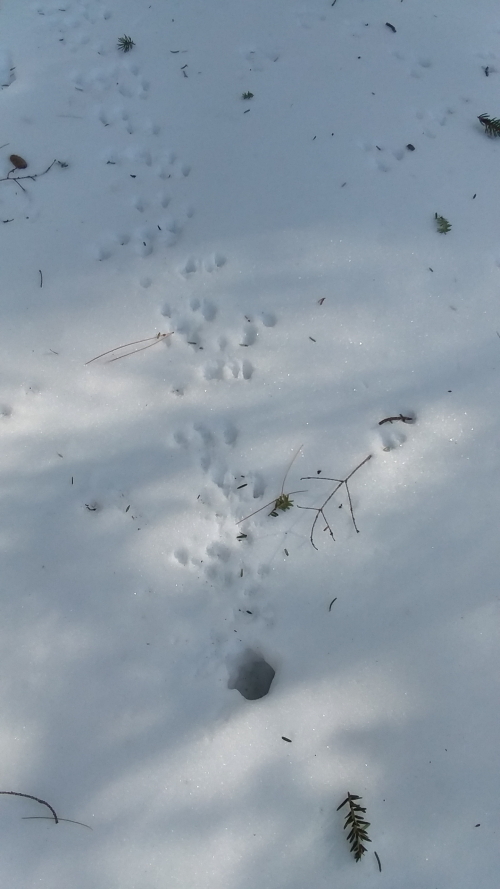


Mice like to travel quickly from one hole to another to avoid those pesky owls.  The largest tracks however, were those of the coyotes, out on the prowl for creatures of any size or shape.  

A coyote following along the shoreline,

and circling around something of interest.
Then heading off into the woods
to leave its marker.

Stumps, rocks, the middle of a trail - these are all favorite places for a canine to leave its mark, knowing  it will be readily noticed by visiting males and females alike.  

Those coyote tracks were left a couple of weeks ago, before the most recent snow, but they show coyotes have been traveling far and wide, both on and off the lake searching for food, and one morning this week, after a few inches of new snow, I came across evidence they had a successful night.


This digestive track can't be from anything other than a white-tailed deer.


It's one of the few parts of a deer the carnivores will leave behind.

It was an unusual situation.  I've come across deer kills on the lakes many times (see journal entries on January 21, 2012 and March 10th 2019) but it was hard to figure out just what happened here.  Clearly the kill was recent because the blood stains were still fresh.

Recent snow and fresh blood indicates a recent kill.

But there were very few tracks or evidence of a fight; everything must have been covered up by the snow the night before.  But why were the intestines exposed?  Were they warm enough that the snow melted on them as it fell?  And that doesn't really explain why some fur was exposed as well.  I could see some signs of struggle a few yards away on the shore line but other than these few remains of the deer, nothing.  

Fur on top of the snow.

I expect the carcass or least some stray bones will appear as the snow melts over the next few weeks.

Every time I see one of these deer kills it's disturbing even though I know it's part of the circle of life, and one deer killed will sustain the many animals that will partake of the feast during the difficult late-winter season, including fox, eagles, hawks, and crows in addition to the coyotes.  

A red-tailed hawk feasts on the carcass from a prior kill.

Even the mice and other rodents will chew on the bones to ingest the minerals they contain.  But it's still hard to accept.  So let's end on a brighter note:  Sunny days and blue skies.  Forget the coyote and dismiss the lion - the March lamb is on the way!


P.S.  If you were interested in seeing Beede Falls which I described last week, it appears the ice over the falls has started to collapse.


Sunday, January 27, 2019

January 27, 2019: The Colors of Ice

This week included a trip up to Arbutus Hill Pond to see what winter there has to offer.  It was after the snow and before the January Thaw, so the skiing was good and the views were beautiful.
The winter scene at Arbutus Hill Pond

Breaking out fresh snow heading up the Magenta Trail

The pond sure looks a lot different in winter than in the summer, and it offers a chance to get up close to some of the nesting sites that are not accessible in summer (nor would it be wise to disturb the residents anyway).  In addition to getting a good look at the beaver lodges, I was able to check out the heron nesting trees.
Heron nest atop a tall pine killed when beavers dammed up the pond

The nest seemed smaller than I remember from the summer - I wonder if it lost some mass during the recent storms, or whether is just looks larger from a distance.


On the way up I came upon a set of tracks running right along the trail that included an unusual mark in the snow that I couldn't figure out.
The mystery mark

It looks like some kind of studded wheel was rolled along beside the track.
This fisher was content to travel a long ways on the trail


I decided the tracks were from a fisher based on their size and track pattern.


A scent marker in a conspicuous location


At one point it also marked a log on the ground, which fisher will do.


Fox and coyote do this as well, but the tracks do not match up with a canine;  they have the all the characteristics of a member of the weasel family (which includes the fisher).
A perfect example of a fisher track set

One clue is that the mystery mark is right at the only place on the long trail where the fisher broke through the crust.  Is it possible that the hunter was carrying a porcupine and when it broke through the snow, its dinner hit the surface and the quills poked all those tiny holes in the crust?  Fisher will kill porcupine, and this trail was leading away from prime porcupine habitat, so it's a possibility.  Also fisher don't usually travel in a straight line;  they tend to weave all around in the forest, searching out rotten trees and tall oaks for squirrel nests.  So that lends credence to the thought that it had already caught its prey and was carrying it straight back to its den.  I haven't come up with a better theory - any ideas out there?

-------

New Hampshire Public Radio has an outdoor/nature piece every other Friday called "Ask Sam" in which Sam Evans-Brown always has something new and interesing to present.  This week the topic was the color of ice (Why is Some Ice Black and Some Ice White?) and I learned several things I didn't know before.  Right off the bat he corrected a misconception I had that water is colorless.  He explained that water is actually blue - a very faint blue - which is why it usually appears colorless to our eyes.  Only when water is very deep are our eyes able to detect the blue color.

Now what about the black ice we had earlier this winter?
This ice formed on a very cold, calm night back in December

He explained that ice appears black when it freezes under calm enough conditions to form very large crystals, which present few facets from which light can reflect and refract - thus light passes through it, and it appears black.  On the other hand, if water is disturbed when it freezes - for example, churned up by waves or wind, the crystals are banged around, preventing them from growing large, which results in countless tiny ice crystals, each with many surfaces to reflect the incoming light (white light) back to our eyes.
White ice near shore

He also describes the interesting aspects of how glacier ice is formed, and how its own weight squeezes out impurities resulting in extremely pure ice.  You can read or listen to this story as well as previous reports here.  And don't forget, next weekend is Pond Hockey on Meredith Bay.  If you look around, you might find your own little glacier on your local lake.


Sunday, June 5, 2016

June 5, 2016

It's the time of year for turtle nesting around the lakes in New Hampshire, and it seems to be a good year based on the many reports from around the state of turtles seen on roadsides and in nesting locations.
A mother Painted Turtle laying her eggs

Turtles lay their eggs in sandy or gravelly soil within a few hundred feet of water, often along road sides where a soft shoulder makes for good nesting conditions;  that's why they are often observed on roads, and also why cars are the largest threat to adult turtles.  Around Lake Wicwas I've seen several mothers laying her eggs, and quite a few more nesting sites, identified by 4 to 6 inch round, shallow holes in the ground.
A snapping turtle on the prowl

A painted turtle looking for some soft earth

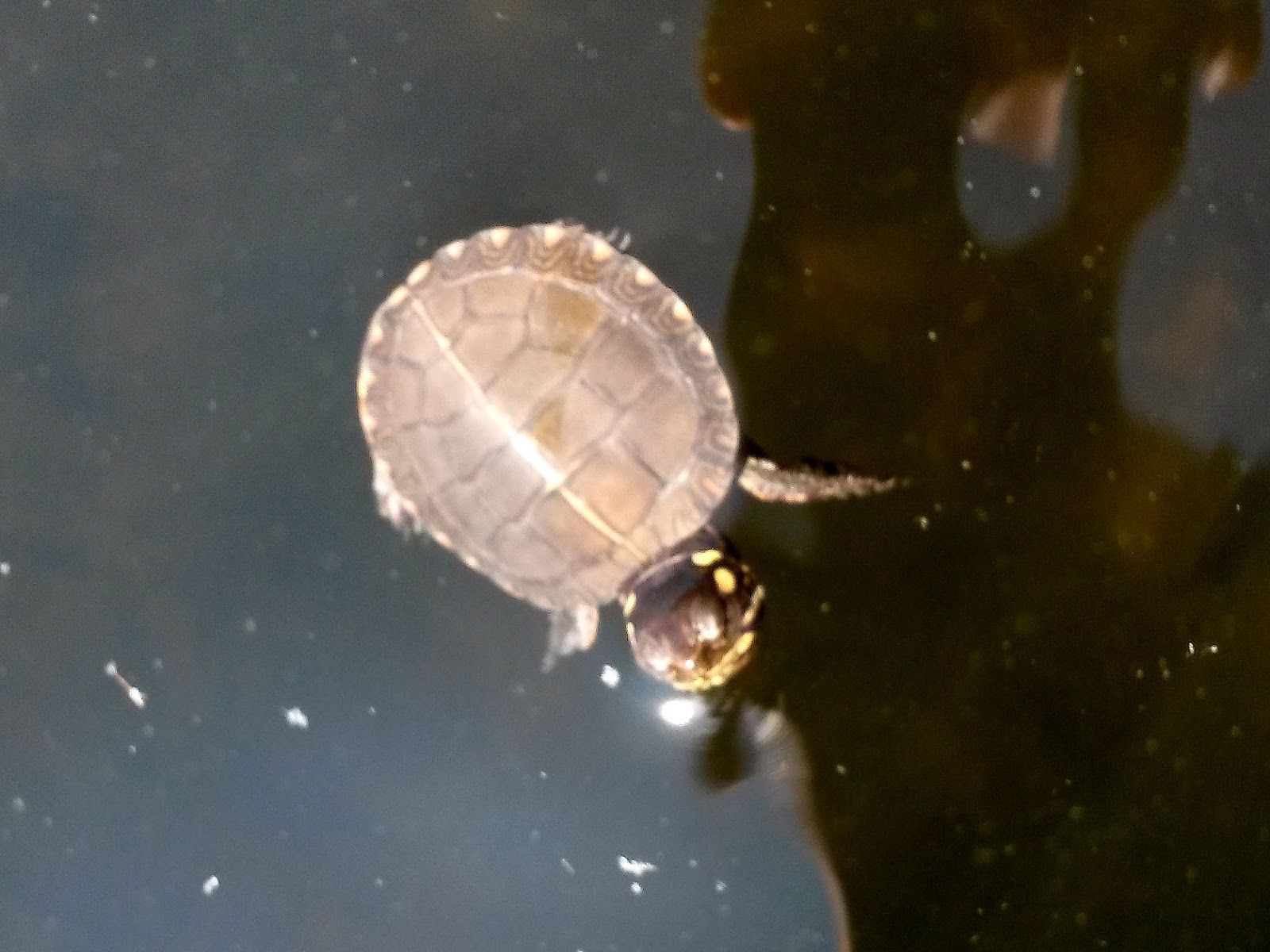
Although they are laying their eggs now, they may have mated several weeks ago, storing sperm until it's needed, sometimes for multiple years.  And like the largemouth bass seen last week, they might have mated with multiple males so a single clutch of eggs (which averages four or five in New Hampshire) may have several fathers.  When the eggs hatch two or three months from now the young turtles may proceed to the lake, or they may overwinter in the nest and make the trip in the spring.  This I just learned after seeing a very young turtle in the water two weeks ago. 
A baby painted turtle which must be from last year's nesting

I was surprised to see one so early, but the ability to overwinter in the nest explained it.  [Ref:  New Hampshire Nature Notes, Hilbert Siegler, Equity Publishing 1962]

The pictures above were of small turtles, only 6 to 8 inches long (shell length), but yes, we do have much larger turtles as well.  I saw one when I was kayaking last week, and the size of it, just a few inches under my boat was unsettling.  Some fellow lake watchers had a great example of a large female walking right across their patio in search of a nesting site.
A big snapper (photograph courtesy of Dave Thorpe)

Keep away from these gals!  (And ones this big are all moms.)  They can be very aggressive and they have extremely powerful jaws that can do real damage to a hand, a foot, even an arm!

I was doing some work on an LRCT conservation property in Gilford this week (in Smart Woods, an interesting parcel with a nice hiking trail) and saw my first ever Fisher Kit - maybe only a couple of weeks old.
A young fisher cat
It was on the forest floor but when it heard me it climbed up a tree, and it was definitely not comfortable climbing yet.  It was quite reluctant and nervous, not like an adult that would have scooted high up in an instant!
How high do I have to go?

I didn't see mother fisher, but I'll bet she was watching!

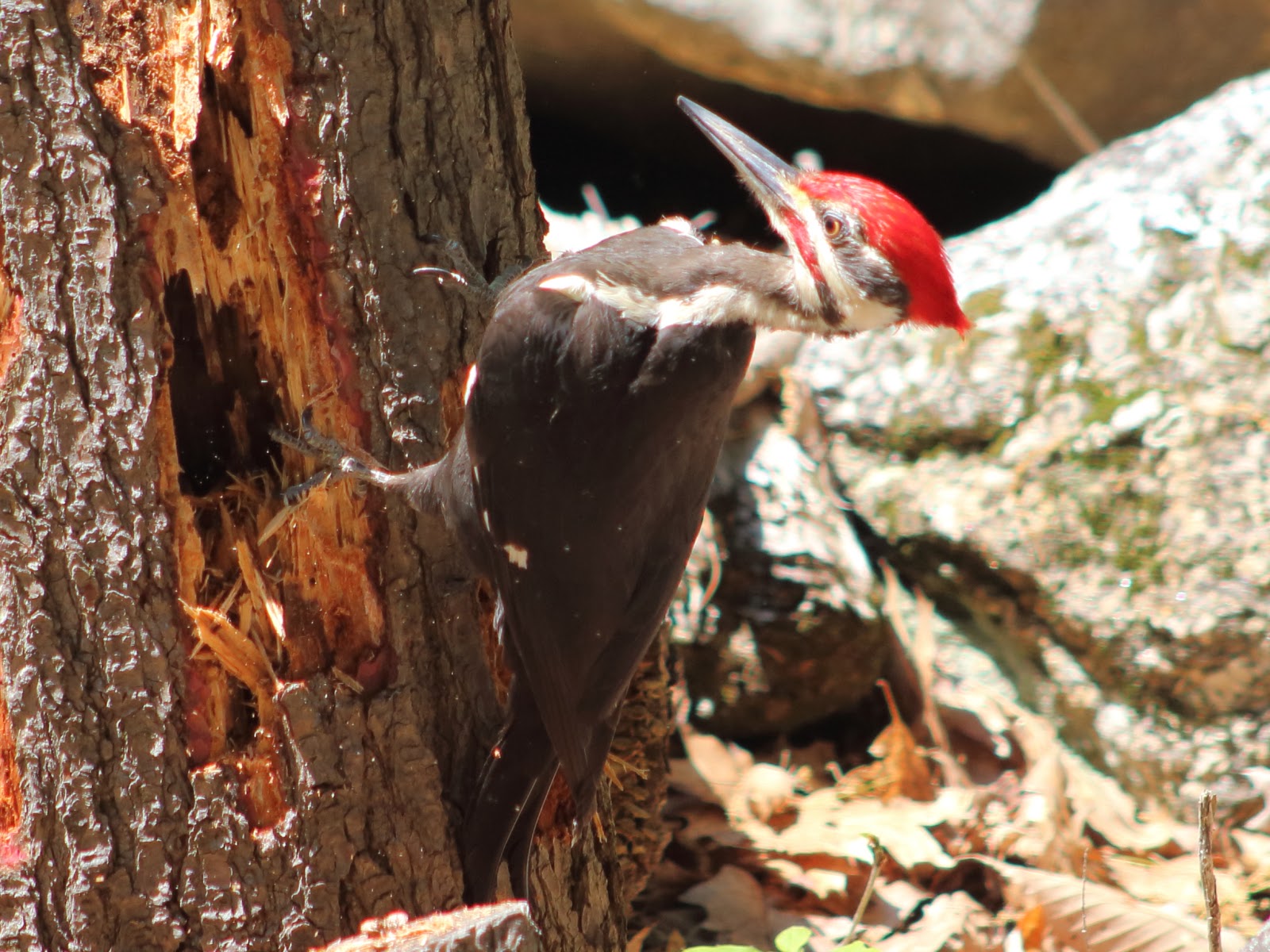
I took an early morning Lake Host shift doing boat inspections at the Wicwas boat ramp this weekend;  I almost always see something interesting while I'm on duty, being situated right between the lake and the large wetlands in the Chemung State Forest.  This time I heard the loud drumming of a pileated woodpecker and it took no time at all to locate it at the top of large pine.
Pileated Woodpecker marking its territory

It probably wasn't looking for food in that dead, hard, resonant tree, but was just letting everyone know it was there and this is its swamp.  After a few sessions of asserting its territory I watched it fly off, displaying its gorgeous white wings.
Pileated woodpeckers are stunning in flight with their 2 and a half foot wingspan

Just the previous day we had seen a pileated - perhaps the same bird being within a mile radius - that was finding some food.  Linda heard the slow thunk, thunk of its large beak working on a dead tree stump.

He (the red mustache and fully-red crown including the forehead indicate it's a male) would tear out a few large chunks of the soft wood, then reach in to collect its bounty.

I'll get you!
Where's OSHA?    No safety glasses for this guy, just a hazard of the job
 Then he would stop to listen for more prey to direct his next attack.

Who's next?
His strong claws were secured in crevasses in the bark to support his vigorous attack.
Strong feet holding tight

With the regrowth of New Hampshire's forests, pileateds seem to be growing in population, but it's still important to leave dead trees since they are their primary source of food. 

What a cool bird, these, the largest of our woodpeckers.

Sunday, April 17, 2011

April 17, 2011

Heavy rain on Saturday night eroded more of the ice on Lake Wicwas, but it didn't make as much progress as one would hope because it was so cold.  In fact, the storm started out with a little hail and sleet.  But by today the ice has turned dark along the west shores, and the openings are getting larger. 
There are large openings at the inlet and outlet, but it looks like several more days before the ice will be out - the current that runs along the north end of the lake that connects them hasn't even opened up yet.
The openings were large enough for two of pairs of Mergansers to share the water today, but just barely. 
Common Mergansers


Whenever they passed close together the males kept themselves between the females, raising and fanning their tail feathers in a display of dominance, and occasionally being even a little more aggressive.


An update on the construction on the south end of the lake:  things are taking shape nicely now - here's a view from the lake.  It is going to be a fabulous house, with incredible views to the north, all the way to the Osceola mountains and the Franconia range.  


I'm seeing signs of a little more animal life around the lake also.  This evening I saw the first beaver of the year swim by, circling the lake by hugging the edge of the ice.  I also found fresh Fisher scat in the woods, with a combination of seeds and animal fur twisted up together.


 But, it does still look a lot like winter on the lake!

Sunday, September 12, 2010

Setpember 12, 2010

Summer is hanging on, but signs of fall are everywhere.  Saturday was a perfect September day, and I got in one more ski trip; the water is still as warm as in July.  I saw many ducks on the lake again this weekend, including a beautiful Wood Duck.  As I came around a point in the kayak, four or five ducks flew off, but one brightly colored male stayed behind, crouching down low against the shore.  But I as raised my camera, he took off also.  This is all I got:

The lake level is a little low, about minus two inches at the dam, but not bad considering how dry it's been.  The lake level has been managed very well lately.  The water level is about three inches below the top board in the dam.  The low water has revealed lots of mud flats in the marshes, and there were many turtles out sunning themselves on Saturday.  I found this Solitary Sandpiper digging on one of the mud flats.
Solitary Sandpiper

It's the season of red berries.  The wintergreen has ripened and its bright red berries are visible all around the shores of Lake Wicwas.  These will stay red into winter, and provide a good food source for many birds.
Winterberry

Partridgeberry
The Partridgeberries are also ripe, but much less ostentatious, hiding amongst the leaf litter on the forest floor.  Both are signs that fall is here.
Red isn't the only color though - I found these large clusters of blue berries at the dam on Meredith Center road.  They have a large woody stalk, with very strong stems holding the berries.  With Emily's assistance, I learned they are Smooth Carrion Flower.  Between the leaves and the berries, they are the food of Bear, Deer, Cottontail Rabbit, Turkey, Ruffled Grouse, and other animals - just another attraction for the diverse fauna around Lake Wicwas.
Smooth Carrion Flower (Smilax herbacea)
Linda found these delicate blue flowers right on the shoreline - I don't know what these are either - any ideas?
Linda also saw the three fawns last week, as well as a fourth fawn with them, but only saw one doe.  Other than the birds, including several wood peckers hammering in the forest, and lots of turtles sunning on the mud flat, I didn't see much wildlife this week.  But a large member of the weasel family came by the house, leaving a large twisted scat to mark his presence.  Being over a 12 inches long, and full of hair, I'm guessing it was a Fisher.
Fisher Cat Scat?

Alas, another clear sign of fall:  we took out the dock today.  But the boat and kayaks are still in for fall tours around the lake.