Showing posts with label Deer Kill. Show all posts

Sunday, January 1, 2023

January 1, 2023: Trauma on the Lake

Happy New Year!  


The end of 2022 gave us some of the best skating we've had on the lake in a couple of years, but it also gave me perhaps the most difficult window into the harshness of nature that I've ever seen.  Thankfully it's not loon-related, and I'll make it clear when this entry is going to the grim side of nature, but first, let's start with the good news:  There is an upside to rain in December.

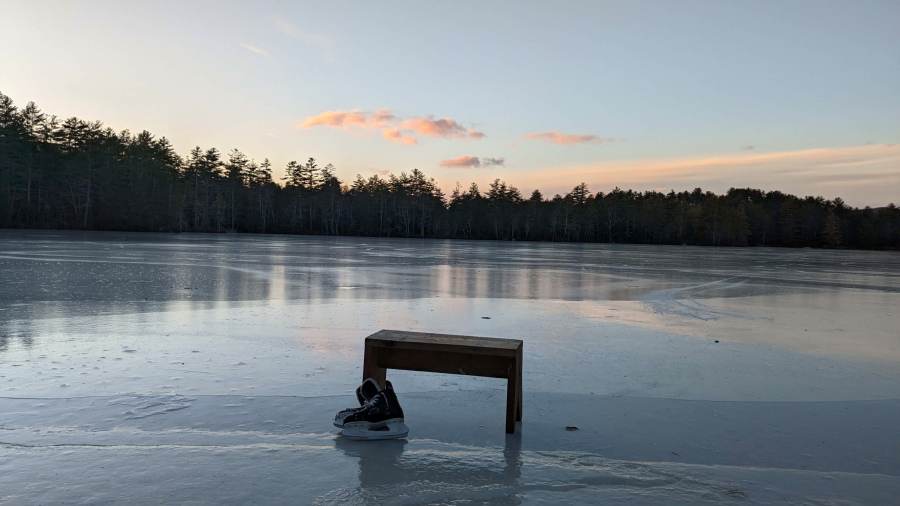
Perfect ice for skating.

That warm, windy, wet day last Friday set the lake up for some great skating after it froze.


Areas that didn't melt out on Friday had six inches of ice by Christmas Day, making it safe to skate in those parts of the lake.  By December 28th the open water had refrozen four to six inches thick (in some places), allowing more of the lake to be used, but we still stayed off areas less than five inches thick.

The line between new and old ice.  The black ice was up to six inches thick.

With warm weather returning I'm staying off the ice again, but if it gets cold there will be more great skating.

As I mentioned last week, roaming predators such as fox, mink, and bobcat take advantage of the ice as it gives them easy access between different parts of their territory, and this year it helped our local bobcat enjoy a Christmas feast.  But there are other animals for which the ice is not welcome, and this is where things get messy.  If you don't want to hear a story about how dispassionate wild animals can be, you should stop reading at this point.  I'll report the story first and save the photos until the end in case you'd like to read about what transpired without seeing it.

As daylight came on Christmas morning something slowly became visible far out on the ice - it looked like a large branch blown onto the ice.  But as the day brightened it became evident there was a deer on the ice.  I've seen this several times before, both on Lake Wicwas and Lake Winnisquam; it's a regular occurrence as predators know if they can drive a deer onto the ice it becomes easy prey - skinny hooves on slippery ice are no match for a clawed coyote or bobcat.  We wondered what had killed it, but then shortly a bobcat walked out onto the ice and sat down and watched.  Was that the predator?  Events over the coming hours revealed that it was, and this was one big cat, almost certainly a male.  Male bobcats can reach 50 pounds while females are 10 to 15 pounds lighter.  After a few minutes of observing whether any other animals were in the area, the bobcat walked out towards the deer.  Here is where it gets really ugly.  The deer was still alive.  We thought it had moved earlier, but now it clearly lifted its head and watched the bobcat as it approached.  

With the intent of understanding the facts of nature, I'll report as objectively as possible, but know that what happened next is quite disturbing.  After determining there were no threats in the area, the cat walked up to the deer and resumed feasting on the rump of the deer, while the poor victim, lacking a couple of legs, watched helplessly while its body was devoured.  This scene repeated itself several times over the course of the day.  I was amazed at the strength and resiliency of the deer - how could it survive such great injury and loss of blood for such a long period of time?

At one point a coyote came out of the woods and onto the ice - a beautiful animal with a glistening coat and bright white chest and forelegs - but it stood just a few yards onto the ice and watched.  I guess it decided it didn't want to tangle with that large a feline, and turned back and didn't return - at least in daylight hours.  As darkness fell the deer was still alive.

I think the bobcat must have guarded its kill all night because the next morning the deer, now lifeless, was still largely intact which wouldn't have been the case if coyotes got to it.  The eagles, however, did make an appearance that day; at one point there were four bald eagles on the ice and in the trees watching and waiting for their turn.

Timing is everything, and it just so happened that Santa brought me a new trail camera for Christmas, so without really learning much about it, I set it out on the second night.   The camera has an infrared feature that allows it to take pictures in the dark without ambient light, and I got several pictures that first night, one of which showed there were two bobcats feeding over night. I had to place it far away as the deer was on ice that I wasn't willing to go on, so it was too far away to be triggered except when one bobcat came close to the camera, so I didn't get all the action.  The night pictures aren't too graphic so I'll show that now.

Two bobcats were present.

Knowing that bobcats are solitary except during mating season in the spring, I asked Patrick Tate - the NH Fish and Game biologist who spoke about bobcats at the Lake Wicwas annual meeting in August - if the male was allowing a female to share in the food.  His reply was "maybe".  He said males have slightly overlapping territory, and this male may be tolerating another male on the edge of his territory.  Considering the deer is on water, it's kind of in no-mans-land, so it could be either another male. 

That evening the camera recorded several videos which I spliced together; they aren't too gory, but they aren't for the queasy either.  You'll see that the cat was quite curious about the camera and several times came right up to examine it.


In the morning the camera captured a few more videos:


Those pictures makes me think news of the kill got to the coyotes and they came in force over night.  The bobcats had been eating carefully, but over the second night the carcass had been decimated.  Perhaps a pack of coyotes came and drove the bobcats away.  

The third night the ice was safe enough to move the camera closer, and now it captured quite a few videos.  The bobcat came back several times over the course of the night and it's possible that at other times it was just out of view of the camera, guarding its kill.  At one point the cat went on high alert when a single coyote approached.  The bobcat stood its ground; the lone coyote was not willing to tangle with the cat and it went quickly on its way.  The camera caught much more of the action that night, including that interaction:


As I learn how to use this new camera I hope to gain more insight into what transpires around the lake when no one is watching.

By Saturday the animals had pulled the carcass apart, and though larger animals will come by and drag off a bone to chew on, it's pretty much up to the birds now to pick the carcass clean.  


I know this is a long post, and it was as difficult to write as it was to observe.  But I find the stories that nature provides to be captivating and the insight into nature too fascinating not to share.  It's remarkable what transpires right beside us, to learn all this takes place right beside our houses and roads - did you notice the headlights of cars driving along Meredith Center Road in the nighttime videos?  

Once again nature shows us just how harsh it can be, but that is the way of the wild.  That one deer fed a dozen or more animals for a week, even longer for the birds:  crows, ravens, vultures, hawks and eagles.  The circle of life goes on.  Let's just hope our loons did in fact fly off safely before the ice filled in the lake.  It will be a long winter waiting to see if all four of our banded loons return next spring when the ice retreats.  The beauty of  a frozen lake depends on one's perspective.

At this point I'll post the pictures.  Proceed according to your own level of sensitivity and curiosity.

We woke to this scene on Christmas morning.

And then the bobcat appeared, answering many questions.


This shows just how big that bobcat is.


Warning:  I found these next two pictures the most disturbing.

How can this be?


Day two  These next two pictures were taken from afar.
Immature bald eagle.
And a mature one.

Day three:
After the second night there was not much left - I'm guessing a pack of coyotes came.  Yes, it's a big cat.

On alert as a coyote approaches.
Coyote arrives
And is shown who's boss.


By Saturday (day 7) the animals had pulled the carcass apart and though larger animals will come by and drag off a bone to chew on, it's pretty up to the birds now to pick the bones clean.  


It was a hard week.  Again, the beauty of  a frozen lake depends on one's perspective.


Sunday, March 21, 2021

March 21, 2021: A Time to Wait

I might have had my last excursion on the lake for a few weeks as we enter one of the two times during the year when our lakes are inaccessible.  In both spring and fall there are several weeks where ice seals the lake off from boating but is not safe for travel even on foot, and with a forecast for several sunny days with temperatures near 60 I may have had my last trip until open water returns.  Even with well over a foot of ice covering most of Lake Wicwas - and many other lakes - there are already open areas where streams empty into the lake or where a south-facing shoreline heats the water.  


Things will progress quickly from here with full sun and warm temperatures.  That same spot looked like this just a few days ago, and it hasn't even been particularly warm.


What keeps me off the ice are the unknow danger spots as strong March sun makes the ice soft and porous, and currents in the lake create unpredictable thin spots.  But I did get one trip across the lake in astronomical spring - the vernal equinox occurred yesterday at 5:37am (eastern daylight time).  

On one of my last trips on the lake I took a walk to the site of the deer kill I found a couple of weeks ago to see if any more evidence had appeared as the snow melted.  It hadn't, and in fact, things had gone the other way.  All evidence of the fur and digestive tract was gone.  The only thing left was the contents of one of the deer's stomachs (being ungulates, deer have four digestive compartments though only one is technically a stomach).

Stomach contents left on the ice.

Looking closely at the contents you can see why they need four stomachs to digest their diet - in winter it looks basically like sawdust.


No wonder no other animal will eat that - except maybe a beaver!  Every other part of the deer has disappeared.

I mentioned last week that I saw the first migrating ducks in one of those open spots near the outlet of Lake Wicwas, and this week there was a pair of Mallards dabbling in the Mill Brook where it spills over the dam on its way to fill up Lake Winnisquam.

Mallards probe the mud in the brook for food.

Soon ducks will be paddling all along the shoreline as those open spots enlarge, and the beavers won't be far behind.

One item to follow up on from last week's barred owl is another candidate for Camouflage Champion:

A great horned owl hides in a tree fork.  Photo by Debby Crowley.

This photo of a great horned owl was taken by friend and photographer extraordinaire Debby Crowley.  Owls certainly have perfected their camouflage technique.

And finally, one of my favorite sights (and smells) of the season:

The Chemung sugar stack is steaming!
(Though you can't see it, it was a-boiling.)

Maple syrup is on the way - I'm already thinking about fresh blueberry pancakes!


Sunday, March 7, 2021

March 7, 2021: Coyotes on the Prowl

Note:  This post has images that some viewers may find disturbing.  Viewer discretion is advised.   ; )

In like a lion, out like a lamb - March is here, crazy changing weather and all - and it certainly has started out like a lion with some of our coldest temperatures of the year and plenty of wind to go with it.  Mt. Washington recorded average winds of 86 mph and gusts over 130 mph on March 2nd; the low temperature for the day was -28F, and that's not the wind-chill (that would be -80F).  It was not nearly as wild around the lakes, but still pretty cold and the wind brought in squalls with enough snow to freshen things up and even allow some animal tracks to be found, including this weasel track.

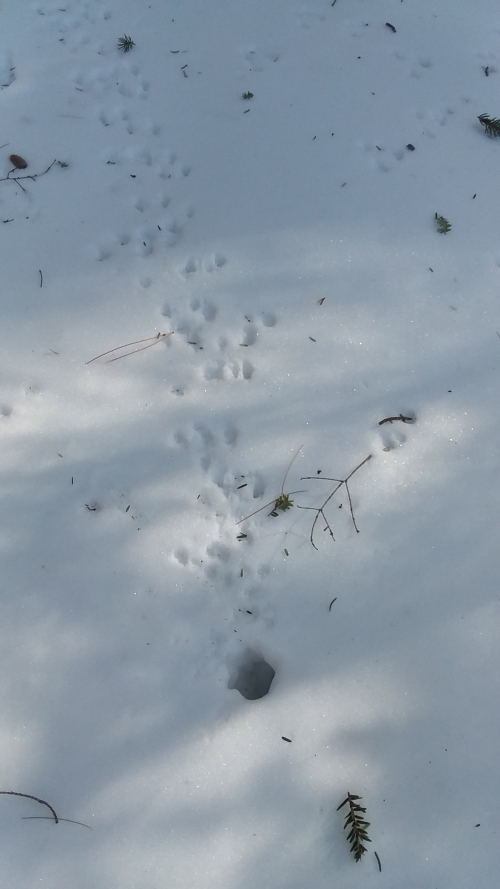
The classic 2-2 track of a bounding weasel.

This closeup shows the double imprint where one foot lands almost directly over the other.

Each print is a double-print where the rear foot landed on top of, or slightly behind, where the front foot landed.  I couldn't follow the track for long because the wind had obliterated the tracks after a very short distance, but the immediate habitat and what behavior I did observe tells me it was a fisher.

There was also a plethora of mouse tracks running all over the new snow, scurrying from one hiding spot to another.


Mice like to travel quickly from one hole to another to avoid those pesky owls.  The largest tracks however, were those of the coyotes, out on the prowl for creatures of any size or shape.  

A coyote following along the shoreline,

and circling around something of interest.
Then heading off into the woods
to leave its marker.

Stumps, rocks, the middle of a trail - these are all favorite places for a canine to leave its mark, knowing  it will be readily noticed by visiting males and females alike.  

Those coyote tracks were left a couple of weeks ago, before the most recent snow, but they show coyotes have been traveling far and wide, both on and off the lake searching for food, and one morning this week, after a few inches of new snow, I came across evidence they had a successful night.


This digestive track can't be from anything other than a white-tailed deer.


It's one of the few parts of a deer the carnivores will leave behind.

It was an unusual situation.  I've come across deer kills on the lakes many times (see journal entries on January 21, 2012 and March 10th 2019) but it was hard to figure out just what happened here.  Clearly the kill was recent because the blood stains were still fresh.

Recent snow and fresh blood indicates a recent kill.

But there were very few tracks or evidence of a fight; everything must have been covered up by the snow the night before.  But why were the intestines exposed?  Were they warm enough that the snow melted on them as it fell?  And that doesn't really explain why some fur was exposed as well.  I could see some signs of struggle a few yards away on the shore line but other than these few remains of the deer, nothing.  

Fur on top of the snow.

I expect the carcass or least some stray bones will appear as the snow melts over the next few weeks.

Every time I see one of these deer kills it's disturbing even though I know it's part of the circle of life, and one deer killed will sustain the many animals that will partake of the feast during the difficult late-winter season, including fox, eagles, hawks, and crows in addition to the coyotes.  

A red-tailed hawk feasts on the carcass from a prior kill.

Even the mice and other rodents will chew on the bones to ingest the minerals they contain.  But it's still hard to accept.  So let's end on a brighter note:  Sunny days and blue skies.  Forget the coyote and dismiss the lion - the March lamb is on the way!


P.S.  If you were interested in seeing Beede Falls which I described last week, it appears the ice over the falls has started to collapse.


Sunday, March 10, 2019

March 10, 2019: Everyone's Hungry

There is some pretty serious snowpack on the ground this March, some of the deepest we get and certainly the most since the banner winter of 2014-2015.  And we're getting another 3-5" today.  It makes for a hard winter for all the animals.  When there is deep snow the deer herds usually stay in their deer yards - thick groves of evergreens, typically hemlock - which provide them protection from weather and predators, and where they collectively trample down the snow for ease in travel.  And they probably yarded-up early this year since we've had snow on the ground since November, so by now they have consumed all the food in and around their yards, and have to look elsewhere, expending precious energy and making them vulnerable to attackers.  That's a guess as to what happened to a deer over by Lake Winnisquam last week.  I was skiing on the north end of the lake when I spotted something on the fresh snow that looked unusual, so I went over to take a look.
Spine and skull of a white-tailed deer

I've seen this several times now - coyotes drive a deer out onto the ice where they keep harrassing it until they tire it out, and then take it down.  This kill site was about 75 yards from the western shore;  the deer probably came out of the Chemung State Forest.
Kill site off the west shore of Lake Winnisquam

The skin and fur had been completely removed and placed nicely in a pile.

I was surprized to see some organs left behind - I would have thought these we would prime delicacies for the animals, but they must know these particular parts are not edible.
I don't know what they are.


All the tracks in the snow indicate how many animals were nourished by this deer over the past couple of days.

It must have been a very recent kill as it was on top of the snow we just got, yet the carcass was already picked clean.

Which means the eagles, hawks, and crows have been getting their fill as well.  I found it interesting that the spine had been dragged some 100 yards from the kill site.  Also, there were no legs to be found;  these were probably dragged away by various coyotes to hide and consume in private.
Kill site at lower left, fur pile towards center; arrow points to spine

Hunger is driving a lot of animals at this late point in a hard winter.  I've had lots of reports of barred owls hanging around people's homes and bird feeders looking for birds and squirrels, including from someone on Meredith Neck who said their owl comes almost every day.  Male owls have to do twice the level of hunting at this point, as they need to bring food to their mate who is now staying on the nest.

Reports of bobcat sightings are also increasing, and our local cat came by a couple of times this week.
Lynx rufus

He dug around under the feeder a bit, probably following scent of a squirrel, but came up with nothing.
Following a scent
This shows their large, furred-feet, designed for walking on deep snow

After a short visit he went on his way, creeping along on top of the snow, sniffing here and there for signs of life.

And even with those large paws an occaional foot broke through the snow.  I uploaded some videos you can watch  Cat1Cat2Cat3Cat4  which show him poking around the edges of the woods and then heading off onto to the lake.  But he circled back later and just sat and watched and waited.  I never saw if he got his meal.

The elusive prey

As much as the squirrels can drive us crazy, they are such in important part of the food chain for so many animals that I don't mind if they fatten up on our bird seed - as long as they stay on the feeders we put out for them and don't destroy the bird feeders!  After all, they too are hungry in this long, hard winter.
Last week in the Hamlin Conservation Area