Showing posts with label Beaver Lodge. Show all posts

Sunday, December 15, 2024

December 15, 2024: A Whole New World

It was last December when I first noticed that beavers were constructing a new dam on the stream that flows out of the Hamlin Town Forest on the west side of Lake Wicwas (A Pond is Born, December 31, 2023).  At that point the beavers had already raised the water level by more than a foot.

Dec 2023:  Note the height of the rocks at the end of the stone wall entering the pond from the right.

Over the course of the past year I stopped by regularly to observe the changes the beavers were making to the area.  Come April, not much had changed other than a repair to the area that was overflowing on the left side of the dam in December.
The repair had brought the water level back up a few inches.


By June the beavers had made significant improvements to the dam, raising it and extending to the left enough to raise the water another six inches, which enlarged the pond significantly.
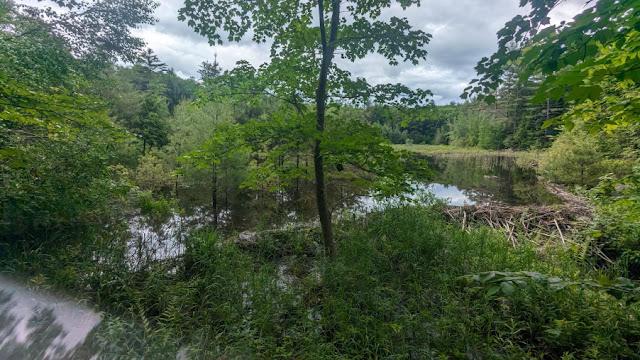
Note the stone wall now - only the last two stones are visible.

My next observation was in August:
August
Not much had changed other than lots of plant growth.  It was a fairly dry summer, so without much rain the water level wasn't at the top of their dam so they had little interest in raising it.
The last two rocks indicate a water level similar to June.

In October, with leaves off the trees, more of the pond was visible and I could see how large it had become.  

As the pond expanded, it flooded the roots of nearby trees resulting in their demise as shown buy the brown needles on the White Pines:
The trees on what is now an island died in less than a year.

When you see tall dead trees in the middle of a wet meadow you can be pretty confident the area was once a beaver pond - and may well be again in the future.

We remained very dry through November so the dam didn't need much attention, which gave the beavers time to work on gathering food and fortifying their lodge for winter. 

They built their lodge against a large boulder that is now an island.


And they cut down and brought out to their lodge enough trees for their entire winter food supply.  
That collection of branches in the water by the lodge is their winter pantry.

Where did all the building materials and foodstuff come from?
Here's the answer.

Larger trees were also felled and all the branches taken off and stuck in the mud beside the lodge.

There's not much left on the southwest side of the pond.
A year and a half ago this pond was just a wet meadow with a stream running through it.


My most recent visit was this past Thursday, after we received 2.7" of rain.  

Now the water level has risen and breached the top of the dam.
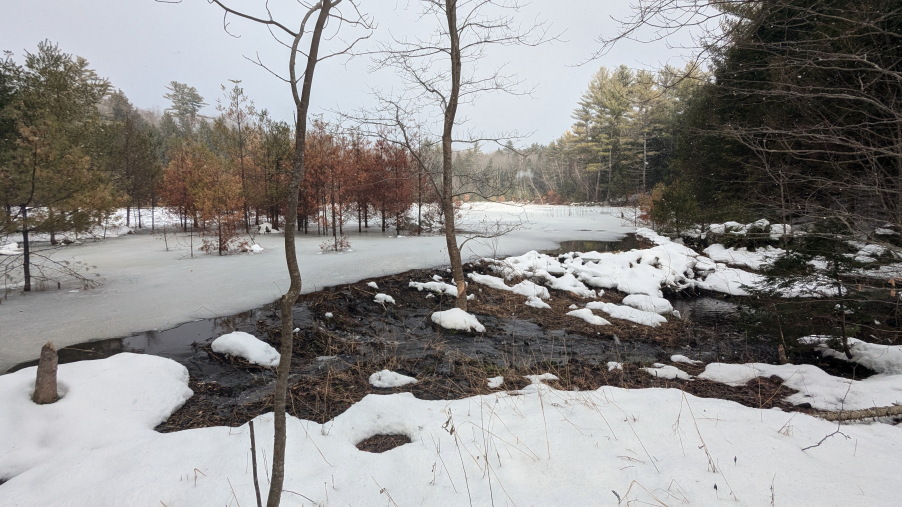
They've probably already been out to repair it - I'll know at my next visit.  One more detail:  Did you notice the tree right in the center of the dam on all the previous pictures?  Well, it won't be there much longer as they've started to take it down.  I'm not sure why they didn't finish.


Those last two rocks at the end of the stone wall have just about disappeared now.  Beavers in New Hampshire need four feet of water at their lodge to ensure their under-water entry hole won't freeze; they need to go in and out all winter for food, and maybe some dam and lodge repair.  I can only assume the beavers have created a pond large and deep enough to get them safely through the winter.  The pod cast "Something Wild" recently did a story titled "What's it Like Inside a Beaver Lodge?"  It's definitely worth a listen!


When beavers create a pond they give birth to an entire new world for dozens of plants and animals - probably more like hundreds.  Some of the obvious ones are the ducks, frogs, turtles, and another similar creatures we see, but also many other less visible animals that are associated with wetlands such as dragonflies, salamanders, and a multitude of other aquatic and semi-aquatic plants and animals.  It's truly a gift to so many species.

If you get out to the Hamlin Forest this winter be sure to check out this beaver pond as well as several others in that forest - there's always something interesting to see!

One last note:  The ice in some coves on Wicwas is 4" thick, enough for skating if you're careful, and the surface is fabulous.  If you go out, be sure to take the proper precautions and equipment, and check the ice thickness regularly.  

My friends the otter triplets were out enjoying it too - before it froze!

Yes, that's open water out there - be safe!


Sunday, January 8, 2023

January 8, 2023: Arbutus Hill Pond Beavers

In early December I noted a lot of beaver activity at Arbutus Hill Pond in the Eames Conservation Area (accessed via the Hamlin/Eames trailhead) so this week I took a walk back up to explore further now that the pond is frozen.  I found that the main beaver lodge has been well maintained, and a second lodge has been added to neighborhood.  

Two active beaver lodges at Arbutus Hill Pond.

This might explain all the activity this fall:  They needed building materials as well as food to sustain an expanding, multi-generational family network.  Larger branches from the trees they felled were used for lodge construction while the smaller branches and twigs were taken for winter food.  Beavers don't typically eat hemlock trees, but they are smart enough to know if they cut them down it will leave space and light for their preferred species to grow.  One homeowner even got into the holiday spirit and used hemlock to erect a Christmas tree on their lodge.


As the population grows beavers need a larger pond to support them and they've been busy on this aspect as well.  The beaver dam on the west side of the pond has been elevated to enlarge the pond, which also required lengthening it so the water wouldn't spill around the ends of the dam.  

Looking south along the dam.

The same point looking north.  The water level below the dam is perhaps three feet lower.
With no snow on the ground when I was there I could easily see the entire dam which I estimate to be 250' in length.

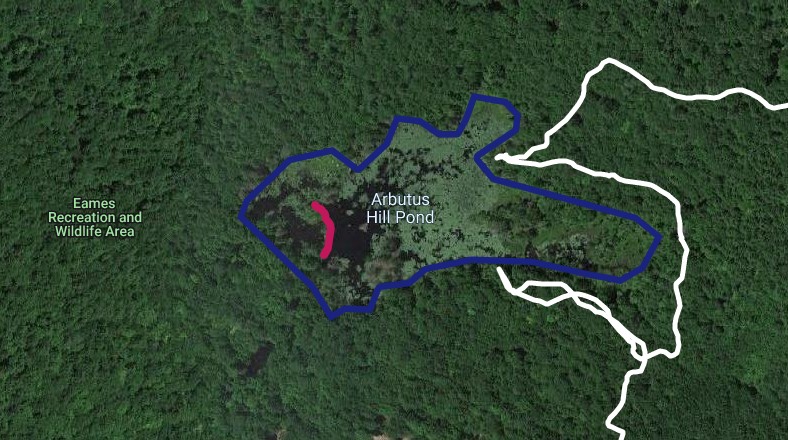
The pink line is the dam, the blue line is the extent of the wetland.  The white line is the hiking trail.  

I think there may be a second dam at the west point of the wetland - something to look for on a future visit.  Winter does make exploring wetlands much easier, though one must be careful of thin spots where there's moving water and beaver paths, especially with all the recent warm weather.  If you would like to visit you can find a trail map at the kiosk or on the Meredith Conservation Commission website.


In mid December we decided it was safe to put the bird feeders out for the winter and it was interesting to watch how long it took different birds to find it.  Within minutes a blue jay was on the feeder, but that was all on the first day.  Surprisingly it took until the second day for the chickadees to show up.  

Our first chickadee on the feeder.

By day three there were a bunch of chickadees, and on day four too many to count, as well as five gray squirrels.  On day seven a red-bellied woodpecker appeared.  It only spent a few seconds on the feeder before it flew off to explore every tree trunk in the yard looking for fresher food.  It's such a pretty bird I hope it returns often.  That same day the first white-breasted nuthatch made its appearance.  Since then there have been many nuthatches, following their usual routine of shoveling seeds out onto the ground until they can get to a great big juicy seed or nut.  Two days later we saw the first downy woodpecker, followed shortly by it's larger relative, the hairy woodpecker.

A hairy woodpecker selects a choice seed.

And it looks like it's going to be a big year for gray squirrels.  One day there were 14 of them in the yard, mostly staying on their own designated feeders and taking advantage of the nuthatches discarded seeds. 


With the low production of acorns this year I expect a lot of squirrels will be looking for handouts.  Maybe the bobcat will switch from venison to squirrel.  He may get a bird or two as well, but they are pretty good escape artists.

We received a couple of inches of snow on Friday, and fresh snow on a heavy overcast day always brings great contrasting scenes.


It even made me notice these tiny self-heal plants, standing in stark contrast against the white snow. 

Dried self-heal blossoms (Prunella vulgaris) poking up above the thin snow cover.
I've walked by these a dozen times in the past few months and never noticed them.  Their dried flowers remind me of hop cones - the kind used in making beer.


At least with Friday's snow the remnants of the deer are covered up - and it looks like winter again.


I hope this finally means a change to a winter weather pattern!


Sunday, December 17, 2017

December 17, 2017 - Ice In

Winter is here, and signs of winter fun are starting to appear.

I don't think the animals in the region think it's a lot of fun, but they are also out leaving their marks in the snow.  This week I saw mouse, squirrel and deer tracks in the light, dry snow, but thankfully no bear tracks;  I expect they are all bedded down now, with the overnight lows falling to near zero.  The red squirrel tracks are easy to identify as they burrow out from under snow and make highways running from tree to tree.
A squirrel trail leads between two productive trees

Another animal highway was visible in the lake before the latest snow fell:
The beavers kept a lane open in the ice

The beavers had made a path by travelling back and forth between two lodges, including their food supply stashed at one of the lodges.
A food stash at a lodge

Because mice have so little mass their tracks are visible only when the snow is extremely soft and fluffy.
Mouse tracks in the light snow
Soon they won't venture on top of the snow much at all - they will tunnel down below it whenever they can to stay out of sight of the owls.

The bright snow brings out details that I wouldn't see otherwise, such as these woodpecker trees I hadn't noticed before.
Woodpeckers working on hardwood trees rather than their usual pine


And the still-flowing streams stand out in stark contrast to the fresh snow.

The red berries of the winterberry have been noticed all fall, and a few wintergreen berries are showing through the snow where they are protected near the trunk of a tree, both providing a bit of Christmas Red to go with the green of the pines, spruce, and hemlock needles.
Winterberry

Wintergreen

It looks like the cold weather will hold at least another week so we should be having a white Christmas this year - I hope to see you out enjoying the beauty of winter over the holidays!


Note:  Ice-in on Lake Wicwas occurred on December 12, an average date, and much earlier than last year.  The ice in one cove is currently 6-1/2" thick, 4" of black ice under 2-1/2" of white ice.  I wouldn't trust the ice yet though, as there was open water only a few days ago.  Keep an eye on the ice fishermen - they tend to cut holes as they go, so have a good idea of where and when it's safe.

Saturday, January 14, 2017

January 14, 2017 - Coyote

The New England roller-coaster continues:  Zero degrees one day, 45 degrees and raining the next, then back to single digits again.  It hasn't done much for the skiing, but the lake did freeze up well enough to provide some decent skating conditions.  It's pretty good for mid-winter:  some really smooth areas interconnected with rougher patches that are easily navigated.  


There have been good hiking conditions when the roller coaster climbs up into the 40s and the snow softens up.  We had a gorgeous spring-like hike up to the White Mountain Ledge on one of those warm sunny days, and were treated to nice views of the whites.
Hiking up to the White Mountain Ledge

A snow-capped Lafayette on the left, Tecumseh and Osceola on the right

When the 'coaster hit a low point on one of the coldest mornings after a light dusting of snow fell, I went for a walk on the lake to see who's been out on the ice.  I've heard lots of night time coyote howling this year, and have seen tracks all over the lake.
A great example of a coyote side-trot in the light snow

I sometimes question whether I'm looking at fox or coyote tracks, but when the two animals cross paths it gives a definite reminder of how small fox prints are compared to those of a coyote.
Coyote from left to right, fox top to bottom


There was something out on the lake that attracted a lot of attention;  maybe that was the cause of all the howling one night.

Looking around, all I found were a few left over bones.

I can't tell what they came from - maybe a turkey?

Coyotes are true survivors, having won the war that humans have waged on them for over a hundred years, adapting along the way some unique survival techniques.  New Hampshire Public Radio's "Exchange" show produced a great program on their story ("The Wolf in Our Backyards") from Native American time to today;  you can listen to it here.
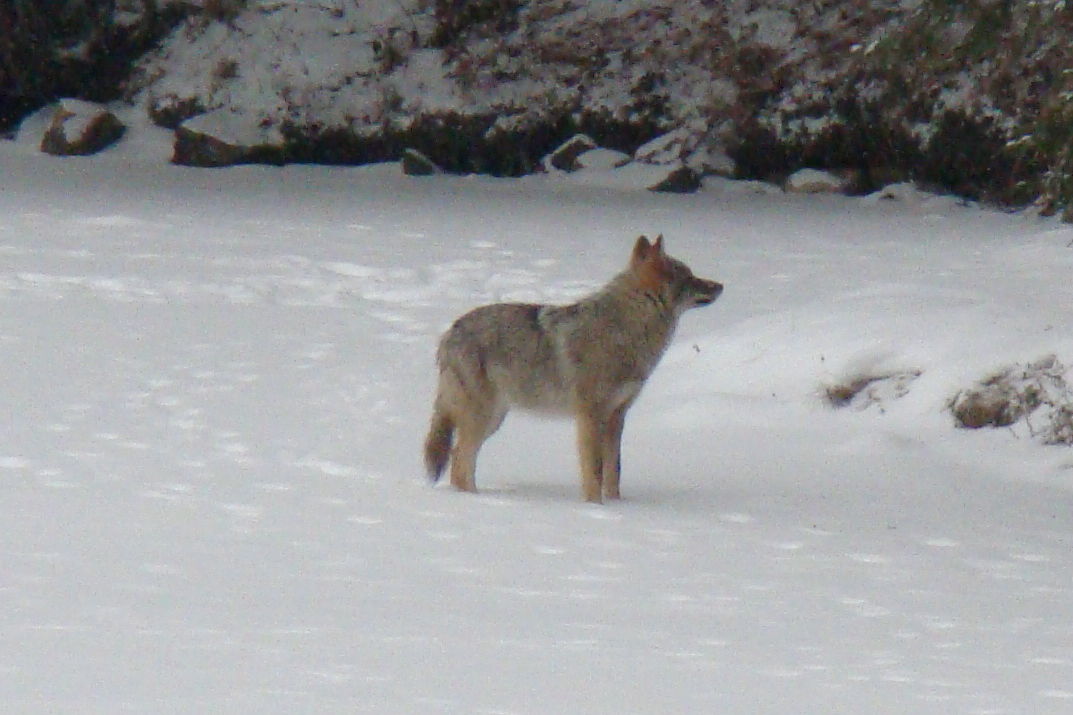
Coyote with a warm fur coat on Wicwas in January 2012
This week their tracks led me to one of the many beaver lodges on the lake.

This coyote had climbed right up on top and sniffed around, following the scent coming from the chimney in the top.
Paw prints at the top of the lodge

I always like thinking about the beavers down there in winter, safe from predators and enjoying a nice temperature-controlled environment - if you call 32 to 39 degrees "nice".

The warm, moist air molecules coming up through the chimney in the top of the lodge crystallize into brilliant miniature ice sculptures in near-zero temperatures.


Curious about other lodges, I took a look at a few more (there are at least nine active or recently-active lodges in Lake Wicwas) as I wandered my way around the lake, including checking on the largest lodge on the lake which is down toward the dam.

It's clearly still active, as indicated by all the fresh branches sticking up out of the ice.

This is their winter food source, having been carefully stored under the water during the fall for later consumption.

I also found a set of bobcat tracks that, like the coyote, went right up on top of the lodge.  The thin snow on the ice left perfect impressions.
A bobcat print no larger than a thumb in a warm mitten


Just like the twists and turns in an animal track, one never knows what surprises the roller coaster will bring us next.  Maybe a frozen tundra, maybe a foot of snow, maybe a sea of mush.  Whatever it brings, I know it will be worth the ride.
Lake Wicwas before the latest freeze