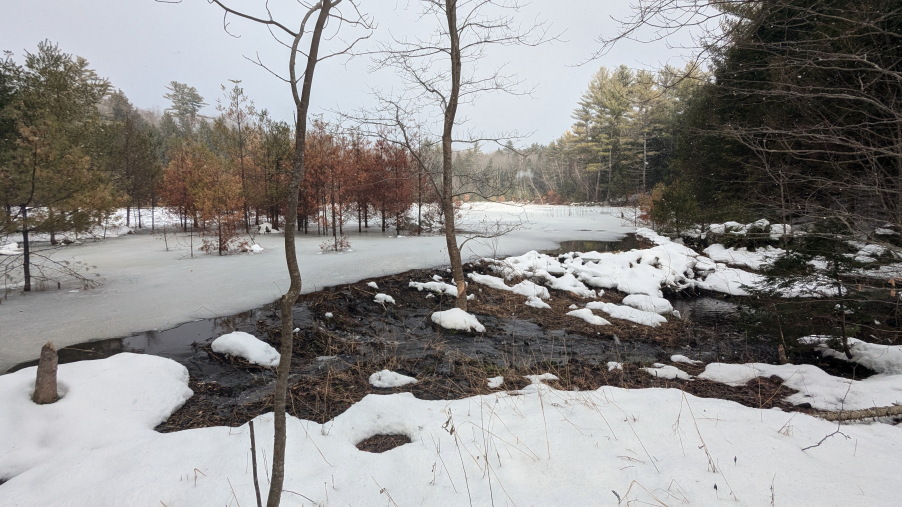
Showing posts with label Beaver Pond. Show all posts

Sunday, September 7, 2025

September 7, 2025: Quieter Days on the Lakes

Welcome to September, a time when things graciously slow down around all the lakes.  I took advantage of a calm day to paddle the big lake; it's a peaceful place on a September morning.

Lake Winnipesaukee in September.

I paddled around several of Meredith's Islands to the east of Meredith Neck: Beaver, Hawk's Nest, Three Mile, and Pine.  I had the lake to myself until almost 11:00, affording opportunities to see several birds including this eagle having its breakfast on Three Mile Island.


I will surmise this is an immature Bald Eagle that has not yet earned its white head and tail feathers.

A little farther along, a Double-crested Cormorant was biding its time off the eastern point of Hawk's Nest Island.

A cormorant surveys the big lake.

I discovered an interesting find deep in a secluded cove in the cut between the Beaver Islands:  a stand of Black Gum (aka Black Tupelo) trees which were starting to turn red.


There used to be several large black gum trees on Wicwas too, but most of them have been taken down by beavers, though there are still a few smaller trees around.  You can find them most easily in the fall when their thick, glossy leaves turn a deep crimson color.

Look for these dark-red black gum leaves in early to mid October.

After paddling past Pine Island I followed the shoreline of Meredith Neck north back to Leavitt Beach, and along the way I rounded a point and flushed a Great Blue Heron off its resting point on a shoreline bounder.


Here are few manmade sights you might recognize from this part of the lake.

Stone marker at the north entrance to the channel behind Pine Island
That's Red Hill directly behind, with 4043' Mt. Passaconaway the high peak off in the distance.

AMC Camp on Three Mile Island
Y-Landing on Meredith Neck

Back on Lake Wicwas, our most famous residents, the loons and our juvenile Spangle, continue to do well even while constantly fending off intruders.  I found mom and spangle fishing in the middle of the lake one bright day.


Stopping to watch - at a safe distance of course - after one dive Spangle came up right next to me!  She did her best to hide, keeping a low profile before she dove again.


Heading north after this I found what I presume to be Spangle's father right at the line defining the north and south nesting territories guarding his domain against four other loons.  Even as a nearly full-size juvenile, spangle is still vulnerable to attack by other loons and protected fiercely by her parents.  

Spangle has shed all her baby feathers and is now fully clothed in juvenile plumage.

The feeble amount of rain we received this week did little to help the drought situation.  The lake is now down about seven inches, and almost all the streams are bone-dry (this was prior to yesterday when we did get some first appreciable rain, the first since July 13th, with more on tap for today).

Not a drop of water in these streams.


The only exception are ones that have beaver dams upstream which store enough water to keep the stream running slowly all summer as water leaks through the dam.  

This stream is supplied with water from the upstream beaver pond shown below.

The pond level is down, but that's what's keeping the stream alive.

The dry summer has been great for tourism and outside activities, but hard on plants and wildlife.  Water in both beaver ponds and flowing streams are incredibly valuable resources to animals in drought years.


I'm hearing lots of reports of ground hornet nests this fall - perhaps due to the dry summer?  I have personal experience with two already.  One I found in the Hamlin forest at the intersection of the Blue and Yellow trails heading up to Crockett's Ledge.  There was a large boulder turned over beside the trail and I wondered why.  Looking around I found the hole where it came from and realized a bear had excavated a bee nest to access the eggs and larvae.  

An excavated yellow-jacket nest.

Hornets that had survived the attack, perhaps because they were away from the nest at the time, were working like a construction crew after a tornado to recover what they could from the remains.  


I still can't image how a bear can endure the dozens, maybe hundreds, of stings it sustains while it feeds on a nest.  My advice to hikers is to simply keep a steady pace as you hike.  As long as you keep moving, even if you stomp right on top of a nest, by the time the hornets come out to investigate, they won't bother you if you've gone past them.  They're only likely to be a problem if you happen sit down right next to one - so be aware of where you stop for a break on your hikes.  If you see bees, move on quickly.


I wanted to mention all the wild fruit that's ripening now but that will have to wait.  I'll share just this fun moment of watching a young robin collecting cherries from a Black Cherry tree.

It's an important time of  year for animals to start stocking up on calories for winter, whether for hibernation or migration.


Sunday, December 15, 2024

December 15, 2024: A Whole New World

It was last December when I first noticed that beavers were constructing a new dam on the stream that flows out of the Hamlin Town Forest on the west side of Lake Wicwas (A Pond is Born, December 31, 2023).  At that point the beavers had already raised the water level by more than a foot.

Dec 2023:  Note the height of the rocks at the end of the stone wall entering the pond from the right.

Over the course of the past year I stopped by regularly to observe the changes the beavers were making to the area.  Come April, not much had changed other than a repair to the area that was overflowing on the left side of the dam in December.
The repair had brought the water level back up a few inches.


By June the beavers had made significant improvements to the dam, raising it and extending to the left enough to raise the water another six inches, which enlarged the pond significantly.
Note the stone wall now - only the last two stones are visible.

My next observation was in August:
August
Not much had changed other than lots of plant growth.  It was a fairly dry summer, so without much rain the water level wasn't at the top of their dam so they had little interest in raising it.
The last two rocks indicate a water level similar to June.

In October, with leaves off the trees, more of the pond was visible and I could see how large it had become.  

As the pond expanded, it flooded the roots of nearby trees resulting in their demise as shown buy the brown needles on the White Pines:
The trees on what is now an island died in less than a year.

When you see tall dead trees in the middle of a wet meadow you can be pretty confident the area was once a beaver pond - and may well be again in the future.

We remained very dry through November so the dam didn't need much attention, which gave the beavers time to work on gathering food and fortifying their lodge for winter. 

They built their lodge against a large boulder that is now an island.


And they cut down and brought out to their lodge enough trees for their entire winter food supply.  
That collection of branches in the water by the lodge is their winter pantry.

Where did all the building materials and foodstuff come from?
Here's the answer.

Larger trees were also felled and all the branches taken off and stuck in the mud beside the lodge.

There's not much left on the southwest side of the pond.
A year and a half ago this pond was just a wet meadow with a stream running through it.


My most recent visit was this past Thursday, after we received 2.7" of rain.  

Now the water level has risen and breached the top of the dam.

They've probably already been out to repair it - I'll know at my next visit.  One more detail:  Did you notice the tree right in the center of the dam on all the previous pictures?  Well, it won't be there much longer as they've started to take it down.  I'm not sure why they didn't finish.


Those last two rocks at the end of the stone wall have just about disappeared now.  Beavers in New Hampshire need four feet of water at their lodge to ensure their under-water entry hole won't freeze; they need to go in and out all winter for food, and maybe some dam and lodge repair.  I can only assume the beavers have created a pond large and deep enough to get them safely through the winter.  The pod cast "Something Wild" recently did a story titled "What's it Like Inside a Beaver Lodge?"  It's definitely worth a listen!


When beavers create a pond they give birth to an entire new world for dozens of plants and animals - probably more like hundreds.  Some of the obvious ones are the ducks, frogs, turtles, and another similar creatures we see, but also many other less visible animals that are associated with wetlands such as dragonflies, salamanders, and a multitude of other aquatic and semi-aquatic plants and animals.  It's truly a gift to so many species.

If you get out to the Hamlin Forest this winter be sure to check out this beaver pond as well as several others in that forest - there's always something interesting to see!

One last note:  The ice in some coves on Wicwas is 4" thick, enough for skating if you're careful, and the surface is fabulous.  If you go out, be sure to take the proper precautions and equipment, and check the ice thickness regularly.  

My friends the otter triplets were out enjoying it too - before it froze!

Yes, that's open water out there - be safe!


Sunday, December 31, 2023

December 31, 2023: A Pond is Born

It's not looking much like the last day of December.  Instead of skating and ice fishing taking place on the lake, I was out in a boat on Friday. 


The mission was to rescue some of the dock items that floated away during last week's flood, and the job was greatly facilitated by the fact that almost all the ice on the lake has cleared out.  An enthusiastic team joined forces to pull, row, and paddle the wayward docks back to their proper winter homes.  It went off without a hitch, and it once again shows how a close-knit, supportive New England community comes together to help each other.


The lake has dropped about a foot since last week but is still seven inches above normal water level.  The drop is evident by sheets of ice that collapsed around the shore line as the water receded.

Ice hung up on shore shows how much the lake has dropped.
The lake is only dropping slowly because the streams flowing in are still swollen with rain and snow melt.


Now to the birth of a pond.  I think we're about to have an opportunity to witness the creation of a new pond right here in Meredith.  It's not a totally new pond, but rather the restoration of a prior wetland that was abandoned years ago.  On a recent work day repairing storm erosion in the Hamlin Town Forest, I noticed a few trees that had just been harvested by beavers.


Investigating further I discovered it wasn't a few trees, but many.

Many stumps in an area being cleared by beavers.

And then I found a new dam that had appeared since the last time I was there and is surely where much of that felled wood ended up.  
This nascent dam was overtopped on the left by the rain, but held firm nonetheless.

What is presently a large wet meadow with a stream running through it, was at one point a beaver pond.  But many years ago, probably after the resident beavers had consumed all the desirable trees within easy reach from the safety of the pond, they moved on to greener pastures. Over time the dam fell into disrepair and the pond slowly drained away.  Today, the trees around the pond have regrown enough that a new generation of beavers has returned with the intent of restoring the old estate to a vibrant family homestead.  

I went to google earth to look at historical photos of the pond dating back to 1984.  In those 60 years it has gone through two cycles of meadow to pond.  The last time there was open water in the pond was 2005, almost 20 years ago - long enough for the beaver's preferred size of tree to have regrown.  

It's in such an accessible location that anyone interested in watching what happens over the next few years can easily do so.  The meadow is just to the left as you leave the trailhead and cross the first bridge.  100 yards down the Yellow Trail, a short spur leads to a view point (binocular icon) where one can see a good portion of the meadow.   I'll report on changes here, but there's nothing like watching it develop it first hand over the years.  


While I was out on Lake Wicwas this week I took note of a huge food store that beavers living in the largest lodge on the lake have amassed for the winter.  

The pantry is right next to the lodge for safe and easy winter access.

There must be a healthy population of beavers living in that home.

That's the goods news from the lake, but there's sad news also, and you may want to skip this next section as it relates to the demise of one of my favorite wild animals.

Right at the dam, where's there's just a narrow strip of road that separates Lake Wicwas from the wetland below the dam, I found an animal dead beside the road.  It was a river otter, one of the most interesting and fun-loving animals in New Hampshire.


These are quick animals, and no doubt had its demise due to bad timing as it leaped up out of one water body to cross over to the other.  Perhaps otters usually travel under the road through the dam spillway, but the high flow over the dam might have required an overland trip for this unfortunate otter.  It looked to me to be a young otter as it's not quite three feet long which is the lower end of the three foot to four-and-a-half foot length of a fully grown river otter. 


A mature otter weighs between 15 and 30 pounds, and this animal weighted well below 30 pounds.  Before giving it a proper burial I took advantage of the sad situation to observe some of the detail on these animals.  Otters have five well-developed toes on each foot, with the hind foot somewhat larger than the front. 
Front foot with well defined claws, toe and heel pads.
You can see a bit of the webbing between the toes on this hind foot.


All four feet are webbed which helps them be such good swimmers and hunters.  Otters have many whiskers on their nose which they use to sense motion of fish both at night and during the day in deep, dark areas of the lake.  They can swim under water for up to a quarter of a mile.  It's their great efficiency in hunting that supposedly provides them so much time for play.

To leave on a happy note, I'll share a video of several otters having a great time in the snow.  This is from Washington State, but it could just as well be any lake with otters here in New Hampshire.


All we need is some snow.  Come on winter!


🎉    Happy New Year!      ðŸŽ‰