Showing posts with label Ice In. Show all posts

Sunday, December 14, 2025

December 14, 2025: Ice-In

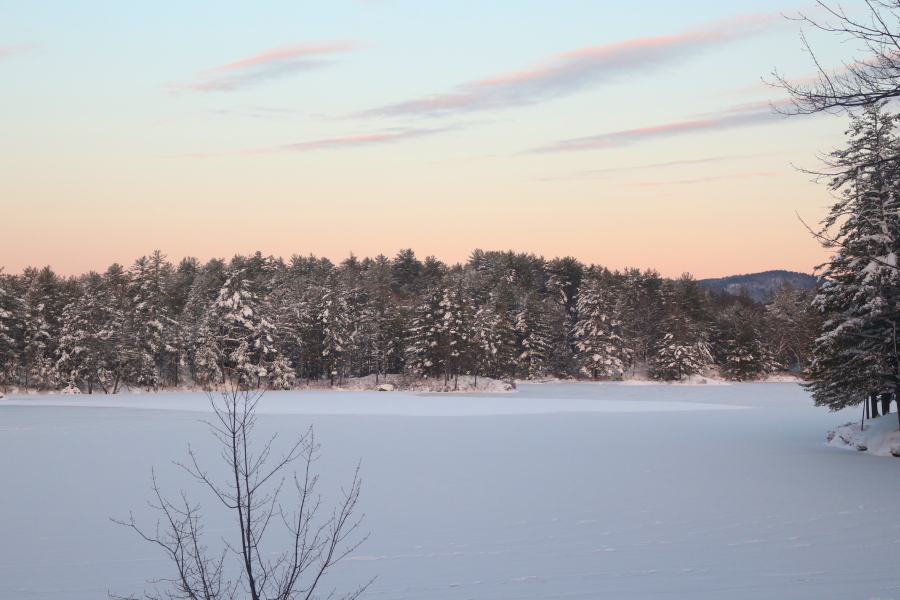
A few more cold days and a calm night early in the week gave Lake Wicwas its earliest ice-in since 2019, being declared on Wednesday morning, December 10th, when the last open area north of the Rawson Wood Islands froze over.  (Thank you KM and LB for the reports!)  By then some of the coves already had six inches of solid ice and were ready for skating.  A few people got out there before the second snow of the season fell and put an end to skating for now. 
Good skating in the cove before the snow.

On my skating trip I found that the otters had also been out enjoying the ice even before the lake froze up.

River Otter tracks frozen in the ice near Sheep Island.

With no concern about falling through the ice, otters get to have fun playing in the ice and slush long before it's safe for humans.

Otter hops and slides.

We'll never know if in fact Spangle, our juvenile loon, made it off the the lake before it froze over, but I'll assume she did, and count it as another successful loon fledged from Lake Wicwas.  That makes eleven loons fledged over the past ten years.


Our second snowfall mirrored the first, dropping another four inches of beautifully light, dry snow - a good medium for seeing animal tracks, large and small, and I found both during a pretty winter walk at Page Pond.  

A gorgeous day at Page Pond Town Forest.

On the small end, I saw that lots of mice had been out scampering on the snow in search of seeds, their long trails flopping on the snow with every hop.

Mouse tracks with their distinctive tail drag in the soft snow.

Their long excursions over the snow leave them vulnerable to attack by predators that may be watching from perches in trees that rodents often scamper between.

A long mouse trail in open cover.

That's one of the reasons we leave a few trees in the fields.  When the snow pack gets deeper, the mice, moles, and voles will create tunnels under the snow for safer travel.  But even down there in the subnivean zone they remain vulnerable to foxes with their excellent auditory and olfactory hunting skills.   (See March 17, 2019:  The Subnivean Zone)

On the larger end of the animal kingdom were signs of a robust deer population in and around the Page Pond Town Forest.  There are deer tracks crisscrossing much of that large unfragmented area of conserved land, and we came across several areas where deer had bedded down for a nap, melting the snow right down to the leaves.

At one spot there were three such beds close together, making me think it might have been a doe with her two fawns.


With winter firmly settled in, it's safe to put out the bird feeders, and it didn't take long for the birds to find them.  Chickadees are always first, but the nuthatches, woodpeckers, titmice and other birds are smart enough to follow the chickadees, knowing chickadees will lead them to food.  A nearby birdwatcher has seen Bluebirds, Carolina Wrens, and an American Tree Swallow - I'll be watching for them as well as many others that should arrive soon.  He also observed momma bobcat and her two kits walking along the ice at the shoreline.  I'll definitely be watching for them and their tracks; they are a lot of fun to follow to learn about their behavior.  (Thanks for sharing RB!) 

Momma and a kit scouting the lake edge a few years ago.


Perhaps you were out enjoying the milder weather yesterday and found your own nature signs.  But if not, today promises to be another good day, perhaps with more sun.  Winter is not only beautiful in the Lakes Region, but with snow on the ground it offers the best opportunities to see what animals are running around in your neck of the woods!

Happy Tracking!


Sunday, December 29, 2024

December 29, 2024: Ice In and Tracks Galore

Where to begin....   

We'll start with Ice-In which was declared on December 27th.  It's possible it actually occurred one day earlier based on how little open water was left on Christmas, but if it did, it wasn't observed, so December 27 it is.  And although the surface is frozen, it is not safe.  Much of the center of the lake - the parts clearly open in last week's drone video - are very thin.  

Lots of open water on Monday Dec 23rd.

But that doesn't stop otters, as they are perfectly happy to climb in and out of the water as their mood desires.  The otter tracks all over the lake are really fun to see, and to imagine their behavior as they randomly run, hop, or slide their way across the lake.

They are completely unlike the fox which are all business - fox are on a mission, traveling in a clean, precise path across the snow, broken only when there is something to sniff at. 
Note the precise path of a canine crossing the otters' path.

Otters on the other hand, dance all over the place, running, sliding, backtracking to tackle one of their siblings.  

Otters having fun, while the pair of foxes just searched for food.

The messy tracks of fun-loving otters.

The jubilant play of the three brothers (totally made up on my part) went all the way from the west side of the lake, over Sheep Island, down to the outlet and across into the wetland between Wicwas and Winnisquam.  
Synchronized slides by the three brothers next to Sheep Island.
Over to Winnisquam.  I didn't think to see if they ran across the road, or swam over the dam.

These good-sized mammals weren't the only animals making their presence known this week, as two of our larger birds were seen as well.  First is this regal Barred-owl seen on Loon Point and captured by Eric Cohen.

Photo by Eric Cohen.

Second, I was able to catch the Pileated Woodpecker as it made its rounds of the lake when it stopped on a tree right in my line of sight.

The red mustache indicates this is a male Pileated.

With fresh snow, cold temperatures, and thick ice in the long-frozen coves (7 inches now), I had a couple of nice ski trips which is how I followed along behind the otters.  I also saw fox, coyote, and bobcat tracks, maybe mink, and several bird tracks which were most likely left by crows.

Much too small to be turkey tracks.


I'll end with a beautiful evening on Mt. Roberts at the Lakes Region Conservation Trust property at Castle in the Clouds.  (Speaking of that, did you see that Castle in the Clouds has been designated as a National Historic Landmark by the U.S. Department of the Interior?)

I had planned to do a sunset hike on the winter solstice but the weather didn't cooperate.  Friday the atmospheric conditions looked promising so I took a late afternoon hike to the summit of Roberts.

Heading up over the ledges on Mt. Roberts in the late afternoon.

On the way down I stopped at the west facing ledge just before sunset as the fog was settling in the valleys between the mountains.


I was treated to a spectacular sunset with Kearsarge, Cardigan, and even Meredith's highest peak, Leavitt Mountain, in the distance.


Pink glow reflects off The Broads in Lake Winnipesaukee.

I tarried long enough to see the lights come on for night skiing at Gunstock.


It's an easy hike down from that viewpoint with a headlamp, especially with the trail packed smooth with dry snow.  Nonetheless, micro-spikes on boots are strongly recommended.


Happy New Year!


P.S.  After writing this I received a report that there is still a small patch of open water.  Depending on its size there may be an update in the ice-in date.  


Sunday, January 7, 2024

January 7, 2024: Otters Under the Ice

We finally have ice-in on Lake Wicwas.  It was called yesterday, January 6th, after a few cold nights.  It's the latest ice-in date on record, matching the prior record set on January 6, 2015, and the third time we haven't had full ice cover by the end of December.  Here's the ice-in trend over the past 22 years along with the linear best-fit trend line.

The historical data for ice-out and the number of days of ice cover are just as disturbing.  

Two days before ice-in we had a quiet, perfectly calm morning, and I was standing at the edge of the lake enjoying the view of thin ice that covered about 80% of the lake at that time.  


Being calm, I was surprised when I heard water sloshing at my feet - there was no wind to make waves and certainly no boats.  Next I heard air moving - again, strange.  Water and air bubbles visible under the clear ice were suddenly moving and I heard increased air noise like blowing.  It started to dawn on me that there was an animal under the ice near a small opening at the shoreline.  Was it a beaver?  A muskrat?  Maybe a mink?  Suddenly there was streak of brown visible through the ice, and a fast, slender animal flashed away underneath the clear black ice.  It was undoubtedly an otter!  I waited quietly and soon it came back, followed by a second right on its tail.  The two zipped back and forth a bit before one of them returned to the breathing hole.  It stuck its nose up through the tiny hole, and this time I was ready - I knew where to aim my camera.

I couldn't see anything, but I was pretty sure I had the right spot, so while I heard breathing and cracking ice, I just kept taking pictures; it wasn't until I got home and blew them up that I found the little critter.
Look in the circle.
There he is.

It was panting hard, like a swimmer that had just come up from a long dive and was restoring the oxygen level in its blood in preparation for another.  In a minute it was gone again, zipping away under the ice.  I didn't move.  Another minute or two - both otters came back.  This time one was on my left at a different hole, the other back on my right.  The one on the right decided it wanted a bigger hole and I heard the ice break as it pushed its nose further up through the ice, enough to expose its whiskers.


It pushed up yet further, opening its mouth, perhaps to suck in more air.

Otters have tongues!

Finally, it opened wide and showed off its fish-chomping teeth.


When I first heard the breathing, before I located the hole, I took a couple of videos.  In this first video you can hear a couple of breaths while I was trying to find the source.


In the second video you hear water splashing from the otter to my left.


Two otter reports in two weeks - this one was a lot more enjoyable than last week's.  There I was, standing four feet away from a river otter, close enough to hear it breathing - does it get any better than that?  And now, having woken up this morning to a world of white, I'll be on the hunt for otter slides as they toboggan on their bellies down onto the lake!

Winter at Wicwas.


Sunday, December 20, 2020

December 20, 2020: Red-bellied Woodpecker

Yes, we'll get to the snow, but first, a new bird appeared in the yard, a first for me in Meredith.

Red-bellied Woodpecker (Melanerpes carolinus)

The instant I saw this bird on the feeder I knew it was something special.  I've only seen one previously, about 50 miles south of here.  One bird book published in 1981 lists their range on the east coast from Florida to as far north as Connecticut.  Another book, published in 1998, lists them as far north as Massachusetts, but says they are "spreading north".  Even the current Cornell Lab or Ornithology website has a map showing the range only as far north as the very southern edge of Massachusetts.


Red-bellied Woodpecker Range (year-round).  Source:  Cornell Lab of Ornithology

But as the climate changes, lots of things are moving north.  

It's a beautiful bird, about as large as the hairy woodpecker with a stunning redhead - just note that it hardly has any red on its belly; it's barely noticeable.

You can discern just a touch of red on the belly in this picture.

But plenty of red on its cap.

The black and white bars on its back are also eye-catching.

The red-bellied has a diet that consists primarily of insects, though it does consume lots of nuts, fruit, and seeds as well.  You know it's a southern bird when the foods listed include oranges, mangoes, and lizards!  It makes me wonder if it came up north along with the storm.  It has been visiting us every day so it must be satisfied with its hunting grounds even now that winter has arrived with a vengeance - our forecasted three to six inch snow storm worked it's way up to three feet here at Lake Wicwas.

The snow didn't even start until after midnight, and by dawn there were 11 inches on the ground.  During the morning it was coming down at a rate of over four inches per hour, with a peak of six inches in a single hour.  And there was no wind, at least on our side of the lake, so these are real snow depths, not drifts.  When it wrapped up less than 12 hours later we measured 33 inches of snow; the Laconia Daily Sun reported 39 inches in Meredith.  At least it was incredibly light and fluffy, and with no wind it wasn't too bad to shovel, but we sure went from nothing on the ground to mid-winter conditions in one day.  

A mid-winter sunrise the day after the storm.

The snow also brought along official ice-in for Lake Wicwas, declared on December 17th.  There was still open water when the snow started falling but all that cold snow in the water and low teens overnight froze the lake over by the morning of the 17th.  This date is in line with the average ice-in over the past 20 years on December 13th, but it's worth noting that over that time period ice-in has moved by more than a week.


In the 1970's there was never any doubt about being on the ice over Christmas vacation - we were always sledding and skating by then.  But especially this year with a heavy snow cover the ice may not be safe by Christmas.  If that trend line extrapolated linearly back 50 years it would put ice-in around mid to late November.  Does anyone have any records prior to 2000?

Though it may look like it, the ice is not safe today - here's where things stood just 5 days ago:

Open water on December 15th.

But there's no doubt that winter has arrived at the lake.


Sunday, December 8, 2019

December 8, 2019: Foxes are Clever - and Light

I don't know how the fox knows when the ice will support its weight - maybe they are just so light that if there's visible ice, they are good to go.  But the very first morning I saw ice on the lake, when there were still many open spots along the shore, there was already a set of tracks across the cove.  And the next day, there was our local red fox taking a short cut from its den to its hunting grounds.
A red fox takes the short route across Lake Wicwas.
Looking for a safe place to get off the ice.


Tracks left from an earlier excursion.

Fox are very efficient animals and will take every advantage offered in conserving energy in their travels.

Snow on the ground makes it more difficult for all the rodent-hunters to catch their prey since the mice can hide under the cover of snow, so it's starting off as a hard winter for fox, owls, and the other small-mammal predators.  At least there are lots of acorns so the mice will be well fed and making plenty more little mice - a female mouse can have over a dozen pups in a litter, as many as ten times per year!

The last reported sighting of our loons was on November 18th, and with ice now, it's safe to say that all our loons have departed.  It was exciting to have fledged two chicks this year as we haven't had a successful nesting since 2014, though it's sad to think we'll never know what happens to Harley and Davidson from this point forward.  If we see a new loon or two appear on the lake in four or five years, we can imagine it is one of this year's chicks, but that would be pure speculation as loons returning from the their maturing period on the ocean often return to the lake of their birth, but they will also venture to another nearby lake if their birth lake is fully populated.  It's too bad young chicks can't be banded, but on the other hand, perhaps the unknown is part of the mystique of the loon.

And loons better be gone from Lake Wicwas;  by December 4th the coves were frozen as was the southern portion of the lake.
Lake Wicwas was frozen part way up Loon Point on Wednesday.

On December 5th there was only one section open on the west shore at the north edge of the conservation area where the Red Trail reaches the lake.
Only a small open area the next day (far left in picture).

By yesterday it was down to a tiny circle of water, and after last night's low of five degrees and calm wind, that had closed up.  We won't know if this is the final ice-in until we see if the next two days of warm temperatures opens things up again.

The Lakes Region didn't get snow measured in feet like farther south but we did have a few inches on Monday and few more Friday night.  The first snow provides the fun of knowing what animals have been living around us all summer even if we haven't seen them; I've already seen tracks of fox, coyote, and deer, but this was my favorite animal track this week:
A porcupine leaves its mark in the snow, framed by unknown prior tracks on either side.

It's certainly starting to look like winter around the lakes.
Squam Lake was still wide open on Saturday, as seen through snow squalls from the summit of Mt. Morgan.
Note:  Ice-in was declared as December 8th as it did hold though the warm spell.