Showing posts with label White Mountain Ledge. Show all posts

Sunday, February 3, 2019

February 3, 2019: Polar Vortex Visits New Hampshire

It is certainly winter now in North America with the infamous Polar Vortex rotating down from the arctic to give us the coldest weather of the season.  NASA posted a neat video of the vortex as captured by weather satellites - it's worth watching the two-second clip.
Click here for video

New Hampshire didn't get the intense cold that our friends in Iowa and Michigan saw, but we had a few cold nights.  The coldest night here was Thursday into Friday morning, and there was a strange occurrence that night.  When I went to bed it was a balmy 2 degrees, and in the morning, around 6:30 it was just about zero.  But when I checked the minimum temperature recorded over night, the thermometer had recorded -11.2 degrees.  I didn't believe it.  The low usually occurs just before sunrise unless there's a weather change moving through, and that wasn't the case;  I doubted it could have warmed up ten degrees before the sun even came up.  So I went to check the data recorded at Laconia airport.  Sure enough, the overnight low there was 1 degree at 3:00 am, rising to 2 degrees at 7:00 am.  Still, my thermometer had never lied before, so I dug at little deeper.

Weather Underground (Wunderground.com) has many certified weather stations all over the country, so I thought I'd check out some closer to Lake Wicwas.  I found a station on Corliss Hill, one on Lake Winona, and one in New Hampton, just west of Lake Pemigewasset.  All three showed the same thing:  a significant drop in temperature after midnight, and then a massive increase of ten to twenty degrees in one hour!  The most extreme event was at Lake Winona which went from -18 degrees just before 7:00 am to +5 degrees at 8:00 am - an increase of 23 degrees in one hour!

I've never seen anything like that.  Perhaps geography was a factor.  Up on Corliss Hill, less than half a mile away but 200' higher in elevation, the increase occurred earlier in the morning, between 1:00 and 2:00 am.  But elevation alone doesn't explain why Laconia airport didn't see the event at all, as the airport is at the same elevation as Lake Wicwas.  Perhaps wind shading played a role.  Lake Winona, like Lake Wicwas, is located east of a steep ledge that rises several hundred feet above the lake.  At any rate, it's the most dramatic temperature change I've seen absent a strong front moving through.  Here's what the usual overnight change looks like, from Corliss Hill, Friday night into Saturday morning.


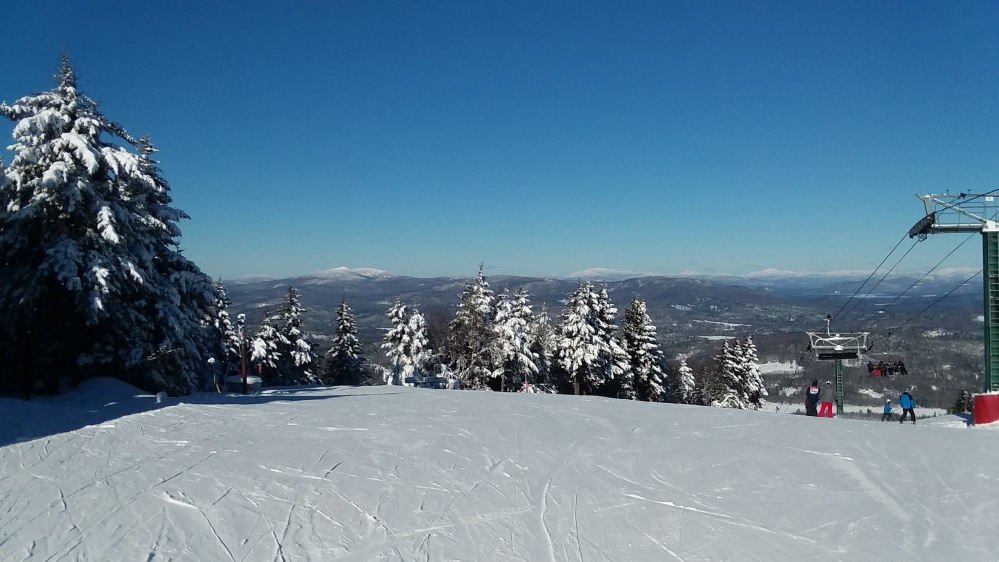
But it's been great to have a nice cold stretch after the last storm to keep the snow light and dry.  Linda decided (on the coldest day of the year) to take a trip up to the White Mountain Ledge.  Admittedly, it was a beautiful blue-sky day.
So we took the snowshoes and trekked through the fresh snow up to see the views.  We had to break the trail the whole way, some of which hadn't been broken out for at least two storms, other parts had only the most recent snow to break through.


We were shielded from the west wind by the hill, and the hard work (plus lots of layers) kept us warm.
She's not cold!
On the trip we saw a few tracks in the snow:  deer, ermine, even those from a snowshoe hare which I'm always excited to see since it doesn't happen very often.  (I couldn't get a decent photo as the tracks were in the shade of hemlock trees.)
You can barely make out the hare track in deep snow -
each track is an amazing six-foot leap from the prior track.

I did note a lack of fox and coyote tracks along the way, though we do have a fox that trots past our house every night, so they are around.  On the first day after the last storm we noted that there wasn't a single squirrel that made its way to the bird feeders, but on the second day they arrived.  There's no doubt about what is the center of attraction in our yard on a cold winter day.

Sunday, January 13, 2019

January 13, 2019: Flying Mammals in Winter

We had some of the coldest weather of the season this week which was good news for winter sports fans and for cool winter sights, and it also brought out one of the more reclusive critters in the forest.
The reclusive and nocturnal flying squirrel

Small animals like this flying squirrel can't hunker down in frigid weather as they have to eat every day to consume enough energy to burn just to keep warm.  Small birds for example can lose 10% of their body weight on a single cold night, a good reason why the chick-a-dees appear at the feeder at dawn's first light.

I have only seen flying squirrels in winter, though that's because they are nocturnal, and we only feed the birds in the winter.  Other people around the lake have special feeding platforms for flying squirrels and they are entertained by their acrobatics on warm summer nights.  They are amazing animals, having adapted a sheet of skin that extends between their front and hind legs, providing a steerable hang glider-type feature.  I have watched them sail off the feeder and make a perfect landing on their selected tree.
You can see the section of skin that stretches out when it spreads its legs to fly

If you want to attract them, try building a platform like this one,
Sharing the table

but attach it to a tree 15 to 30 feet above the ground.  They'll climb up, but fly off when it's time to depart.

The cold weather blew in from Canada after a storm which brouht heavy, wet snow that took down enough trees and limbs to leave 40% of Meredith without electricity;  Meredith and Moultonborough seemed to be hit the hardest, sitting right at the line where it was all snow, but still warm enough to wet and sticky.  It might have played havoc with the power company, but it was beautiful to look at and left a solid base for skiing and snow shoeing.
A good case of cement snow

I took a ski across the lake and up to the White Mountain Ledge as the storm was winding down.
Looking north from the White Mountain Ledge in the Hamlin Conservation Area

There were lots of trees bent down to block the trail, and countless limbs and branches broken off, laying on the ground.

The Meredith Trail Crew will have plenty to keep them busy this spring!

The coldest night was Saturday at just above zero, so of course that was the day we went skiing - cold but fabulous views.
Summit of Ragged Mountain

It was plenty chilly, but I'll bet this winter has worse yet to come.


Saturday, January 14, 2017

January 14, 2017 - Coyote

The New England roller-coaster continues:  Zero degrees one day, 45 degrees and raining the next, then back to single digits again.  It hasn't done much for the skiing, but the lake did freeze up well enough to provide some decent skating conditions.  It's pretty good for mid-winter:  some really smooth areas interconnected with rougher patches that are easily navigated.  


There have been good hiking conditions when the roller coaster climbs up into the 40s and the snow softens up.  We had a gorgeous spring-like hike up to the White Mountain Ledge on one of those warm sunny days, and were treated to nice views of the whites.
Hiking up to the White Mountain Ledge

A snow-capped Lafayette on the left, Tecumseh and Osceola on the right

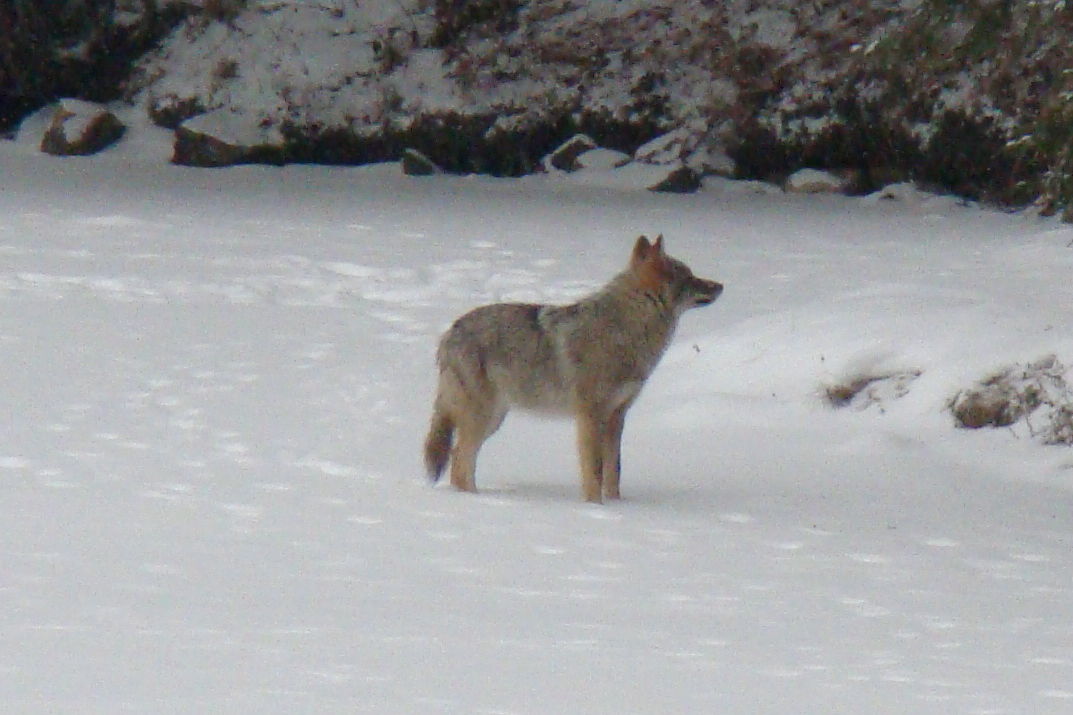
When the 'coaster hit a low point on one of the coldest mornings after a light dusting of snow fell, I went for a walk on the lake to see who's been out on the ice.  I've heard lots of night time coyote howling this year, and have seen tracks all over the lake.
A great example of a coyote side-trot in the light snow

I sometimes question whether I'm looking at fox or coyote tracks, but when the two animals cross paths it gives a definite reminder of how small fox prints are compared to those of a coyote.
Coyote from left to right, fox top to bottom


There was something out on the lake that attracted a lot of attention;  maybe that was the cause of all the howling one night.

Looking around, all I found were a few left over bones.

I can't tell what they came from - maybe a turkey?

Coyotes are true survivors, having won the war that humans have waged on them for over a hundred years, adapting along the way some unique survival techniques.  New Hampshire Public Radio's "Exchange" show produced a great program on their story ("The Wolf in Our Backyards") from Native American time to today;  you can listen to it here.
Coyote with a warm fur coat on Wicwas in January 2012
This week their tracks led me to one of the many beaver lodges on the lake.

This coyote had climbed right up on top and sniffed around, following the scent coming from the chimney in the top.
Paw prints at the top of the lodge

I always like thinking about the beavers down there in winter, safe from predators and enjoying a nice temperature-controlled environment - if you call 32 to 39 degrees "nice".

The warm, moist air molecules coming up through the chimney in the top of the lodge crystallize into brilliant miniature ice sculptures in near-zero temperatures.


Curious about other lodges, I took a look at a few more (there are at least nine active or recently-active lodges in Lake Wicwas) as I wandered my way around the lake, including checking on the largest lodge on the lake which is down toward the dam.

It's clearly still active, as indicated by all the fresh branches sticking up out of the ice.

This is their winter food source, having been carefully stored under the water during the fall for later consumption.

I also found a set of bobcat tracks that, like the coyote, went right up on top of the lodge.  The thin snow on the ice left perfect impressions.
A bobcat print no larger than a thumb in a warm mitten


Just like the twists and turns in an animal track, one never knows what surprises the roller coaster will bring us next.  Maybe a frozen tundra, maybe a foot of snow, maybe a sea of mush.  Whatever it brings, I know it will be worth the ride.
Lake Wicwas before the latest freeze


Sunday, October 14, 2012

October 14, 2012

Frost on the pumpkin!  Lake Wicwas had its first freeze on Saturday morning, though only in open areas that were exposed to the cold sky and the effects radiational cooling - anyplace protected by a cover of trees remained frost-free.  I didn't see any pumpkins around the lake, but there was frost on the leaves that had fallen into open fields.


With a clear day upon us, we had a beautiful walk up to the White Mountain Ledge on the Hamlin trails, and found some nice views to the north.  We got one glimpse of a snow covered Mount Lafayette when it cleared from its cloud blanket, but all the other mountains are still green.
From the White Mountain Ledge
Mt. Chocorua

There were beautiful views around the lake as well, with the dark blue water sparkling in the brisk north wind.  Here is the scene looking northeast towards the Lakeland School.  Old timers around the lake will remember when this was the Wicwas Lodge - maybe even some who remember the Lake Wicwas House?  There is a great history of the site on Dean Dexter's New Hampshire Commentary, "Smith Corner, Lake Wicwas, Meredith NH"   (Click Here).
Lakeland School

We also visited Crockett's Ledge, where there are still many yellow trees looking looking over towards Lake Winnisquam.  
Lake Winnisquam

This large structure - visible with binoculars - on the hilltop looking east towards Winnipesaukee was built in the last few years.  Could it be just a private residence?  


On our hike we saw lots of old tree stumps that are decomposing, and becoming hosts for moss, lichen, fungus, and now even small trees.  These new residents will accelerate the rate of the stump's decay.  Some of them have the appearance of tiny fairy yards. 

Lichen:  Reindeer and British Soldier
There were lots of animals out enjoying the pleasant day, collecting food for the winter.  Perhaps the first frost got them thinking about the long season ahead.  Or, more likely, it is just that we put the bird feeders back out.  (Risking the bears as well!)  In addition to the usual visitors, we saw the first Snow Bird, and a Purple Finch.
Purple Finch


There is still plenty of color around the lake to enjoy!

From Crockett's Ledge

Sunday, January 23, 2011

January 23, 2011

More snow and more cold weather is keeping Lake Wicwas in the deep freeze.  Several inches of snow fell on Tuesday, but unfortunately we also had some freezing rain mixed in which put a frozen crust on top of the new snow.  But it was followed up with a bit more snow, and then several more inches on Thursday night into Friday, and this last storm was all cold, dry powder, leaving a great surface for weekend snow sports, at least for humans.  This was the view northeast from the White Mountain Ledge on Saturday; Mount Chocorua is just visible on the far left.
Looking Northeast from the White Mountain Ledge
Deer Signs on Arbutus Hill
The wildlife isn't as thrilled, as indicated by the lack of tracks around the lake.  The deer in particular have a hard time moving around in deep snow, hindered even more with a sharp crust in the middle of the snow pack.  I took a ski in the Hamlin area to both the White Mountain Ledge and along the Arbutus Hill View trail, and saw only a few fox tracks up near the Red Trail along the ridge, and some deer tracks on Arbutus Hill.  The deer had been by just a few hours before, as the tracks and scat were on top of the previous day's snow.

There were also signs of browse, including scrapes on these birch trees, with scrapings well above my head indicating a fairly good size deer.  (Linda likes the colors of new snow under the tree cover on a bright, cold day!)
Deer Browse
Barbara R. Smyth Trail


The bright blue sky and brilliant sun made for another fabulous day; I captured this scene along the Barbara R. Smyth trail where deciduous tress and the recent  logging let in abundant sunshine.


Today I took a ski on the lake; it's been cold enough that the air vents on the beaver lodges haven't even thawed out.  Again, not many tracks, but the cold didn't stop this mouse from making his rounds up and over this lodge.
Mouse Tracks on a Beaver Lodge
After investigating a hole in the lodge it traveled all the way across the ice to far shore, carving a drunken path on its way.  But it made it to the trees before an owl saw it.

Blue Jay Landing Site


Here's an interesting pattern left by a Blue Jay landing in the light snow, with its individual feathers leaving their own imprint.


If you haven't seen the article in the Weirs Times about the Wicwas Lake Grange, you can find it here:  Weirs Times 20 January 2011 Edition.  It has some nice history about the Grange as well as the local area.  We are fortunate to still have this Grange which is named after the lake, as many have closed.  Both the Winnepesaukee Grange in Meredith Village and the Garnet Hill Grange in Center Harbor have closed, merging with the Wicwas Grange.