Sunday, September 23, 2018

September 23, 2018: Changing Seasons

We are just past the equal of day and night:  astronomical fall began last night at 9:54 pm when the autumnal equinox occured.  As the days get shorter and cooler both plants and animals sense it - everything is starting to prepare for the coming change.  Here is just a sampling of the many indicators around Lake Wicwas that the local community is adapting to what must come.

The trees on the shoreline are just starting to show some color.


Turtles and frogs are out collecting every last bit of warmth they can get before they go into hibernation.
Painted Turtle absorbing the late day sun
This wood frog was using the warmth these wood chips absorbed from the sun

Bees are scurrying around, gathering up as much pollen as they can find to get them through the winter. 
A Bumble bee transferring pollen from the blossoms on Linda's Coleus to its hind legs

A northern water snake was swimming across the lake - perhaps it was hoping to catch a passing squirrel?
A Northern Water Snake cruises the lake

I bet the snake is a faster, more agile swimmer than a squirrel. 


The geese are starting to flock up for their travels south; I counted 39 on the lake one afternoon.  This big one, probably a male, was on lookout duty.
A Sentry off Mark Island

After having little visible presence during the summer the beavers become much more active this time of year.  Here they have stuffed the dam at the outlet of Lake Wicwas with all kinds of debris as they attempt to raise the water level to increase the size of their domain.
Many thanks to the town for cleaning this out yet again

The comeback of beavers to New Hampshire after their virtual extirpation has created the water bodies that are a big factor in the recovery of the Great Blue Heron population as well.  I caught one such heron gliding over the lake on its way to a rocky perch for some fishing.


I didn't see much of Mr. Wood Duck this summer, but he did make an appearance on one of my kayak trips around the lake this week.  He and the misses will stay together on the lake for some time yet and migrating wood ducks on their way south will stop by to visit them.

Many birds - herons, loons, ducks - will be around quite a bit longer, some right up until the lake finally freezes over.

Many human residents of the lakes are also getting ready to find a warmer place to spend the winter.  Here are some bittersweet late-summer scenes, as we get ready for the changes as well.

The final sunset cruise of the Hurricane.

The Blue Heron Lodge basking in the low, late day sun.

A warm, calm day for a kayak - hopefully there will be few more of these!

One last canoe before closing up the cabin.

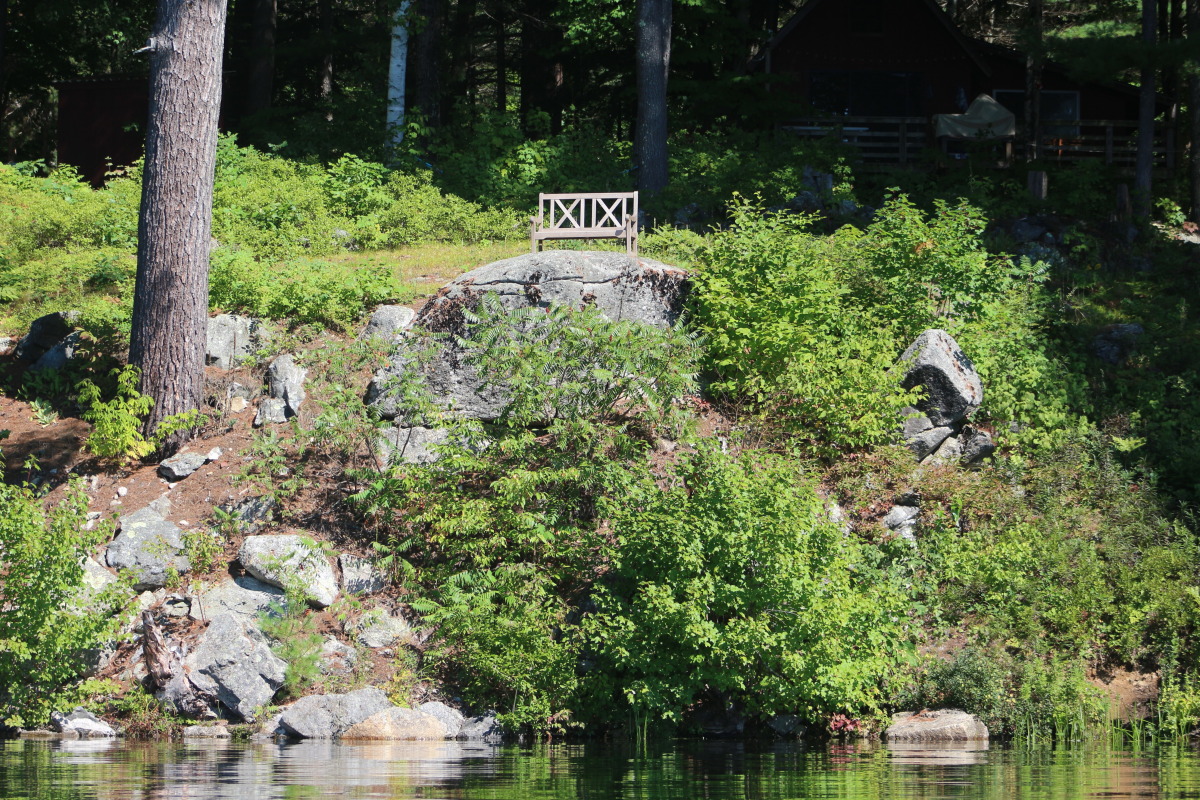
And finally, a lonely bench overlooking the lake waits for someone to come sit and enjoy the sights of the season.  I hope you'll be able to take in some of the most beautiful sights of the year as we make the transition into autumn.
Sunday, September 16, 2018

September 16, 2018: Rocky Raccoon

We took a road trip to Newport this week, which of course included visits to a couple of wildlife refuges on the Rhode Island coast.  The highlight was the Sachuest Wildlife Refuge at the tip of Middletown, Rhode Island.  There are beautiful coastal views of 360 degrees around the park with lots of bird watching opportunities.
Harlequin ducks, I think
Mockingbird
Butterflies too (Monarch)
Pastel Easter candies for them to eat

Another nice refuge is the Emilie Ruecker Wildlife Refuge over on the Little Compton side of the bay.  There we saw egrets perched in trees and lots of fiddler crabs on the banks.
Egrets in trees?
Fiddler Crabs

While we were there the surf all the way from Hurricane Florence kept building, and by the last day it was pretty impressive.

The surfers certainly were enjoying the high surf, especially with calm winds as the storm was so far away, and with warm water temperatures at this point in the season.
Surfing off the rocks along the Newport Cliff Walk

Now back to New Hampshire and our little raccoon.  I say little because I think it was a young one based on its size and its behavior.  It didn't seem fazed by my presence, of which it was clearly aware.

It also made quiet calling sounds as it poked around on shore.  It decided it was concerned enough about me to head down into the lake to swim along in a little more protected position from land predators.
More of a raccoon's body is exposed when swimming than a beaver, muskrat, or otter

But it let me follow it along for a good 15 minutes, all the way along the shoreline, occasionally coming up on shore and then hopping back down into the water.


It was as comfortable on the water as it was on land, paddling along, climbing up and down the bank as it pleased, on occasion rummaging around under a hemlock looking for something to eat. 

As I watched I thought how easy it would seem to be for a coyote to catch it.  Here I was, large and clumsy, crashing through the woods, yet I was able to walk ahead of it and then watch it come up towards me and swim or waddle by.  How hard would it be for a much smaller, camouflaged, deft coyote to hide by the shore and grab it on the way by?

Eventually I went on my way, allowing it continue its morning safari around the lake shore.


If you were in the area this weekend, I hope you enjoyed the beautiful, calm, days - the water is still nice and warm.  But the lake is also quite high, even before we get the dump of rain from the remnants of Florence.  At least we won't get seven foot waves on Wicwas!

Sunday, September 9, 2018

September 9, 2018 - Swimming Squirrels

You may have seen a picture shared by the Society for the Protection of New Hampshire Forests (SPNHF) of a gray squirrel swimming across the Merrimack River.
A gray squirrel out for a swim.  Photo by Ellen Kenny

Bow Lake, photo by Jill Allison


I didn't know squirrels would swim on their accord, but since then people have been posting all kinds of pictures of swimming squirrels, including one swimming around boats in Bow Lake.


Someone even caught one of the little rodents swimming  between two islands right here on Lake Wicwas!  (Thanks for sharing!)
Lake Wicwas, unknown photographer


So now, in addition to running, jumping, chewing, and even flying, we can add swimming to the resume of multi-talented gray squirrel.
Pawtuckaway Lake, photo by Amy Daniels Nardone

Personally, I'm happy swimming in warm water, so as far as I'm concerned this great summer weather can continue as long it wants to - even if it doesn't produce the clear blue skies we appreciate in the fall hiking season.  A quick trip up Mount Major this week certainly didn't provide the clear skies that will be heading our way in the near future.
Looking north over Lake Winnipesaukee to the hazy White Mountains from Mount Major

But it did show early signs of foliage turning.  In addition to blueberry bushes turning red there were quite a few trees on the hills with tinges of yellow in them.
Blueberry turning red on the summit of Mount Major


Morning walks with fresh dew everywhere will often reveal pretty spider webs that would be unnoticed later in the day.
Chemung State Forest

Sometimes in unexpected places.
Way up high in the power lines

And once your eye is drawn to uncommon places, other interesting scenes are revealed.

Spiders aren't the only animals that decorate power lines.


On another morning I heard the tell-tale pounding of a pileated woodpecker working on a tree and was able to track it down.  Here's a link to a video I took of it working on an oak tree near the lake;  no tripod, so I apologize for the shaky video.

Finally, I saw yet another new creature on the lake this week, an extremely rare find that dates back to the Cretaceous period.
Fending off the ferocious Lake Wicwas T. Rex

One never knows what will appear on a New Hampshire lake.

Sunday, September 2, 2018

September 2, 2018 - Hummingbird Moth

September is here; days are shorter, the sun is lower, but at least the water is warm.  Another week of hot humid weather has kept lake temperatures above what I'd expect for Labor Day weekend.

After a hot, dry July which put us in a drought condition, the past month was the wettest August on record.  (The total precipitation in Concord was 10.67", far exceeding the prior record of 9" recorded all the way back in 1892.)  The rain restored the lake level which is back to spring levels at 6" over full pool.  It also rejuvenated all the plants (including the weeds), and working in the garden this week Linda found yet another strange, new insect taking advantage of the flowers in her garden.
A Hummingbird Clearwing moth (Hemaris thysbe) drinks from a tall phlox

This confused little insect can't decide if it's a hummingbird, a butterfly, or a moth.  When we saw it I thought it was a hummingbird, but soon learned it's an insect, scientifically classified as a moth, but it sure flies around and takes nectar from flowers like a hummingbird.  And it uses its proboscis much like a butterfly to draw nectar from a flower.  It was very hyperactive, not spending more than second at any one flower before dashing off to another in a seemingly random manner, but from dozens of attempts I got a couple of pictures of it.

It flies with its proboscis tightly rolled up.
Just starting to unfurl as it approaches a bloom
Then it quickly extends it as it approaches a flower.

Inserting the proboscis deep into the flower, it takes a very short drink before moving on.
A quick drink
I found a good description of this moth and its lifecycle at the USDA website on the Hummingbird Moth.  Its long tongue allows it to collect nectar from flowers most other pollinators can't reach, and phlox are one of its favorite flowers, along with lilac and blueberry.  But the larvae (caterpillars) which look like small tomato hornworms, feed on different plants including dogbane and cherry, both of which we have in this region of New Hampshire.  When the caterpillars are fully grown they just drop to the ground and spin a cocoon where they spend the winter amidst the leaf litter.  So it's a good idea not to rake up all those fall leaves in your pollinator gardens!  [Ref: ibid USDA]

I took my late summer weed-watcher tour of Lake Wicwas this week and am happy to report I saw no unusual weeds.  You may have seen a recent note from NH Lakes that their Lake Host program has recorded 24 "saves" so far this summer, a save defined as the identification and removal of an invasive species from a boat about to be launched or just retrieved from a lake.  Local lakes included on the save list are Waukewan (water chestnut) and Winnipesaukee (milfoil).  You can find the full list of saves here.  My tour was not without interest though, as I did enjoy plenty of good, pretty weeds as well as a few animals.
Yellow pond-lily (Nuphar lutea)
Turtlehead (Chelone glabra), named because the flower looks like the head of turtle
I think this is a black duck
Feather probably from a duck, but maybe a goose
Painted Turtle

Even the turtles are taking advantage of the late summer warmth.  And the humid air last week, combined with smoke from the fires in the west, again provided us with some spectacular skies.

There may not be too many more of these summer sunsets left in the year.