 |
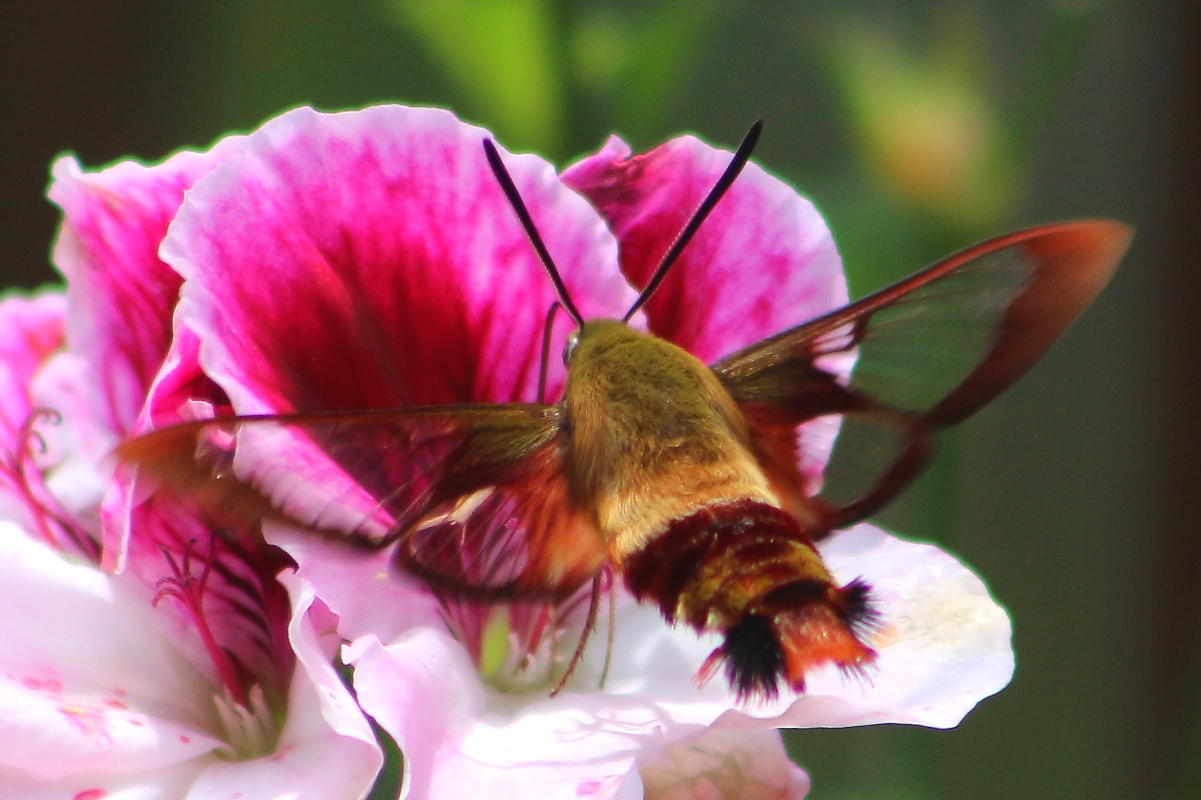
| Hummingbird Clearwing Moth (Hemaris thysbe) |
It's a beautiful insect, rather large, and the transparent wings add a special beauty around the flowers.

It's an interesting mashup of a hummingbird, a bee, a butterfly, and a moth - it actually is in the moth family - but it has a proboscis that it uses like a butterfly to drink nectar from deep in a flower.

Linda's hard work rewards us with more grace and wonder than just beautiful flowers!
The story of nests this summer continues. This week I found this nicely woven bird nest right in the middle of the road.

The unanswered questions are, who made it and why was it there? Presumably it fell from a tree overhanging the road, but was it after the eggs had hatched or was it dislodged by a predator? I looked into various bird nest construction methods and materials to try to identify it which led me to think it's a warbler nest, but I found insufficient defining characteristics to say just which warbler. The well-woven grass, pine needles, and bits of wasp nest point towards perhaps a Pine Warbler or a Chestnut-sided Warbler.

I'm happy to hear your thoughts on this.
And next, another loon nest: The south pair of Wicwas loons is now on a nest! It's on the same island as last year in Harris Cove.
We'll hope they fare better than the north pair, but there's a promising sign for the north pair too: they were seen mating on a shore in Marion Cove this week. Warning: the following video is R rated.
And next, another loon nest: The south pair of Wicwas loons is now on a nest! It's on the same island as last year in Harris Cove.

We'll hope they fare better than the north pair, but there's a promising sign for the north pair too: they were seen mating on a shore in Marion Cove this week. Warning: the following video is R rated.
Loons mating on June 15. Video by Michael Marion.
A loon typically lays an egg within a week of copulating, so by next week we should have another nest.
Last week we were noticing all the brown needles on the White Pines. This week the trees look much better, back to green. That's because all the old needles are now elsewhere.
While some leaves are ending their life cycle, ready to be recycled by microorganisms into soil, others are just getting started. The light green on these Hemlock needles show they're beginning to synthesize chlorophyll through photosynthesis.
Our newest beaver pond over in Hamlin is growing rapidly too but that story will have to wait. I'll close this week with a pretty blue flower, and for Sunday, a church with a beautiful view and a name to go with it.

The church has a beautiful view of the Belknap Mountains, but I do have to admit that I photoshopped the picture to remove the utility lines that somewhat spoil the view.
Last week we were noticing all the brown needles on the White Pines. This week the trees look much better, back to green. That's because all the old needles are now elsewhere.
 |
| New pine needle carpeting makes for quiet walking in the forest. |
While some leaves are ending their life cycle, ready to be recycled by microorganisms into soil, others are just getting started. The light green on these Hemlock needles show they're beginning to synthesize chlorophyll through photosynthesis.

Our newest beaver pond over in Hamlin is growing rapidly too but that story will have to wait. I'll close this week with a pretty blue flower, and for Sunday, a church with a beautiful view and a name to go with it.
 |
| Pointed Blue-eyed Grass |
 |
| Mountain View Church on Upper Bay Road in Sanbornton. |

The church has a beautiful view of the Belknap Mountains, but I do have to admit that I photoshopped the picture to remove the utility lines that somewhat spoil the view.
Happy Father's Day to all the fathers out there!


