Showing posts with label Wood Frog. Show all posts

Sunday, April 14, 2024

April 14, 2024: Eclipse

Well, the eclipse of 2024 stole the show for this week, and perhaps this decade, but I'll first record the dates of some spring milestones for the journal.  I saw my first phoebe on Tuesday, April 9th, and heard the first wood frogs singing in the vernal pools that same warm evening.  On my first kayak trip of the year I found Canada geese nesting on an island, not in the marsh, because the lake level is so high their usual location in the marsh is flooded.  There should be more signs of spring to report next week.

So, the eclipse.  Certainly the northeast lucked out on the weather with perfect atmospheric conditions in northern New New Hampshire to observe the celestial event of the century.  Linda and I decided to take the trip up to Colebrook to get a full three minutes of totality during the eclipse, and it was worth every second of the drive up and back - all eight hours of it coming home.

I'll start by saying I found the people around us to be the most polite and jubilant large crowd I've ever experienced.  Even standing in long lines to get coffee everyone was happy and sharing stories.  I met one person who lives in Texas and was planning to watch the eclipse in San Antonio.  But when she saw the Texas forecast on Sunday, she bought a plane ticket to Boston and drove up to Colebrook that morning!   Even the drivers in the massive traffic jam heading home were courteous - everyone was still stunned by what they just witnessed, and the long drive gave us lots of time to ponder what we had experienced.

Having arrived early we found a comfortable spot in a large field with a good view and watched other  eclipse observers file in - the anticipation was building.  

The event started at 2:17 pm when the moon took its first bite out of the sun.  (The following pictures were taken with a solar filter on the camera.)


Over the next hour the sun was slowly gobbled up, the light dimming so slowly that my eyes adjusted and I wasn't really aware it was getting darker until perhaps 75% of the sun was blocked.  

The colors changed as the sun was covered, though it didn't have the same hue as a normal sunset.  Even with over 95% of the sun blocked the scene was still quite bright.
This was only about 30 seconds away from totality.

The temperature dropped and the wind picked up; I put on my coat.  As it got noticeably darker, the crowd got quieter and quieter.  The wind stopped.  Someone noted that birds were flying off to find a safe spot for the night.  Stars appeared.  There was a sunset on the horizon for 360 degrees as darkness loomed.

By the time there was just the smallest sliver of sun showing, the crowd fell silent.  

Then, a truly magical moment occurred - it was like a light switch.  According to Dr. Angela Speck, chair of the Physics and Astronomy department of the University of Texas at San Antonio, even at 99.9% partial eclipse, there is still at least 100 times more light coming from the sun than during totality, and when that last sliver of sun went instantly dark, the most fabulous ring of light appeared around the moon. 

The silence was burst with a huge cheer, gasps, hoots and hollers.  Safely taking off the dark glasses and filters from the camera and binoculars, the sight was truly astonishing.  Through the binoculars you could clearly see the red solar prominences that are produced by plasma, super-heated gases in the sun's surface which emit red light (think of the light from a helium-neon laser). 

Solar prominences, hot plasmas containing highly charged helium and hydrogen gas.

These don't show up well in my pictures but you probably saw excellent images from telescopes photographing the event.  During totality I took a couple of photographs with different exposure times to capture the corona which is the hot outer atmosphere around the sun, visible only during a total eclipse.  The longer exposures capture the dimmer parts of the corona farther from the sun while over-exposing the bright edge around the moon.  

This exposure was 1/15 of a second; the prior image was 1/250th of a second.
Just as quickly as totality arrived, it left.  In an instant we were blinded by a flash of just 0.01% of the sun; we had to look away, and it was over.  It was three minutes of magic, followed by another hour of the sun slowly returning to normal.  

The factors that came together to allow Linda and I and thousands of others to experience this celestial miracle are hard to fathom.  In addition to the weather, the size of the sun and moon, and their distance from earth, all conspired in this fleeting moment in of wonder.  There was more than one discussion about whether the nearly identical size of the the sun and moon as viewed from our planet is a highly improbable coincidence or whether there is some divine or scientific aspect to it.  Do these particular parameters have a correlation with the establishment of life on earth?  The natural world provides endless questions to ponder.  

It was only three minutes, but it's three minutes of my life that will be remembered; that image is burned into my mind forever.  


Sunday, April 11, 2021

April 11, 2021: The Loons Arrive

It's one of those times in the year when so much is happening it's hard to keep up with it all.  Ice-out on Lake Wicwas was declared on Wednesday, April 8th, a bit earlier than the average date for the past 20 years which is April 12th.  Almost all the other lakes are also open including Winnipesauke, Winnisquam, and Newfound.  And even before ice-out one of our star loon spotters saw the first loons on April 6th (thank you Annie Crane!).  I heard loons but didn't see any until my first kayak on the 8th when I found four different loons around the lake, all single birds, though the April 6th observation was a pair.  Also on the 8th I saw a loon preening and thought I saw a bit of red under the water, and knowing our long-time female has a leg band with red on it, I watched carefully.  Eventually, as the bird got to cleaning and oiling it's belly feathers it rolled enough to lift a leg out of the water; first one leg, then the other, and sure enough, there were bands!

The right leg has green over silver bands.

The left leg has yellow with black stripe over red bands.


But it's not our bird!  I sent those pictures off to the Loon Preservation Committee, knowing they'd have records that would identify where this bird was banded, and within a couple of hours I had the answer and a brief history.  Caroline Hughes, LPC biologist reported that this loon was banded in 2018 on Lake Pemigewasset.  The next summer she was "kicked off" Pemigewasset and was replaced by an un-banded loon.  That summer she was observed by Henry Stevens (whom we know well from his internship with the LPC that summer) on Opechee Bay.  There were no sightings in 2020.  Caroline asked us to be on watch to see if she stays on Wicwas this summer or moves on, so when you see a loon preening, watch (with binoculars from a far distance of course) to see if you can detect any bands, and let us know.

The beavers have been very active this spring, even before ice-out, making not only their morning and evening trips but also afternoon trips.  It's not often I get to see one out in the sunshine.

A rare sunlight-lit beaver on patrol.

One morning, a beaver aggravated by my presence circled back and forth along the edge of the ice as I stood and watched; he gave me several good tail slaps.

The beaver is swimming from right to left.

This went on long enough that I decided to try to get an action shot, and was able to catch two slaps on video - you can see them here (the second slap is clearer than the first).  It you watch carefully it is actually a two-step process where the tail slaps down and then flips up again as it dives, throwing more water into the air.  (Youtube lets you play video in slow motion:  under settings, set the play back speed at 0.25 for the relevant parts.)  Beaver alerts are loud enough that I'm still startled by the crash if I don't see it coming.


For the record, here are some other spring sightings along with the dates first observed:

Song sparrow, Eastern Phoebe, March 28  (Russ Brummer)
Wood frogs, April 4
Spring peepers, Great blue heron, April 6
Common loon, April 6  (Annie Crane)
Ring-necked Ducks, April 8
Hermit thrush, Tree Swallow, April 10

Every year ice out is a little different.  On Lake Wicwas, Marion Cove is usually one of the last places to be ice free, but this spring it was essentially clear a day before the lake's west shore and the boat ramp were open.  Just six days before ice-out the lake had a full cover of snow and ice.

April 2nd:  A solid covering of ice.

By noon on April 8th only the coves along Wicwood Shores Rd and the boat ramp were still inaccessible.

Ice in the west cove on Wicwas.

The boat ramp on Chemung Rd at noon.

But by 6:00pm they were open and ice-out was called - let summer begin!

Blue Water is back!

I hope you enjoyed the early summer preview these past few days wherever you were!

Sunday, September 23, 2018

September 23, 2018: Changing Seasons

We are just past the equal of day and night:  astronomical fall began last night at 9:54 pm when the autumnal equinox occured.  As the days get shorter and cooler both plants and animals sense it - everything is starting to prepare for the coming change.  Here is just a sampling of the many indicators around Lake Wicwas that the local community is adapting to what must come.

The trees on the shoreline are just starting to show some color.


Turtles and frogs are out collecting every last bit of warmth they can get before they go into hibernation.
Painted Turtle absorbing the late day sun
This wood frog was using the warmth these wood chips absorbed from the sun

Bees are scurrying around, gathering up as much pollen as they can find to get them through the winter. 
A Bumble bee transferring pollen from the blossoms on Linda's Coleus to its hind legs

A northern water snake was swimming across the lake - perhaps it was hoping to catch a passing squirrel?
A Northern Water Snake cruises the lake

I bet the snake is a faster, more agile swimmer than a squirrel. 


The geese are starting to flock up for their travels south; I counted 39 on the lake one afternoon.  This big one, probably a male, was on lookout duty.
A Sentry off Mark Island

After having little visible presence during the summer the beavers become much more active this time of year.  Here they have stuffed the dam at the outlet of Lake Wicwas with all kinds of debris as they attempt to raise the water level to increase the size of their domain.
Many thanks to the town for cleaning this out yet again

The comeback of beavers to New Hampshire after their virtual extirpation has created the water bodies that are a big factor in the recovery of the Great Blue Heron population as well.  I caught one such heron gliding over the lake on its way to a rocky perch for some fishing.


I didn't see much of Mr. Wood Duck this summer, but he did make an appearance on one of my kayak trips around the lake this week.  He and the misses will stay together on the lake for some time yet and migrating wood ducks on their way south will stop by to visit them.

Many birds - herons, loons, ducks - will be around quite a bit longer, some right up until the lake finally freezes over.

Many human residents of the lakes are also getting ready to find a warmer place to spend the winter.  Here are some bittersweet late-summer scenes, as we get ready for the changes as well.

The final sunset cruise of the Hurricane.

The Blue Heron Lodge basking in the low, late day sun.

A warm, calm day for a kayak - hopefully there will be few more of these!

One last canoe before closing up the cabin.

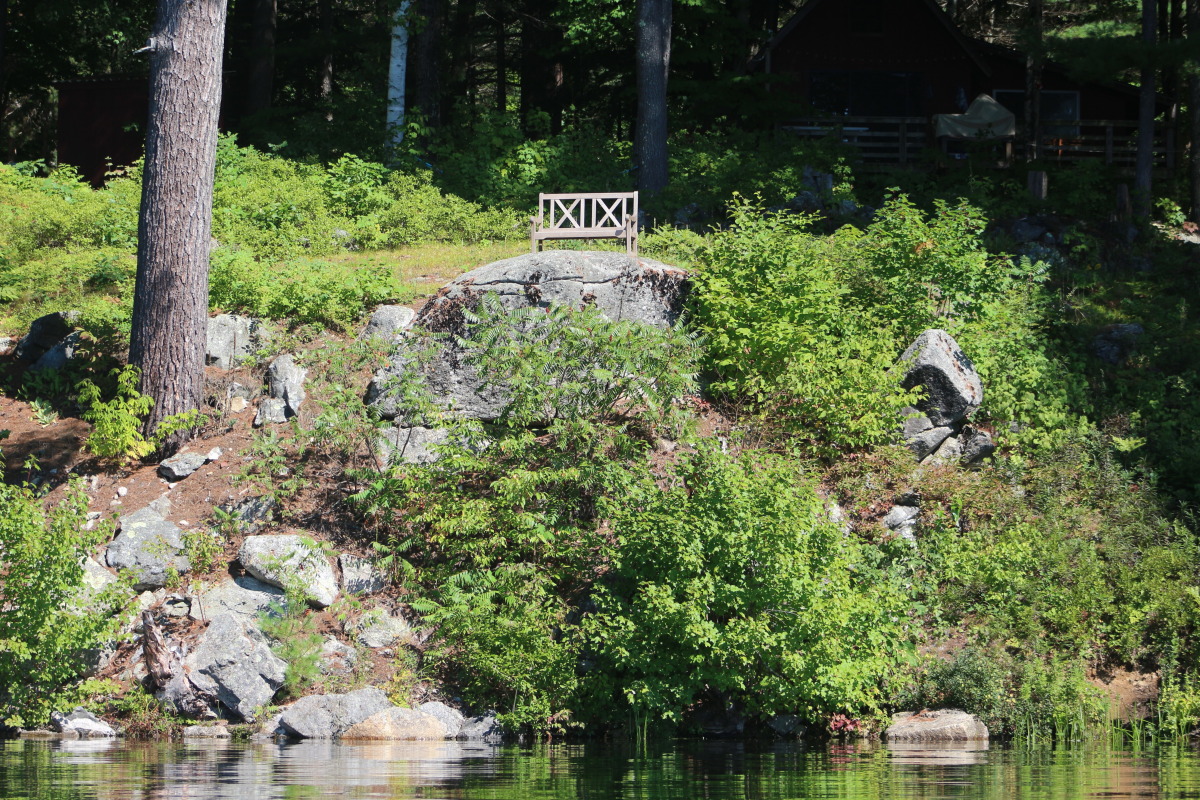
And finally, a lonely bench overlooking the lake waits for someone to come sit and enjoy the sights of the season.  I hope you'll be able to take in some of the most beautiful sights of the year as we make the transition into autumn.

Sunday, April 22, 2018

April 22, 2018 - The Mystery Bone

It's always fun to run into a friend who is also out enjoying the sights and sounds of nature.  Last week I bumped into Russ Brummer, a teacher at New Hampton School, out with a couple of his students on field trip, and we talked a bit about interesting things we had seen over the winter.  After we had gone our separate ways I thought, I should have asked him about a mystery Linda and I had been working on (after all, Russ is the Science Department Chair at the New Hampton School and has degrees in Biology and Environmental Studies!).  Linda had found this fox scat (or possibly coyote scat) that featured a prominent bone protruding from it.
Fox scat with an unusual bright-white object sticking out

At least it looked like a bone to me.  But after separating it to look closer, it didn't have the structure of any bone I could recall.
Hollow and folded construction made me think bird

So when I got home I sent a few pictures to Russ to see what he could offer.  He immediately proposed that it was a tooth.  Since I happen to have a couple of animal jaws that I have collected from my walks over the years I went to look them over.
Deer and beaver bones
Deer teeth are sharp and pointy
It doesn't look like a deer tooth.
Beaver teeth however have that folded characteristic
So sure enough, it is a tooth, and most definitely a molar from a beaver!  It makes one wonder if the fox caught a beaver, or more likely was just gnawing on the leftovers of one that had died or was killed by something else.  Either way, thanks Russ for solving the mystery!

-----------

After a few steps forward, spring took a step backward this week with another cold stretch and a touch of snow that brought us back to winter scenes.
Wicwas from Crockett's Ledge

But the past few days have put us back on the right track, with ice in Meredith Bay receding down the lake, and the ice on Wicwas showing signs of softening as it turns from white to dark gray.
Ice in Meredith Bay is almost to Church Landing
There is a large section of Wicwas that had turned black by noon today


I also saw my first Great Blue Heron of the season, fishing in the ice off the Harris Conservation Area, and just today, the first wood frogs were singing in a vernal pool, calling to their mates that spring is here.  Other signs of spring are joining in too:
Bright Blue Jays
An oak is born

It won't be much longer now, and with the weather finally changing I look forward to seeing more friends out on the trails - and soon enough on the lakes - with more mysteries to share and solve.


Late breaking news:  The first loons were spotted on Lake Wicwas today, in the open channel of water along the north side of the lake!  (Thanks AC & TC!)