Showing posts with label Flying Squirrel. Show all posts

Sunday, January 13, 2019

January 13, 2019: Flying Mammals in Winter

We had some of the coldest weather of the season this week which was good news for winter sports fans and for cool winter sights, and it also brought out one of the more reclusive critters in the forest.
The reclusive and nocturnal flying squirrel

Small animals like this flying squirrel can't hunker down in frigid weather as they have to eat every day to consume enough energy to burn just to keep warm.  Small birds for example can lose 10% of their body weight on a single cold night, a good reason why the chick-a-dees appear at the feeder at dawn's first light.

I have only seen flying squirrels in winter, though that's because they are nocturnal, and we only feed the birds in the winter.  Other people around the lake have special feeding platforms for flying squirrels and they are entertained by their acrobatics on warm summer nights.  They are amazing animals, having adapted a sheet of skin that extends between their front and hind legs, providing a steerable hang glider-type feature.  I have watched them sail off the feeder and make a perfect landing on their selected tree.
You can see the section of skin that stretches out when it spreads its legs to fly

If you want to attract them, try building a platform like this one,
Sharing the table

but attach it to a tree 15 to 30 feet above the ground.  They'll climb up, but fly off when it's time to depart.

The cold weather blew in from Canada after a storm which brouht heavy, wet snow that took down enough trees and limbs to leave 40% of Meredith without electricity;  Meredith and Moultonborough seemed to be hit the hardest, sitting right at the line where it was all snow, but still warm enough to wet and sticky.  It might have played havoc with the power company, but it was beautiful to look at and left a solid base for skiing and snow shoeing.
A good case of cement snow

I took a ski across the lake and up to the White Mountain Ledge as the storm was winding down.
Looking north from the White Mountain Ledge in the Hamlin Conservation Area

There were lots of trees bent down to block the trail, and countless limbs and branches broken off, laying on the ground.

The Meredith Trail Crew will have plenty to keep them busy this spring!

The coldest night was Saturday at just above zero, so of course that was the day we went skiing - cold but fabulous views.
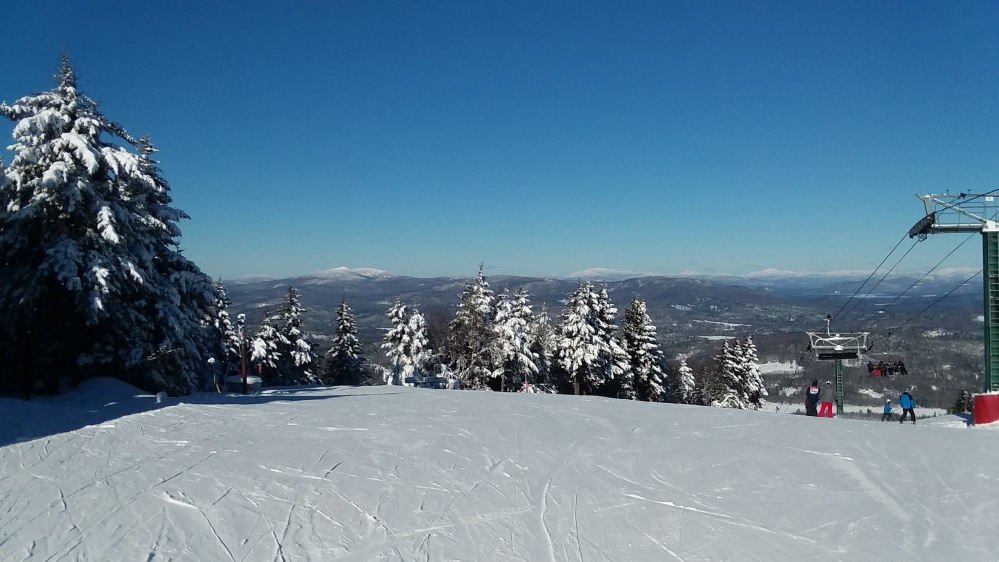
Summit of Ragged Mountain

It was plenty chilly, but I'll bet this winter has worse yet to come.


Sunday, January 24, 2016

January 24, 2016

Winter is finally settling in on the Lake, though it is not a particularly snowy one so far - unlike our neighbors to the south who really don't want those two feet of snow that fell over the past couple of days.  We received a few inches of snow early in the week which was followed by five days of strong northwest winds which blew the snow around for days.

The snow was deep in those places where the trees caught the wind and dropped the snow down into the forest. 

Streams still running fast from the recent rain cleared out any snow that landed with their grasp.

There was enough snow left behind for some skiing on Lake Wicwas but the conditions varied from windblown crust to soft powder to bare ice. 
Variable conditions cover the surface of a wintry Wicwas
The texture and patterns that the team of wind and snow create are different with every storm, and vary around the lake depending on the contours of the shore.
Diverse snow patterns etched on the lake by the north wind

The first bob-house of the season also appeared on the lake this week.
Ice fishing season has arrived on Wicwas

Most winters we have a visit from one of our more interesting local residents, and it is always a treat.
Flying Squirrel


The flying squirrels may be around all year, but I only see them in the winter, and always at night.  They arrive an hour or two after sunset, clinging to bird feeders with their tiny feet, usually on the coldest nights.

These little guys are very bold - we let them dine for a while, but after we tire of watching them spew copious amounts of seed on the ground, we shoo them away.  And unlike the red or gray squirrels, you have to walk right up to them before they will abandon the feeder - I'm sure it's because they know they can jump off at the last second and glide away to safety.  Their aim is uncanny, always landing right on the trunk of a large tree which they scurry up, disappearing into the darkness. 

This one showed off his best acrobatic tricks, climbing up to the highest point to get the optimum trajectory before finally disembarking from the feed trough.  
Nature does provide plenty of winter entertainment for those of us easily amused.
The Lake Wicwas Flying Circus

Sunday, January 20, 2013

January 20, 2012

Lake Wicwas has been on a weather roller coaster lately.  How does a 50 degree temperature change sound?  It was 55 on Monday, (though still two degrees from the record high) and then 5 degrees on Friday.  Most of our snow melted, though we received a few more inches on Wednesday;  not enough to ski in the woods, or even to need snow shoes, but it sure made for a splendid sunrise.
Photo Credit:  L. Powell
I did take a nice ski on the lake, at least on the edges.  After the warm weather and open water just a few weeks ago, I'm still not willing to bet my life that the middle of the lake is safe.

Along my trip, I came across a marker obviously staked near an active beaver lodge.  It was clearly put there intentionally, and well marked.  When I saw a second near another beaver lodge, I figured something was going on.  I checked two other lodges, and they also had similar markers.  What's up?


Today, I got my answer. On a walk around the lake we came across a couple of people at one of the markers.  They are trappers, and I learned a lot about beavers and trapping.

Trapping season runs from November through April;  starting in November, beavers grow a layer of soft fur, which makes this the best season for pelts.  There isn't much of a market for beaver pelt;  he sends the pelts to Idaho for tanning, and is collecting enough to make a bed cover.

A small piece of poplar wood is used for bait, which makes the trap pretty much a one-species snare - no other animal will be attracted to an old chunk of wood!  Trappers must check their snares at least every three days, so it's a pretty intensive undertaking. 

Trapping to meet the insatiable European demand for pelts completely eliminated beavers from all of New England except the farthest reaches of Maine by the middle of the 1800s.  After their reintroduction in Vermont in the early 1900s, their population has boomed - they have few predators left and little market value.  It is not uncommon for a colony to completely harvest their available food supply, and have to move on or starve.  Land owners in the lakes region will hire trappers to reduce the size of a colony if it is devastating their property.

Lake Wicwas and its surrounds are probably near the limit of a healthy population, based on the observations I've made.  I've identified eleven lodges within the boundaries of Lake Wicwas alone, not including the Chemung Forest or the Hamlin/Eames/Smyth area.  It might sound cruel, but trappers are doing what nature no longer takes care of on its own.

This particular trapper will help people with problem animals, including skunk and raccoon.  Let me know if you need a contact.


On Saturday we took a hike -  no snow shoes needed - up to Arbutus Hill Pond.  On the way we saw deer, moose, rabbit, and fox tracks.


Rabbit Tracks

There are also splendid ice formations on the streams.

We were startled at one point by a grouse that flew out from under cover of a hemlock tree, followed shortly be two or three more.  We followed their tracks a bit;  they are rather narrow, often in a straight path without distinct foot prints except where the snow was barely an inch deep beneath the tree they were hiding under.  Without seeing the birds we never would have identified the tracks.


The ice fishermen were out in force this weekend, at least before the squall came through today.
Ice Fishing on Lake Wicwas
There was once again dynamic weather, with sun on the lake but threatening weather coming over the hills from the west.
Squalls coming from the West
Oh - and then this evening, we had another visit from the flying squirrel! 

They are very bold rodents;  it really takes a lot to get them to abandon an unrestricted food source!  If you've never seen a flying squirrel actually fly, see if you can run this video - it's my first attempt at uploading a video.

A late update:  I captured a beautiful gray fox coming and going on his nightly rounds early this morning.  Keep the trappers away from him - we need the foxes - they keep the rodent population in check!

2:18 am
4:23am

Sunday, February 12, 2012

February 12, 2012

Meredith hosted the fishing derby this weekend, and there was plenty of activity out on Lake Wicwas for the big event.  Fisher-people were scattered all over the lake, including a well-equipped village on the north side of Bryant Island.  They had quite a group, with huts, vehicles, and high tech equipment, and they were having good luck, catching perch, pickerel and black crappie.


They even had air support!

The pilot flew in Barnstead to bring reinforcements.  He took off while I was there, soared up high, then veered back and gave us a low altitude flyover. 

I kind of like the low-tech style of ice fishing, bringing out the supplies via sled.  This bob house was my favorite, complete with American flag and a wood stove.

The ice was good enough for skating again, which made for quick travel around the lake.  How crazy is that, to be able to skate on the entire lake in the middle of February?  Here's a nice look at the newest house on the lake, which has been in progress for well over a year now. 
Back on the nature-side, we took a walk through the blue trails in the Hamlin area and explored some of the beaver ponds.  The paths are pretty icy from all the melt and freeze cycles. 
Beaver Pond near the Original Blue Loop Train

On one of the beaver ponds, the rising water from the beavers enlarging their dam is evident in recently killed hemlock trees along the shore line of the pond.  Most of the shoreline looks like this.
Hemlocks Killed by Rising Water Levels

As many know, one of the bridges has been washed out, but the stream crossing is easy with the low water.  It will be a different story come spring.
Bridge out on Blue Trail

From a different bridge, water swirling around the rocks had created an artistic ice pattern.

Back closer to home, the animals have taken away the half of the deer backbone with the skull, leaving only the rear half.
Ribs and Pelvis

This is all that's left of the original site - the crows eventually even went after the intestines, and now they hack violently at the few remaining bones, trying to get at the marrow.


After dark we had another visit from a flying squirrel.  This time I couldn't resist going out and scaring it off the railing to see if they really can fly, and I wasn't disappointed.  In fact, if I didn't see it with my own eyes, I wouldn't have believed it.  When it jumped off, it dropped straight down for a few feet to pick up air speed.  Then it spread its "wings" and soared in a perfect parabolic arc right across the yard toward the lake.  It flew straight towards a tree, and about ten feet away it pulled up, gaining maybe five feet of altitude to reduce its speed, and timed the physics perfectly so that it land gently right on the trunk of a tree.  It soon returned and we got to see an encore performance.  How did a mammal learn that skill and gain that capability?
Flying Squirrel

Preparing for Take-off

Wednesday, December 28, 2011

December 28, 2011

This evening we experienced yet another new creature at Lake Wicwas - something we've never seen before:  a flying squirrel. 

They are reportedly quite common in this area, but being nocturnal, they are not often seen.  Flying squirrels do frequent bird feeders, but since we don't put our feeders out during bear season, and we don't usually bird-watch in the middle of the night, we've never seen one.  This evening though, Linda turned on the light to see if the approaching cold front was bringing any snow, and there on the feeder was this cute little guy.

I don't know if it's a "northern" or a "southern" flying squirrel, but I'll guess a northern because of its rich brown coloring, where the southern has a lighter fur in the winter.  The northern is larger, and this one seems rather small, but it was scrunched up due to the cold, so it's difficult to judge its true size.

It hung onto the feeder for a long time - at least 30 minutes - trying to get to the seed, which it couldn't reach with its short legs.  Linda spreads lots of seeds under the feeders for the ground birds, and the squirrels enjoy that as well, and they know that where there are seeds on the ground, there's a source up above!

You can see the dark line that separates its dark uppper-body from the the light fur on the underside of the layer of skin that stretches between its legs and its body that it uses to glide from tree to tree or from tree to ground. 

This guy was not at all concerned about us or the light coming on the middle of the night - it made no attempt to run off.  In fact, it let me go out and take a couple of pictures with a flash from only a few feet away!  I thought when I went out it would leap off the feeder, but instead it just hung on with its little feet, and went on trying to crack the cache.

One more of nature's fantastic creatures observed on the shores of Lake Wicwas!