Showing posts with label Mt. Chocorua. Show all posts

Sunday, September 19, 2021

September 19, 2021: The Sun Also Rises

Summer time brings the most spectacular sunsets, often presented thanks to copious amounts of water vapor in the summer air, and sometimes with a supporting cast of smoke from fires in the west that drifts in our direction in the upper atmosphere.  But early fall is my favorite time for sunrises, and not just because the sun comes up at a more reasonable hour:  sunrise was at 6:28 am yesterday, shortly before I saw the first rays of the day scrape the top of the hill that contains Crockett’s Ledge.  

Yesterday's first light filters through the morning mist.

In another month the sun will rise after 7:00 am as we lose almost 20 minutes of daylight each week as we approach the autumnal equinox.  The next few weeks - before sunrise is set back again by the end of daylight savings time - is my favorite time to climb up Crockett’s in the dark to watch the sun rise over the hills to the east. 

Sunrise from Crockett's Ledge.

If you decide to experience it for yourself, just be on the watch for bears, as I once had an encounter with a bear and two cubs heading up there for the sunrise.

One of my favorite aspects of learning about all the different forms of life in the Lakes Region is knowing what something is when you come across it, sometimes where you least expect it.  One day, opening our mailbox, I saw this stuck to the top of the inside.

An egg sac that didn't arrive via the USPS.

Having just learned about pirate spiders this summer (see Plundering Spiders) I immediately recognized it as a pirate spider egg sac.  Knowing what it is, and that’s it’s not going to hurt me (or the mail person) I’m comfortable letting it be and watching to see if I’ll find any eight-legged scallywags scurrying through the rigging on the mailbox.

On the subject of spiders, this is a good time of year to spot all the bowl-and-doily spiders living in our fields and meadows.  

A bowl and doily spider web saturated with morning dew.

These clever spiders are present throughout the summer but their double, bowl-shaped webs are most noticeable on misty mornings when the heavy dew condenses of the threads of their web.  Their secret to survival is the two-layed web.  They live on the lower web (the doily), protected from predators by the upper web (the bowl).  They lie in wait for an insect to fall, fly, or crawl into the bowl, at which point they sneak up on it from below to bite and inject venom into the unexpecting prey.  The female builds the nest, and the male may live in her house, participating in the capture and the consumption of the food her domicile provides. 

September so far has blessed us with wonderful late-summer weather - nothing even close to a frost yet - with just a few hints of color starting to show in the trees around the Lakes.
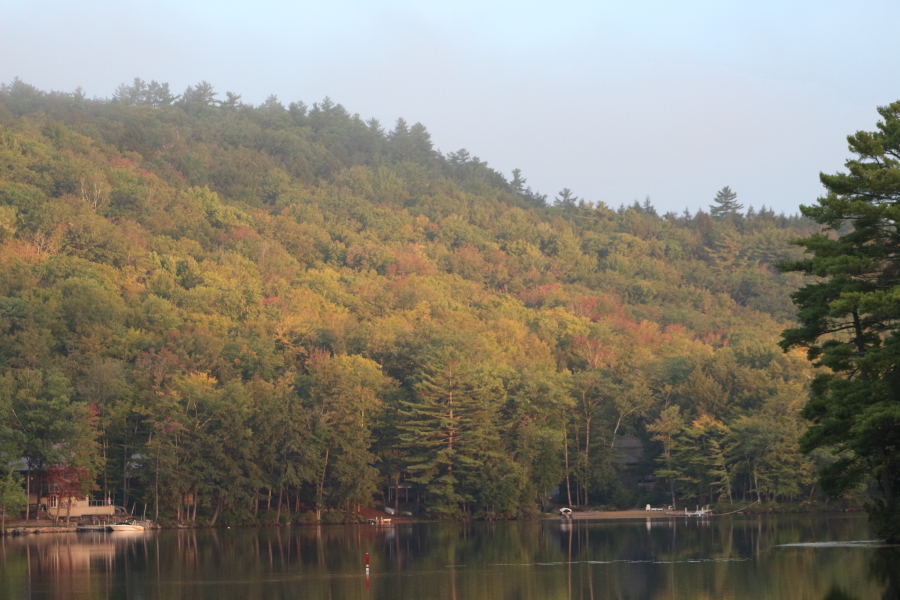
Tree tops are starting to turn on the hills west of Lake Wicwas.

I was farther north up on Mount Chocorua this week and even in the White Mountains there’s very little foliage changing.

The Three Sisters with Mt. Chocorua on the left.

A flash of red on Carter Ridge coming down from Middle Sister.  (Mt. Washington is in the distance.)


It's time for a loon update.  Coco and Jimmy are still here, fishing on their own, though one of them, presumably Jimmy, is still often found close to mom and he continues to make a somewhat whiny  sound as he begs mom to catch him a fish - I can hear it on a quiet day carrying far across the cove.
Jimmy nags mom for a meal.

They are a couple of mighty fine looking birds, and we should still have many weeks to enjoy them.


They'll be here to watch plenty more sunrises this fall.


Sunday, May 27, 2018

May 27, 2018 - Moose in the Lakes Region

Defining the northern boundary of the Lakes Region is a set of mountains known as the Sandwich Range, the best known of these being 3490' tall Mt. Chocorua, with its bald peak sticking out prominently even among taller mountains.  Mt. Whiteface and Mt. Passaconaway are also in this range, and these two are the most southerly mountains of New Hampshire's famous 4000-footers (these two are visible to the right-of-center in the photo at the top of the blog).
Mt. Passaconaway from Mt. Whiteface;  Mt. Chocorua is in the distance

Hiking these two mountains this week I was thrilled to come upon a large quantity of moose droppings on the trail leading up to Mt. Passaconaway.  In fact, on one half-mile stretch I counted 64 piles of scat right on the trail, some being quite large (and fresh).
A lot of of moose poop

It was nice to see signs of a good moose population close by the Lakes Region, even if not quite within the formal boundary.  I used to see moose regularly in Meredith around Lake Wicwas - sometimes up near Arbutus Hill Pond, sometimes swimming across the lake, and sometimes right on Chemung Road.
Chemung Rd, 2011
Wading through the marshes
But the last moose I've seen around Wicwas was in 2013, and even their signs have been few and far between.  In 2016 I found scat on the trail in the Eames Conservation Easement, and also on Fogg Hill in Center Harbor, and in 2015 there were fresh tracks along Marion Lane in Meredith.
That's a big animal

The moose activity I found this week was at an elevation between 3200 and 3300 feet;  it's likely they are now favoring the cooler environment to the north and at higher altitudes as the climate becomes warmer.  I recently read an article by Kristine Rines in the May/June issue of the New Hampshire Wildlife Journal about the decline of moose in New Hampshire.  Over the past 17 years, the estimated population of moose in the state has declined from over 7,100 to 3,200, and the biggest cause is shorter winters which allows more ticks to attack and weaken moose.  Research done by collaring and tracking moose shows the impact of shorter, warmer winters:  collared moose calves were found to have mortality rates as high as 80% when winter arrived late, versus 30% when there is an early snow and dry fall.  Considering that our winters are already 3 weeks shorter than they were just 30 years ago, and getting worse, it doesn't look good for our local moose population.

When I first heard of the tick problem, I couldn't understand how a tiny tick could kill a giant moose.  (Note:  these are "winter ticks", Dermacentor albipictus, not the wood ticks or deer ticks that bother humans and domestic pets.)  But biologists studying moose harvested by hunters have counted ticks in the tens of thousands on a single animal.
Winter ticks on a moose's neck

Now I get it.  They not only kill calves and adults, but they weaken females enough that it lowers their reproductive rate.  One helpful factor is that the state tracks moose populations and reduces hunting permits based on the population in each wildlife management area (WMA), and will stop hunting altogether when a threshold population is hit.  Already, hunting has been stopped in two of New Hampshire's wildlife areas - how long will it be before it's stopped state-wide?

Around Meredith, I still expect to see moose again, but it may be a rare event.  We can only hope that other species don't have the same fate, although there is concern that we may lose the loons to a warming climate as well.  But not this year!  Our loons are back on the lakes and hopefully focused on finding a good nesting site.

The nesting season is looking a lot better than last year's rainy spring.  The lakes are already at their summer levels and having been rather dry (the past two days meager rainfall notwithstanding), perhaps the black flies won't torment the loons as much.  We're keeping our eyes open for signs of nesting activity already.

And if you're out and about (with your tick repellent in hand!) keep your eye open for more flowers.  The lilacs and colombine are blooming now, and I saw my first Lady's Slipper on Wednesday.
Pink Lady's Slipper on the Harris Conservation Area

Columbine along the trail on Red Hill in Moultonborough
And if you're on the water over the next few weeks, be careful to give the loons a wide berth;  we want to give them every chance to avoid the fate of the moose as long as possible.


Sunday, January 23, 2011

January 23, 2011

More snow and more cold weather is keeping Lake Wicwas in the deep freeze.  Several inches of snow fell on Tuesday, but unfortunately we also had some freezing rain mixed in which put a frozen crust on top of the new snow.  But it was followed up with a bit more snow, and then several more inches on Thursday night into Friday, and this last storm was all cold, dry powder, leaving a great surface for weekend snow sports, at least for humans.  This was the view northeast from the White Mountain Ledge on Saturday; Mount Chocorua is just visible on the far left.
Looking Northeast from the White Mountain Ledge
Deer Signs on Arbutus Hill
The wildlife isn't as thrilled, as indicated by the lack of tracks around the lake.  The deer in particular have a hard time moving around in deep snow, hindered even more with a sharp crust in the middle of the snow pack.  I took a ski in the Hamlin area to both the White Mountain Ledge and along the Arbutus Hill View trail, and saw only a few fox tracks up near the Red Trail along the ridge, and some deer tracks on Arbutus Hill.  The deer had been by just a few hours before, as the tracks and scat were on top of the previous day's snow.

There were also signs of browse, including scrapes on these birch trees, with scrapings well above my head indicating a fairly good size deer.  (Linda likes the colors of new snow under the tree cover on a bright, cold day!)
Deer Browse
Barbara R. Smyth Trail


The bright blue sky and brilliant sun made for another fabulous day; I captured this scene along the Barbara R. Smyth trail where deciduous tress and the recent  logging let in abundant sunshine.


Today I took a ski on the lake; it's been cold enough that the air vents on the beaver lodges haven't even thawed out.  Again, not many tracks, but the cold didn't stop this mouse from making his rounds up and over this lodge.
Mouse Tracks on a Beaver Lodge
After investigating a hole in the lodge it traveled all the way across the ice to far shore, carving a drunken path on its way.  But it made it to the trees before an owl saw it.

Blue Jay Landing Site


Here's an interesting pattern left by a Blue Jay landing in the light snow, with its individual feathers leaving their own imprint.


If you haven't seen the article in the Weirs Times about the Wicwas Lake Grange, you can find it here:  Weirs Times 20 January 2011 Edition.  It has some nice history about the Grange as well as the local area.  We are fortunate to still have this Grange which is named after the lake, as many have closed.  Both the Winnepesaukee Grange in Meredith Village and the Garnet Hill Grange in Center Harbor have closed, merging with the Wicwas Grange.