Showing posts with label Bowl and Doily Weaver Spider. Show all posts

Sunday, September 27, 2026

September 27, 2026: Misty September Morning

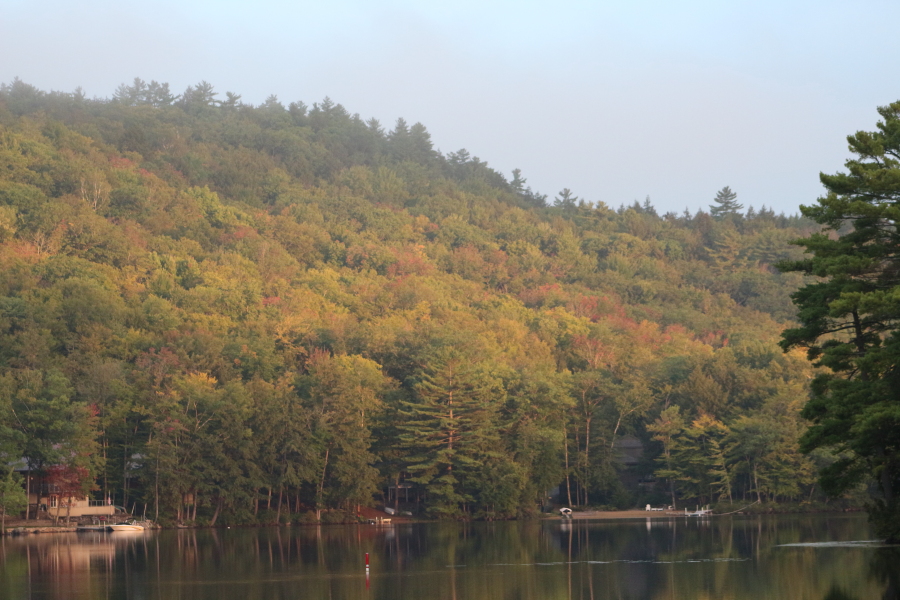
Now that we're past the autumnal equinox, shorter days mean sunrise occurs at a more agreeable hour to experience the wonders the dawn of a new day bestows upon us.

Mist rises from Wicwas shortly before 7:00am.
Water evaporating from the warm lake condenses into gently twisting sinuous veins of vapor, and soon, low rays from the rising sun penetrate the gloom, illuminating early foliage in low wetlands where cool air settles over night.
Chemung State Forest.

Dew collects heavily on spider webs, lending a season-appropriate, ghostly feel to the scene.
Hundreds of Bowl-and-doily Spider webs will go unnoticed an hour later when the dew evaporates.
Bowl and Doily Weaver spider webs collect the morning's dew.

An orb-weaver spun a classic haunted-house specimen of a web.


As the day warms and the light brightens, other autumnal gems emerge from the shadows.
Indian Cucumber
Canada Mayflower

Sometimes it's difficult to get myself out of the house before breakfast on a cool fall morning, but I'm always rewarded when I do.


Often these nascent misty mornings ripen into glorious September afternoons, which then draw me onto the water.  Dragonflies catch meals of late summer insects, turtles soak up the last warm rays of summer, and the aquatic foliage turns colors every bit as beautiful as the trees.


Amphibians and reptiles use these warm days to keep their body temperatures high enough to eke out a few more weeks before they search out a safe sanctuary for their long siesta through the coming winter.  Sometimes they seek out human assistance, as did this Milk Snake which tried to take up residence in a warm garage.
Milk Snake.  Photo by MT

I've never seen a milk snake - thanks for sharing!


It seems most loons have left the lake now, but both Pip and mom are still resident, and spending a lot of time fishing. 
Pip and mom provide a good comparison of juvenile and late-season mature plumage.

Pip is taking long dives, sometimes away from mom, but often in the same vicinity, and when mom comes up with a Pip-size meal she waits for Pip to surface to offer it up, which is always accepted.
Mom, waiting for Pip to surface to deliver a plump sunfish. 
Nature's equivalent of door dash.

At this point in the season, much of an adult loon's breeding plumage has faded.  Only a few of the distinctive rectangular white spots are still visible.
Mom is losing her summer finery.

Even when an adult's spots are gone, it won't be confused with a juvenile which can be recognized by the gray and white chevron pattern.
Pip is a fine looking young guy or gal at this point.


I've been noting a lot of interesting fungi this fall, too many to add to this post.  I'll hopefully have space for them next week.  I'll close this entry with a precursor to foliage season.
Lilly pads and Bur-reed in their fall colors.


The experts are forecasting excellent foliage this year so make your plans now - colors will be coming on strong north of the notches this week.


Sunday, June 2, 2024

June 2, 2024: Momma Snapper

This week I came across a good size snapping turtle ambling down a gravel road looking for the perfect spot to place her eggs.  
A large, well armored Snapping Turtle.

It's a safe bet that a snapper up on dry land is a female, as males have little reason to leave the safety of the lake.  Did you notice those long, sharp claws for digging a nest in hard packed ground? 

Out of water and exposed to any predator brave enough to tangle with that strong jaw.

I've written previously about snappers and their deceptive technique to increase the odds for their offspring to survive.  A single female Snapping Turtle will dig multiple nest holes, but will only place her eggs in one of them.  A predator won't know where the eggs are, and after a failed attempt or two at finding food, may give up.  On aptly named Turtle Island in Lake Wicwas I've seen dozens of holes and sand piles where snappers have created false nests to stymie predators.  

Another unusual trait of Snapping Turtles is that the sex of the hatchling isn't determined when the egg is fertilized, but rather the resulting gender is determined by the temperature of the ground in which it develops.  If the temperature of the nest is below 68 degrees Fahrenheit, all the eggs will be female.  If the temperature is above 73 degrees they will all be male.  Between these temperatures there will be some of each gender.  Personally, I'm hoping for lots of little boy turtles this summer!

She's not the only reptile out nest building.  This Painted Turtle was doing her thing in the same general area a few days earlier.

A Painted Turtle lays her eggs.

Both of these turtles managed to make their way about a hundred yards through thick growth to find their nesting spot.

On the much smaller end of the herpetofauna scale (the collective term for amphibians and reptiles) is this little Red Eft that happened to be walking down the same dirt road.  

That's the tip of my shoe.

These mid-life-stage Eastern Newts aren't rare, but it's always a treat to find one creeping along a hiking trail in the woods, most often after a summer rain.  

Talking about trails, the Chokeberry are blooming now.  I found these right beside the trail at the very summit of Red Hill.

Black Chokeberry on Red Hill in Moultonborough.

Chokeberry is well adapted to growing in wet areas and many are growing along the shores of local lakes and wetlands. 

And on the shores around Lake Wicwas.

In the fall they'll have large black berries that are consumed by birds as well as mammals large and small.


Did you find some Lady's Slippers to enjoy this week?  This Tiger Swallowtail butterfly did.

A Tiger Swallowtail looks for nectar in a Pink Lady's Slipper.

However, the butterfly left unsatisfied as Lady's Slippers don't produce nectar!  These are two of several Lady's Slippers growing right beside the trail leading up to Crockett's Ledge in the Hamlin Town Forest.  

Keep your eye out now for pretty white Bunchberry flowers down low to the ground.

Bunchberry will have red fruit in the fall.

These are woodland plants, found mostly in slightly open areas of damp forests.


Following up on the bird nests of last week, I forgot to mention one, a phoebe nest that's built on a beam under our deck.  The poor bird flies off the nest every time we go by the deck.  That's one bird that's getting its exercise.  And there's yet another nest under construction, one who's location is unknown to me. 

An American Robin gathers nest building material.

It's late for a Robin's first nest, and since Robins will often have two or even three broods each summer and don't usually reuse a nest, this bird is probably working on nest number two.

Have you noticed the dragonflies have emerged?  I've seen several of various shapes and colors including swarms of Chalk-fronted Corporals which are common at this point in the season.

Chalk-fronted Corporal.

But the most beautiful dragonfly I saw this week was this one with fabulous clear wings that reflect the light with the most delectable colors.


I haven't been able to identify it, but I were to name it I'd call it the Rainbow Dragon.

Nature's beauty reveals itself once again.


There were signs this week the second pair of loons are preparing their nest - maybe there will be news to report next week.


Sunday, September 19, 2021

September 19, 2021: The Sun Also Rises

Summer time brings the most spectacular sunsets, often presented thanks to copious amounts of water vapor in the summer air, and sometimes with a supporting cast of smoke from fires in the west that drifts in our direction in the upper atmosphere.  But early fall is my favorite time for sunrises, and not just because the sun comes up at a more reasonable hour:  sunrise was at 6:28 am yesterday, shortly before I saw the first rays of the day scrape the top of the hill that contains Crockett’s Ledge.  

Yesterday's first light filters through the morning mist.

In another month the sun will rise after 7:00 am as we lose almost 20 minutes of daylight each week as we approach the autumnal equinox.  The next few weeks - before sunrise is set back again by the end of daylight savings time - is my favorite time to climb up Crockett’s in the dark to watch the sun rise over the hills to the east. 

Sunrise from Crockett's Ledge.

If you decide to experience it for yourself, just be on the watch for bears, as I once had an encounter with a bear and two cubs heading up there for the sunrise.

One of my favorite aspects of learning about all the different forms of life in the Lakes Region is knowing what something is when you come across it, sometimes where you least expect it.  One day, opening our mailbox, I saw this stuck to the top of the inside.

An egg sac that didn't arrive via the USPS.

Having just learned about pirate spiders this summer (see Plundering Spiders) I immediately recognized it as a pirate spider egg sac.  Knowing what it is, and that’s it’s not going to hurt me (or the mail person) I’m comfortable letting it be and watching to see if I’ll find any eight-legged scallywags scurrying through the rigging on the mailbox.

On the subject of spiders, this is a good time of year to spot all the bowl-and-doily spiders living in our fields and meadows.  

A bowl and doily spider web saturated with morning dew.

These clever spiders are present throughout the summer but their double, bowl-shaped webs are most noticeable on misty mornings when the heavy dew condenses of the threads of their web.  Their secret to survival is the two-layed web.  They live on the lower web (the doily), protected from predators by the upper web (the bowl).  They lie in wait for an insect to fall, fly, or crawl into the bowl, at which point they sneak up on it from below to bite and inject venom into the unexpecting prey.  The female builds the nest, and the male may live in her house, participating in the capture and the consumption of the food her domicile provides. 

September so far has blessed us with wonderful late-summer weather - nothing even close to a frost yet - with just a few hints of color starting to show in the trees around the Lakes.

Tree tops are starting to turn on the hills west of Lake Wicwas.

I was farther north up on Mount Chocorua this week and even in the White Mountains there’s very little foliage changing.

The Three Sisters with Mt. Chocorua on the left.

A flash of red on Carter Ridge coming down from Middle Sister.  (Mt. Washington is in the distance.)


It's time for a loon update.  Coco and Jimmy are still here, fishing on their own, though one of them, presumably Jimmy, is still often found close to mom and he continues to make a somewhat whiny  sound as he begs mom to catch him a fish - I can hear it on a quiet day carrying far across the cove.
Jimmy nags mom for a meal.

They are a couple of mighty fine looking birds, and we should still have many weeks to enjoy them.


They'll be here to watch plenty more sunrises this fall.


Sunday, October 5, 2014

October 5, 2014

The beavers have been very active lately - they have even been trying to stop the water flowing over the dam by piling up branches and packing reeds and mud on the dam.  Even though the town water control person has been removing the debris several times a week, they were able to raise the water level a couple of inches above the dam setting.  It appears they are building a second structure just a short way downstream from the dam.  I understand the town has hired a trapper to try to reduce the beaver population on the lake.

One morning I watched a beaver searching the shoreline for saplings to cut down and take away for winter food.  At one point it stopped to take a break and give itself a bath. 
Beaver on the Prowl

It climbed up on rock just below the waterline and spent several minutes scrubbing its fur all over, head to toe.  I took a couple of videos, but the resolution after uploading to the blog is so low you can't see what it is doing very well.


After its morning ablutions it swam around the shore again, reconnoitering for future logging trips.

Back on August 31 I posted pictures of hundreds of tiny double-decker spider webs;  this week I saw a spider in one of them and was able to identify it:  a Bowl and Doily Weaver Spider.
Bowl and Doily Weaver Spider

This spider is less than a quarter of an inch long.  In its two-layer web, the top web is the bowl, while the lower web is the doily. 

The spider hangs out on the doily waiting for a customer to come along and land in the upper web which is not sticky.  The spider then walks on threads strung above the doily and reaches up from below to grab the unsuspecting guest, and, lunch-time!  The two webs also provide protection from predators (and photographers).

The team of people working to continue to protect Lake Wicwas have been very busy this fall as well, including working with very generous land owners and the state to conserve three more tracks of land.  The Lake Wicwas Assocation, working with the Lakes Region Conservation Trust, applied for a grant from the state Aquatic Resource Mitigation (ARM) fund to ensure there will be no cost to the landowners in the process.  On Monday the ARM committee toured on-land and from the water to assess the properties. 
Aquatic Resource Management Committee Assessing the Properties Planned for Conservation

I am optimistic they will see the value of these important wetland properties. 
One of the Properties to be Conserved

The leaves around Lake Wicwas are approaching their peak color;  they will probably reach it by Columbus day, so it will be a great week to do some leaf-peeping. 

Red Maple

Although not nearly as obvious, even the White Pine trees drop leaves this time of year.
Photo Credit:  Nick Molloy

And the forest-floor plants are producing fall bounty too.

Fruit on an Indian Cucumber-root

The rain and wind on Saturday brought down some of the early-turning leaves, which are now painting the trails and the lake with red and orange.

Beware:  If you have any pretty maples along your shore line, you may want to protect them from this guy!