Showing posts with label Pirate Spider. Show all posts

Sunday, September 19, 2021

September 19, 2021: The Sun Also Rises

Summer time brings the most spectacular sunsets, often presented thanks to copious amounts of water vapor in the summer air, and sometimes with a supporting cast of smoke from fires in the west that drifts in our direction in the upper atmosphere.  But early fall is my favorite time for sunrises, and not just because the sun comes up at a more reasonable hour:  sunrise was at 6:28 am yesterday, shortly before I saw the first rays of the day scrape the top of the hill that contains Crockett’s Ledge.  

Yesterday's first light filters through the morning mist.

In another month the sun will rise after 7:00 am as we lose almost 20 minutes of daylight each week as we approach the autumnal equinox.  The next few weeks - before sunrise is set back again by the end of daylight savings time - is my favorite time to climb up Crockett’s in the dark to watch the sun rise over the hills to the east. 

Sunrise from Crockett's Ledge.

If you decide to experience it for yourself, just be on the watch for bears, as I once had an encounter with a bear and two cubs heading up there for the sunrise.

One of my favorite aspects of learning about all the different forms of life in the Lakes Region is knowing what something is when you come across it, sometimes where you least expect it.  One day, opening our mailbox, I saw this stuck to the top of the inside.

An egg sac that didn't arrive via the USPS.

Having just learned about pirate spiders this summer (see Plundering Spiders) I immediately recognized it as a pirate spider egg sac.  Knowing what it is, and that’s it’s not going to hurt me (or the mail person) I’m comfortable letting it be and watching to see if I’ll find any eight-legged scallywags scurrying through the rigging on the mailbox.

On the subject of spiders, this is a good time of year to spot all the bowl-and-doily spiders living in our fields and meadows.  

A bowl and doily spider web saturated with morning dew.

These clever spiders are present throughout the summer but their double, bowl-shaped webs are most noticeable on misty mornings when the heavy dew condenses of the threads of their web.  Their secret to survival is the two-layed web.  They live on the lower web (the doily), protected from predators by the upper web (the bowl).  They lie in wait for an insect to fall, fly, or crawl into the bowl, at which point they sneak up on it from below to bite and inject venom into the unexpecting prey.  The female builds the nest, and the male may live in her house, participating in the capture and the consumption of the food her domicile provides. 

September so far has blessed us with wonderful late-summer weather - nothing even close to a frost yet - with just a few hints of color starting to show in the trees around the Lakes.
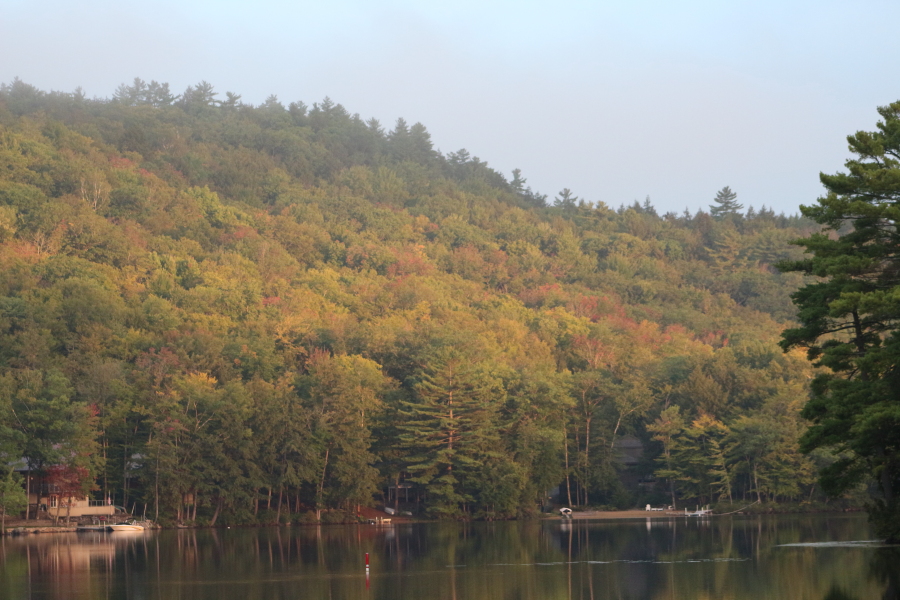
Tree tops are starting to turn on the hills west of Lake Wicwas.

I was farther north up on Mount Chocorua this week and even in the White Mountains there’s very little foliage changing.

The Three Sisters with Mt. Chocorua on the left.

A flash of red on Carter Ridge coming down from Middle Sister.  (Mt. Washington is in the distance.)


It's time for a loon update.  Coco and Jimmy are still here, fishing on their own, though one of them, presumably Jimmy, is still often found close to mom and he continues to make a somewhat whiny  sound as he begs mom to catch him a fish - I can hear it on a quiet day carrying far across the cove.
Jimmy nags mom for a meal.

They are a couple of mighty fine looking birds, and we should still have many weeks to enjoy them.


They'll be here to watch plenty more sunrises this fall.


Sunday, August 1, 2021

August 1, 2021: Plundering Spiders

Working around Linda's gardens last week I came across an interesting thread-covered orange ball that instantly piqued my curiosity - what is that?

This strange object was about 3/8" in diameter.

It was attached securely to the underside of a surface where it was protected from the elements as well as from predators.  It took a little digging to figure out what it was because I had no idea what animal created it to give me a hint as to where to start looking.  My first thought was a moth or butterfly as it looked like a cocoon or pupae, but all those searches didn't reveal anything.  So I broadened my aperture and eventually was able to identify it as an egg sac, and was then able to narrow it down to a spider egg sac, and finally to that of a Pirate Spider.  Ever heard of them?  I hadn't.  But wow, what a cool creature.

Pirate spider, of the family Mimetidae.  Photo by Project Noah

Pirate spiders get their name from their method of hunting:  they attack other spiders' webs and plunder their treasure.  Pirates belong to the orb-weaving family of spiders, but over time they have lost their ability to make webs, though they still produce silk and glue to form their egg sacs and attach them to something.  Their hunting technique today involves invading another spider's web and using its front legs to lightly vibrate the web which attracts the homeowner.  

There are a couple of theories as to why this works.  One holds that the host spider thinks there's an insect struggling in its web so it goes to out collect it's catch.  Another theory is that the occupant thinks there's an intruding spider on its web so it heads out to defend its castle.  Either way, when the web-owner gets within range of the pirate's pair of very long, barbed front legs (see photo above) the plunderer grabs hold of it and quickly sinks its fangs in to inject a poison that is specifically engineered to kill spiders - it's in fact harmless to most other animals.  [Most of this information was derived from an article written by Zoe Cormier and published in BBC news.  If you're intrigued about these pillaging spiders you can explore more here.]

After I saw a photo of the pirate spider I realized that I had just recently seen one - it had hitchhiked home in my blueberry bucket and I found it when sorting out the blueberries from the detritus that always gets in the blueberry pail:  pine needles, stems, ants, and yes, plenty of spiders.  Usually those are jumping spiders, but now I know to watch for pirates.  Sadly, I didn't know what it was at the time and released it back to the land of buccaneers without getting a mugshot.  

This week's bizarre loon report comes to us courtesy of Michael Marion and Debby Crowley.  First, Michael saw the loon chicks up on his beach - literally on the beach - while the parents were out fishing nearby.  I do hope they're teaching the chicks to watch out behind them.  Then Deb Crowley saw what she thought was a duck on shore, but when looking closely realized it was one of the loon chicks.  While she watched, she saw it do a "poop shoot" right in the air!

Jimmy or Coco returning from a bathroom break.  Those legs sure are big and strong already. 
Photo by Debby Crowley.

I've seen hawks and eagles do that from a tree, but never a loon, probably because they're always in the water.  So it was off to the Loon Preservation Committee to ask if this was unusual.  The response from our local field biologist Jayden Jech and senior biologist John Cooley came quickly.  From Jayden: "After speaking with John, he shared with me that this behavior is quite normal for both loon chicks and adult loons to defecate on shorelines.  Definitely an interesting observation!"

So there it is, another "normal" but bizarre trait of the common loon.

Coco and Jimmy are just over four weeks old now and are subject to fewer dangers, but they're far from safe as we have lost chicks as late as August 23rd in prior years, sometimes to raptors, sometimes to other loons, and we still have many other loons frequenting Lake Wicwas.  Yesterday morning I saw a pair of loons fly onto the lake from the south, skimming in for a landing, followed shortly by a second pair.


The second pair landed just past the first;  I'm guessing they are travelling together.  There was a fifth loon in the water just to the left of these four.

Two flying, two in the water, barely discernable on the left.

And then there was this raft of 12 loons that Keith Duggan saw on the lake.
A large asylum of loons.  Photo by Keith Duggan.

Coco and Jimmy's parents will have to be diligent for weeks to come.


As we move towards the latter half of summer the later-season fruits are starting to mature.  This is the hobblebush viburnmum that was decimated by the deer in the spring (May 2, 2021) but it bounced back enough to put out a good amount of fruit, at least on the higher branches above the deer's' reach:


The black cherries are also starting to ripen.

Like the hobblebush, this fruit will turn black - if the birds and the bears don't eat them all first.


The cherries are ripening just in time to supplant the dwindling blueberries - I've probably picked my last batch of pirate-laden Wicwas blueberries for the year.