Showing posts with label Sunrise. Show all posts

Sunday, August 3, 2025

August 3, 2025: Skunking through the Flowers

We've had the cutest little young skunk slinking through the yard all week.


It's been here almost every day, snuffling around amidst the flowers, foraging for grasshoppers, beetles, grubs, and caterpillars which it quickly gobbles up.  

Skunks are a real asset to gardens, keeping down the population of garden pests, but we're not so sure we want a skunk living close by once it grows up.  Skunks are like porcupines in that their defenses are so strong that they have almost no predators and don't feel a need to flee.  They are more likely than most animals to stand their ground and deploy their defense mechanism if needed.  

Juvenile skunks are often out during daylight when they're learning how to find food, and this one was not one bit fazed by our presence.  It would walk right up to the door where I was standing.

Mature skunks are primarily nocturnal and we definitely don't want to step outside at night and startle a skunk that might give us a spray!  Living amongst nature is rewarding, but his situation is something we'll have to figure out. 


Here's one tasty little tidbit our young skunk would be happy to find, but hopefully not up on our deck.
A Geometer

Inch worms are the larvae of moths in the family Geometridae.  The name comes from the Greek geometer which means earth-measure - an apt term for a caterpillar that measures out it travels across the planet one inch at a time.  Sometimes this one has a hard time deciding just where it wanted to go next.


On an early morning paddle this week I came across a thick mat of a newly flowering, tiny aquatic plant.

I think this one is a Conespur Bladderpod. 
Conespur Bladderpod

It's similar to the flower of the Floating Bladderwort, but this one grows in a thick tangled mat rather than a single free-floating plant. 


I also saw Spangle and Star fishing for breakfast with mom - and enjoying the sunrise.

They are growing nicely but they still have along way to go before they're ready to fly.
Photo by Ken Buckley

Spangle is already demonstration her independence by spending time away from the rest of the family.  It's nice to watch the nesting season progressing smoothly, at least in the southern half of the lake.  


That morning was one of several warm and calm mornings this week - it's the most beautiful time of day.
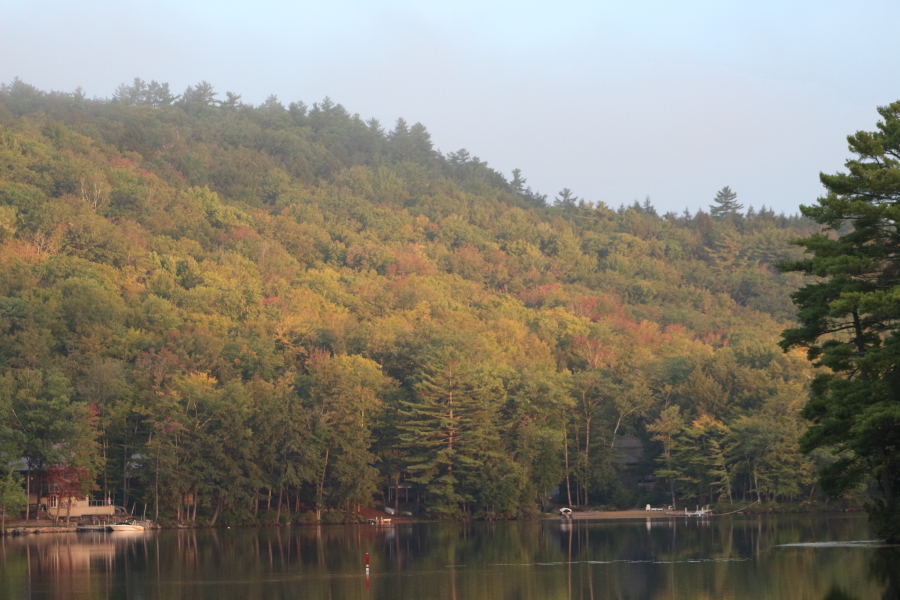
Sunrise on Lake Wicwas.


Sunday, September 19, 2021

September 19, 2021: The Sun Also Rises

Summer time brings the most spectacular sunsets, often presented thanks to copious amounts of water vapor in the summer air, and sometimes with a supporting cast of smoke from fires in the west that drifts in our direction in the upper atmosphere.  But early fall is my favorite time for sunrises, and not just because the sun comes up at a more reasonable hour:  sunrise was at 6:28 am yesterday, shortly before I saw the first rays of the day scrape the top of the hill that contains Crockett’s Ledge.  

Yesterday's first light filters through the morning mist.

In another month the sun will rise after 7:00 am as we lose almost 20 minutes of daylight each week as we approach the autumnal equinox.  The next few weeks - before sunrise is set back again by the end of daylight savings time - is my favorite time to climb up Crockett’s in the dark to watch the sun rise over the hills to the east. 

Sunrise from Crockett's Ledge.

If you decide to experience it for yourself, just be on the watch for bears, as I once had an encounter with a bear and two cubs heading up there for the sunrise.

One of my favorite aspects of learning about all the different forms of life in the Lakes Region is knowing what something is when you come across it, sometimes where you least expect it.  One day, opening our mailbox, I saw this stuck to the top of the inside.

An egg sac that didn't arrive via the USPS.

Having just learned about pirate spiders this summer (see Plundering Spiders) I immediately recognized it as a pirate spider egg sac.  Knowing what it is, and that’s it’s not going to hurt me (or the mail person) I’m comfortable letting it be and watching to see if I’ll find any eight-legged scallywags scurrying through the rigging on the mailbox.

On the subject of spiders, this is a good time of year to spot all the bowl-and-doily spiders living in our fields and meadows.  

A bowl and doily spider web saturated with morning dew.

These clever spiders are present throughout the summer but their double, bowl-shaped webs are most noticeable on misty mornings when the heavy dew condenses of the threads of their web.  Their secret to survival is the two-layed web.  They live on the lower web (the doily), protected from predators by the upper web (the bowl).  They lie in wait for an insect to fall, fly, or crawl into the bowl, at which point they sneak up on it from below to bite and inject venom into the unexpecting prey.  The female builds the nest, and the male may live in her house, participating in the capture and the consumption of the food her domicile provides. 

September so far has blessed us with wonderful late-summer weather - nothing even close to a frost yet - with just a few hints of color starting to show in the trees around the Lakes.

Tree tops are starting to turn on the hills west of Lake Wicwas.

I was farther north up on Mount Chocorua this week and even in the White Mountains there’s very little foliage changing.

The Three Sisters with Mt. Chocorua on the left.

A flash of red on Carter Ridge coming down from Middle Sister.  (Mt. Washington is in the distance.)


It's time for a loon update.  Coco and Jimmy are still here, fishing on their own, though one of them, presumably Jimmy, is still often found close to mom and he continues to make a somewhat whiny  sound as he begs mom to catch him a fish - I can hear it on a quiet day carrying far across the cove.
Jimmy nags mom for a meal.

They are a couple of mighty fine looking birds, and we should still have many weeks to enjoy them.


They'll be here to watch plenty more sunrises this fall.


Sunday, October 20, 2019

October 20, 2019: Bucks on the Prowl

I've seen quite a few signs of white-tail deer lately - the bucks that is - out and about, claiming their territory.  I caught this guy on my trail camera one night this week.
A nice size buck cruises its territory.


The most visible signs are the many "scrapes" they make on the ground. 
The buck was facing to the left, kicking debris to the right to clear the soil.

These are commonly seen near hiking trails because bucks with a rack of antlers appreciate the easy travel along cleared trails.  The scrape above shows that the buck had dug up leaves and such and thrown it back a good ten feet.  The scrape itself often has a triangular shape where the buck used its front feet to dig at the ground. 
The typical V pattern made by the front hooves.

After making a scrape a buck will urinate there so it can soak into the bared ground, thus letting its scent linger for several days.  This provides a mating signal to the females in the area, as well letting other bucks know that this territory - and its resident females - have been claimed. 

Another technique bucks use to mark territory is called a rub. 
A rub on a young hemlock tree.

I found this rub on a hemlock tree this week in the same area.  A buck will rub its antlers on a tree, often an aromatic hemlock, to leave another territorial marker.  Deer have glands near their eyes which add their unique scent to that of the freshly released hemlock bark which intensifies the marker.

Deer aren't the only creatures out prowling around in the dark these days.  The sunrise in late October and early November is the latest we get all year (later than at the winter solstice due to daylight savings time) so it's the least painful time to get up to witness the birth of a new day.
The first peak of sun rises over Lake Winnisquam.

This week I took the short hike up Ladd Mountain in the Chemung area of Meredith to indulge in the beauty of early morning.
Mist on Lake Winnisquam

It's an easy 1-mile hike up, and when I was there this summer I thought it would be good vantage point with an eastern exposure overlooking the northern end of Lake Winnisquam.  I wasn't disappointed.
Dawn breaks over Meredith.

It's hard to believe we still haven't had a hard frost.  One morning the temperature dropped to almost freezing, low enough that in an open field with a lot of radiational cooling, I saw my first ice crystals of the season. 
First ice, only in open areas on the very lowest lying leaves.


Earlier in the week I was out on Turtle Island in Lake Wicwas doing some fall clean-up and saw that the turtle nests laid way back in June had hatched out.
Holes and shells where baby turtles emerged from the nest.
The shell fragments are soft and leathery feeling.


I had forgotten how late in the year snapping turtle eggs hatch until my brother sent me photos of 21 little guys hatching out from a nest in Canterbury on October 1st.
Just two of a litter of 21.  Photo by Glen Powell.  (Thanks for sharing!)

Snapping turtles have evolved with a very strange property related to hatching eggs.  The sex of the turtles that hatch is dependent on the temperature while they are developing in the ground.  Temperatures below 77 degrees F will result in only male turtles, while temperatures above 80 produce only females.  Between these temperature there will be a mix of sexes.  It seems like a strange way to balance the population, and it makes me wonder if they will evolve quickly enough to maintain a successful population at our latitude as the planet's temperature increases.

There were a lot of photos being shared of the rainbow that appeared on Friday.  I was lucky enough to be out on run and saw it shimmering over the hills north of Lake Wicwas.
Rainbow over Wicwas, seen from Wicwood Shores Rd.

At least one adult loon is still on on the lake, and one of the chicks remains glued to her (?) side all the time. 
One of the chicks, most likely with mom.


They separate only to dive, regrouping as soon they surface.

It's a pretty sight to see loons on the lake in autumn.


There were a lot of gorgeous colors around the Lakes Region this week before the storm that blew through on Wednesday night stripped many leaves off the trees, but there is still plenty of color to be seen this weekend.
Still nice colors west of the lake as of yesterday (Oct 19th).

One of these nights we'll get that first hard frost.

Sunday, September 18, 2016

September 18, 2016

It sure is dry all around the Lakes Region right now.  The drought isn't as severe here as farther south but still, everything is brown and parched, and the small streams feeding the lake have gone dry.
Dry stream beds are the norm

Lake Winnipesaukee is a foot and a half below full pool, and a fisherman told me Lake Massabesic in Manchester is four feet low and the boat ramps are closed.  Lake Wicwas has been very fortunate that - between good management of the dam and the assistance of the beavers - the lake has been high all summer, and as of yesterday is just one inch below full level.
The level at the dam is barely below full pool

The beaver have helped us in two ways.  First, all summer long they have been stuffing every manner of debris in the dam.  (Note all the vegetation they've added in the picture above.)

In addition to raising the water level until the town comes and removes the mess, they also plug up all the leaks that every dam has, further reducing the outflow from the lake (beavers are genetically programed to impede any running water they find).  The other contribution they've provided is a dam they created where Blake Brook enters Lake Wicwas (see August 21 post).  This has raised the water level behind the dam two or three feet, impounding a good reservoir of water that continues to feed the lake.  I expect we are also blessed with many springs that supply the lake as well, as it's hard to believe the small trickle of visible inflow would keep the lake full without other sources.

I was on duty for a morning session of Lake Hosting on Saturday and I went early to watch the sun rise from Crockett's Ledge.  It had the makings of a beautiful morning, with a full moon shining through a thin layer of fog to light the trail on the way up.  When I arrived the fog was low and the mountains were rising above.
Ladd and Leavitt Mountains rising above the fog

The double hump of Gunstock and Belknap mountains

But within minutes the fog thickened and rose

and soon obscured any view.
Lakes and mountains are out there somewhere

Still, it was calm and serene, with birds starting to sing, and there was a little early foliage to enjoy.

Back at the boat ramp the lake remained pretty much fog-bound.
Looking back up at Crockett's Ledge

But the sun to the east was working its magic.
Fog burning off over the Chemung Forest

By 7:30 it had cleared and unveiled a perfect, warm, sunny September day.
Fog lifts off the lake

In the afternoon the goldenrod was radiant in the rich autumn sun, calling to a wide array of pollen-collecting insects to amass their reserves of pollen.
Goldenrod in full bloom

Wasps

Honeybees
Hornets
And Bumblebees
Nice to see them all sharing the bounty of the fall flowers.

Finally, on a late-afternoon walk I spotted the elusive Hermit Thrush deep in the forest, and very skittish.

A Hermit Thrush in a rare stationary moment
This is a bird I hear often but rarely see, in keeping with it's name.  It is one of the last birds to migrate, but nonetheless, it will soon be off on its travels south, as autumn hints at its impending arrival to the lakes.
Red Maples are the first to change color, hinting at what's to come