Showing posts with label Hawk. Show all posts

Sunday, September 21, 2025

September 21, 2025: A Flock of Flickers

Tomorrow marks the autumnal equinox, and fall migration is well underway.  I was in Wilmot for a forestry class, and from one open meadow we watched a kettle of a dozen or more Broad-Winged Hawks fly over us using the warm air from the field to gain altitude on the rising thermals.  There was also a Red-tailed Hawk mixed in with them.  Another migrating species seen this week was the Northern Flicker.
Northern Flicker

There was a flock of a least a dozen birds feeding madly on some type of insect in the gravel road. 

Picking insects from the road.

They were borrowing a trick from crows which pull up chunks of sod in lawns to find grubs; the flickers were turning over small stones to find their prey.
Stones uprooted in search of insects.

That first photo was a male flicker, identified by the black "mustache" on its face.  The female is lacking that mark.

Female Flicker.

Both have a black chest mark and a red chevron on the back of their head; the eastern version, described as the "yellow-shafted" group, has yellow wing feathers, the edges of which can be seen in the above photo and the following photo.  In flight, a conspicuous white spot is visible from behind.  

Note the red chevron and yellow wing edges.

Either way, It's a handsome bird.

The Lakes Region is right at the southern limit of its breeding range (which is likely moving northward now) so this flock was probably traveling together on their way south, which for some flickers may be as near as southern New Hampshire.


This was another week of totally rain-free, warm, sunny days.  I spent one afternoon just drifting in a couple of secluded marshes watching birds and dragonflies.  The dragonflies provided the best entertainment as dozens of them darted over the water and vegetation, defending their own territory and testing the defenses of their neighbors.  Only for a moment would one hover over its claim before an intruder had to be sent away, but I was able to capture a few of them.


The next day a pretty Autumn Meadowhawk posed on a railing for me.

Male Autumn Meadowhawk

The bright red abdomen indicates it's a mature male.  Earlier I had seen a duller meadowhawk which was probably a female, or perhaps an immature male.


Floating peacefully in the late afternoon September sun, reflecting on the beauty of life, one has time to discover the smaller aspects of the world that usually go unnoticed.  On this day, low in my kayak, small white specs on fading green lily pads caught my eye.

I thought they were eggs of some sort.  But looking closely, I saw small spikes sticking out from some of them - they looked like legs.  So I plucked one of the pads and brought it home for further study. 


A macrophotograph revealed more detail.

A little digging brought me to conclude these are the shed exoskeletons of a small insect that hatched from an egg in the water into a larval stage, and when ready, climbed onto a lily pad to shed its shell and fly away as a winged insect.  My best guess is a species of midge in the family Chironomidae, which are small non-biting insects.  One study of New Hampshire lakes by Donna Frances identified 65 species of midges.  [Ref:  Distribution of Midge Remains (Diptera: Chironomidae) in Surficial Lake Sediments in New England]


I'm afraid I have to close this week on a sad note.  Rhys Bowen passed away suddenly this week.  Many readers of this journal knew Rhys from his many years of work with the Lakes Region Conservation Trust, most recently as Chair of the Board of Trustees.  In fact, the day before he passed, Rhys was with a team evaluating a property as a possible conservation opportunity.  Rhys was an expert birder; he led guided bird walks for the LRCT, and was one of my go-to experts for bird advice, whether on a bird identification, or for finding good birding spots from South Carolina to Alaska.  When I corrected a birding ID on this blog, it was usually Rhys that gently noted I may have made an error.  

Rhys was a good friend who gave so much to me and so many others in our community.  I am among the many who will miss him greatly.


Sunday, March 22, 2015

March 22, 2015 - Spring???

The stars say spring has arrived, but mother nature says otherwise;  winter was still very much in control when I took a walk on the lake this weekend.

A hole cut through the ice, almost at the limit of the ice auger, shows 25 inches of ice is still protecting Lake Wicwas from the sun's warming rays. 

Near one of the islands in the center of the lake we discovered one of the more intriguing natural events I've seen, something that appeared to be a minature volcano in the middle of the lake, with giant ice chunks thrown up around an open center.
A Volcano on Lake Wicwas?

As we approached it became clear it was larger than it appeared from a distance.

Upon peering inside, the source of the volcano became evident:  A large rock (made of Kinsman Granodiorite no doubt) lying just below the surface of the lake provided the impetus for the eruption.


My guess is that the ice formed above the rock last fall when the water was high, and then all the snow this winter built up on top, adding to the mass of 25" of ice on the lake.  Then as the lake drained during the winter, the ice dropped down below the top of the rock, prying up the chunks of ice. 


I expect this artifact will survive for a while considering the cold forecast for the next week.  If you're interested in seeing it first-hand, it is located off the west shore Sheep Island, about 200 yards from the southern tip of the island.

Other not-so-natural items on the lake weren't so exciting.  The trash pile made two months ago by fishermen (see 25 January 2015) is still there, complete with beer cans, and now there are remnants from an ice-fishing house left behind.
This spring's boating hazards

Warning for early boaters and bass-fishermen:  be on the lookout for flotsam in Lake Wicwas this spring.

Even though the weather has been cold, the animals are becoming much more active.  I found the track of good size moose frozen in the shallow mud from one warm day.
Moose Tracks
 This large animal has giant hooves, and travels 37 inches between steps - over three feet!


Lots of rodents are out now as well, including the first chipmunk of spring, all nicely sharing the spillage from the bird feeders. 


Note that the department of fish and game has announced the bears are active as well, so it's time to take down those feeders.

One afternoon I spotted a small hawk - probably a sharp-shinned hawk - sitting on a branch on the shore line.  It swooped down to a bit of open water and sat on the ground.  At this point we noticed a gray squirrel on a tree right next to the hawk - very strange, as usually not a squirrel nor a bird is to be seen when a raptor makes an appearance.  Even more strange, this squirrel starting climbing down the tree right toward the bird.  Just as we thought this rodent had a death wish, the hawk flew off in the opposite direction, and that's when we saw the root of the circumstance:  it had a small gray object in its talons.  It appears that mother squirrel had just lost one of its young.  Mother ran after the bird a few yards, but then stopped and looked off into the distance at the disappearing hawk.


She then sat motionless on the cold, frozen snow for a long time, wringing her hands, hoping, though knowing, she had seen the last of her offspring.  But what a bold move to stare down a hawk to try save one of her own!

It was yet another reminder that the natural world is a constant battle for survival.  But she will have another litter very soon, especially with all the easy food she gets from a winter of bird feeders!  It gives me a lot more compassion when the squirrels get to the feeders.  And it's nice to know we are supporting the entire food chain.

So the animals are out and ready for spring; how about you?  Can you believe we'll be swimming in this "water" in a mere two months time?

Sunday, July 7, 2013

July 7, 2013

After several more days of near constant rain, the weather finally turned just in time for the holiday weekend.  Although it was still very humid, at least the rain went away so everyone could enjoy their outdoor events.  The lake was busy with boaters, fishermen, and swimmers. 

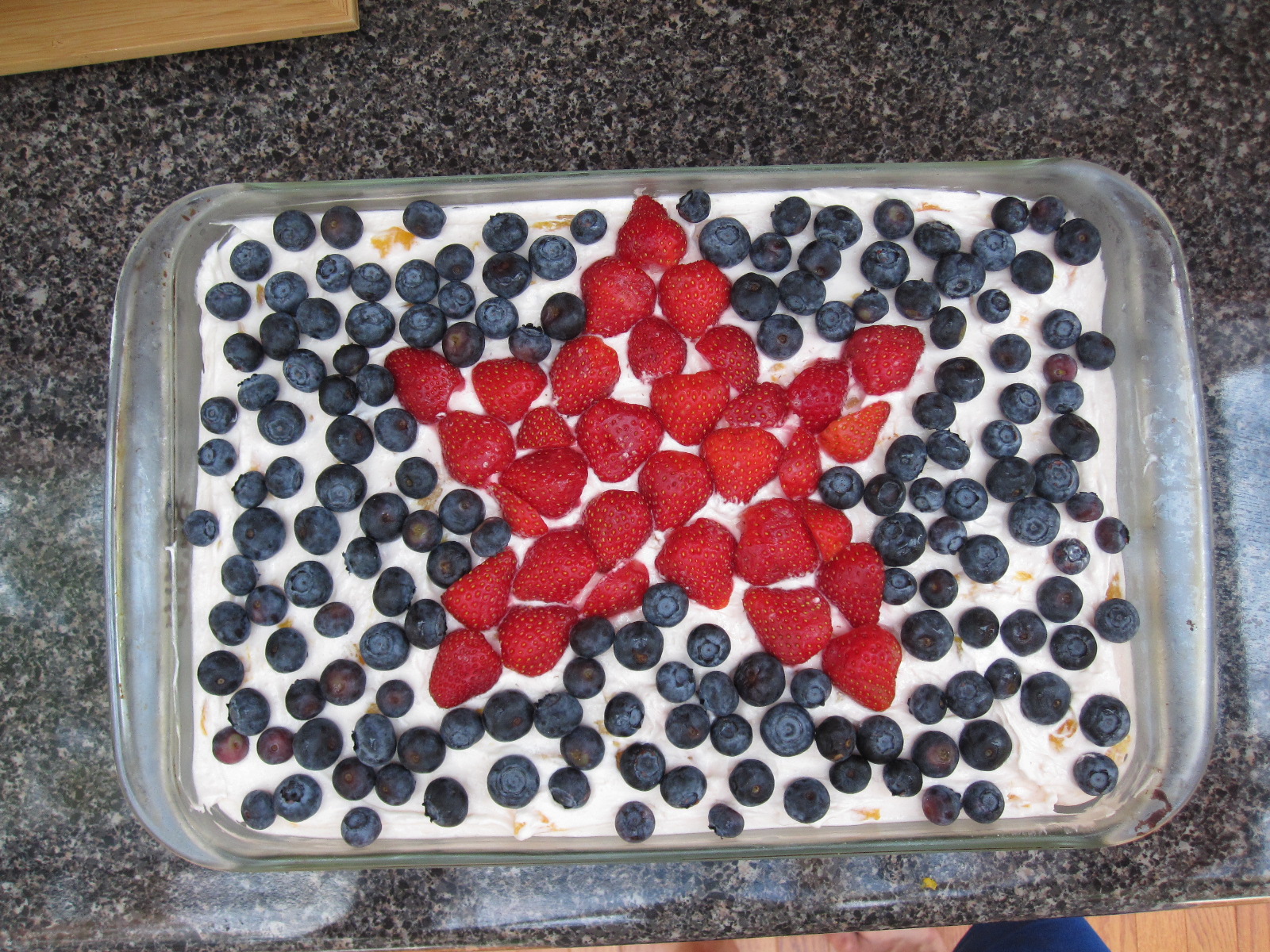
One of the highlights of the summer season for me has begun:  Blueberry season.  They are just starting to ripen in the sunniest locations, and should be going strong for several weeks.  All the rain and now the hot weather has made them very plentiful this year. 
Blueberry Season has Begun
 

We're looking forward to lots of blueberry-themed breakfasts, desserts, and all kinds of treats!

As for wildlife around the lake this week, it has been pretty quiet as expected with hot and humid days.  There are lots of nighttime sounds, but not much visible during the day.  I did see a couple of hawks and a Turkey Vulture, as well as the loons.  There has been a single loon as well as a pair on the lake, and occasionally a group of three loons fishing together.  I can only guess that the group of three might be the pair and the lone celebrating their own Fourth of July event.  It's not looking like there's going to be a chick hatched on Wicwas this year.

The highlight of the week was seeing a young bear run across the road right in front of me one morning on a run.  It came up out of the swamp in the Chemung Forest, bounded across Chemung road, and up into the woods by Old Stanton Road.  It left big, wet paw prints on the road, and lots of sprinkles of water that shook off its fur as it ran.  Alas, it was far too quick to even think about getting a picture, and I wasn't about to follow it!

So, no pictures of animals around the lake, but there were lots of humans enjoying great summer weather in New Hampshire, and the humidity made for awesome sunsets.
The Sun Sets over the Land of the Free

Sunday, April 15, 2012

April 15, 2012

New Hampshire continues to have little rain, and Lake Wicwas is even lower than it was two weeks ago. There are rocks poking their heads above the surface where I haven’t seen them before, and underwater surprises are lurking for the unwary. I have only seen a few fishing boats out so far, but the beautiful weather this weekend brought out lots of kayaks and canoes.

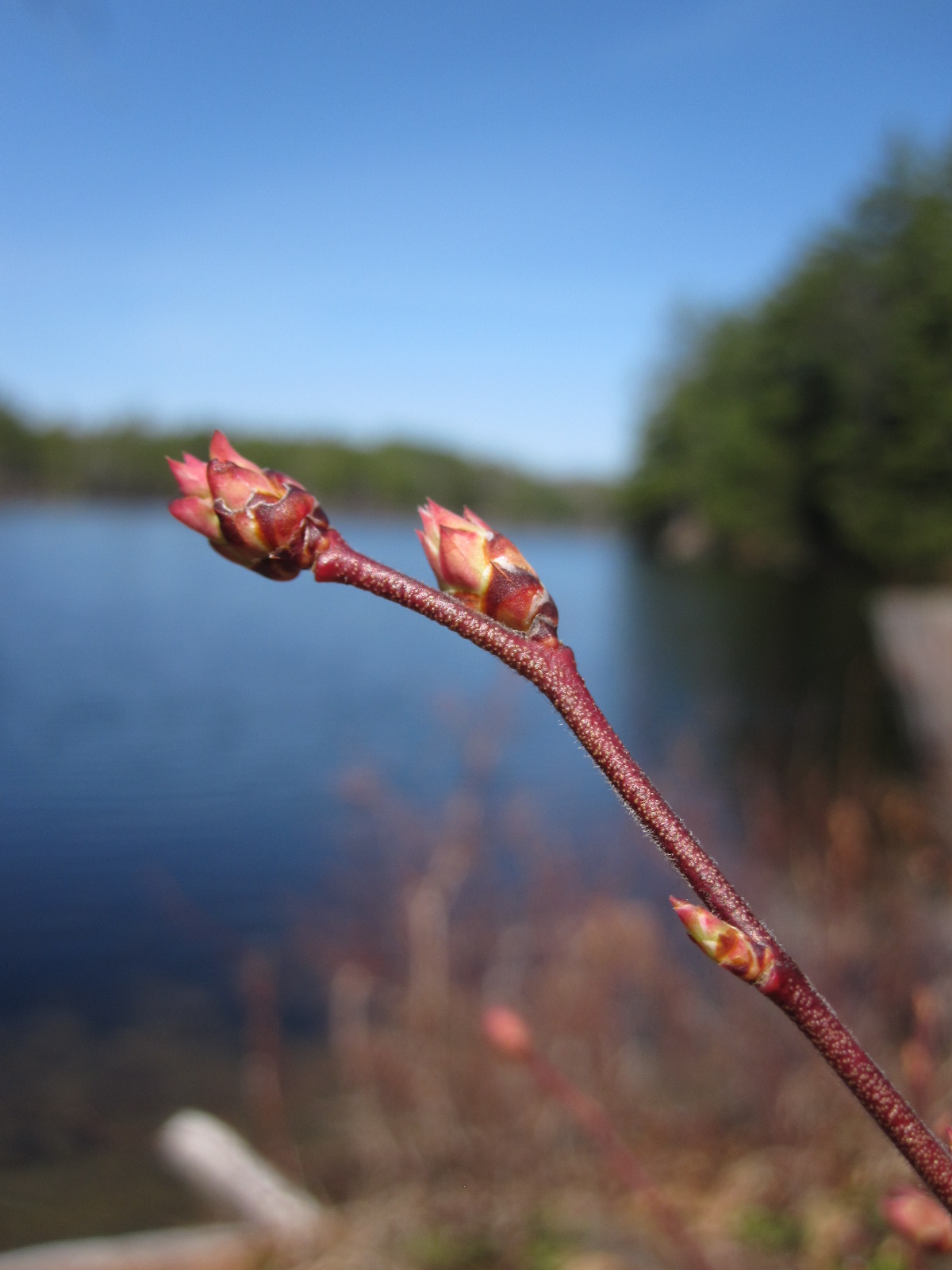
I’m currently anchored close to home, recovering from some foot surgery, so I’m not able to get out and photograph what’s happening around the lake this spring.  I’ll be missing one of my favorite times of the year, seeing life return with animals and tiny wildflowers emerging.  I was able to find some blueberry buds swelling up, and red maples bursting out their early flowers.

Blueberry Buds

Red Maple

Fortunately my partner-in-crime captured a few sights for me. One recent event she found was the work of the pileated woodpeckers we saw earlier – a pine with several fresh holes tracking the path the ants had burrowed in the tree and made their nest.


She also found the first flowers blooming – the tiny, fragrant, trailing arbutus.

Trailing Arbutus (Mayflower)
There continues to be a steady parade of water fowl passing through the cove. Mergansers, wood ducks, mallards, even a pair of buffleheads glided past this week (not to mention the geese).

Buffleheads

Early one morning, with the sun just lighting up the hills, I saw a single otter swim across the cove, bounding up on land to take a short-cut across a peninsula back to the water on the other side.  It's rejuvenating to see beautiful summer mornings return.


At one point this afternoon, flying low overhead, were three hawks - finding the thermals driven up by the warm southwesterly breeze - when a fourth, even lower, came by with a tasty red squirrel dangling from its claws.   I’ll bet it didn’t share.

There is also a regular procession of beavers going by every evening just at sunset.  I did manage to drag myself over to the nearest beaver harvest, and found a lot more cutting has occurred in the past few weeks. The NH DES wouldn’t like what’s going on within the shoreline protection area!  At least the beavers don’t disturb the shrubs or soil.

To stave off the cabin fever, we took a drive up north and found there’s still some winter left in the notches. There’s snow on the Franconia and Presidential ranges, and one could still ski on the upper two-thirds of canon.

Presidential Range

Canon Mountain


Child's Park


Back closer to home, the work on the new playground at Child’s Park is nearly complete, just in time for summer. The equipment is in and they were grading the new ball field.

 A couple of early customers were already scoping it out.


And, as another indicator of the approaching summer, the sun has now moved far enough around in the sky to bring back summer sunsets!

Sunday, October 23, 2011

October 23, 2011

Fall hasn't completely abandoned the Lakes Region, but it's getting closer every week.  There is still nice color in the trees, but it's mostly yellows on  the beech and oak.  This morning I took a ride at sunrise (it seems like it's getting later every week) down to the boat landing to get a look at Crockett's ledge, and it is still quite spectacular.
Sunrise from the Boat Landing

The sight of the ledge was so nice that I rode up to the yellow trail, left my bike, and hiked up to the top of the ledge.  The view was equally spectacular, but diametrically opposed.  Where from the east the sun reflected brightly off the trees, from the west, I was looking at the shaded side of everything, with the light reflecting off the water and the valley fog.  As I watched in the still morning (it was so quiet I could hear the geese arguing with each other way up at the opposite end of the lake) I reflected as well - on how perspective has such a great impact on how differently people can experience the exact same event.
Sunrise from Crockett's Ledge

Returning home, this bright white birch, which has lost all its leaves, stood out against the yellow beech trees. 
White Birch Amongst the Beech
Earlier, on the way out I had caught a beaver swimming in the cove along Chemung road, and also saw the mist rising up from the swamp in the Chemung Forest. 
Chemung State Forest


There has been a lot of beaver activity as they, like all the animals, prepare for winter.  Their lodges are growing with fresh wood, and there are many new tree-cuts all around the shore as they collect food for their winter.  They cut the small, tender trees and drag them under their lodge where they stick them in the mud, and will later eat their bark during their long winter season.
Beaver Lodge


One afternoon this week I had two avian encounters.  First I heard a wild flurry of birds squawking and calling - the tell-tale sign of bird-of-prey in the vicinity.  It didn't take long to find the source of the commotion, as red-tail hawk moved from one tall tree to another with only two flaps of its tremendous wings.  But its tormentors weren't satisfied, and soon the hawk flew off with an entourage of jays, crows, and myriad smaller birds following along like annoying paparazzi.

The second event was more startling.  While I heard the hawk scene from a good distance, the ruffled grouse made me jump when it took off just a few yards from the trail with its loud flurry of wings beating the air.  As kids we called them "helicopter birds" because that's what they sound like when they take wing.

We also stopped by Meredith Center to check out the progress there.  The new building is now roofed and sided, but there was no activity today.
Child's Park

On the way we stopped by the dam to check on the water flow - it is still a rushing torrent.  There was also a family there fishing, and a pretty maple visible from the road.
Lake Wicwas Dam

We haven't seen any unusual migratory birds yet, but there is a continuous flow of mallards going by.

And here's perhaps the last view of the bright side of Lake Wicwas for 2011.
Crockett's Ledge