Showing posts with label Volcano. Show all posts

Sunday, February 26, 2023

February 26, 2023: Bigfoot Sighting!

On a recent trek through through the wilds west of Wicwas I had the incredible fortune to catch a glimpse of the ethereal and much sought-after Sasquatch!  

Bigfoot stalks the forests west of Lake Wicwas.

Careful examination of the area however, turned up no evident prints so I was unable to track it or even measure the size of its feet.  How it got there and where it came from will remain a mystery, adding to the perplexing history of this mythical creature.
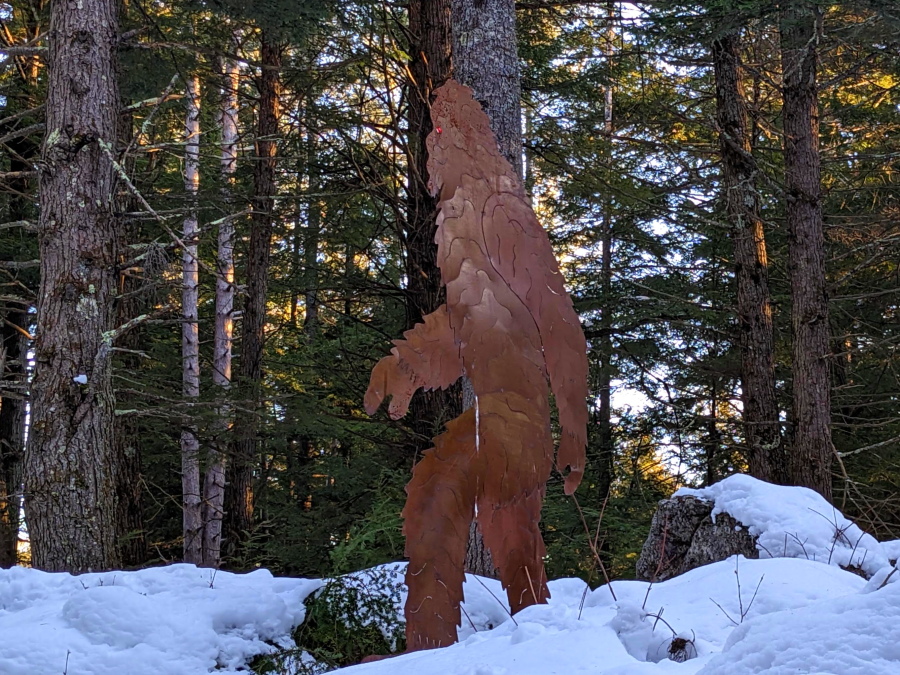
Now we know Bigfoot has red eyes.


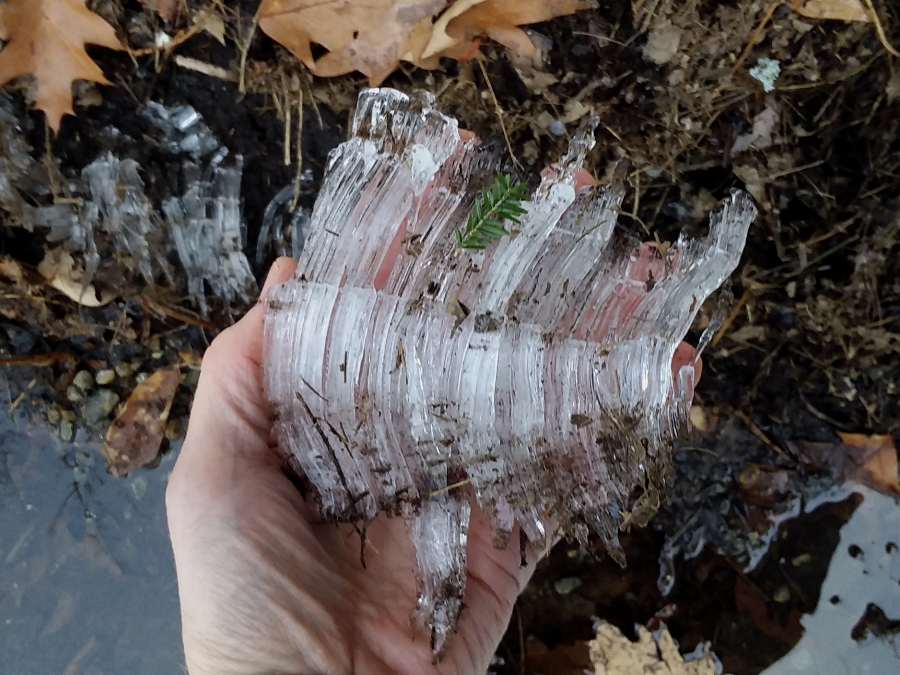
This week was another roller-coaster week in New Hampshire.  It started warm, got snowy, then turned frigid.  On Monday the lake was still good for skating, and I saw a few of these ice volcanoes on the lake.

Ice volcanoes
Bumpy but smooth, if that makes any sense.

And it had been so warm in recent weeks that the snowdrops have emerged already, the earliest I've ever seen them.

Snowdrops were up by February 12th.


My prior earliest observation of snowdrops was on February 17th, just last year.   Fortunately they haven't yet bloomed, because snow and cold arrived and plunged us back into winter.

This recent cold spell reminded me again of seeing self-heal plants poking up through the snow earlier this winter, which made me think about how plants - perennials in particular - can survive through frigid New England winters.

Self heal after a January snowfall.

Warm blooded animals create their own heat, and cold blooded animals either seek a space that stays above freezing, or incredibly, as in the case of the wood frog, create chemicals that let their body freeze nearly solid without damage.  But how do evergreen trees and perennials with roots within the frost line survive sub-zero temperatures?  Plant cells, like all living materials, contain water which expands when it freezes, which would normally burst the cells open.   To understand how plants avoid having their cells burst when temperatures drop below freezing, I went to the UNH Extension Service data base and found a nice summary of their methods written by Sharon Walker titled  "Dormancy - A Key to Winter Survival".  Walker explains that during the summer plants create materials, especially sugars and salts, which they store in their cells.  This lowers the freezing point of the water in their cells, the same way salt in the ocean lowers the ocean freezing point to 28 degrees versus fresh water at 32 degrees.  Furthermore, as the weather cools their cells wall become more permeable to water which allows water to leave their cells, increasing the concentration of sugars and salts, and allowing more room for expansion without bursting.

I've seen how the leaves of rhododendron and related plants curl up in very cold weather - I wonder if the curling is the result of contraction of cells in their leaves. 


So far this winter our cold snaps have been short, and this one is again only a couple of days and barely below zero so it will be just a short test for the flora and fauna of the Lakes Region.  But it's cold and snowy this morning, and nice to have winter back - it is February after all.  
A snowy morning from the top of Ragged Mountain.  Photo by Linda Hammill (thanks!)

The snowdrops will have to use their magic chemistry to pull through another roller coaster New England winter.


Sunday, January 17, 2021

January 17, 2021: Hungry Squirrels and Ice Art

Jack frost was busy this week, spreading his creative artwork generously in multiple locations; he really seems to revel in wide fluctuations of weather and temperature.  One of the most intricate of his creations appears when he goes out on a cold night right after a rather humid day, before the moisture in the atmosphere can escape his grasp, and he snatches it out of the air and locks it onto whatever surface he can find, in this case, our windows.
Jack Frost's artwork adorns the windows.


He most often shows his harder edges, but sometimes he relaxes a bit and shows his softer side with smooth, circular, swoops.

The very next night he walked along a small drainage that was still flowing with snow melt from the warm weather.  Here he chilled the saturated soil enough that it froze at the surface and was forced to release its heat up into the cold air, growing more of the ice needles that he usually makes early in the season.  With a plentiful supply of warm water and cold air, he made some pretty large needles.
Some of the larger ice needles I've seen.


Another interesting ice formation was several weeks in the making, but it also has do with changing weather:  Jack made us a lake-volcano.


I call these volcanoes because it appears a rock has erupted up out of the ice.  But of course, the lake froze right after the water level was high due to the melting of three feet of snow, and when the water drained out, the ice dropped back down around the rock.  A couple of weeks ago we had an earthquake; this week, a volcano.

I received a couple of enquires this week about all the holes in the snow with leaf debris scattered about them.
Who lives down there?


These aren't actually homes, but are signs of red squirrels foraging down below the snow cover for something to eat.  Looking carefully I could sometimes determine if they were successful in obtaining a meal, and if so, what they extracted.  Here's a hole where it's pretty clear the squirrel came up with an acorn or two.
Acorn Scraps


Other holes showed a lot of conifer debris thrown out of the hole, making me think the little guy was in search of hemlock or pine cones.  


It's not obvious that our friend found anything to eat in this next one, but it certainly found oak leaves and a pine cone.


Why it didn't open the cone is unknow to me - did it know there were no developed seeds inside?  Perhaps it was focused more on acorns as all the oak leaves suggest.  Another question is how they know just where to dig.  I can only assume they're able to smell oak or pine or hemlock aromas down below the snow - the rodent equivalent of following your nose to the bakery aisle at Moulton Farm.

Finally, I'm happy to report, in addition to squirrel tracks, there are miles of human tracks everywhere on the lake and on the trails all around the Lakes Region.
Lots of people have been enjoying the Bald Ledge Trail at Sky Pond in New Hampton.

The surface of Lake Wicwas is peppered with boot prints, ski tracks, ice fishing holes and sled trails, even mountain bike tracks.  Jack Frost isn't the only person taking advantage of the beautiful winter weather.
The Snake River draining Lake Winona into Lake Waukewan. (Bald Ledge)

Sunday, March 29, 2015

March 29, 2015

Lake Wicwas was absolutely gorgeous today.  A low temperature of 17 degrees overnight froze everything up, and then the noon sun softened the surface nicely.  I saw ski tracks from people enjoying the smooth, soft conditions, as well as lots of animal tracks.  The light snow that fell yesterday, reworked by the melt-freeze-melt cycle, created a surface that left imprints of the most perfect coyote tracks I have seen.


This trail pattern is called a "side trot".  All of the front foot tracks are on the left, and the hind foot tracks are on the right.


Note that the front foot is larger than the rear, as it is on the fox as well.

Coyote on Lake Wicwas, January 2012

The Wicwas volcano that erupted last week grows.  As the lake level continues to be lowered (it's now 10" below full level) to reduce flooding from the spring freshets that will soon pour into Lake Wicwas, the ice slabs continue to be forced skywards.  Compare the change over just four days:
March 21st

March 25th
Usually at this time of year the ice is too treacherous to venture onto the lake, but drilling another hole I found it is still 23 inches thick.  But it is changing - the first four inches are now soft and porous after a couple of warmer days assaulted the surface.  And around the edges there are many openings and thin spots, so care is in order even with the thick layer in some places.

During a run on one of those warmer days I had a rare spring sighting - a wooly bear caterpillar.
Wooly Bear Caterpillar  (Pyrrharctia isabella)

I usually see these in the fall.  As usual, it was sunning itself on the warmth of pavement - on Chemung Road - having probably just crawled out from the neighboring stone wall.  Knowing it wouldn't make it to the next phase of its transformation in that spot, I scooped it up and put it on the shoulder of the road.   But instinct is hard to overcome, and it immediately motored directly back onto the road.  I placed it farther off the shoulder, and this time it rolled up into its protective crescent shape and played dead, so I went on my way, hoping for the best.

Unlike most caterpillars, the wooly bear overwinters as a caterpillar.  It curls up inside its wooly blanket deep in a stone wall or under forest debris, and will freeze solid over the winter.  In the spring it will thaw out and form its pupa, eventually becoming a moth that will mate and lay eggs for the next round of wooly bears.  The wooly bear is the larval stage of the Isabella Tiger Moth - I will keep an eye out for one of these moths this summer.
From Wikipedia: http://en.wikipedia.org/wiki/File:Pyrrharctia_isabella.jpg

Last week I saw my first chipmunk of 2015, and this week I saw their offspring out and about, little tiny 'munks, chasing each other all over on top of the snow.  They are rather curious and not very wary of humans yet, staring at me from just a few feet away.  They will either learn quickly, or have the same fate the young grey squirrel met last week.

The fox diet seems to be changing, adding in more vegetation with the reduction in the snow pack - much to the relief of the local rodents. 

Fox Scat
This fox scat included a large, thick, cardboard-like substance that had not been digested, and that I was not able to identify.

The closest material I can compare it to would be an avocado peel;  did this fox perhaps get into someone's garbage?

Thinking about animals and their interaction with humans, there was an unfortunate case of twelve deer dying from being fed by well-intentioned people in the southern part of New Hampshire;  you can read about it here.  It is never a good idea to feed wild animals - well, except I guess the birds, but even there one must careful for the bears. 

With the warmer weather, New Hampshire's fifth season has begun:  mud season.  (The sixth is black fly season.)  This can be, visually, a rather ugly season, even though psychologically it's beautiful, knowing winter is melting away.  Even where the mud doesn't show through, the world is rather unsightly due to the ravages of a hard winter being exposed by the receding snow.


It's been a challenge to keep the forest clean this winter

Fortunately, that touch of snow yesterday freshened things up a bit. 

Now, isn't that better?

Once again, Lake Wicwas was absolutely gorgeous today.


Sunday, March 22, 2015

March 22, 2015 - Spring???

The stars say spring has arrived, but mother nature says otherwise;  winter was still very much in control when I took a walk on the lake this weekend.

A hole cut through the ice, almost at the limit of the ice auger, shows 25 inches of ice is still protecting Lake Wicwas from the sun's warming rays. 

Near one of the islands in the center of the lake we discovered one of the more intriguing natural events I've seen, something that appeared to be a minature volcano in the middle of the lake, with giant ice chunks thrown up around an open center.
A Volcano on Lake Wicwas?

As we approached it became clear it was larger than it appeared from a distance.

Upon peering inside, the source of the volcano became evident:  A large rock (made of Kinsman Granodiorite no doubt) lying just below the surface of the lake provided the impetus for the eruption.


My guess is that the ice formed above the rock last fall when the water was high, and then all the snow this winter built up on top, adding to the mass of 25" of ice on the lake.  Then as the lake drained during the winter, the ice dropped down below the top of the rock, prying up the chunks of ice. 


I expect this artifact will survive for a while considering the cold forecast for the next week.  If you're interested in seeing it first-hand, it is located off the west shore Sheep Island, about 200 yards from the southern tip of the island.

Other not-so-natural items on the lake weren't so exciting.  The trash pile made two months ago by fishermen (see 25 January 2015) is still there, complete with beer cans, and now there are remnants from an ice-fishing house left behind.
This spring's boating hazards

Warning for early boaters and bass-fishermen:  be on the lookout for flotsam in Lake Wicwas this spring.

Even though the weather has been cold, the animals are becoming much more active.  I found the track of good size moose frozen in the shallow mud from one warm day.
Moose Tracks
 This large animal has giant hooves, and travels 37 inches between steps - over three feet!


Lots of rodents are out now as well, including the first chipmunk of spring, all nicely sharing the spillage from the bird feeders. 


Note that the department of fish and game has announced the bears are active as well, so it's time to take down those feeders.

One afternoon I spotted a small hawk - probably a sharp-shinned hawk - sitting on a branch on the shore line.  It swooped down to a bit of open water and sat on the ground.  At this point we noticed a gray squirrel on a tree right next to the hawk - very strange, as usually not a squirrel nor a bird is to be seen when a raptor makes an appearance.  Even more strange, this squirrel starting climbing down the tree right toward the bird.  Just as we thought this rodent had a death wish, the hawk flew off in the opposite direction, and that's when we saw the root of the circumstance:  it had a small gray object in its talons.  It appears that mother squirrel had just lost one of its young.  Mother ran after the bird a few yards, but then stopped and looked off into the distance at the disappearing hawk.


She then sat motionless on the cold, frozen snow for a long time, wringing her hands, hoping, though knowing, she had seen the last of her offspring.  But what a bold move to stare down a hawk to try save one of her own!

It was yet another reminder that the natural world is a constant battle for survival.  But she will have another litter very soon, especially with all the easy food she gets from a winter of bird feeders!  It gives me a lot more compassion when the squirrels get to the feeders.  And it's nice to know we are supporting the entire food chain.

So the animals are out and ready for spring; how about you?  Can you believe we'll be swimming in this "water" in a mere two months time?