Showing posts with label Spring Peeper. Show all posts

Sunday, May 7, 2023

May 7, 2023: Black and White Warblers Crash the Party

This spring party is feasting on a buffet of insects, providing much entertainment.  The air show started a few weeks ago when the phoebes appeared, but really hit its stride this week with the arrival of masses of yellow-rumped warblers.  Whereas the phoebes - which have taken up residence near our house - dash out from a tree branch to catch a bug and then return to the same tree to watch for the next victim, the yellow-rumped warblers were flying along quickly from tree to tree, the whole flock moving rapidly in the same direction.  As I was watching the yellow-rumped's do their thing, I noticed one bird acting differently - rather than flitting about catching flying insects, this bird was rapidly climbing up and around the trunk of an oak tree like a nuthatch.  With binoculars, I saw it was the Black and White Warbler.  I hear their distinctive "squeaky-wheel" call often, but rarely see them, and have never gotten a picture of one before, but I was able to here.
Black and White Warbler

They move so fast it's hard to get a picture that isn't blurred by their motion.  According the Cornell Lab of Ornithology, black and white warblers often travel with large bands of other migrating warblers.  The B&W's come all the way from Florida or Central America to breed here.  Their diet consists almost entirely of spiders and insects, especially their larva, all of which they pick out of crevices in the bark of trees.  Black and white warblers are ground-nesters, usually building their nest at the base of a tree or a rock for protection and cover.   
Belting out it's high-pitched squeaky-wheel song.

Other additions to the spring bird arrivals this week included the Winter Wren and the Ruby-crowned Kinglet.  Here's one of the many Yellow-rumped warblers.

The robins are once again building their annual nest under our deck.
Mrs. Robin collects nesting materials.

They've been doing this for so many years I guess they just don't mind being disturbed every time we walk by.

The cool and damp weather has meant a long season for the trailing arbutus - they are still blooming.  The service berries have joined them now, as have the fly-honeysuckle.
Fly Honeysuckle (Lonicera canadensis)


You're surely aware that all the rain in the northeast has caused significant flooding and washouts of roads and trails.  A beaver dam on Meredith Neck failed and now the pond is just a shallow mud hole after the rush of water took away part of Meredith Neck Road.  There were reports of the beavers rebuilding the dam that held back the pond after the first breach, but they haven't been seen since it failed a second time with the latest rain.  All the beaver dams around Wicwas seem to have held.  The water level in the lake was as high as twelve inches above normal, but it's now coming back down.  Profile Falls in Bristol is gushing, and the trail to the Pemigewasset River is impassible due to flooding.
Profile Falls on the Smith River.

The first warm sunny evening following all that rain sure got the Spring Peepers excited:


I went for a kayak the day the weather was clearing; I did get a few showers on me, but it was worth it, as our male loon gave me a great show as it performed a thorough preening routine.


Afterwards, he wanted to make darn sure I knew it was him out there:
Making sure I saw his leg band.


Things are getting busy around the lake as spring hits its stride - I barely mentioned all the plants now bursting out with buds and leaves - maybe next week.  I'll close with a video of a Turkey Vulture that was enjoying the airflow being forced upwards by the cliff at Crockett's Ledge.  

While I was there I also saw an osprey fly right overhead.  Ledges provide good vantage points for observing animals as well as great views!

Sunday, April 17, 2022

April 17 2022: Our Banded Loons Return

An encouraging sign for our loons as well as the loon population in general appeared this week:  Our mating pair of loons has returned.  I was able to get a good look at the bands on the legs of both the male and the female, proof they are the same pair that fledged two healthy chicks, last summer, Jimmy and Coco.

The female has lots of jewelry, two bands on each leg.

The male has only a single band on its left leg.

The pair will spend the next month or two fattening up on fresh fish and selecting a nesting site.  I've heard sounds of contests with other loons, so there's likely to be a little territory resolution to be done as well.  Last year the various loons resolved their differences fairly quickly and this pair had nested by the first of June; we can only hope this year goes as well as last.  (I reported this sighting to the LPC, and perhaps you saw that they scooped me and put these pictures in their newsletter!)  

On the subject of mating and territory, one day I was drawn from a long distance by the persistent tapping of a woodpecker declaring his territory.  As I carefully closed in on the sound I was amazed at how much noise a small bird can produce.  The downy woodpecker knows to find good solid, dead but dry branch to hammer on which will resonant loudly throughout the forest.  The farther the sound can carry, the larger territory a male woodpecker can claim.  After a long time circling under the tree I was finally able to spot the percussionist, way up high on a dead oak limb.  The video is poor, but you can clearly understand how his signal carries far across the land (click on the video below):


Our list of summer migrants continues to grow, with this week's arrivals including pine warblers, brown creepers, and great blue herons, one of our larger birds on the lake.  Our highly visible raptor, the osprey - also known as the fish hawk - has returned and immediately made its present known by its loud kip-kip-kip call as it flies off from its perch overhanging the lake where it sits looking for an unsuspecting fish down below.  One evening after a successful fishing expedition it flew into our cove and ate its catch in a secluded spot where an eagle wouldn't steal its dinner.  It was dusk and I didn't want to disturb it, knowing it was hungry after its long flight from Central America, but I was able to get a couple of pictures of meal time.

"This looks like a safe spot."

"No one followed me?"

"Time to eat!"

I'm not sure why osprey fluff all their feathers up like this:


Could it be to help them dry off after their dive into the water to catch the fish?


Another of my favorite birds that visit Lake Wicwas in the spring and fall made a quick appearance this week.

Mr. and Mrs. Bufflehead

This is Mr. Bufflehead, I didn't get a decent shot of Mrs.
These birds still have a long way to travel - their primary breeding ground ranges from western Canada to Alaska.  The Lakes Region may be their first fuel and rest stop as they leave their winter grounds along the Atlantic coast.


Last week it was the wood frogs singing, and this week, on April 11th, it was the spring peepers raising a racket in the newly awakening forest.  And as spring unfurls, lots of green shoots are erupting from the earth and buds are swelling, ready to burst open with the next sunny warm day.  And more spring flowers are blooming too!

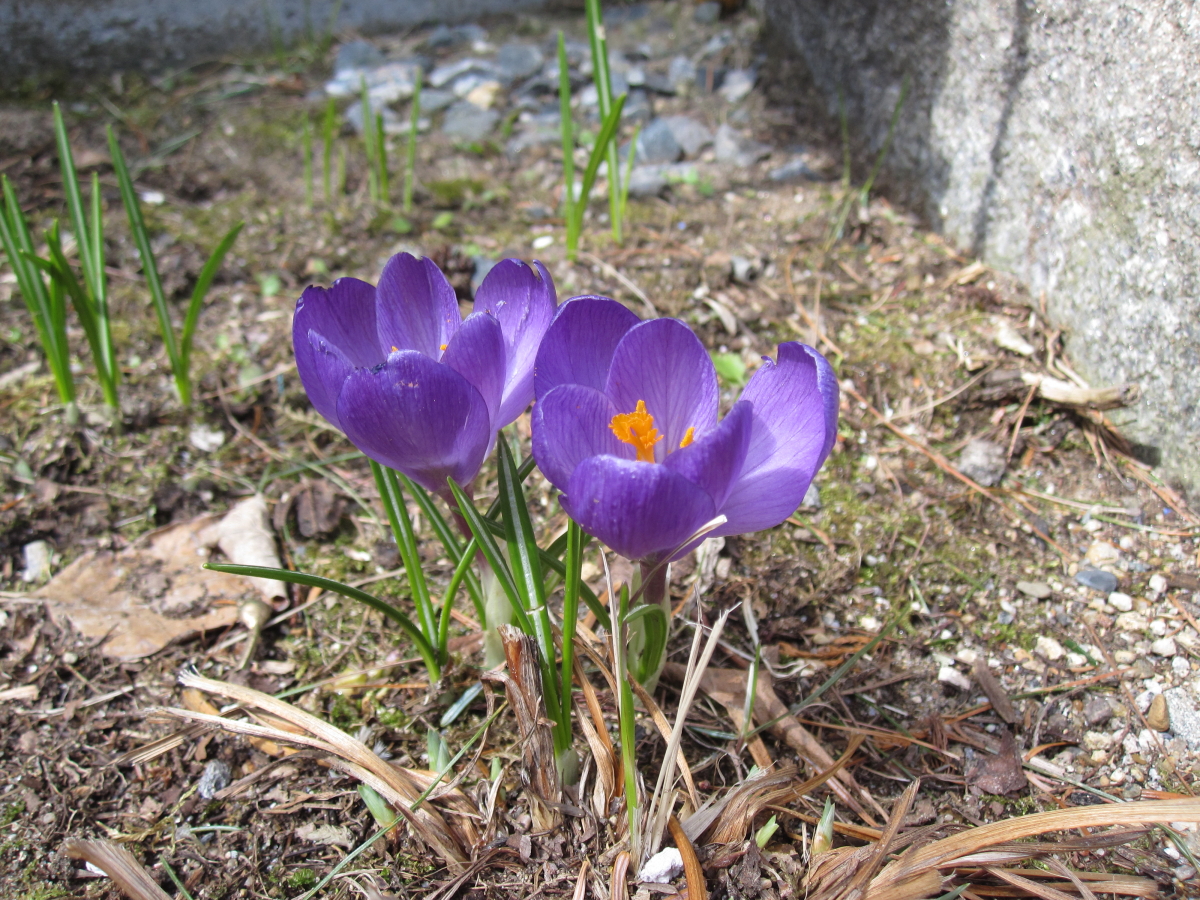
Crocuses

The season of renewal is here  -  Happy Easter!


Sunday, April 11, 2021

April 11, 2021: The Loons Arrive

It's one of those times in the year when so much is happening it's hard to keep up with it all.  Ice-out on Lake Wicwas was declared on Wednesday, April 8th, a bit earlier than the average date for the past 20 years which is April 12th.  Almost all the other lakes are also open including Winnipesauke, Winnisquam, and Newfound.  And even before ice-out one of our star loon spotters saw the first loons on April 6th (thank you Annie Crane!).  I heard loons but didn't see any until my first kayak on the 8th when I found four different loons around the lake, all single birds, though the April 6th observation was a pair.  Also on the 8th I saw a loon preening and thought I saw a bit of red under the water, and knowing our long-time female has a leg band with red on it, I watched carefully.  Eventually, as the bird got to cleaning and oiling it's belly feathers it rolled enough to lift a leg out of the water; first one leg, then the other, and sure enough, there were bands!

The right leg has green over silver bands.

The left leg has yellow with black stripe over red bands.


But it's not our bird!  I sent those pictures off to the Loon Preservation Committee, knowing they'd have records that would identify where this bird was banded, and within a couple of hours I had the answer and a brief history.  Caroline Hughes, LPC biologist reported that this loon was banded in 2018 on Lake Pemigewasset.  The next summer she was "kicked off" Pemigewasset and was replaced by an un-banded loon.  That summer she was observed by Henry Stevens (whom we know well from his internship with the LPC that summer) on Opechee Bay.  There were no sightings in 2020.  Caroline asked us to be on watch to see if she stays on Wicwas this summer or moves on, so when you see a loon preening, watch (with binoculars from a far distance of course) to see if you can detect any bands, and let us know.

The beavers have been very active this spring, even before ice-out, making not only their morning and evening trips but also afternoon trips.  It's not often I get to see one out in the sunshine.

A rare sunlight-lit beaver on patrol.

One morning, a beaver aggravated by my presence circled back and forth along the edge of the ice as I stood and watched; he gave me several good tail slaps.

The beaver is swimming from right to left.

This went on long enough that I decided to try to get an action shot, and was able to catch two slaps on video - you can see them here (the second slap is clearer than the first).  It you watch carefully it is actually a two-step process where the tail slaps down and then flips up again as it dives, throwing more water into the air.  (Youtube lets you play video in slow motion:  under settings, set the play back speed at 0.25 for the relevant parts.)  Beaver alerts are loud enough that I'm still startled by the crash if I don't see it coming.


For the record, here are some other spring sightings along with the dates first observed:

Song sparrow, Eastern Phoebe, March 28  (Russ Brummer)
Wood frogs, April 4
Spring peepers, Great blue heron, April 6
Common loon, April 6  (Annie Crane)
Ring-necked Ducks, April 8
Hermit thrush, Tree Swallow, April 10

Every year ice out is a little different.  On Lake Wicwas, Marion Cove is usually one of the last places to be ice free, but this spring it was essentially clear a day before the lake's west shore and the boat ramp were open.  Just six days before ice-out the lake had a full cover of snow and ice.

April 2nd:  A solid covering of ice.

By noon on April 8th only the coves along Wicwood Shores Rd and the boat ramp were still inaccessible.

Ice in the west cove on Wicwas.

The boat ramp on Chemung Rd at noon.

But by 6:00pm they were open and ice-out was called - let summer begin!

Blue Water is back!

I hope you enjoyed the early summer preview these past few days wherever you were!

Sunday, May 3, 2015

May 3, 2015

The activity level is accelerating rapidly around the lake now that spring is finally arriving.  I found my first wildflower of 2015, a Mayflower (Trailing Arbutus) up on Crockett's Ledge.
Trailing Arbutus (Mayflower - Epigaea repens)

It was at the edge of the woods on the ledge where it enjoys lots of sun, which must explain why it was a few days early, arriving on April 28th!

The second wildflower I saw was a new one for me, a Coltsfoot. 
Coltsfoot (Tussilago farfara)


This member of the aster family is a pretty hardy plant, as there are dozens of them pushing up through the sand plowed up all winter long on the edge of Wicwood Shores Rd. 

At first I thought they were dandelions, but unlike dandelions, the coltsfoot displays its blossoms first; the leaves come later.

Higher up off the ground, the Red Maples are really showing their colors now. 
Red Maple Buds


And flitting around in the tops of those maples have been large flocks of an early spring arrival, the Yellow-rumped Warbler.
Yellow-rumped Warbler (Dendroica coronata)

These hyperactive creatures are constantly hopping from branch to branch, darting out to catch a bug, and back again.  They barely sit in one spot long enough to snap a picture!


I'm thrilled to see so many of them, making an early dent in the bug population, and yes, they really do snatch those nasty buggers right of the air!
Locked on and going in for the kill

In the other direction, down at lake level, the beavers are going great-guns too. 
An evening swim in the rain


They are swimming in the lake every evening, and are already depositing branches along the top of the dam, trying to curtail outflow from the lake.  They are piling mud and debris all over the shore line, and bare sticks, left behind after being gnawed clean of every last bit of bark and cambium, adorn the lake bottom.


Ringed-neck duck and beaver enjoying a rainy evening together


One evening this beaver was sharing its cove with a solitary Ring-necked duck. 


When they detect me on the shore - which they always do - they let me know their displeasure with a loud smack of their tail on the water. 
Beaver Alert
Click the video:


Oh, and let's not miss one of the greatest sounds of spring and summer - the Spring Peepers!

(Yes, those are also raindrops you hear.)


One final note:  the Meredith sculpture walk is about to be updated.  If you haven't seen all these great works of art, including three by Meredith's own Steve Hayden (one of which is the iconic sailboat in scenic park) you should do so soon. 
"Black Sailboat" by David Little & Steven Hayden

Fred Huntress was in town this week starting to make spaces for new creations.  There's not much time left to get one more look!
Fred Huntress and "Railing Sleeper Bear Club" by artist Justin Gordon

Sunday, May 4, 2014

May 4, 2014

The Lake Wicwas Music Festival has returned for its 2014 season.  Their season opener presents a well-know chorus consisting of a full complement of amphibians, featuring in particular the Spring Peepers.  These free concerts are open to anyone who partakes in an evening walk - or just opens their window.


Later in the season the troupe will add featured soloists such as the wood frog and that famous bass player, the bullfrog.

At the conclusion of the opening night performance, the musicians were presented with a fragrant bouquet of spring's first wildflowers;  the Trailing Arbutus being the first to bloom as usual.
Trailing Arbutus (Mayflower)

There is still great visibility in the woods before the leaves fill in the open spaces.  I saw the Osprey and  a Hawk sitting up high in the trees.  I didn't see another late-night vocalist, but I did hear the first Barred Owl hooting one night under a crescent moon.  This time of year also reveals just how large the cliff is behind Lake Wicwas.  During the summer all but the top of it is hidden behind tall trees, but presently a substantial portion of the sheer face is visible.  There was a group up on top enjoying the beautiful weather on Saturday.
Crockett's Ledge from Chemung Road

We still haven't had a warm stretch of weather, and the flowers and trees are a bit behind schedule, but only by a few days.  The Red Maple leaves have progressed to the point where the first emergent leaves are barely visible.

Red Maple Leaves Emerging
I was able to find a bit of ice still hanging on deep in a crevice in the ledges, but it won't last much longer now.

The Last Ice?
It sure is heartwarming to see the sun, moon, and bright mornings reflecting off liquid water.