The best season for hiking has arrived - cool temperatures, clear blue skies, and no bugs! It's the perfect stage to explore all the bounty autumn has to offer, whether it's in your back yard, on a lake, or in the mountains.
 |
| Squam Lake and the Ossipee Mountains from Whitten Woods' north view point |
Linda and I took a walk at
Whitten Woods, a new conservation area opened by the New England Forestry Foundation and the Squam Lakes Association. Located in Ashland at the site of a historic farm owned by Rubin Whitten who saved the residents of Ashland by sharing his wheat crop from this hill, the only crop that survived the "Year Without a Summer".
In 1816 Mount Tambora in Indonesia erupted, affecting weather across the world. In New Hampshire there was frost, snow, and ice throughout the summer, with killing frosts every month. Most of the crops failed, leaving the settlers without a winter food source. But up on this high, south facing hill, Whitten had planted wheat - an unusual crop in these parts, but more tolerant of cold weather. His was one of the only crops which survived; the elevation may have helped, as cold airs sinks down into the valleys. He offered his crop to the townspeople, becoming a local legend and hero. [Ref:
Eric Werme,
Old Farmer's Almanac,
WMUR]
It's a pleasant hike on good trails with two nice view points.
 |
| Whiteface (left) and Chocorua (right) from Whitten Woods' south view point |
Starting up from the trail head on Highland Street just outside of downtown Ashland we enjoyed some early color in the leaves and plenty of fall flowers.
 |
| Calico Aster (Aster lateriflorus) |
There is a lot of blue in flowers right now, including this dark-blue bud I didn't recognize and can't identify - any ideas? (Update: Paula Wanzer identified this for me - it is a Closed Gentian, an interesting flower. I'll try to provide more information on it next week.)
 |
| Closed Gentian (Gentiana andrewsii) |
As we walked along the old roads of Whitten's farm, signs of human activity were evident, including fruit trees such as this crab apple.
Humans may not be harvesting produce here anymore, but the animals continue to take advantage of what the settlers left behind. Seeing motion in the branches led us to a red squirrel fattening up for winter on the small fruit.
Most of the property has long since been taken over by forest, which has clearly been logged in the recent past based on the size of the trees. But as we walked we came across some large areas that have been kept open over the years, though we couldn't determine why.
 |
| A long, wide slope running up the south hill has been continually mowed, with only ferns growing in it |
Why was this stretch of gentle terrain kept open all these years? It looked like a ski slope.
Whitten Woods is a great, nearby place to visit, and a good skiing and snowshoeing option in the winter.
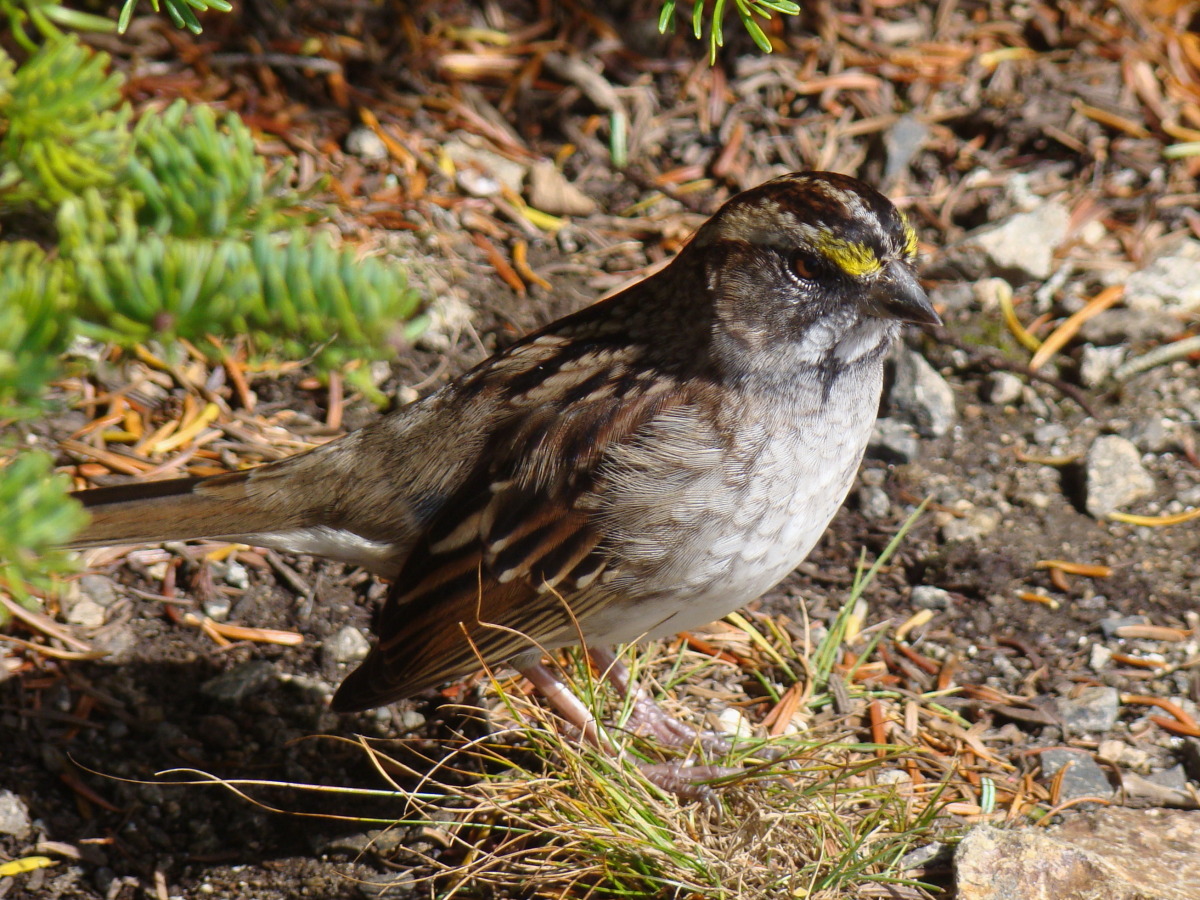
Earlier in the week on a hike at higher terrain, a small visitor came to say hello to me.
 |
| White-throated Sparrow (Zonotrichia albicollis) |
This is the famous singer of "Old-Sam-Peabody-Peabody-Peabody" that frequents the boreal forests in the highest elevations of the White Mountains.
This pretty bird hopped out of the scrub, right up to my feet as soon as I sat myself down on the summit of 4327' high Mt. Flume at the southern end of the Franconia Range. It was clearly looking for a handout (which it didn't get).
 |
| Mt. Flume, where this sparrow lives - probably knowing that's where hikers drop bits of food as they enjoy the view |
It's a pretty harsh environment to survive; they must put up with it in order to live in such a beautiful place.
 |
| A birds-eye view of Mt. Lincoln, Mt. Lafayette, and Mt. Garfield from the summit of Flume |
Back down at lake level, the water has been cooling off, but it's still plenty warm to form morning mist on the lakes.
On Saturday the fisherman were out for perhaps the last bass tournament of the year. As they roared down the lake in the morning a loon hid in the mist, watching them go by.
Our mating pair is still on the lake, though their brilliant contrasting black and white plumage is starting to fade into the drab gray clothing they will wear through the winter.
It may be the best season for hiking, but that doesn't mean there aren't plenty of days left on the water to watch for loons, sunsets, and coming shortly, brilliant fall leaves. Whether at elevation or sea level, there's autumn beauty everywhere you look in New Hampshire.