Showing posts with label graupel. Show all posts

Sunday, April 26, 2026

April 26, 2026: Graupel to Gulls

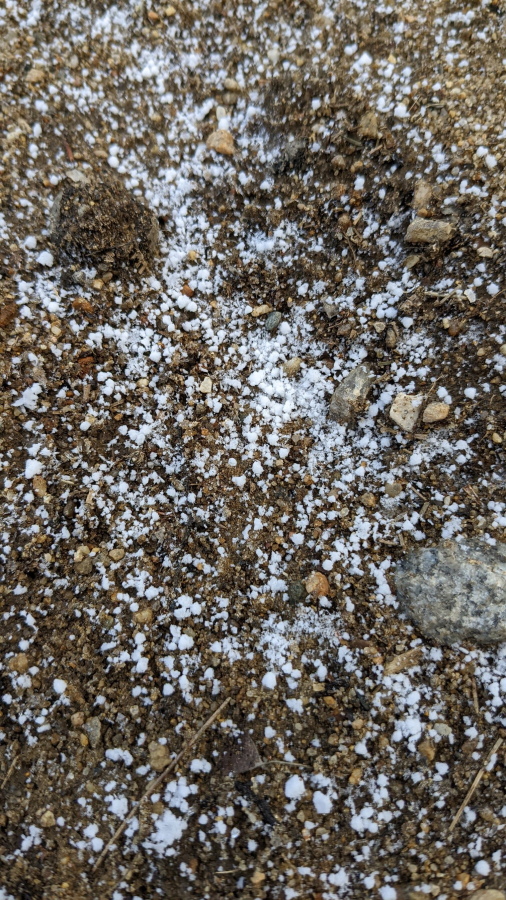
This week began with a cold front passing through which kindled some nice winter squalls and produced another round of graupel for us.

Grauple

I've written before about the atmospheric conditions that cause this unusual form of precipitation (see December 4, 2022).  The conditions rarely last more than a few minutes but it's fascinating to see - and hear! - whenever it occurs.

But shortly after the graupel squall, we were far from New Hampshire, having left graupel weather for gull weather.
Laughing Gulls in South Carolina

We might see laughing gulls along the New Hampshire coast in another month, but these were on the Isle of Palms in South Carolina where we were on a visit to family and friends in Mount Pleasant.  Other birds at the shore in South Carolina, we'll never see on the New England Coast.

Brown Pelicans

Pelicans are graceful, beatiful in their own way, yet somehow rather ungainly all at the same time.  

Pelicans use a plunge dive technique to catch their prey, dropping down head first into water where they've spotted a school of fish, hitting the water with their large beak open wide.  The impact is so powerful it can actually stun the fish which makes them easier to capture.  

A Pelican Plunge Dive

The bird then scoops up three gallons of seawater with as many fish as it can corral, raises its head to let the water drain out through the corners of it beak, and swallows its catch of fresh seafood.  


We walked the shore of Isle of Palms to "The Breach" where a storm broke a hole through the barrier island and now separates Isle of Palms and Sullivan's Island.  Here we watched a couple of bottlenose dolphins fishing.

Tamanend's Bottlenose Dophin

The dolphin dive technique

I had one of my better experiences observing these intelligent mammals.

Only recently have biologists learned there are two distinct species of dolphins.  The animals that are seen near the shoreline spend their entire lives in coastal waters; these are now called "Tamanend's Bottlenose Dolphins."  Members of the species that kept the name Common Bottlenose Dolphin spend their lives in deeper water offshore, though they may come close to land during migration.  You can read about the research by NOAA that led to this determination here:  Bottlenose Dolphins Along the East Coast Proposed to be a Different Species


I'll close with an interesting animal from yet another class of animals, a reptile called the Green Anole.

The most amazing aspect of the anole is it's ability to change color almost instantly from green to brown and back to blend in with what it's sitting on.  This particular anole was not focused at all on blending in:  It crawled along a narrow ledge and then stopped on this white drain pipe for several minutes.  It was very exposed, and it put on quite a display.  It would nod its head up and down a few times, then inflate and display its bright prink dewlap.

You can probably guess the two primary reasons it does this.  One is a male (it's most likely a male as females sometimes have a dewlap but it's not so dramatic)  showing domain over territory as anoles are highly territorial.  The other is a practice common to males of many animals:  to look strong, healthy, and beautiful to potential mates.

Isn't he handsome!


P.S.  Here's early notice of a guided bird walk that will be hosted by the Meredith Conservation Commission on May 9th.  You can find more information here.


Sunday, November 16, 2025

November 16, 2025: Buffleheads

A few more migrating birds found Lake Wicwas a pleasant place to rest during their long travel south for the winter, including this group of Buffleheads.

Bufflehead are really enjoyable to watch this time of year, bringing a flash of brightness and action to the November scene.  

Buffleheads relaxing on Lake Wicwas.

And they seem to be more tranquil than many other ducks; they spend many hours just swimming around slowly in formation, occasionally diving for food.  

Six males and two females.

I'll assume this is because they are tired!  Bufflehead migrate at night, leaving precisely at dusk, and sometimes traveling hundreds of miles in a single night. [ref:  Travis Audubon]  This allows them to take advantage of calmer winds and helps them avoid predators.  

But, as you probably noticed, they weren't a uniform flock - for some reason there was a Scaup mixed in with them, though it tended to drift away to fish closer to shore on occasion.

A Lesser Scout hangs out with the Buffleheads

If I've seen a Scaup before it would have been on the ocean, and I didn't know it.  I've not seen one on Wicwas.  I believe this is a Lesser Scaup based on a small corner on the back of its head; the Greater Scaup has a smooth, rounded head.

The squared-off back of the head is barely discernable in this picture.

You can read more about buffleheads in the above link to Travis Audubon.


More signs of the colder temperatures are evident around the lake.

Ice crystals on wintergreen, an evergreen which turns a burgundy color in cold weather.

Radiation cooling and damp ground provide an excellent canvas for Jack Frost to practice his art.

Low bush blueberry

Jack really pays attention to detail.

Beautifully rendered ice crystals.

Other signs of the season were found at the water's edge:

Cat-o-nine Tails

When the cat-o-nine tails start to shred you know winter's near.  We also had our first snowflakes in the air this week, as well as a little graupel that collected on the ground.

Graupel

I've mentioned this interesting form of precipitation before.  It forms when a snowflake floats around inside a cloud containing supercooled water droplets which adhere to the snowflake.  When the growing ice ball gets too heavy, it drops from the cloud to earth.  Here you can see some of the snowflakes as well as the graupel.


November is a transition time between seasons with less activity taking place as everyone prepares for winter, both human and wild.  It makes for a  peaceful time on the lake. 


And a nice reprieve from the busy summer and fall seasons before winter hits, a time for all to relax, reenergize, and enjoy some tranquility along with the buffleheads.


Sunday, December 4, 2022

December 4, 2022: Early Winter Artistry

The battle between the seasons continues to be waged.  First a warm front pushed up from the south bringing warm gale-force winds and rain which saturated the ground and filled up the ponds.  Then a cold front made an attack, with its strong, cold, dry northwest winds driving back the wet weather.  Cold air following rain commissioned more interesting ice-art to be sculpted by nature.  Vernal pools along the Red Trail leading up to the White Mountain Ledge in the Hamlin Town Forest, which had been filled up again, were slowly draining into the soil when the cold temperatures hit.

A vernal pool beside the trail to the White Mountain Ledge.

Vernal pools typically don't have an outflow, but with the ground not yet frozen, water was seeping slowly in the soil, gradually lowering the water level as the surface of the pond froze.

Ice surrounds a blueberry bush in a vernal pool.

The artistic talent of nature is exquisite:


This ice formed some time after the cold front passed as the water needed time to cool down, but other ice formed just as the two fronts clashed, generating an interesting form of precipitation known as graupel.
Graupel

Graupel starts high in a cloud as snowflakes, but as the flakes pass through an atmospheric layer containing super-cooled water droplets, those droplets freeze onto the snowflakes, creating tiny, hard snowballs.

Being hard and round they tend to bounce and roll around, collecting in low spots.
Graupel reminds me of King Derwin of the Kingdom of Didd and his quest for a new kind of precipitation which led to Oobleck - and the rescue of the kingdom by young Bartholomew Cubbins.  Right now I'd be happy with some good old fashioned snow!

Also along the Red Lakes to Ledges Trail in Hamlin, down by the lake, I saw that the beavers have been busy.
Hemlocks girdled by beavers.

In addition to the  gnawed trees are several large scent mounds where the beavers are claiming their territory. 
Scent mounds on the shoreline tell other beavers this part of the lake has been claimed.

I won't be surprised to see a new beaver lodge being constructed in this cove over the next few years.

There was a group of common mergansers visiting Lake Wicwas this week, nine of them, apparently all males out on a guys-only trip.
A flock of male common mergansers.  Photo by Neil Crimmins.

They were traveling together and spent most of the day fishing and exploring the lake, being seen at both ends of the lake over the course of the day.
Earlier in the day, at the opposite end of the lake.  Photo by Linda Powell.
These are likely this year's juveniles which haven't yet found a mate; common mergansers pair up in late winter or early spring.

All the animals - ducks, beavers, loons - have at least a couple more weeks to enjoy open water since ice is still forming only in the smallest coves and streams.  
A topographical display of ice on a small stream.

With more warm and wet weather yesterday, we may have more opportunities for nature's ice-art.


Sunday, December 5, 2021

December 5, 2021: Ebb and Flow

Ice is starting to form on the lakes now and every year it takes a different path.  This year Lake Wicwas is imitating an ocean with the ice ebbing and flooding like the tides.  The first ice appeared along the edges of sheltered coves on November 29, accentuated by a dusting of snow over night.  

Nov 29th

The next day was cold, and dawn on December 1st revealed the sheet of ice had crept half way across the cove.  

Dec 1st, 8:15 am

That night a couple of inches of snow fell and filled in the entire cove with a slushy layer that would be a stretch to call "ice" but nonetheless, there was no open water on that foggy morning.  

Dec 2nd, 3:15 pm

But the wind picked the next day and soon the slush was worn away.

Dec 3rd, 9:30 am


As the day progressed the wind eroded the ice most of the way back to the far shore.

Dec 3rd, 2:45 pm


That night it was calm and cold again - at 19 degrees the coldest of the season I think - and the ice advanced again.

Dec 4th, 8:30am

But this day was calm and barely rose above freezing so the ice held its ground throughout the day.

Dec 4th, 10:00 am

And this morning:  Another cold, calm night let the ice creep out the farthest yet, this time highlighted by a veneer of graupel.

Dec 5th

All of the cove was frozen except for the area north and east of the point on the right, and last night Jack Frost was particularly creative in designing the artwork on the clean canvas of lake after the graupel fell.

The area of ice between the shoreline and yesterday's ice.

These are some of the more dramatic ice patterns I've seen on the lake.


Graupel forms inside a cloud when super-cooled water droplets freeze onto an ice crystal churning around in the cloud.

This bit of graupel fell last night.

 As more ice builds on the particle its mass increases until finally gravity pulls it down from the cloud to the ground.

Graupel along with a few uncorrupted snow flakes.


There's no way to predict the weather well enough to guess when ice-in will occur, but the fact that significant portions of the open lake have had skims of ice means that it could be soon; a couple of cold, calm days could do the job.

There was some unexpected goose activity on one of those cold, blustery nights.  For about 30 minutes well after sunset there was a raucous explosion of geese squawking and honking out on the lake.  I can't imagine what they were arguing about at that time of night in dark December - unless some members of the skein (flying group of geese) were revolting at the leader having brought the formation down in that cold, dark, windy spot for the night!

Winter is coming on strong now, though the inch or two of snow we picked up earlier in the week was the first measurable snow at the lake.


It wasn't much, but it at least gave us a hint of winter and dreams of a white Christmas to come.